If you have ever wondered whether the past tense of strive should be strove or strived, you are not alone. The verb strive has an unusual set of forms, which can make its past tense confusing.
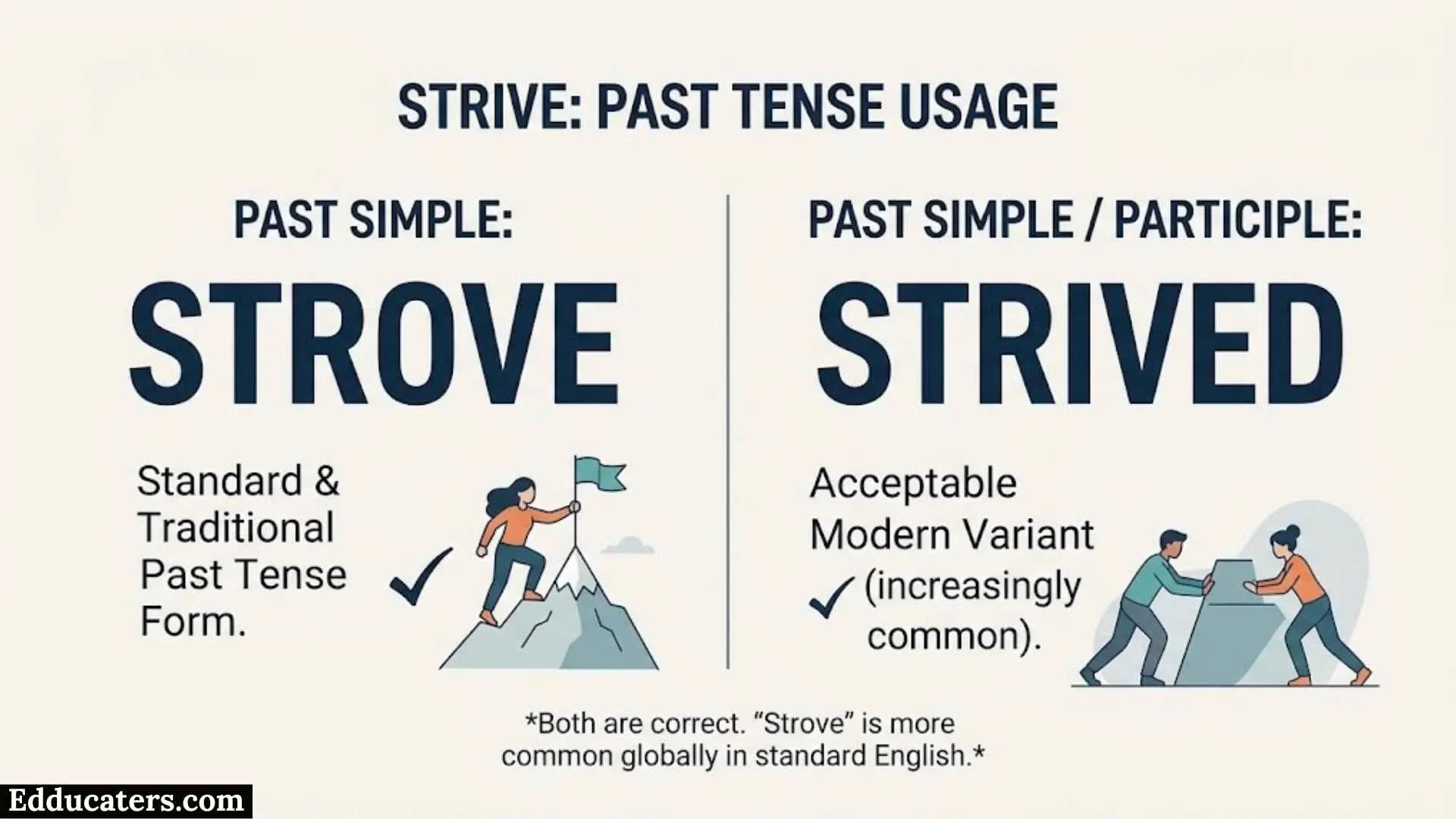
The short answer is that both “strove” or “strived” are accepted past forms of “strive.” However, strove is the traditional irregular past form, while strived is the regular past form that is also recognized in modern English. For the past participle, striven is the traditional form, although strived can also function as a past participle.
So, if you are writing a sentence about something that happened in the past, you can use strove or strived, depending on your preferred style. Understanding the difference between these forms will help you choose the form that sounds natural in your sentence.
Strove or Strived: Which Is Correct?
Strove or strived can both be correct when they function as the simple past of strive.
The verb strive means to make a strong or determined effort to achieve something. It often suggests continued effort, especially when something is difficult or requires persistence.
For example:
- She strove to improve her writing.
- She strived to improve her writing.
- The team strove to meet its goal.
- The team strived to meet its goal.
Both forms can communicate the same basic meaning.
The main distinction is grammatical history or style rather than a difference in meaning. Strove follows the traditional irregular pattern of strive → strove → striven. Strived follows the regular pattern in which -ed is added to the base verb.
Modern dictionaries recognize strove or strived as past forms of strive, so it would be inaccurate to say that strived is simply an incorrect word.
What Does Strove Mean?
Strove is the traditional simple past form of strive.
It means that someone made a strong effort to accomplish something in the past.
For example:
- She strove to become a better writer.
- He strove to solve the problem before the deadline.
- They strove for greater equality.
- The organization strove to improve its services.
The pronunciation of strove is approximately /stroʊv/ in American English. It rhymes closely with words such as rove or drove.
The word is especially common in formal, literary, historical, or carefully edited writing. Oxford lists strove as a past simple form of strive.
What Does Strived Mean?
Strived is also an accepted form of the verb strive.
It follows the regular past-tense pattern:
strive → strived
For example:
- She strived to improve her performance.
- The company strived to provide better service.
- They strived to create a fair system.
- He strived for excellence throughout his career.
The pronunciation of strived is approximately /straɪvd/.
Some readers are surprised to see strived listed as a legitimate form because they learned the traditional pattern strive → strove → striven. However, major dictionaries recognize strived as a past form. Cambridge lists strove or strived for the past tense and striven or strived for the past participle. Oxford also lists both strove and strived as past simple forms.
Strove or Strived in the Past Tense
If you are talking about a completed action in the past, strove or strived can be used.
Using “Strove”
Use strove as the traditional irregular past form:
- She strove to finish the project.
- He strove to understand the difficult concept.
- The students strove to achieve higher grades.
- The team strove to overcome the challenge.
- They strove for peace.
Using “Strived”
Use strived as the regular past form:
- She strived to finish the project.
- He strived to understand the difficult concept.
- The students strived to achieve higher grades.
- The team strived to overcome the challenge.
- They strived for peace.
The meaning remains essentially the same in these examples.
Is Strived a Word?
Yes, strived is a word.
It is a recognized inflected form of the verb strive. It can function as a simple past form or as a past participle.
For example:
The students strived to reach their goals.
Here, strived is the simple past.
It can also appear in a perfect construction:
The students have strived to reach their goals.
Here, strived functions as the past participle.
Cambridge, Oxford, Collins, and other dictionary sources recognize strived as an accepted form of strive.
Therefore, treating strived as a misspelling is not accurate.
What Is the Past Tense of Strive?
The traditional past tense of strive is strove, but strived is also an accepted past form.
The traditional verb pattern is:
| Verb Form | Traditional Form | Alternative Form |
| Present | strive | — |
| Simple past | strove | strived |
| Past participle | striven | strived |
| Present participle | striving | — |
Examples:
- Present: I strive to improve.
- Simple past: I strove to improve.
- Simple past: I strived to improve.
- Past participle: I have striven to improve.
- Past participle: I have strived to improve.
- Present participle: I am striving to improve.
This is why the question can be confusing. Unlike many irregular verbs that have one widely accepted traditional past form, strive has developed an accepted regular alternative.
Strive, Strove, Strived, or Striven
The four forms can look confusing, but each has a specific grammatical role.
Strive is the base form.
I strive to do my best.
Strove is a traditional simple past form.
I strove to do my best.
Strived can be used as a simple past form or past participle.
I strived to do my best.
I have strived to do my best.
Striven is the traditional past participle.
I have striven to do my best.
The important point is that strove is normally used for a completed past action, while striven appears after auxiliary verbs such as have, has, or had.
Strove or Strived in a Sentence
Here are natural examples showing how strove or strived can be used.
Sentences With “Strove”
- She strove to make the presentation perfect.
- He strove to remain calm during the discussion.
- They strove for a better future.
- The company strove to satisfy its customers.
- We strove to find a practical solution.
- The athlete strove to improve her performance.
- He strove to understand the complicated instructions.
- The team strove to finish the work on time.
- She strove for excellence in everything she did.
- The researchers strove to find an explanation.
Sentences With “Strived”
- She strived to make the presentation perfect.
- He strived to remain calm during the discussion.
- They strived for a better future.
- The company strived to satisfy its customers.
- We strived to find a practical solution.
- The athlete strived to improve her performance.
- He strived to understand the complicated instructions.
- The team strived to finish the work on time.
- She strived for excellence in everything she did.
- The researchers strived to find an explanation.
These examples show that changing strove to strived does not necessarily change the basic meaning of the sentence.
Strove or Strived for Formal Writing
If you want the traditional form in formal writing, strove is a natural choice.
For example:
The committee strove to establish a fair process.
The form strived is also grammatically acceptable:
The committee strived to establish a fair process.
Because both forms are recognized, choosing strove is not a requirement for grammatical correctness. It is more closely associated with the traditional conjugation of strive.
This distinction can be useful when writing academic, professional, literary, or formal material. If your style consistently uses traditional irregular forms, strove may fit better.
Strove or Strived: Past Participle
The traditional past participle of strive is striven.
For example:
- She has striven to improve.
- They have striven for equality.
- He had striven to find an answer.
- We have striven to provide accurate information.
However, strived can also be used as a past participle:
- She has strived to improve.
- They have strived for equality.
- He had strived to find an answer.
- We have strived to provide accurate information.
Cambridge lists striven or strived as past participles, while Oxford likewise recognizes both forms.
One form that should generally be avoided in standard modern usage is using strove as the past participle in constructions such as has strove. The traditional perfect construction is has striven, while modern regular usage permits has strived.
Is “Strove” More Correct Than “Strived”?
Not in the simple sense of one being correct while the other is incorrect.
Strove is the traditional irregular past form, while strived is also an accepted form. Major dictionaries document both.
If you want to follow the traditional conjugation, use:
strive → strove → striven
If you prefer the regular modern form, you can use:
strive → strived → strived
The choice can depend on style, register, or personal preference. What matters most is using the form correctly within the grammatical construction.
Strove or Strived: Common Mistakes
Mistake 1: Assuming “Strived” Is Incorrect
Incorrect assumption:
“Strived” is not a real English word.
Correct:
Strived is an accepted form of strive.
Major dictionaries explicitly include it.
Mistake 2: Using “Strove” After “Have”
A common grammatical problem is:
She has strove to improve.
For traditional usage, write:
She has striven to improve.
You can also write:
She has strived to improve.
Mistake 3: Treating “Strove” as the Only Possible Past Form
It is perfectly understandable to learn strove as the traditional past tense. However, modern dictionaries also recognize strived.
So it is better to understand the full set of accepted forms rather than memorizing a single answer.
Mistake 4: Confusing “Strive” With “Strife”
Strive is a verb meaning to make a strong effort.
They strive to succeed.
Strife is a noun referring to conflict or serious disagreement.
The country experienced years of strife.
These are related historically, but they have different grammatical roles and meanings.
How Do You Pronounce Strove?
Strove is pronounced approximately:
/stroʊv/
Break it down as:
strove → strohv
It has one syllable.
The vowel sound is similar to the vowel sound in go in many varieties of English.
How Do You Pronounce Strived?
Strived is pronounced approximately:
/straɪvd/
Break it down as:
strived → stryvd
It has one syllable.
The first vowel sound is the same basic vowel sound found in strive, while the final -ed is pronounced as a /d/ sound rather than as a separate syllable.
Oxford gives /strəʊv/ for strove in British pronunciation and /straɪvd/ for strived.
Strove or Strived: Which One Should You Use?
If you want the traditional form, use strove for the simple past.
She strove to improve her skills.
If you prefer the regular past form, strived is also acceptable.
She strived to improve her skills.
For a traditional past participle, use striven:
She has striven to improve her skills.
For the regular past participle, strived is also accepted:
She has strived to improve her skills.
A simple way to remember the traditional pattern is:
Strive → strove → striven
If you prefer the regular pattern:
Strive → strived → strived
Both patterns are documented in modern English dictionaries.
Strove or Strived: Quick Comparison
| Form | Grammatical Use | Example |
| strive | Base form | We strive to improve. |
| strove | Traditional simple past | We strove to improve. |
| strived | Accepted simple past | We strived to improve. |
| striven | Traditional past participle | We have striven to improve. |
| strived | Accepted past participle | We have strived to improve. |
| striving | Present participle | We are striving to improve. |
FAQs About Strove or Strived
Is “strove” the past tense of “strive”?
Yes. Strove is the traditional simple past form of strive. Strived is also an accepted past form.
Is “strived” a word?
Yes. Strived is a recognized English word and an accepted inflected form of strive. It can function as a simple past form or past participle.
Is “strove” or “strived” correct?
Strove or strived can both be correct as past forms of strive. Strove is the traditional irregular form, while strived is the regular alternative.
What is the past participle of “strive”?
The traditional past participle is striven. Strived is also accepted as a past participle.
For example:
They have striven to succeed.
Or:
They have strived to succeed.
Can I say “I have strived”?
Yes. I have strived is grammatically acceptable because strived can function as a past participle.
Can I say “I have strove”?
In standard modern English, use I have striven or I have strived instead. Strove is normally the simple past form.
Is “strived” more common in American English?
The availability of strived is not limited to American English. Major English dictionaries recognize it without restricting it to a single national variety. Oxford lists it alongside strove, while Cambridge lists both forms.
What is the easiest way to remember the traditional forms of “strive”?
Remember the sequence:
strive → strove → striven
This gives you the base form, traditional simple past, and traditional past participle.
Conclusion
Strove or strived can both be correct. Strove is the traditional irregular past tense of strive, while strived is an accepted regular alternative. For the traditional past participle, striven is the standard form, although strived is also accepted as a past participle.
If you want to follow the traditional conjugation, remember strive → strove → striven. If you encounter strived, however, there is no need to treat it as a spelling mistake. It is a legitimate form of the verb.
The key is to understand the grammatical role of the form you are using. Use strove or strived for a simple past action, and use striven or strived after auxiliary verbs such as have, has, or had.

Hi, I’m Nathan Whitmore, and I enjoy making English grammar easy for learners of all ages. I believe grammar should be practical, not confusing. I write simple, well-researched guides that help readers improve their writing, speaking, and overall communication skills.
I spend a lot of time studying grammar patterns, sentence construction, punctuation, and modern English usage. My goal is to create lessons that anyone can understand, whether they are students, teachers, or professionals.
Books
Clear English Grammar
The Smart Writer’s Grammar Handbook
 Claire Holloway
 Julian Mercer