Language is a living, evolving landscape, and few debates highlight this more than the variation between “baptised” or “baptized.” If you have ever looked at a church record, a formal document, or a religious text and noticed the difference, you are not alone. This subtle variation often causes confusion for writers striving for accuracy. Is one version incorrect? Is this simply a matter of preference, or does it depend on where you live?
Understanding the distinction between these two forms is essential for anyone who values precise and professional communication. In this guide, we will explore the history of these spellings, the geographic influences that dictate their use, and the best practices for choosing the right one for your specific audience.
Quick Answer:
“Baptized” or “baptised” are both correct spellings of the same word. The choice depends on regional preference: “Baptized” with a ‘z’ is the standard spelling in American English, while “baptised” with an ‘s’ is preferred in British English and many Commonwealth countries. Both are widely understood and grammatically acceptable worldwide.
Comparison Table
| Feature | Baptized | Baptised |
| Correct Term | Correct (US) | Correct (UK) |
| Incorrect Word | None (both are valid) | None (both are valid) |
| Meaning | Admitted to Christianity | Admitted to Christianity |
| Part of Speech | Verb (Past Participle/Past Tense) | Verb (Past Participle/Past Tense) |
| Grammar Rule | Standard American Suffix | Standard British Suffix |
| Correct Usage | She was baptized last week. | He was baptised in the chapel. |
| Incorrect Usage | N/A | N/A |
| Pronunciation | bap-tahyz-d | bap-tahyz-d |
| Common Mistake | Mixing regional styles | Mixing regional styles |
| Memory Tip | ‘Z’ for the American ‘Zeal’ | ‘S’ for the British ‘Standard’ |
| Example | The infant was baptized. | The infant was baptised. |
Meaning of Each Word
Defining “Baptized”
“Baptized” is the past tense and past participle form of the verb “baptize.” It describes the religious rite of immersion in water or sprinkling with water, symbolizing purification or regeneration and admission to the Christian Church.
- Grammar Role: It functions as an action verb or an adjective describing the status of a person.
- Pronunciation: /bæpˈtaɪzd/
- Examples:
- The community gathered as the new believers were baptized.
- Many families keep a record of the day their children were baptized.
Defining “Baptised”
“Baptised” is the alternative spelling of the same verb. It carries identical meaning, pronunciation, and grammatical function. The only difference is the replacement of the ‘z’ with an ‘s,’ a hallmark of British English orthography.
- Grammar Role: It functions as an action verb or an adjective.
- Pronunciation: /bæpˈtaɪzd/
- Examples:
- The local parish registry shows exactly when he was baptised.
- In many regions, it is customary to have the ceremony baptised in the family church.
Key Differences
- Geography: The primary difference is regional. “Baptized” follows the American English preference for ‘z’ in words ending in -ize. “Baptised” follows the British English preference for -ise.
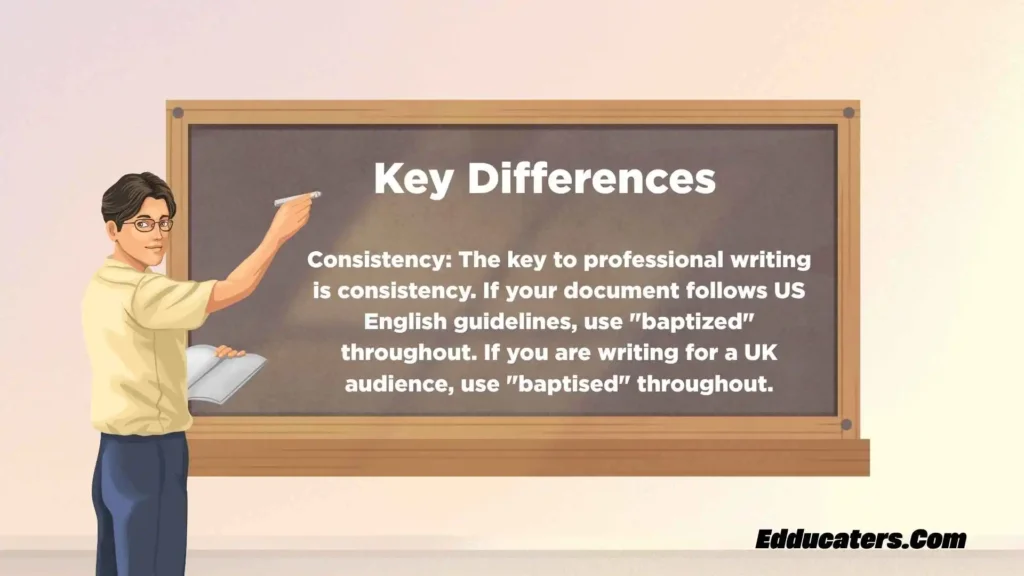
- Consistency: The key to professional writing is consistency. If your document follows US English guidelines, use “baptized” throughout. If you are writing for a UK audience, use “baptised” throughout.
- Etymology: Both words derive from the Greek baptizein. The transition to ‘z’ in American English is largely attributed to the influence of Greek roots, while British English spelling shifted more toward French-influenced ‘s’ endings over time.
Grammar Rules
The spelling of this word falls under the broader debate of -ize versus -ise suffixes.
In American English, the -ize suffix is the default for most verbs derived from Greek roots. This is considered the standard for US publications, such as The Chicago Manual of Style.
Conversely, British English often favors the -ise ending. However, it is important to note that many British dictionaries, including the Oxford English Dictionary, acknowledge the validity of the ‘z’ spelling. Despite this, the ‘s’ remains the dominant convention across the UK, Australia, and New Zealand.
When to Use Each Word
- Academic and Professional Writing: Always defer to the style guide you are following. If you are using AP or Chicago style, “baptized” is your choice. If you are following a British style guide (like the Oxford Style Manual), “baptised” is standard.
- Formal vs. Informal: Neither spelling is considered more “formal” than the other. Both are equally professional.
- Business and Emails: In global business communications, either is acceptable, but ensure your choice matches the rest of your document (e.g., if you are using “organization,” use “baptized”).
Common Mistakes
The most common “mistake” is inconsistency. If you spell “organization” with a ‘z’ (US style) but write “baptised” with an ‘s’ (UK style) in the same document, you create a distracting experience for the reader.
- Why people confuse them: Many people assume one version is technically wrong because they have only ever seen one variation. Neither is wrong, but both require context.
- Tips to avoid mistakes: Check your software settings. If your document is set to “English (United States),” your spellchecker will flag “baptised.” If it is set to “English (United Kingdom),” it will flag “baptized.” Choose one setting and stick to it.
Original Examples
- School: The history teacher explained how the king was baptized in the eleventh century.
- Workplace: The corporate archives contain records for everyone who was baptized at the company’s founding church.
- Business: Our international office prefers using “baptised” to maintain alignment with European spelling standards.
- Conversation: “Were you baptized as a child?” he asked during the interview.
- Books: The novelist described the small, wooden font where the protagonist had been baptized.
- News: The local newspaper published a list of all children baptized during the Christmas season.
- Social Media: A user shared a photo of the chapel where they were baptized many years ago.
- Everyday English: I always forget whether I should write “baptized” or “baptised” in my journal.
- Formal Document: All individuals to be baptized must register with the parish office by Friday.
- Research: The scholar noted that the early converts were baptized in the river.
- Email: Please confirm if the guests have been baptized before finalizing the ceremony details.
- Biography: She was baptized in a quiet ceremony held in her family’s ancestral home.
- Article: The report highlighted the cultural significance of being baptized in the village tradition.
- Speech: “We are here to celebrate the day this child was baptized,” the minister declared.
- Journalism: The article tracks the increase in the number of people baptized over the last decade.
- Diary: My grandfather kept a small Bible where he noted the dates his children were baptized.
Memory Trick

To remember the difference, associate the letter with the region:
- Z is for Zealously American.
- S is for Standard British.
Alternatively, look at the rest of your words: if you write “apologize,” use “baptized.” If you write “apologise,” use “baptised.”
Mini Quiz
- Which spelling is the standard for American English?
A) Baptised
B) Baptized - True or False: “Baptised” is grammatically incorrect.
A) True
B) False - If you write “organize,” which spelling should you use for “baptize”?
A) Baptized
B) Baptised - In which variety of English is “baptised” most common?
A) American
B) British - Which suffix is often associated with American English spelling?
A) -ise
B) -ize
Answers: 1(B), 2(B), 3(A), 4(B), 5(B).
FAQs
Is one version more correct than the other?
No, both “baptized” or “baptised” are correct. “Baptized” is the standard spelling in American English, while “baptised” is the standard in British and international English. The validity of each depends entirely on regional conventions and your preferred style guide.
Can I use both spellings in the same document?
It is highly recommended that you do not. For consistency and professional readability, you should choose one style either American or British and use it throughout your entire document. Mixing the two can make your writing appear unpolished and inconsistent.
Does my computer spellchecker matter?
Yes, your computer’s language setting will determine which spelling is marked as “correct.” If you are writing for a British audience, ensure your word processor is set to “English (UK)” to avoid constant red lines under the word “baptised.”
Where do these spellings come from?
The roots are in the Greek word baptizein. The English language diverged during the standardization of dictionaries. American English, influenced by Noah Webster, adopted the ‘z’ to favor phonetics and Greek roots, while British English leaned toward the French-influenced ‘s’ spelling for many years.
Does the pronunciation change?
No, the pronunciation remains the same regardless of the spelling. Whether you spell it with a ‘z’ or an ‘s’, it is pronounced /bæpˈtaɪzd/. There is no difference in how the word is spoken in any English-speaking region.
Which version should I use for a global audience?
For a truly global audience, either is acceptable, but “baptized” is often recognized as the standard in many international business and academic settings due to the influence of American publications. However, if your target audience is in the UK, Australia, or New Zealand, “baptised” is preferred.
Key Takeaways
- Both “baptized” and “baptised” are correct.
- “Baptized” (with a ‘z’) is standard in American English.
- “Baptised” (with an ‘s’) is standard in British and Commonwealth English.
- Consistency is the most important rule; choose one and stick to it.
- The pronunciation is identical for both spellings.
- Always check your document’s language settings to avoid unnecessary spelling errors.
Conclusion
The debate between “baptised” or “baptized” is essentially a window into the fascinating regional variations of the English language. Neither word is inherently wrong; rather, they represent different standards of orthography that have developed over centuries.
If you find yourself writing for an American publication that favors the ‘z’ or a British institution that prefers the ‘s’, the most important factor is maintaining consistency. By understanding the regional origins of these spellings, you can approach your writing with confidence, ensuring your work remains clear, professional, and grammatically accurate no matter where your readers are located.

Hello, I’m Claire Holloway. I have always been passionate about the English language and enjoy turning complex grammar rules into simple, easy-to-follow lessons. I believe that every learner can become a confident English writer with the right guidance.
I create educational content focused on grammar, vocabulary, sentence structure, and writing improvement. Every article I publish is designed to help readers learn with confidence and accuracy.
Books
Grammar Without Confusion
Modern English Usage Guide
 Nathan Whitmore
 Julian Mercer