The English language is full of subtle grammatical traps, and few cause as much hesitation as the placement of the apostrophe in “people’s” or “peoples’.” At first glance, both appear to indicate possession for a group, but the rules governing these terms are specific and non-negotiable.
If you are writing a formal academic thesis, a corporate report, or a casual social media update, using the wrong form can make your writing look sloppy. In this guide, you will learn the precise grammatical distinction between these two terms, explore why the confusion exists, and discover simple rules to ensure your writing is always polished, accurate, and professional.
Quick Answer:
Use people’s (apostrophe before the ‘s’) when referring to the plural of “person.” It is the standard possessive form for a group of human beings. Use peoples’ (apostrophe after the ‘s’) only when referring to multiple distinct ethnic groups, nations, or cultures, such as in the phrase “the rights of indigenous peoples’.”
Comparison Table
| Feature | People’s | Peoples’ |
| Correct Word | People’s | Peoples’ |
| Meaning | Possessive of a group of humans | Possessive of multiple ethnic groups/nations |
| Part of Speech | Possessive Noun | Possessive Noun |
| Grammar Rule | Plural of “person” is “people” | Plural of “people” as a distinct group |
| Correct Usage | The people’s choice | The world’s indigenous peoples’ cultures |
| Incorrect Usage | The peoples’ opinion | The people’s of the world |
| Pronunciation | Same as “peoples” | Same as “peoples” |
| Common Mistake | Misplacing the apostrophe | Using it when “people’s” is intended |
| Memory Tip | “People” already implies a group | “Peoples” is a specific group identifier |
| Example | The people’s voices matter. | The rights of all peoples’ are equal. |
Also Check This Post: Fourth or Forth: Expert Tips for Choosing the Right Word
Meaning of Each Word
Defining “People’s”
“People” is the irregular plural of the noun “person.” Because it does not end in an ‘s’, we create the possessive form by adding an apostrophe and an ‘s’ following the standard rule for nouns that do not end in ‘s’. Use this form whenever you are talking about the members of a group, a community, or the public.
- Grammar Role: Possessive noun representing multiple individuals.
- Examples:
- The people’s reaction to the new law was immediate.
- It is the people’s right to assemble peacefully.
Defining “Peoples'”
“Peoples” is the plural form of the word “people” when “people” refers to an ethnic group, team, or nation. Since the word “peoples” already ends in an ‘s’, the possessive form is created by simply adding an apostrophe to the end. You should only use this when discussing multiple distinct groups of people (e.g., various cultures or nationalities).
- Grammar Role: Possessive noun representing multiple ethnic or national groups.
- Examples:
- The peoples’ traditions were honored at the festival.
- International law protects various peoples’ rights.
Key Differences
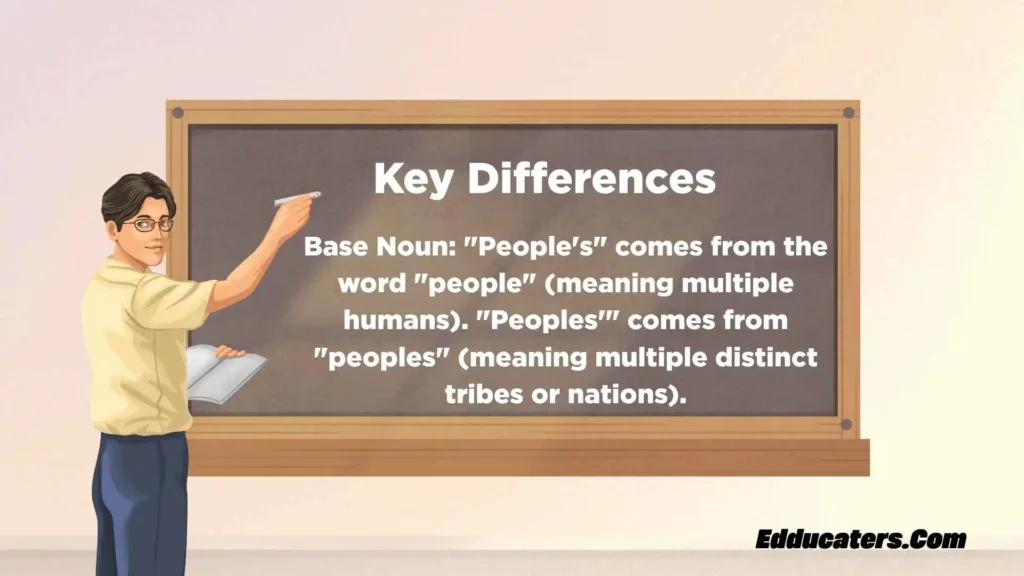
- Base Noun: “People’s” comes from the word “people” (meaning multiple humans). “Peoples'” comes from “peoples” (meaning multiple distinct teams or nations).
- Apostrophe Placement: In “people’s,” the apostrophe sits before the ‘s’ because the base word “people” is already plural. In “peoples’,” the apostrophe sits after the ‘s’ because you are pluralizing the word “peoples.”
- Context: Use “people’s” for the general public or groups. Use “peoples'” for anthropological, political, or historical discussions involving distinct groups or cultures.
Grammar Rules
The rule for possessives in English is usually straightforward: add an apostrophe and an ‘s’ to most nouns, or just an apostrophe to nouns that already end in ‘s’. The confusion here stems from the word “people” being a collective noun.
Most people know “people” as the plural of “person.” However, “people” can also be treated as a singular collective noun when it describes a distinct ethnic group. When you pluralize that specific usage, you get “peoples.” Therefore, the possessive of that plural is “peoples’.” If you are simply talking about a crowd or the public, stick to “people’s.”
Also Check This Post: To Many or Too Many? Easy Grammar Rules Explained
When to Use Each Word
- Academic Writing: In history or sociology, you will often use “peoples'” to describe interactions between different ethnic groups.
- Professional/Business Writing: You will almost always use “people’s,” as you are typically addressing the public or an organization’s members.
- Formal English: Follow the “peoples'” rule strictly in formal papers to show high-level linguistic competence.
- Daily Conversation: In casual settings, “people’s” is by far the most common term; “peoples'” will rarely appear in normal speech.
Common Mistakes
People often add an apostrophe after the ‘s’ in “people’s” because they incorrectly think that since the word refers to a group, it must end in an apostrophe. Another mistake is using “peoples'” when referring to a general crowd, which sounds overly academic or stiff.
- Incorrect: “The peoples’ voices were heard.” (Unless you are talking about multiple distinct nations).
- Correct: “The people’s voices were heard.”
Original Examples
- The people’s verdict was clear by the end of the night.
- The diverse peoples’ cultures were showcased during the grand event.
- We advocate for the people’s basic human rights.
- The historian researched the peoples’ migration patterns across the continent.
- It is the people’s job to hold their leaders accountable.
- Different peoples’ languages have unique phonetic structures.
- The charity focuses on the people’s immediate medical needs.
- This region is home to many different peoples’ historical sites.
- The people’s struggle for freedom has inspired many generations.
- We must respect the peoples’ right to self-determination.
- The people’s representative arrived at the courthouse today.
- The study analyzed various peoples’ economic systems over time.
- Everyone felt the people’s joy at the festival.
- Ancient peoples’ navigation methods remain a mystery today.
- The people’s trust in the institution has grown significantly.
- The exhibition highlights the peoples’ artistic contributions.
- I admire the people’s resilience in the face of adversity.
- The diplomatic summit addressed the peoples’ common interests.
Memory Trick

Think of the “S-Test.” If you are talking about “people” (the group), the word is “people.” Since it doesn’t end in ‘s’, add ‘s. If you are talking about “peoples” (nations/cultures), the word already ends in ‘s’, so just add the ‘ at the end.
Mini Quiz
- The ______ opinion changed after the announcement.
A) people’s
B) peoples’ - The world is home to many indigenous ______ rights.
A) people’s
B) peoples’ - It is the ______ choice, not the government’s.
A) people’s
B) peoples’ - Historians studied the ______ unique pottery styles.
A) people’s
B) peoples’ - ______ lives were forever changed by the event.
A) People’s
B) Peoples’
Answers: 1(A), 2(B), 3(A), 4(B), 5(A).
FAQs
Is “peoples'” a real word?
Yes. “Peoples” is the plural of “people” when referring to distinct ethnic or national groups, and “peoples'” is its correct possessive form.
Can I use “peoples'” instead of “people’s” to sound smarter?
No, doing so is incorrect unless you are specifically referring to multiple distinct ethnic or cultural groups. Using it for a general group makes your writing sound confused.
What is the plural of “person”?
The plural of person is “people.” The possessive of “people” is “people’s.”
Do I ever write “peoples’s”?
No, that is never correct. You either add ‘s or just the apostrophe.
Is there a difference between American vs. British English?
No, the rules for possessive forms are the same in both varieties of English.
How do I know if I’m talking about “peoples”?
Ask yourself: “Am I discussing different cultures, nations, or teams?” If yes, use “peoples’.” If you are just talking about a group of humans or the public, use “people’s.”
Key Takeaways
- People’s = The possessive of the group “people.” Use this for the public or crowds.
- Peoples’ = The possessive of “peoples” (distinct cultures/nations). Use this in academic or historical contexts.
- Apostrophe rule: Always place the apostrophe after the ‘s’ only if the base word (like “peoples”) already ends in ‘s’.
- Context matters: Choose “people’s” for everyday life and “peoples'” for specialized group discussions.
Conclusion
Understanding the difference between “people’s” or “peoples'” is a mark of a careful and precise writer. While the two terms share the same pronunciation, their grammatical roles are distinct. By remembering that “people’s” belongs to the general public and “peoples'” belongs to the study of distinct cultural groups, you can navigate your writing with confidence.
If you are drafting a simple letter or a complex historical report, using the correct apostrophe placement ensures your message remains clear and professional.
Also Check This Post: Baptised or Baptized: A Simple Guide to the Correct Spelling

Hi, I’m Nathan Whitmore, and I enjoy making English grammar easy for learners of all ages. I believe grammar should be practical, not confusing. I write simple, well-researched guides that help readers improve their writing, speaking, and overall communication skills.
I spend a lot of time studying grammar patterns, sentence construction, punctuation, and modern English usage. My goal is to create lessons that anyone can understand, whether they are students, teachers, or professionals.
Books
Clear English Grammar
The Smart Writer’s Grammar Handbook
 Claire Holloway
 Julian Mercer