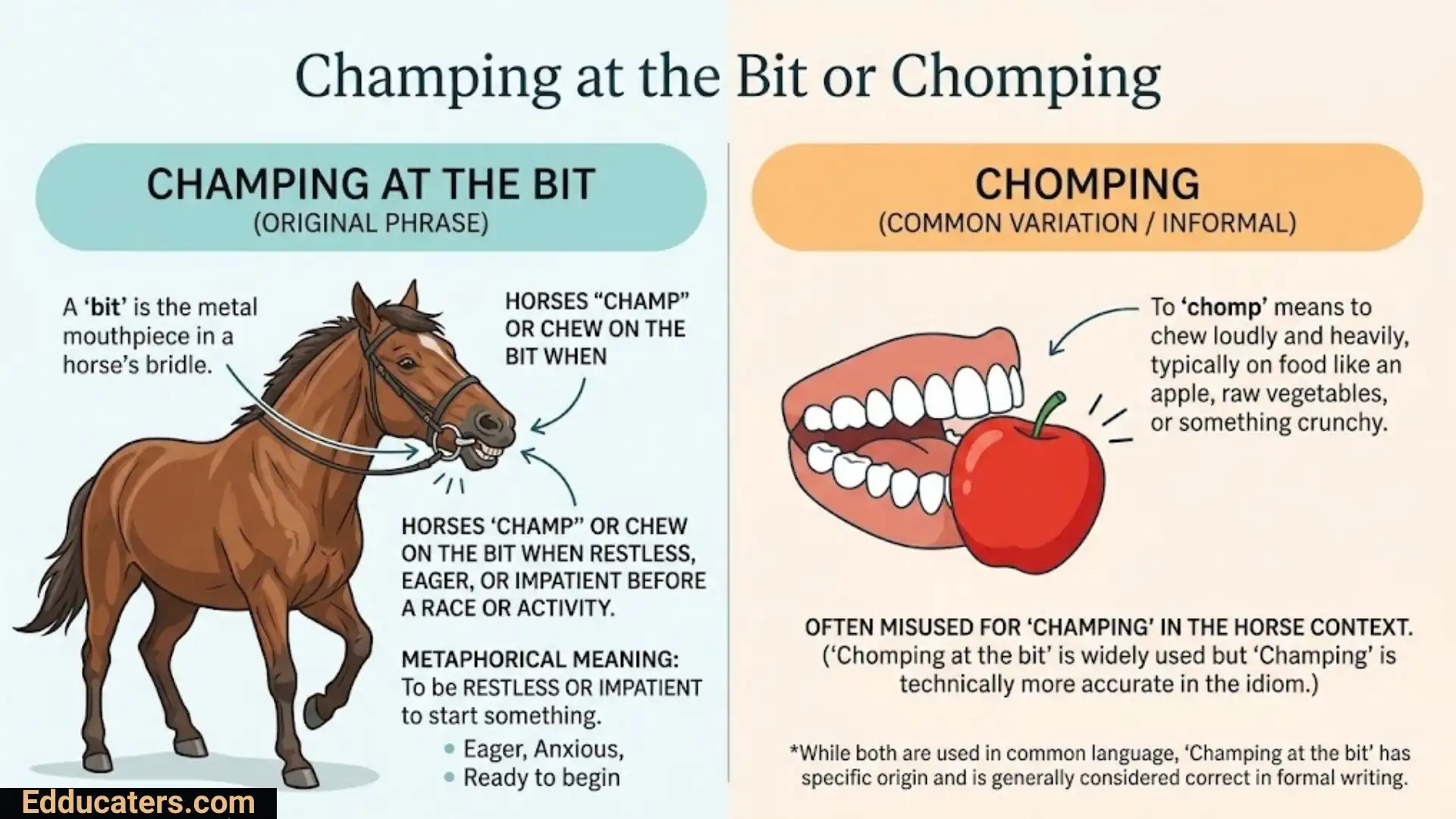
If you have ever heard someone say they are “champing at the bit” or “chomping at the bit,” you may have wondered which expression is correct. The two phrases sound almost identical, and both are commonly used to describe someone who is eager to do something.
The traditional expression is “champing at the bit.” It has been used for centuries and comes from the image of a horse impatiently working its mouth against a bit. “Chomping at the bit” is a later and very common variant, especially in American English. It carries the same figurative meaning and is widely understood.
So, if you’re asking “Is it champing at the bit or chomping at the bit?”, the traditional answer is champing at the bit, but chomping at the bit is also an established modern form.
Champing at the Bit or Chomping: Which Is Correct?
“Champing at the bit” is the traditional form of the idiom, while “chomping at the bit” is a widely used variant. Both mean that someone is very eager, impatient, or restless to do something.
| Form | Status | Meaning | Usage |
| Champing at the bit | Traditional form | Very eager or impatient to do something | Formal, traditional, general English |
| Chomping at the bit | Common variant | Very eager or impatient to do something | Common modern usage, especially American English |
If you want to use the original, traditional form, choose champing at the bit. If you encounter chomping at the bit, however, it should not automatically be treated as a spelling mistake.
Is “Champing at the Bit” Correct?
Yes. “Champing at the bit” is correct and is the traditional form of the expression.
The verb champ has an older sense meaning to bite, chew, or grind with the teeth. The expression developed from the behavior of horses wearing a bit.
For example:
The players were champing at the bit to get onto the field.
This means the players were extremely eager to begin playing.
Is “Chomping at the Bit” Correct?
Yes. “Chomping at the bit” is also widely used and recognized.
The verb chomp means to bite or chew vigorously. Because “chomp” is much more familiar to many modern English speakers than “champ” in this sense, the variant “chomping at the bit” developed naturally.
For example:
The children were chomping at the bit to open their presents.
The meaning is essentially the same as:
The children were champing at the bit to open their presents.
Champing at the Bit or Chomping Meaning
The meaning of both expressions is to be very eager, impatient, or restless to do something.
Someone who is “champing at the bit” may have been waiting for an opportunity and is now ready to act.
For example:
Sarah was champing at the bit to start her new job.
This means Sarah was extremely eager to start her new job.
The phrase can communicate more than simple excitement. It often suggests that the person doesn’t want to wait any longer.
Compare these sentences:
I was excited to start the project.
This simply expresses enthusiasm.
I was champing at the bit to start the project.
This suggests that I was very eager and impatient to get started.
That slight sense of impatience is an important part of the idiom.
What Does “Champing at the Bit” Mean?
“Champing at the bit” means being eager or impatient to do something.
The phrase is normally used figuratively when talking about people, teams, groups, or organizations.
For example:
- The students were champing at the bit to hear the results.
- She was champing at the bit to return to the stage.
- The team was champing at the bit to begin the match.
- He was champing at the bit to tell everyone the news.
- We were champing at the bit to start the journey.
In each example, the subject is waiting for something but is ready and eager for it to happen.
What Does “Chomping at the Bit” Mean?
“Chomping at the bit” has essentially the same modern meaning as “champing at the bit.”
It means that someone is very eager, impatient, or restless to do something.
For example:
The new employees were chomping at the bit to begin their first project.
The sentence tells us that the employees were eager to get started.
You can usually replace “chomping” with “champing” without changing the basic meaning:
The new employees were champing at the bit to begin their first project.
Both sentences express the same idea.
What Is the Difference Between Champing or Chomping?
The difference is mainly historical and lexical, rather than a difference in the modern meaning of the idiom.
Champ is an older verb that can mean to bite or chew.
Chomp means to bite or chew energetically or noisily and is much more familiar to many modern speakers.
The traditional idiom developed with champ, giving us:
champing at the bit
Later, speakers increasingly used the more familiar chomp, giving us:
chomping at the bit
The modern expressions have effectively converged in meaning.
Champ
The verb champ has a relatively old-fashioned flavor when used outside this expression. It can describe biting or chewing, particularly with the teeth.
The word remains familiar partly because of the idiom:
champing at the bit
Chomp
Chomp means to bite or chew something vigorously.
For example:
The dog chomped on the toy.
Because “chomp” is a familiar everyday verb, “chomping at the bit” can feel more natural to some speakers.
Champing at the Bit Origin
The origin of “champing at the bit” comes from horses.
A bit is a piece of equipment placed in a horse’s mouth and connected to the bridle. A restless or excited horse may move its mouth against the bit, bite it, or chew on it while waiting to move.
That physical image became a metaphor for human impatience.
A person who is champing at the bit is figuratively like a horse that is ready to move but has to wait.
The expression therefore combines two ideas:
- The bit represents restraint or being held back.
- Champing represents restless movement or biting.
- The complete idiom represents impatience and eagerness to act.
This is why the phrase is particularly suitable when someone is waiting for permission, an opportunity, a result, or a chance to begin.
Why Do People Say “Chomping at the Bit”?
The popularity of “chomping at the bit” is easy to understand.
The verb chomp is common modern English, while champ is much less familiar in its older biting or chewing sense. As a result, speakers naturally associate the expression with the familiar word “chomp.”
There is also a strong visual connection. A horse can literally appear to be chomping or chewing on its bit.
Over time, this helped establish “chomping at the bit” as a recognizable variant.
This is an example of how idioms can change as speakers reinterpret unfamiliar words using words that are more familiar to them.
Is “Chomping at the Bit” a Mistake?
Not necessarily.
Calling “chomping at the bit” simply a mistake would be too strong because the expression is widely used and understood in modern English.
However, if you’re asking which form represents the traditional idiom, the answer is:
Champing at the bit
“Chomping at the bit” is best described as a common variant rather than an unrelated expression.
If you are writing in a context where traditional usage matters, “champing at the bit” is the safer choice.
Champing at the Bit Pronunciation
Champing at the bit is commonly pronounced:
CHAMP-ing at the bit
The first syllable of champing receives the main stress.
A common IPA representation is:
/ˈtʃæmpɪŋ æt ðə bɪt/
You can break the phrase down like this:
- champing — CHAMP-ing
- at — at
- the — thuh
- bit — bit
The beginning of champing has the same “ch” sound found in words such as chair and child.
Chomping at the Bit Pronunciation
Chomping at the bit is pronounced:
CHOMP-ing at the bit
A common IPA representation in varieties with the LOT vowel is:
/ˈtʃɒmpɪŋ æt ðə bɪt/
The main difference between the two pronunciations is the vowel sound in champing or chomping.
Is Champing at the Bit British or American?
“Champing at the bit” is used in both British and American English.
It is not a straightforward British-versus-American spelling difference.
The variant “chomping at the bit” is also used in both varieties, although it is particularly common in American English.
So this isn’t like:
- colour / color
- tyre / tire
- centre / center
Those pairs represent established regional spelling differences.
With champing / chomping, the situation is different. The two forms developed through different word choices, with champing at the bit being the traditional form and chomping at the bit becoming a common variant.
Champing at the Bit Examples
The phrase works naturally when someone is waiting for an opportunity and is eager to act.
Examples With “Champing at the Bit”
- The students were champing at the bit to hear the final results.
- She was champing at the bit to begin her new job.
- The players were champing at the bit to get onto the field.
- I was champing at the bit to tell my family the good news.
- The children were champing at the bit to open their presents.
- The team was champing at the bit to start the competition.
- He was champing at the bit to show everyone his new design.
- We were champing at the bit to begin our journey.
- The young athletes were champing at the bit to compete.
- Everyone was champing at the bit for the announcement to begin.
Examples With “Chomping at the Bit”
The variant works in the same situations:
- The team was chomping at the bit to get started.
- She was chomping at the bit to return to work.
- The children were chomping at the bit to go outside.
- He was chomping at the bit to tell his friends what happened.
- The players were chomping at the bit before the final match.
- We were chomping at the bit to see the finished product.
- The audience was chomping at the bit for the show to begin.
- The athletes were chomping at the bit to compete.
- I was chomping at the bit to try the new equipment.
- The employees were chomping at the bit to launch the project.
Champing at the Bit Synonyms
There are several ways to express the same general idea.
Common synonyms and related expressions include:
- eager
- impatient
- keen
- restless
- enthusiastic
- itching to
- raring to go
- anxious to
- ready to
- desperate to
However, these aren’t always perfect replacements.
For example:
She was eager to start.
This expresses enthusiasm.
She was champing at the bit to start.
This adds a stronger feeling of impatience and pent-up eagerness.
Similarly, “itching to” can sound more informal:
I’m itching to try the new car.
While “champing at the bit” can work in both conversational and more formal contexts.
Is Champing at the Bit a Positive or Negative Expression?
The expression is generally neutral, but the context can give it either a positive or negative tone.
It can describe positive excitement:
The young players were champing at the bit to compete in their first championship.
Here, the phrase communicates enthusiasm and anticipation.
It can also suggest impatience:
The manager was champing at the bit to take control of the situation.
Here, the phrase may suggest that the manager is frustrated about having to wait.
So “champing at the bit” does not automatically mean something positive or negative. The surrounding context determines the tone.
Is Chomping at the Bit Offensive?
No. “Chomping at the bit” is not normally considered offensive.
It is a standard idiomatic expression used to describe eagerness or impatience.
For example:
The students were chomping at the bit to start the trip.
There is nothing offensive about this sentence.
The phrase can occasionally sound critical if it describes someone who seems too impatient or overly eager, but that is a matter of tone rather than offensiveness.
For example:
He was chomping at the bit to take over the department.
Depending on the context, this might suggest ambition or impatience. It does not make the expression offensive.
Can “Champing at the Bit” Be Used in a Poem?
Yes. “Champing at the bit” can be used in poetry, especially when a writer wants to create an image of restraint, anticipation, or intense eagerness.
The horse imagery gives the expression a strong metaphorical quality, which can work well in creative writing.
For example, a poem might use the idea of a horse waiting to run as a metaphor for a person who feels trapped or impatient:
Waiting for the gate to open,
champing at the bit,
ready for the road ahead.
This is an original example showing how the idiom can function poetically. The phrase can suggest not only eagerness but also held-back energy.
If you’re searching for a “champing at the bit poem,” the phrase itself is useful because it naturally creates imagery around horses, movement, restraint, and anticipation.
When Should You Use “Champing at the Bit”?
Use “champing at the bit” when you want to describe someone who is extremely eager or impatient to do something.
It works particularly well in situations involving:
- Waiting for an opportunity
- Waiting for permission
- Preparing to begin something
- Anticipating an event
- Wanting to take action
- Being held back temporarily
- Feeling excited about what comes next
For example:
The researchers were champing at the bit to begin the next stage of the experiment.
The researchers aren’t merely interested. They are very eager to begin.
When Should You Use “Chomping at the Bit”?
Use “chomping at the bit” when you’re comfortable with the common modern variant.
It is particularly natural in conversational or informal writing.
For example:
The kids were chomping at the bit to get outside.
This sounds perfectly natural to many English speakers.
However, if you’re specifically trying to preserve the traditional form of the idiom, choose “champing at the bit.”
Common Mistakes With Champing at the Bit
Mistake 1: Saying “Champing on the Bit”
The established expression is:
Champing at the bit
Not:
Champing on the bit
The preposition at is part of the idiom.
Mistake 2: Assuming “Chomping” Is Always Wrong
It is too simplistic to say:
“Chomping at the bit” is incorrect.
A better explanation is that “chomping at the bit” is a widespread variant, while “champing at the bit” is the traditional form.
Mistake 3: Using the Expression for Ordinary Activity
The idiom implies eagerness or impatience.
For example:
I was champing at the bit while doing my homework.
This sounds unusual unless the speaker was especially eager or impatient to do the homework.
A better context would be:
I was champing at the bit to finish my homework so I could go outside.
Mistake 4: Thinking the Phrase Means “Eating”
Because chomp means to chew or bite, someone unfamiliar with the idiom might interpret “chomping at the bit” literally.
In most modern contexts, however, it is figurative and means being eager or impatient.
Champing at the Bit vs. Raring to Go
“Raring to go” is a close informal alternative to “champing at the bit.”
For example:
The players were champing at the bit to begin.
could become:
The players were raring to go.
Both express strong eagerness.
The difference is tone. “Raring to go” is generally more conversational, while “champing at the bit” preserves the vivid horse-related image.
Champing at the Bit vs. Itching to
“Itching to” is another common alternative.
She was champing at the bit to start the project.
and:
She was itching to start the project.
Both indicate strong eagerness.
“Itching to” is usually more informal. “Champing at the bit” can sound more colorful or figurative.
Frequently Asked Questions
Is It Champing at the Bit or Chomping at the Bit?
The traditional form is “champing at the bit.” However, “chomping at the bit” is also a widely used variant with the same modern meaning.
Which Is More Correct: Champing or Chomping at the Bit?
“Champing at the bit” is more traditional and historically established. “Chomping at the bit” is a common modern variant, so it should not automatically be treated as incorrect.
What Does Champing at the Bit Mean?
It means being very eager, impatient, or restless to do something. It often describes someone who is waiting for an opportunity to act.
What Does Chomping at the Bit Mean?
It has essentially the same meaning as “champing at the bit”: to be very eager or impatient to do something.
Where Does Champing at the Bit Come From?
The expression comes from the behavior of horses. A restless horse may work, bite, or chew its bit while waiting to move. The image became a metaphor for human impatience and eagerness.
Is Chomping at the Bit Offensive?
No. “Chomping at the bit” is not generally offensive. It is a normal English idiom, although in some contexts it can imply that someone is particularly impatient.
What Is a Synonym for Champing at the Bit?
Depending on the context, synonyms include eager, impatient, keen, restless, itching to, raring to go, and anxious to.
How Do You Pronounce Champing at the Bit?
It is commonly pronounced “CHAMP-ing at the bit.” A common IPA representation is /ˈtʃæmpɪŋ æt ðə bɪt/.
Can Champing at the Bit Be Used in a Poem?
Yes. The expression can work particularly well in poetry because its horse imagery can represent anticipation, restraint, impatience, and the desire to move forward.
Is Champing at the Bit British or American?
It is used in both British and American English. “Chomping at the bit” is also used in both varieties and is especially common in American English.
Conclusion
So, is it “champing at the bit” or “chomping at the bit”?
The traditional answer is “champing at the bit.” It is the older form of the idiom and means being very eager or impatient to do something.
However, “chomping at the bit” is also a well-established modern variant. It developed partly because “chomp” is a much more familiar word to many modern speakers. It has the same figurative meaning and is not simply a random spelling error.
If you’re writing formal or traditional English and want the safest choice, use “champing at the bit.” If you’re reading modern English, don’t be surprised by “chomping at the bit.”
The key thing is that both forms communicate eagerness or impatience, while “champing at the bit” remains the traditional expression.

Hello, I’m Claire Holloway. I have always been passionate about the English language and enjoy turning complex grammar rules into simple, easy-to-follow lessons. I believe that every learner can become a confident English writer with the right guidance.
I create educational content focused on grammar, vocabulary, sentence structure, and writing improvement. Every article I publish is designed to help readers learn with confidence and accuracy.
Books
Grammar Without Confusion
Modern English Usage Guide
 Nathan Whitmore
 Julian Mercer