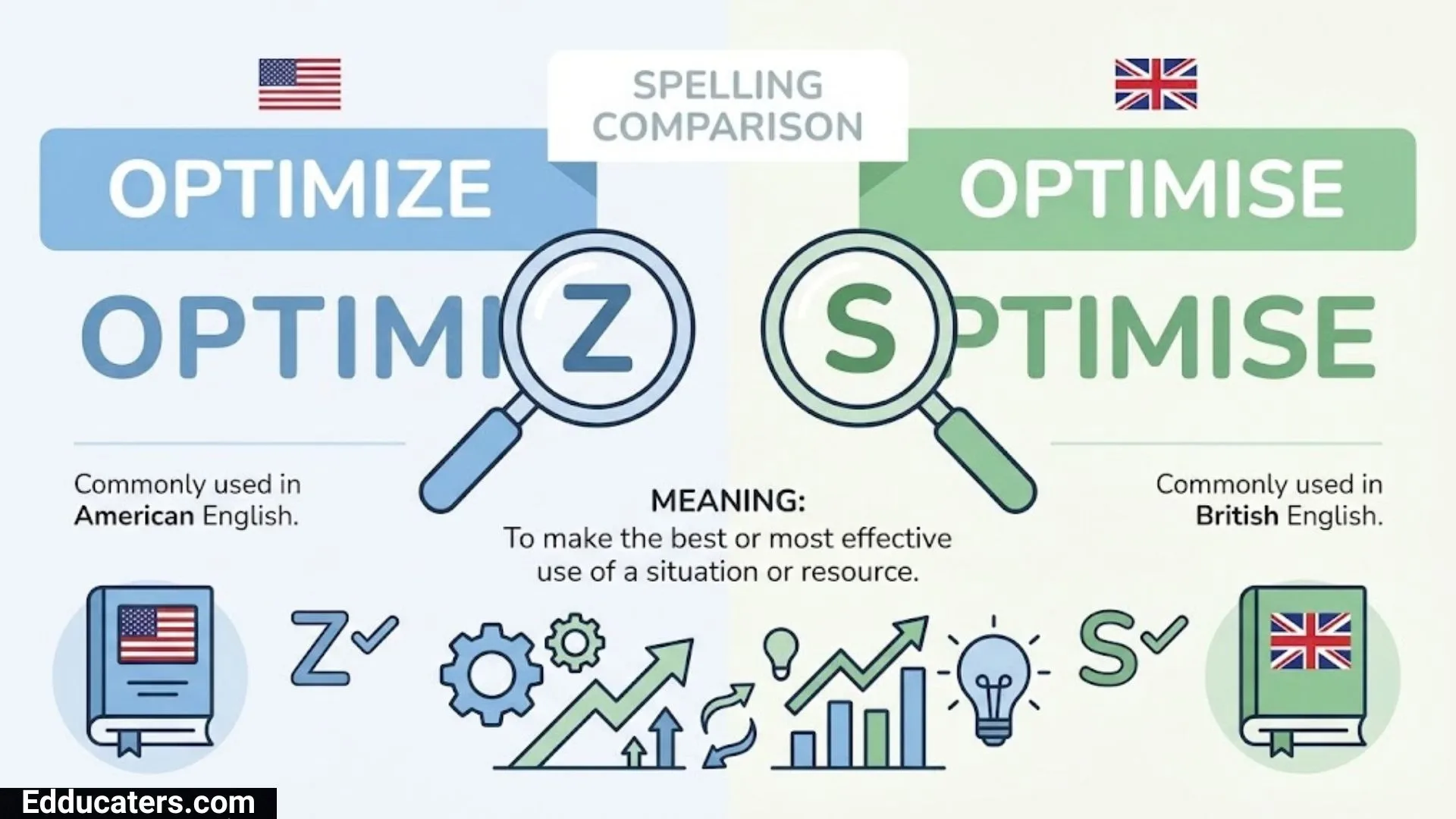
If you’ve ever wondered whether to write optimise or optimize, the answer depends mainly on which variety of English you’re using. Both spellings are correct, and both have the same meaning: to make something as effective, efficient, or useful as possible.
Optimise is the standard spelling in British English and is commonly used in Australia, New Zealand, and South Africa. Optimize is the standard spelling in American English and is also widely used in Canadian English, where both spellings may appear depending on the context.
The difference is simply the letter s or z before the ending -e. The meaning, grammar, and pronunciation remain the same. In this guide, I’ll explain how to use each spelling, how to pronounce the word, what its opposite is, and which version you should choose for your audience.
Optimise or Optimize: Which Is Correct?
Both optimise or optimize are correct spellings of the same English verb. The main difference is regional spelling preference, not meaning or grammar.
| Spelling | Common Usage | Example |
| Optimise | British English, Australian English, South African English | We need to optimise the website. |
| Optimize | American English | We need to optimize the website. |
Both sentences mean that the website needs to be improved so it performs as effectively as possible.
Choose the spelling that matches your audience or your organisation’s style guide. If you’re writing for American readers, use optimize. If you’re writing for a British or Australian audience, optimise is generally the better choice.
The most important rule is consistency. Avoid switching between the two spellings in the same article, report, website, or other piece of writing unless you have a specific reason to do so.
What Does Optimise or Optimize Mean?
Optimise or optimize means to improve something to achieve the best possible result, make the best use of available resources, or increase efficiency.
The word is commonly used in technology, business, education, science, engineering, and everyday conversation.
For example:
- A business can optimise its operations to reduce wasted time and money.
- A website owner can optimize a page to improve its performance.
- A student can optimise a study schedule to make better use of available time.
- An engineer can optimise a machine to use less energy.
- A mobile app developer can optimise an application to make it run more smoothly.
The word doesn’t always mean making something perfect. Often, it means finding a better balance between competing goals, such as cost, speed, quality, and efficiency.
Optimise or Optimize as a Verb
Both spellings are verbs. They describe the action of improving something or making it work more effectively.
Examples:
- We need to optimise our daily schedule.
- The developer will optimize the software.
- She optimises her workflow to save time.
- The company optimized its delivery process last year.
The spelling changes according to regional preference, but the verb’s grammatical role remains the same.
Optimise or Optimize Pronunciation
Both spellings have the same pronunciation. The difference between optimise or optimize is written, not spoken.
The word is commonly pronounced:
- IPA: /ˈɒp.tɪ.maɪz/ in many British accents and /ˈɑːp.tə.maɪz/ in many American accents.
- Simple pronunciation: OP-tuh-myze or OP-ti-myze, depending on the accent.
- Syllables: op-ti-mise or op-ti-mize.
- Stress: The first syllable, OP, receives the main stress.
The final sound is a voiced /z/ sound in both spellings. Although one version contains s and the other contains z, the final sound is not different.
For English learners, the easiest way to remember the pronunciation is to focus on the three syllables and place the strongest emphasis on the first one.
Optimise or Optimize Examples in Sentences
Examples make it easier to understand how the word works in everyday English. You can use either spelling in the following sentences, provided you follow the spelling convention appropriate for your audience.
Sentences Using Optimise
- I want to optimise my daily routine so I have more time to study.
- The company plans to optimise its delivery process.
- We should optimise the website for mobile users.
- She changed her schedule to optimise her productivity.
- The team worked together to optimise the use of available resources.
- Regular maintenance can help optimise the machine’s performance.
- The school aims to optimise learning opportunities for students.
- We need to optimise the database before launching the application.
- He uses analytics to optimise his marketing campaigns.
- The new system should help us optimise our workflow.
Sentences Using Optimize
- We need to optimize the website before the product launch.
- The engineer helped optimize the machine’s energy consumption.
- She uses a calendar to optimize her working hours.
- The team optimized the application to improve its speed.
- Businesses can optimize their budgets by identifying unnecessary expenses.
- The software automatically optimizes certain system settings.
- I want to optimize my study plan for the final examinations.
- The company is trying to optimize its customer service process.
- Developers regularly optimize code to improve performance.
- We optimized the schedule to reduce waiting times.
Notice that the sentences use the same grammatical patterns. The spelling changes, but the meaning and intended action remain the same.
British English: Optimise or Optimize?
In British English, optimise is the traditional and generally preferred spelling. It follows the common British convention of using -ise in many verbs where American English often uses -ize.
Examples of similar spelling differences include:
| British English | American English |
| Optimise | Optimize |
| Organise | Organize |
| Realise | Realize |
| Recognise | Recognize |
| Modernise | Modernize |
This pattern applies to many words, although British English also accepts -ize spellings in certain styles and dictionaries. Therefore, it would be inaccurate to say that every -ize spelling is automatically wrong in British English.
If you’re writing for a British publication, school, employer, or website, check its preferred style. If no guidance is available, optimise is a sensible default.
Optimise or Optimize in American English
In American English, optimize is the standard spelling.
American publications, businesses, educational institutions, and technology companies generally use the -ize ending in this word.
Examples:
- We need to optimize our search function.
- The company optimized its production process.
- This tool helps users optimize their schedules.
- The website is optimized for smaller screens.
Using optimise in American writing may be understood perfectly well, but it can look inconsistent with the spelling conventions readers expect.
If your content targets a United States audience, choose optimize and apply the same American spelling style to related words throughout the text.
Optimise or Optimize in Australia
In Australian English, optimise is generally the preferred spelling.
Australian English commonly uses -ise in words such as organise, realise, and recognise. This convention is widely followed in Australian education, professional communication, and publishing.
Examples:
- We should optimise the website for Australian customers.
- The business wants to optimise its operating costs.
- Students can optimise their study time by planning ahead.
If you’re writing a blog post, business report, school assignment, or website for Australian readers, optimise is usually the appropriate choice.
The same principle applies to related spelling choices: follow the Australian English convention consistently rather than mixing British-style and American-style forms without a reason.
Optimise or Optimize in Canada
Canadian English uses spelling conventions influenced by both British and American English. As a result, both optimise or optimize can be encountered, although optimize is common in Canadian professional and technical writing.
The best choice depends on the publication, organisation, or style guide you’re following.
For example:
- A Canadian company may write, “We optimize our online services.”
- A publication following a British-influenced house style may choose, “We optimise our online services.”
Neither choice should be judged without considering the relevant style requirements.
If you’re preparing a Canadian school assignment, formal report, or business document, consult the requested style guide. If no guide is specified, optimize is a practical choice, particularly in technical and business contexts.
Optimise or Optimize in India
Indian English often follows British-influenced spelling conventions. For that reason, optimise is a common and appropriate choice in Indian English.
You may see it in educational material, professional documents, websites, and business communication.
Examples:
- We need to optimise the website for Indian users.
- The company is working to optimise its supply chain.
- Students can optimise their revision schedules before examinations.
However, optimize also appears in Indian writing, especially in software documentation, international business, and content produced for American audiences.
If you’re writing specifically for an Indian audience, optimise is a reasonable default. If your organisation follows American English or an international technical style guide, use optimize instead.
Optimise or Optimize in South Africa
In South African English, optimise is generally the preferred spelling.
South African English shares many spelling conventions with British English, including the use of -ise in words such as optimise, organise, and recognise.
Examples:
- The organisation wants to optimise its resources.
- We need to optimise the website’s loading speed.
- The team optimised the process to reduce delays.
For South African academic writing, professional documents, and local websites, optimise is normally the natural choice. Nevertheless, an organisation may use American English in its technical documentation or international communications.
Follow the relevant style guide when one is provided.
What Does Auto Optimise Mean?
Auto optimise means to improve or adjust something automatically, usually through software, a device, or a system, with little or no manual intervention.
The spelling of optimise or optimize depends on the regional English convention being used. The underlying meaning of auto optimise and auto optimize is the same.
Examples include:
- A phone may automatically optimise battery usage.
- A computer program may optimize performance settings.
- A camera may automatically adjust settings to improve an image.
- A website platform may optimise images to reduce loading times.
In American English, the phrase is generally written as auto optimize or automatically optimize. In British, Australian, and South African English, auto optimise or automatically optimise is common.
The exact function depends on the product. Automatic optimisation might improve speed, save power, reduce file sizes, or adjust settings, but it does not necessarily improve every aspect of performance at once.
What Is the Opposite of Optimise or Optimize?
There isn’t one universal opposite of optimise or optimize. The best antonym depends on what you’re trying to express.
| Opposite Word | Meaning | Example |
| Worsen | Make something worse | The change could worsen performance. |
| Degrade | Reduce quality or performance | Poor maintenance may degrade the system. |
| Deteriorate | Become worse over time | The machine’s condition began to deteriorate. |
| Undermine | Weaken effectiveness or success | The unnecessary changes may undermine the process. |
| Neglect | Fail to give proper attention | If you neglect maintenance, efficiency may decline. |
| Impair | Damage or reduce effectiveness | The faulty component can impair performance. |
For example, if you optimise a website to improve its speed, slow down or reduce performance may describe the opposite result more naturally than a single formal antonym.
If you’re talking about making a process less efficient on purpose, de-optimise or de-optimize may be appropriate in specialised technical contexts. These forms are less common than everyday alternatives such as worsen or make less efficient.
Optimise or Optimize: Verb Forms and Grammar
Both spellings follow the same grammatical rules. Only the regional spelling changes.
| Verb Form | British-Style Spelling | American-Style Spelling |
| Base form | Optimise | Optimize |
| Third-person singular | Optimises | Optimizes |
| Present participle | Optimising | Optimizing |
| Simple past tense | Optimised | Optimized |
| Past participle | Optimised | Optimized |
Examples:
- Present: I optimise my schedule every week.
- Third-person singular: She optimises the website regularly.
- Present participle: We are optimising the system.
- Simple past: They optimised the process yesterday.
- Past participle: The software has optimised the settings.
In American English, the corresponding forms use z: optimizes, optimizing, and optimized.
The word can also form related expressions:
- Optimisation / Optimization: The process of improving something.
- Optimiser / Optimizer: A person, tool, or system that optimises something.
- Optimised / Optimized: Improved or adjusted to work more effectively.
The spelling of these related forms should also remain consistent with the English variety you’re using.
Common Mistakes When Using Optimise or Optimize
Although the difference between the two spellings is simple, writers sometimes make avoidable mistakes.
1. Mixing Regional Spellings
Inconsistent: We need to optimise the website and optimize the application.
Consistent British-style spelling: We need to optimise the website and optimise the application.
Consistent American-style spelling: We need to optimize the website and optimize the application.
Mixing styles isn’t always grammatically incorrect, but it can make a document look inconsistent. Follow one spelling convention unless a quotation, official name, or other specific reason requires a different form.
2. Assuming Optimise Is Incorrect in American English
Optimise is a recognised English spelling, not a meaningless or invented word. However, optimize is the standard American preference.
Use the form that suits your audience instead of treating a regional variant as universally wrong.
3. Assuming Optimize Is Always Incorrect in British English
British English commonly prefers optimise, but optimize is also accepted in some British dictionaries and styles.
If a British publisher specifies -ise, follow that instruction. Otherwise, consider the organisation’s established spelling conventions.
4. Confusing Optimise With Perfect
To optimise something means to improve it towards a desired outcome. It doesn’t necessarily mean making it flawless.
For example, a business may optimise its delivery schedule by reducing delays, even if occasional delays remain.
5. Using Optimise Without Explaining the Goal
The word is most useful when the reader understands what you’re trying to improve.
Instead of writing, “We need to optimise the system,” you could write, “We need to optimise the system to reduce loading times.”
The second sentence provides a clearer purpose and makes the intended improvement easier to understand.
Frequently Asked Questions
Is It Optimise or Optimize?
Both spellings are correct. Optimise is generally preferred in British, Australian, and South African English, while optimize is standard in American English. Canadian English uses both, depending on the style guide and context.
Is Optimise British or American English?
Optimise is primarily associated with British English and is commonly used in Australia, New Zealand, and South Africa. American English generally uses optimize.
Is Optimize Correct in British English?
Yes. Although optimise is the traditional British preference, optimize is also accepted by some British dictionaries and publications. Follow the spelling convention required by your publisher or organisation.
Is Optimise Correct in American English?
Optimise is a recognised spelling, but optimize is the standard American form. For American readers, optimize is usually the better choice.
Do Optimise or Optimize Have Different Meanings?
No. Both words mean to improve something so it works as effectively or efficiently as possible. The difference is regional spelling, not meaning.
How Do You Pronounce Optimise or Optimize?
Both spellings are pronounced the same way within the same accent. The word has three syllables, with the main stress on the first: OP-ti-mize. The final sound is /z/.
What Is the Past Tense of Optimise or Optimize?
The past tense is optimised in British-style spelling and optimized in American spelling. For example, “We optimised the website” and “We optimized the website” are both correct.
What Is the Opposite of Optimise?
The opposite depends on the context. Words such as worsen, degrade, and impair can express the opposite of improving something. For a process or system, make less efficient may be the clearest alternative.
Is It Optimise or Optimize in Australia?
Optimise is generally preferred in Australian English. It follows the common Australian spelling pattern used in words such as organise, recognise, and realise.
Should I Use Optimise or Optimize for SEO?
Use the spelling that matches your target audience and maintain consistency throughout your content. For an American audience, use optimize. For British, Australian, or South African readers, optimise is generally appropriate. The spelling alone does not guarantee better search rankings; relevance, clarity, and content quality also matter.
Conclusion
Both optimise or optimize are correct, and they share the same meaning, pronunciation, and grammatical rules. The choice comes down to regional spelling preferences and the style you want to follow.
Remember these simple guidelines:
- Use optimise for British, Australian, and South African English.
- Use optimize for American English.
- For Canadian English, follow your organisation’s preferred style.
- For Indian English, optimise is a common choice, although optimize is also used.
- Keep related spellings, such as optimisation or optimization, consistent throughout your writing.
If you’re unsure which spelling to choose, consider who will read your content. Matching your audience’s English variety is the simplest way to make your writing clear, natural, and consistent.

I’m Julian Mercer, an English language writer dedicated to helping people master grammar through practical examples and clear explanations. I enjoy teaching grammar in a way that is both engaging and easy to remember.
My work focuses on grammar rules, punctuation, word usage, and writing techniques that readers can apply in everyday life. I believe learning English should be simple, enjoyable, and useful.
Books
English Grammar in Practice
Writing with Precision
 Nathan Whitmore
 Claire Holloway