
Have you ever stared at your laptop screen, cursor blinking, wondering whether to hyphenate a common phrase? You are not alone. The confusion between “check in” and “check-in” is one of the most frequent dilemmas in English writing. While they sound identical, their roles in a sentence are distinct, and swapping them can make your writing look imprecise or unprofessional.
Understanding the difference comes down to one simple grammatical concept: the distinction between a verb phrase and a noun (or adjective). In this guide, you will learn exactly when to use each term, how they function within a sentence, and the simple trick to ensure you never make this mistake again.
Check In or Check-In: (Quick Summary)
Use check in (two words, no hyphen) as a verb phrase to describe the action of registering or reporting your presence. Use check-in (hyphenated) as a noun or an adjective to describe the process, the location, or the time associated with that action. Always use the verb form for actions and the hyphenated form for things.
Comparison Table: Check In vs. Check-In
| Feature | Check In | Check-In |
| Category | Verb Phrase | Noun or Adjective |
| Part of Speech | Verb | Noun / Adjective |
| Function | Describes an action | Names a thing or describes a noun |
| Rule | Subject + Action | Person, Place, or Thing |
| Correct Usage | “Please check in at the desk.” | “The check-in process was fast.” |
| Incorrect Usage | “I have a check in at 3 PM.” | “I need to check-in for my flight.” |
| Memory Tip | Two words for two steps (verb + particle). | One unit for one thing (hyphen joins). |
Meaning of Each Word
Check In (Verb)
“Check in” is a phrasal verb. In English, a phrasal verb combines a base verb with a preposition or adverb to create a new meaning. “Check in” signifies the act of reporting one’s arrival or registering at a specific location, such as a hotel, airport, or office.
- Usage: You use this when you are performing the action.
- Example: “I need to check in at the hotel before we go to dinner.”
- Example: “Don’t forget to check in with your manager after you finish the report.”
Check-in (Noun or Adjective)
“Check-in” acts as a noun (the event or the place) or an adjective (describing another noun). When you add the hyphen, you are creating a compound word that identifies a specific entity.
- Usage: You use this to name the desk, the time, or the overall procedure.
- Example: “The check-in desk is located on the second floor.” (Adjective)
- Example: “What time is your flight’s check-in?” (Noun)
Key Differences
- Action vs. Object: The primary difference is function. If you are doing the action, use two words. If you are pointing to the desk or the process, use the hyphen.
- Sentence Position: “Check in” usually follows a subject or an infinitive marker (e.g., “I will check in”). “Check-in” often functions as the subject of a sentence or sits before another noun (e.g., “The check-in line is long”).
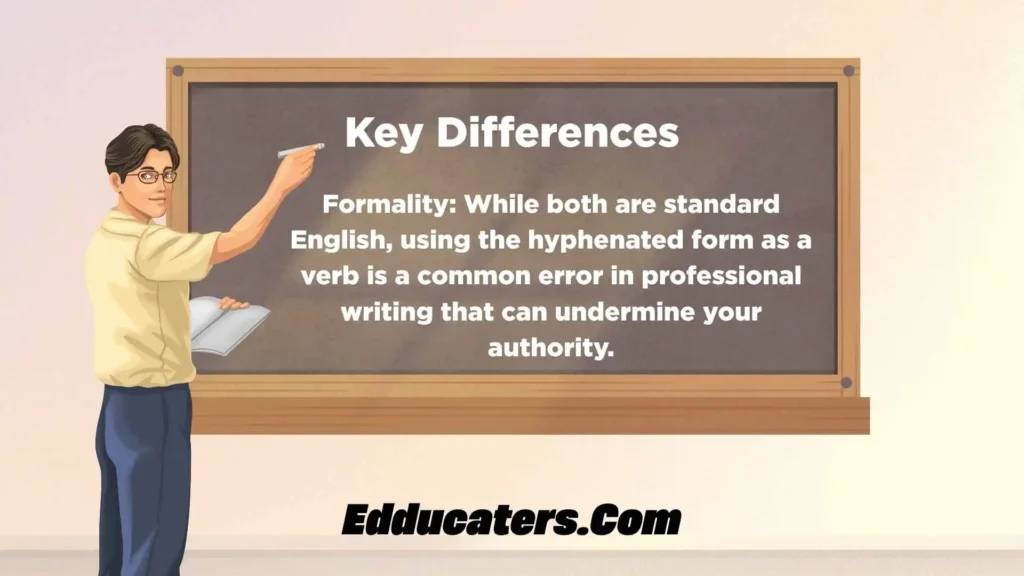
- Formality: While both are standard English, using the hyphenated form as a verb is a common error in professional writing that can undermine your authority.
Grammar Rules
The rule governing this pair is the Compound Noun Rule. In English, when a phrasal verb is transformed into a noun, it is often hyphenated to show that the two words now function as a single grammatical unit.
- The Verb Rule: Keep the verb phrase open. The verb “check” is separate from the preposition “in.”
- The Noun Rule: Use the hyphen to link the words together, transforming the action into an object.
- Exception: Some style guides allow “checkin” (one word) in digital or informal contexts, but this remains non-standard in professional or academic writing. Stick to the hyphen for clarity.
When to Use Each Word
- Academic/Professional Writing: Always strictly observe the distinction. Use “check in” for actions and “check-in” for items or events.
- Business Emails: Use “check in” when asking a colleague for an update (e.g., “I wanted to check in regarding the project”). Use “check-in” when referring to a meeting or procedure (e.g., “The team check-in is scheduled for Monday”).
- Daily Conversation: People often ignore the hyphen when texting, but using it correctly shows attention to detail.
Common Mistakes
The most common error is using “check-in” as a verb. People often see the noun form on signage at airports and assume it is the correct spelling for the action.
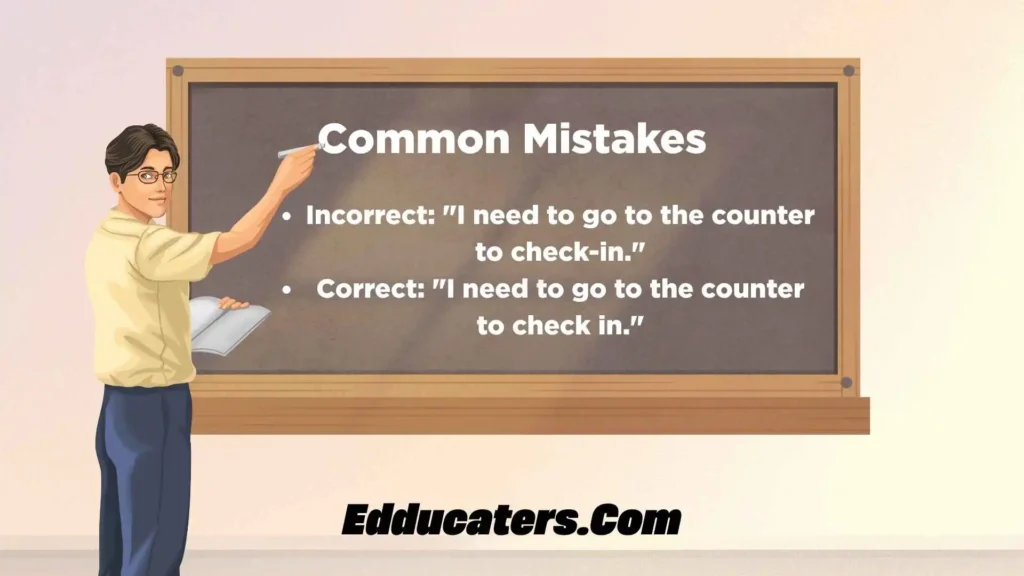
- Incorrect: “I need to go to the counter to check-in.”
- Correct: “I need to go to the counter to check in.”
- Tip: If you can replace the word with “register,” use “check in.” If you can replace it with “appointment” or “procedure,” use “check-in.”
Original Examples
- Students must check in at the front office before entering the library.
- The check-in deadline for the international flight is two hours before departure.
- I will check in with you once I arrive at the conference center.
- The hotel check-in experience was seamless and efficient.
- Please check in your luggage at the designated kiosk.
- We have a brief team check-in every Friday morning.
- The check-in agent asked for my passport and boarding pass.
- I need to check into my hotel room by four o’clock.
- He wrote a quick email to check in on the status of the supply shipment.
- The check-in area was crowded with travelers.
- Could you check in with the client and see if they are satisfied?
- The online check-in process saved us a lot of time.
- She decided to check in at the desk after finding her gate.
- The company requires a daily check-in for all remote employees.
- I plan to check in with my mentor to discuss my career path.
Memory Trick
Think of the “Action vs. Object” rule.
- “Check in” (No hyphen): The “no” in “no hyphen” reminds you that there is “no” thing, only an action.
- “Check-in” (Hyphen): Imagine the hyphen as a piece of tape holding the two words together to create a single, heavy object (a noun).
Mini Quiz
- Which sentence is correct?
a) I need to check-in to my flight.
b) I need to check in to my flight.
Answer: b - Identify the noun in this sentence: “The check-in was delayed.”
a) The
b) check-in
c) was
Answer: b - Fill in the blank: “We should ___ with the team tomorrow.”
a) check in
b) check-in
Answer: a - “My _____ time is at 3:00 PM.” Which word fits?
a) check in
b) check-in
Answer: b - True or False: “Check-in” is a phrasal verb.
a) True
b) False
Answer: b (It is a noun or adjective)
FAQs
Why do people confuse check in and check-in?
People often see “check-in” written on signs at airports and hotels. Because these signs use the noun form to label a location, casual writers mistakenly assume the hyphenated version is the standard spelling for the verb, leading to widespread misuse in daily communication.
Is it ever okay to write “checkin” as one word?
In highly informal digital contexts, such as software UI or social media, “checkin” is sometimes used. However, in formal, academic, or professional writing, it is considered non-standard. Always prefer “check-in” for nouns to maintain high standards of English grammar.
Does British English differ from American English on this?
No, both American and British English follow the same convention. In both dialects, “check in” is the verb phrase and “check-in” is the noun or adjective. This is a standard rule across all forms of global English.
Can I use “check-in” as a verb if I am writing an email?
No. Even in emails, using “check-in” as a verb is grammatically incorrect. It is always better to use the verb phrase “check in.” Maintaining correct grammar in professional correspondence builds trust and demonstrates clear communication skills to your colleagues and clients.
How do I know if I should hyphenate?
Ask if the word is an action or a thing. If you are doing something, use the verb phrase: “I will check in.” If you are talking about a specific item, event, or location, use the noun: “The check-in is complete.” The hyphen serves as the bridge between two words to form a noun.
Are there other words that follow this rule?
Yes, this is a common pattern in English. Other examples include “log in” (verb) versus “login” (noun), “stand by” (verb) versus “standby” (noun/adjective), and “set up” (verb) versus “setup” (noun). Always check if you are performing an action or naming an object.
Key Takeaways
- Check in is a verb phrase used for actions.
- Check-in is a noun or adjective used for things, places, or events.
- Use the “Action vs. Object” test to verify your choice.
- Avoid using the hyphenated form as a verb to keep your writing professional.
- Proper use of these terms significantly enhances the readability and authority of your writing.
Conclusion
Mastering the nuance between “check in” and “check-in” is a hallmark of strong writing. By remembering that the verb phrase stays open and the noun form requires a hyphen, you ensure that your communication is both accurate and professional.
If you are writing a formal report, a quick business email, or a casual message, consistently applying these rules will help you avoid common errors. Next time you need to report your arrival or discuss a process, you can confidently use check in or check-in exactly where they belong.

Hello, I’m Claire Holloway. I have always been passionate about the English language and enjoy turning complex grammar rules into simple, easy-to-follow lessons. I believe that every learner can become a confident English writer with the right guidance.
I create educational content focused on grammar, vocabulary, sentence structure, and writing improvement. Every article I publish is designed to help readers learn with confidence and accuracy.
Books
Grammar Without Confusion
Modern English Usage Guide
 Nathan Whitmore
 Julian Mercer