Language often presents us with curious puzzles, and few are as persistent as the debate between “moulding” or “molding.” If you have ever stared at a screen, cursor blinking, wondering which spelling belongs in your architectural report or home renovation blog, you are not alone. These two words often appear interchangeable, but the choice between them reveals a subtle divide in global English usage.
Mastering this distinction elevates your writing, showing a keen eye for regional standards and professional precision. In this guide, we will untangle the confusion, explore the rules governing these spellings, and ensure you always choose the right term with absolute confidence.
Quick Answer: The Essential Difference
“Molding” is the standard spelling in American English, while “moulding” is the preferred spelling in British English. Both words refer to the same act of shaping material or a decorative strip used in architecture. Choose “molding” for US audiences and “moulding” for UK, Canadian, or Australian audiences to maintain regional consistency.
At a Glance: Moulding or Molding
| Feature | Molding | Moulding |
| Primary Region | United States | UK, Canada, Australia |
| Part of Speech | Noun / Verb | Noun / Verb |
| Meaning | Shaping or a decorative strip | Shaping or a decorative strip |
| Grammar Rule | American preference (no ‘u’) | British preference (includes ‘u’) |
| Common Mistake | Using the wrong regional spelling | Using the wrong regional spelling |
| Example | He installed crown molding. | He installed crown moulding. |
Defining the Terms
What is Molding?
In American English, “molding” functions as both a noun and a verb. As a noun, it refers to a contour or decorative strip used in construction, or the act of shaping a substance like clay or plastic. As a verb, it describes the process of giving form to a material. Because American English generally favors the removal of silent or redundant letters—a trend popularized by Noah Webster the “u” present in the original Old French or Latin roots was dropped.
What is Moulding?
In British English, “moulding” is the standard orthography. While it carries identical meanings to the American version referring to architectural woodwork or the act of creating a form—it retains the “u” from its etymological ancestors. This spelling is consistent with other British English conventions, such as “colour” versus “color” or “favour” versus “favor.”
Key Differences and Nuances
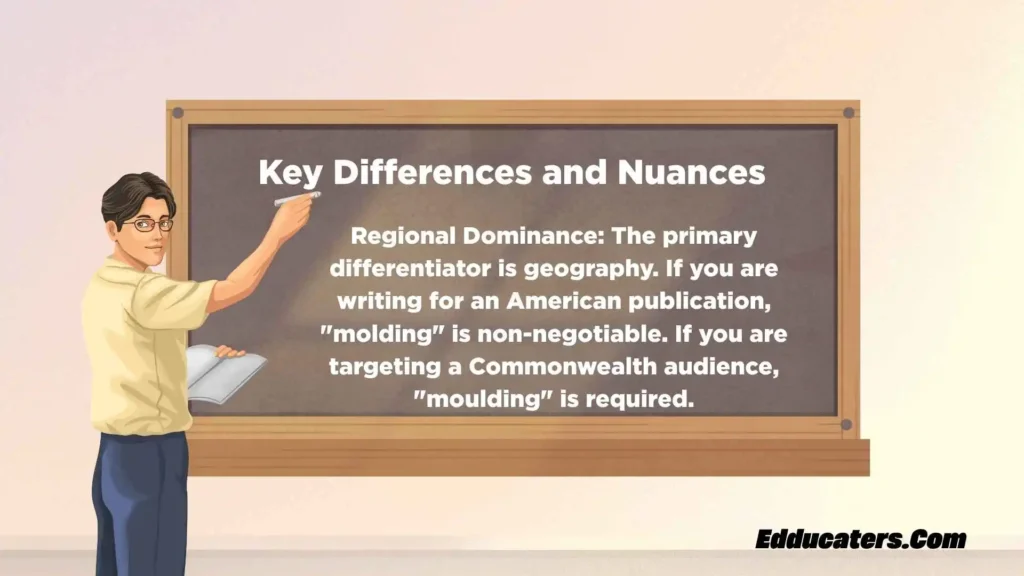
- Regional Dominance: The primary differentiator is geography. If you are writing for an American publication, “molding” is non-negotiable. If you are targeting a Commonwealth audience, “moulding” is required.
- Architectural Context: In professional architectural drafting, using the spelling consistent with the local building code or regional publication style is vital for maintaining professional credibility.
- The “U” Factor: The presence of the “u” is the only substantive difference. Neither spelling is “more correct” in a global context; correctness is determined entirely by the linguistic territory of your reader.
Essential Grammar Rules
The distinction between these two words is purely orthographic rather than grammatical. In both American and British English, the word serves the same grammatical roles:
- As a Noun: “The crown molding [or moulding] looked elegant.”
- As a Verb (Participle): “She was molding [or moulding] the clay into a vase.”
There are no complex inflectional rules to worry about; the choice simply depends on the “dialect” of the document. If you are using American English, avoid the “u.” If you are using British English, always include the “u.” Consistency is the most important rule here—do not mix the two within the same document.
Contextual Usage Guide
Academic and Professional Writing
In formal reports, ensure you identify your target audience early. Academic papers submitted to US universities require “molding.” Journals based in London or Sydney will expect “moulding.” Check your style guide (such as APA, MLA, or Chicago) to see if it specifies regional dialect requirements.
Business and Emails
For international business, adopt the spelling of the company’s headquarters. If you are emailing a client in Chicago, use “molding.” If you are writing to a design firm in Manchester, use “moulding.”
Daily Conversation
In speech, the two words are pronounced identically (/ˈmoʊldɪŋ/). Because the spelling difference is invisible in conversation, confusion usually only arises when writing. When in doubt during a casual text or email, either will be understood, but using your local convention is always the safest bet.
Understanding the Confusion
The confusion stems from the historical evolution of the English language. When English speakers moved to North America, they sought to simplify spelling to make it more phonetic and efficient. Conversely, British English maintained many of the “u” spellings found in older French loanwords. Because we now live in a hyper-connected digital world, we frequently encounter both spellings simultaneously, leading many to believe one is “wrong” when both are technically standard within their respective regions.
Original Examples for Every Situation
- The artisan spent hours molding the wet clay into a perfect sphere. (US)
- The carpenter measured the room to ensure the crown moulding was cut precisely. (UK)
- Our history textbook details the molding of early American political institutions. (US)
- She used a silicone moulding compound to create a replica of the antique statue. (UK)
- Social media influencers often show off their home renovations, highlighting intricate wood molding. (US)
- The factory specializes in the moulding of high-density plastic parts for the automotive industry. (UK)
- The interior designer recommended a minimalist molding profile for the modern office. (US)
- Historical preservationists were careful to restore the original Victorian moulding. (UK)
- He practiced the art of molding bronze in his university sculpture class. (US)
- The teacher explained the process of moulding individual student identities through education. (UK)
- We searched for a supplier that offered high-quality baseboard molding. (US)
- The ornate moulding above the fireplace was the room’s main focal point. (UK)
- News reports highlighted the molding of public opinion through strategic advertising. (US)
- The plastic moulding of the toy car was slightly misaligned. (UK)
- She enjoyed the tactile experience of molding bread dough before baking. (US)
The Memory Trick: Think “U” for “UK”

To remember which spelling to use, simply use this mnemonic:
“U” is for “UK.”
If you are writing for a British (UK) audience, use the word with the “u” (moulding). If you are writing for an American audience, skip the “u” and go with molding.
Mini Quiz: Test Your Knowledge
- Which spelling is preferred in a US-based architectural magazine?
A) Moulding
B) Molding
C) Both are incorrect - Does the “u” change the pronunciation of the word?
A) Yes, it makes it longer.
B) Yes, it adds a subtle sound.
C) No, they are pronounced the same. - Which sentence is correct for a UK reader?
A) The plaster moulding looks beautiful.
B) The plaster molding looks beautiful.
C) Neither is correct. - If you are writing a global email, what should you prioritize?
A) Spelling both ways.
B) Choosing one region and sticking to it throughout.
C) Using the British spelling only. - Is “molding” considered an error in British English?
A) Yes, it is always incorrect.
B) No, it is simply an American variant.
C) It is only used for verbs.
Answers: 1-B, 2-C, 3-A, 4-B, 5-B
Frequently Asked Questions
Is one spelling objectively better?
No. Neither “molding” or “moulding” is objectively superior. They are both valid, recognized spellings. The “better” choice is simply the one that aligns with the regional dialect and style guide of the audience you are currently addressing.
Does the meaning change based on the spelling?
No, the definition remains identical regardless of the spelling. Whether you are discussing the decorative wooden trim around a ceiling or the industrial process of shaping plastic, the meaning remains consistent across all English-speaking variations.
Can I use “moulding” in an American essay?
Generally, no. American teachers and professors expect American English conventions. Using “moulding” in an American academic context may be flagged as a spelling error, as it deviates from the standard US orthography expected in American English curricula.
Why do some people say “molding” is wrong?
People often mistake regional preference for inaccuracy. Because British English is often perceived as the “traditional” parent language, some assume the “u” is mandatory. However, language evolves, and American English spelling reforms are a legitimate, widely accepted part of modern standard English.
Does software autocorrect identify these as errors?
Most modern word processors and browser spellcheckers use the user’s regional settings. If your computer is set to “English (US),” it will flag “moulding” as an error. If set to “English (UK),” it will flag “molding.” Ensure your software settings match your target audience.
Which version should I use for a website?
If your website targets a global audience, check your analytics to see where most of your readers are located. If the traffic is mixed, pick one style—either US or UK—and maintain it consistently across all pages to build trust and authority with your readers.
Key Takeaways
- Molding is the standard American spelling.
- Moulding is the standard British, Canadian, and Australian spelling.
- The word choice carries no difference in definition or pronunciation.
- The only rule is to be consistent; never mix these spellings within a single document.
- Use the “U is for UK” memory trick to make the correct selection every time.
Conclusion
Navigating the differences between “moulding” or “molding” is a classic example of how geography shapes the English language. By understanding that “molding” is the American standard and “moulding” is the British standard, you can navigate your writing tasks with precision and authority.
If you are crafting professional architectural copy or everyday social media content, choosing the correct spelling demonstrates professionalism and respect for your audience’s linguistic norms. Stick to your chosen regional convention, and you will never have to worry about this spelling puzzle again.

I’m Julian Mercer, an English language writer dedicated to helping people master grammar through practical examples and clear explanations. I enjoy teaching grammar in a way that is both engaging and easy to remember.
My work focuses on grammar rules, punctuation, word usage, and writing techniques that readers can apply in everyday life. I believe learning English should be simple, enjoyable, and useful.
Books
English Grammar in Practice
Writing with Precision
 Nathan Whitmore
 Claire Holloway