When you are describing an item that costs a significant amount of money, you have likely found yourself staring at your screen, wondering whether to write “pricey” or “pricy.” Is one spelling a mistake, or are they both acceptable?
This confusion is incredibly common, and even professional writers often find themselves hesitating before hitting the publish button. Language is constantly evolving, and when it comes to variant spellings, it can be difficult to determine which one adheres to standard conventions.
In this article, you will learn the origins of these two spellings, discover which one is considered the gold standard in formal writing, and gain the confidence to use the correct term in every professional or casual situation.
Quick Answer
Both pricey or pricy are correct and interchangeable. “Pricey” is the older, more traditional spelling and is generally preferred in formal writing and style guides. “Pricy” is a simplified variant that has gained popularity in informal, modern English. You can use either, but “pricey” remains the safer choice for professional documents.
Comparison Table
| Feature | Pricey | Pricy |
| Correct Word | Pricey | Pricy |
| Meaning | Expensive; high-cost | Expensive; high-cost |
| Part of Speech | Adjective | Adjective |
| Grammar Rule | Derived from “price” | Simplified variant |
| Correct Usage | “That watch is too pricey.” | “That watch is too pricy.” |
| Incorrect Usage | “It is a price-y item.” | “It is a price-y item.” |
| Pronunciation | /ˈpraɪsi/ | /ˈpraɪsi/ |
| Common Mistake | Using it as a verb | Using it as a verb |
| Memory Tip | Keeps the ‘e’ from ‘price’ | Removes the ‘e’ for speed |
| Example | The hotel was quite pricey. | The hotel was quite pricy. |
Meaning of Each Word
Defining “Pricey”
The term “pricey” is an adjective used to describe something that costs a large amount of money. It is informal, conversational, and carries a connotation that the item or service might be overpriced or luxury-oriented. It directly incorporates the full word “price,” making it the etymologically intuitive spelling.
- Grammar Role: Adjective.
- Usage: Used to describe goods, services, or lifestyle choices.
- Pronunciation: Pronounced “PRY-see.”
- Examples:
- “The organic produce at this boutique market is rather pricey.”
- “We decided against the pricey vacation package.”
Defining “Pricy”
“Pricy” is a phonetic variant of “pricey.” English has a history of dropping the ‘e’ before a suffix (like “icing” from “ice” or “taming” from “tame”). Because of this pattern, many writers naturally gravitate toward “pricy.” It holds the exact same definition and function as its counterpart.
- Grammar Role: Adjective.
- Usage: Informal, increasingly common in web content and casual media.
- Pronunciation: Pronounced “PRY-see.”
- Examples:
- “That new gadget is a bit pricy for my budget.”
- “She found a cheaper alternative to that pricy dress.”
Key Differences
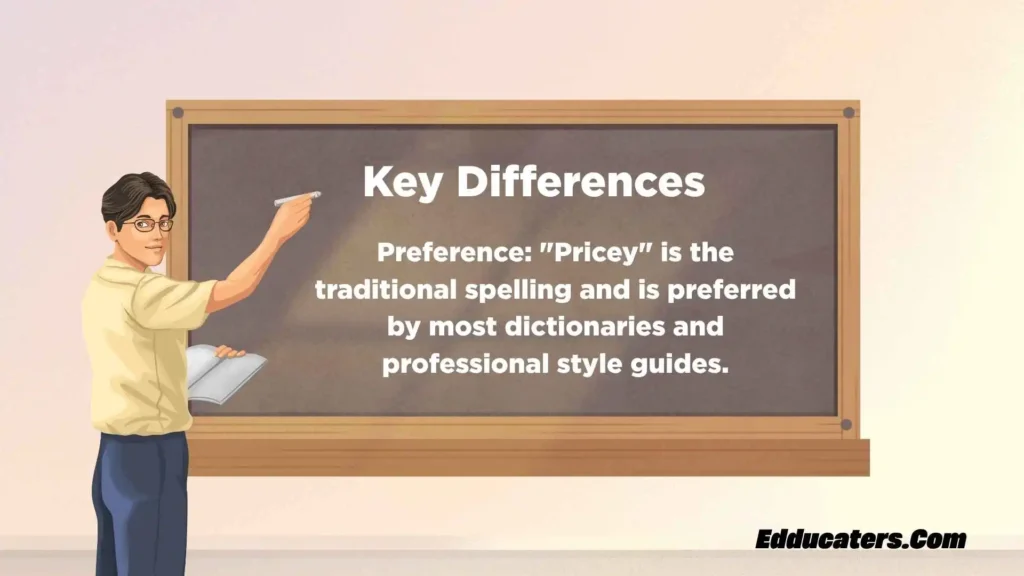
- Preference: “Pricey” is the traditional spelling and is preferred by most dictionaries and professional style guides.
- Formality: If you are writing a formal report, a legal document, or a scholarly article, “pricey” is the standard choice.
- Modernity: “Pricy” is widely accepted in digital media, social media, and casual blog posts where brevity and modern spelling trends are favored.
- Etymology: “Pricey” maintains the visual connection to the base word “price.”
Grammar Rules
There is no strict rule forbidding either spelling. In English, adjectives ending in a silent ‘e’ usually drop the ‘e’ before adding a suffix starting with a vowel (e.g., “force” becomes “forcible”). However, when the suffix starts with a consonant (like “y”), the ‘e’ is usually kept (e.g., “ice” becomes “icey” or “price” becomes “pricey”).
Because “pricey” keeps the ‘e’, it aligns with traditional morphological rules. “Pricy,” while technically breaking that trend, is widely recognized as a “simplified spelling.” Both have become standard entries in major English dictionaries.
When to Use Each Word
- Academic Writing: Stick to pricey. It is the formal, established form.
- Professional/Business Writing: Pricey is recommended to maintain a polished, authoritative tone in proposals and client communications.
- Emails: Use pricey for professional emails and pricy for casual emails to friends.
- Social Media/Blogs: Both are acceptable. Pricy often fits the fast-paced, abbreviated nature of modern online content.
- Daily Conversation: Use whichever feels natural to you; the difference is purely orthographic.
Common Mistakes
The most common mistake associated with these words is not the spelling, but the usage.
- Mistake 1: Using it as a verb. Neither “pricey” nor “pricy” are verbs. You cannot “pricey” something.
- Incorrect: “I will pricey this item later.”
- Correct: “I will price this item later.”
- Mistake 2: Confusing it with “pricey-er.” When using the comparative form, you must follow standard adjective rules.
- Incorrect: “This is more priceyer.”
- Correct: “This is pricier” (both “pricey” and “pricy” become “pricier” in the comparative).
Original Examples
- The luxury sedan was far too pricey for our family budget.
- She bypassed the pricy boutiques and went straight to the outlet mall.
- Finding a reliable mechanic in the city has become an increasingly pricey endeavor.
- The menu at the new bistro is a bit pricy, but the food is worth every cent.
- We chose the less pricey option after comparing all the quotes.
- Even the most pricy tech gadgets sometimes lack essential features.
- Investors found the initial acquisition costs to be surprisingly pricey.
- I need a gift that looks expensive but isn’t overly pricy.
- Their pricey marketing campaign failed to reach the intended demographic.
- You should check the clearance rack if you want to avoid pricy fashion trends.
- Buying real estate in this neighborhood is a very pricey commitment.
- The consultant provided a pricy solution to a simple problem.
- That pricey coffee machine never worked as well as advertised.
- Don’t be fooled by the pricy packaging; the quality is quite low.
- A pricey education does not always guarantee a successful career.
- The airline charges pricy fees for extra baggage.
- I prefer to invest in quality rather than simply paying for pricey brand names.
- That event ticket was too pricy, so we decided to stay home.
- We avoided the pricey hotel in favor of a charming local inn.
- His pricy taste in suits is a direct result of his professional success.
Memory Trick
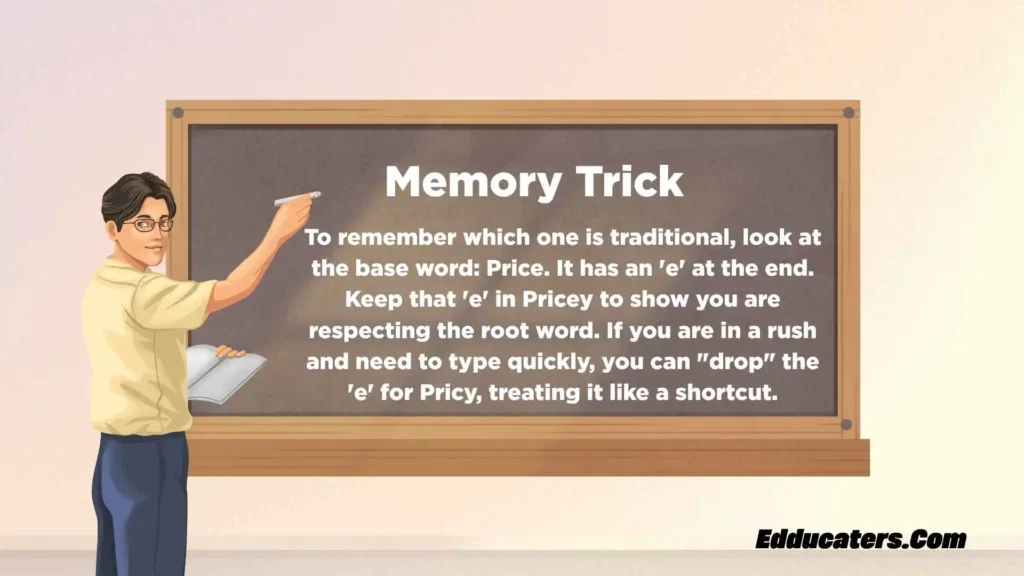
To remember which one is traditional, look at the base word: Price. It has an ‘e’ at the end. Keep that ‘e’ in Pricey to show you are respecting the root word. If you are in a rush and need to type quickly, you can “drop” the ‘e’ for Pricy, treating it like a shortcut.
Mini Quiz
- Which spelling is generally preferred in formal writing?
A) Pricy
B) Pricey
C) Both are equally formal
D) Neither - What is the comparative form of “pricey”?
A) Priceyer
B) Pricier
C) More priceyer
D) Most pricier - Are “pricey” and “pricy” verbs?
A) Yes, they describe the act of setting a price.
B) No, they are adjectives.
C) Only “pricey” is a verb.
D) Only “pricy” is a verb. - If you drop the ‘e’ from “pricey,” what do you get?
A) A misspelling
B) A verb
C) A recognized, informal variant
D) An adverb - Which sentence is grammatically correct?
A) That shirt is very pricey.
B) That shirt is very price-y.
C) That shirt is very pricy.
D) Both A and C.
Answers: 1(B), 2(B), 3(B), 4(C), 5(D).
FAQs
Is one spelling more “correct” than the other?
“Pricey” is the older and more widely accepted form in formal writing. However, both are considered correct in modern English dictionaries. There is no risk of being marked wrong for using either, but “pricey” is safer for high-level professional contexts.
Can I use both spellings in the same document?
It is poor practice to mix spellings in a single document. If you use “pricey” once, you should continue to use “pricey” throughout. Consistency is the hallmark of a professional writer. Choose one and stick to it.
Why does the ‘e’ disappear in “pricy”?
The ‘e’ disappears because of a trend in English to simplify words that contain silent ‘e’s before suffixes. While traditional rules often suggest keeping the ‘e’ before a consonant suffix, the phonetic influence of “pricy” has made it an accepted simplification in casual English.
Does this apply to British English?
The preference for “pricey” holds true in British English as well. British style guides generally favor traditional spellings, and “pricey” is consistent with standard British orthographic conventions. “Pricy” is less common in formal British publications.
How do I make the comparative form?
The comparative form for both is “pricier,” and the superlative form is “priciest.” Regardless of how you spell the base adjective (“pricey” or “pricy”), the ‘e’ is dropped when adding “-er” or “-est” to form the comparison.
Is it okay to use these words in a cover letter?
It is generally better to avoid them entirely in a formal cover letter. Instead of saying “Your company has a pricey service,” use “Your company offers a premium-priced service” or “Your service is quite costly.” This sounds more professional and avoids the informal tone of “pricey.”
Key Takeaways
- Both are correct: “Pricey” and “pricy” are interchangeable, though “pricey” is traditional.
- Professionalism: Use “pricey” for formal or professional documents to ensure a classic, polished tone.
- Consistency: Always maintain the same spelling throughout your entire document.
- Grammar: Never use these words as verbs; they are strictly adjectives.
- Comparison: The comparative forms are always “pricier” and “priciest.”
Conclusion
Deciding between “pricey” or “pricy” does not have to be a source of stress. While “pricey” holds the title for the traditional, formal spelling, “pricy” has successfully integrated itself into modern, casual English. As long as you remain consistent in your writing and avoid using these terms as verbs, you are using them correctly.
By following the standard convention of using “pricey” in professional contexts and keeping your usage consistent, you will ensure that your writing is clear, credible, and polished. The next time you need to describe something expensive, choose the spelling that best fits your document’s tone, and write with confidence.

Hi, I’m Nathan Whitmore, and I enjoy making English grammar easy for learners of all ages. I believe grammar should be practical, not confusing. I write simple, well-researched guides that help readers improve their writing, speaking, and overall communication skills.
I spend a lot of time studying grammar patterns, sentence construction, punctuation, and modern English usage. My goal is to create lessons that anyone can understand, whether they are students, teachers, or professionals.
Books
Clear English Grammar
The Smart Writer’s Grammar Handbook
 Claire Holloway
 Julian Mercer