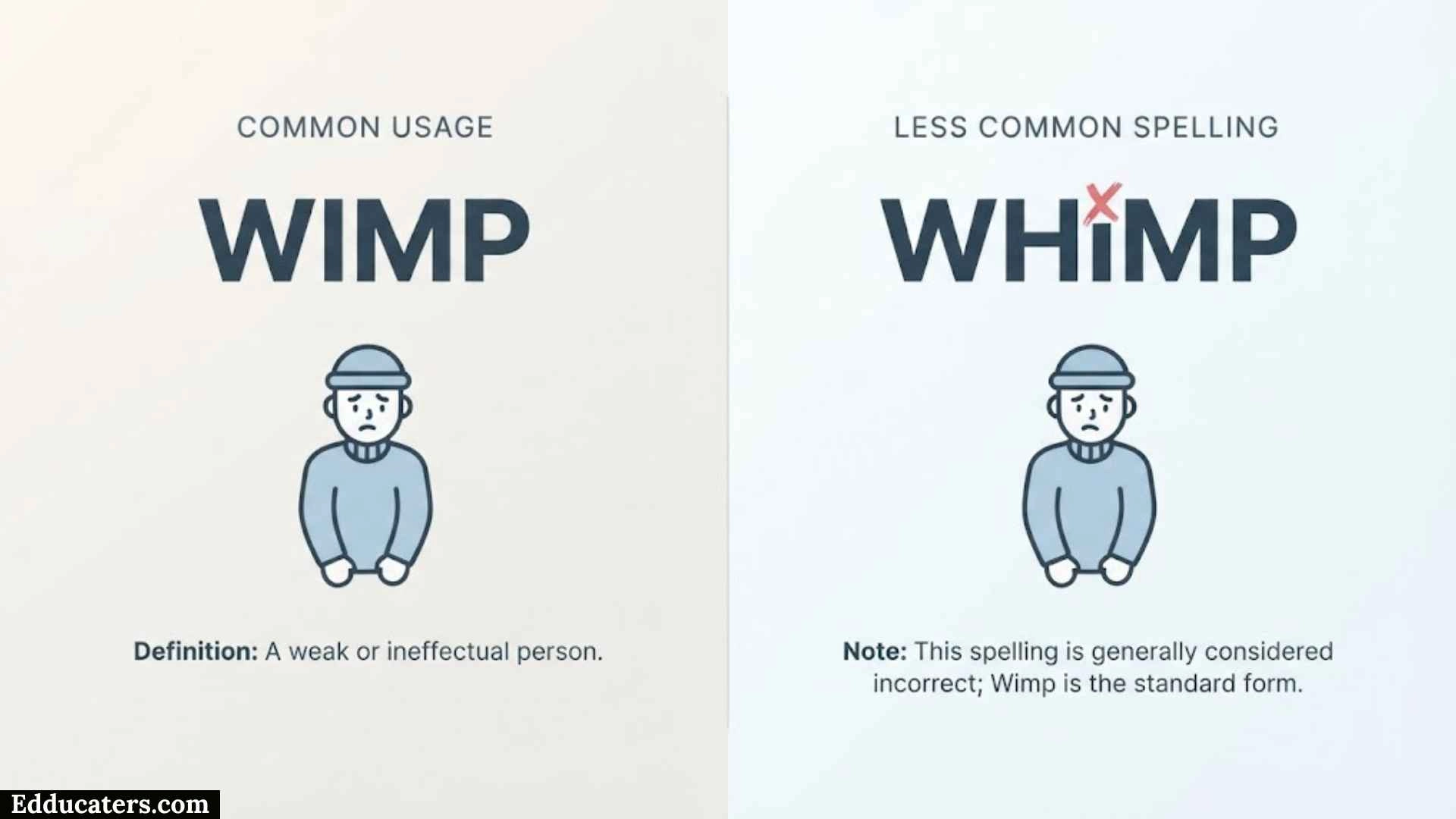
If you are wondering whether the correct spelling is whimp or wimp, the answer is simple: wimp is the standard spelling when you mean a person who is weak, timid, or lacking confidence or courage. Whimp is generally not the standard spelling for this meaning.
The confusion is understandable because adding h after w feels natural in English words such as when, where, and which. However, wimp has its own established spelling and pronunciation.
This guide explains the difference between whimp or wimp, what wimp means, how to pronounce it, how it works as a noun and verb, where wimp out comes from, why people sometimes write whimp, and when the word may sound too informal or insulting.
Whimp or Wimp: Quick Answer
Wimp is the correct standard spelling when you are referring to someone who is considered weak, timid, unconfident, or lacking courage.
Whimp is generally a misspelling when it is intended to have the same meaning.
| Spelling | Standard English? | Meaning | Example |
| wimp | Yes | A person who is not strong, brave, or confident | Don’t be a wimp. |
| whimp | Usually no | Generally a misspelling of wimp | ❌ Don’t be a whimp. |
Major English dictionaries list wimp as an informal word for a person who is not strong, brave, or confident. Cambridge gives the pronunciation as /wɪmp/, while Oxford also identifies the noun as informal and disapproving.
The Simple Rule
When you mean a weak or timid person, use:
wimp
Not:
whimp
For example:
Don’t be a wimp.
This is the standard spelling.
What Does Wimp Mean?
Wimp is an informal noun used for someone who is perceived as weak, timid, fearful, or lacking confidence.
Cambridge defines wimp as a person who is not strong, brave, or confident. Oxford gives a very similar definition and labels the word informal and disapproving.
The word can describe different kinds of perceived weakness. Someone might be called a wimp because they are afraid of something, avoid a difficult situation, lack confidence, or appear physically unprepared for something.
For example:
I felt like a wimp when I refused to go on the roller coaster.
Here, the speaker is saying they felt frightened or lacking in courage.
Another example is:
He looks tough, but he is a wimp when it comes to spiders.
The word does not necessarily mean that someone is physically weak. It can also refer to fear, nervousness, or a lack of confidence.
Wimp Is an Informal Word
An important part of understanding wimp is its tone.
It is not normally a neutral or formal description. Cambridge labels it informal and disapproving, and Oxford similarly marks it as informal and disapproving.
That means the word can sound insulting, critical, teasing, or joking depending on the situation.
For example, two friends might say:
You’re such a wimp!
They may be joking with each other.
But saying the same thing to a coworker or stranger could sound rude.
If you need neutral language, alternatives such as timid, nervous, hesitant, or unconfident may be more appropriate, depending on what you actually mean.
Why Is Wimp Correct Instead of Whimp?
The standard spelling is simply wimp. The extra h is not part of the established spelling of the word.
The confusion probably comes partly from English spelling patterns. English contains many common words beginning with wh, including:
- when
- where
- what
- which
- while
Because of this pattern, a writer who has mainly heard the word spoken may reasonably wonder whether it should be written whimp.
However, spelling cannot always be predicted from similar-looking words. The established dictionary form is wimp, pronounced /wɪmp/. Cambridge and Oxford both list this spelling and pronunciation.
Is Whimp Ever Used?
You may occasionally encounter whimp in informal writing, online comments, user-generated content, or as an intentional spelling.
That does not make it the standard spelling of the ordinary English word wimp.
If you are writing a school assignment, article, email, report, or other standard English text and you mean a weak or timid person, use wimp.
There can be special cases where an unusual spelling belongs to a particular name, title, quotation, or fictional character. In such a case, the spelling should be preserved because you are reproducing that specific name or wording rather than choosing the ordinary English word.
How Do You Pronounce Wimp?
Wimp is pronounced /wɪmp/ in both British and American English. Cambridge gives the UK and US pronunciation as /wɪmp/.
It has one syllable:
wimp
The vowel sound is the short i sound found in words such as:
- sit
- ship
- limp
- simple
The word ends with the consonant sounds m + p.
Why Pronunciation Can Cause Spelling Confusion
When people learn a word mainly through conversation, they may know how it sounds without knowing how it is spelled.
Because wimp begins with a /w/ sound, someone might incorrectly associate it with words beginning with wh. The pronunciation itself does not indicate that an h belongs in the spelling.
This is a useful reminder that English spelling often has to be learned as an established form rather than reconstructed entirely from sound.
How Is Wimp Used in a Sentence?
The most common use of wimp is as a noun.
Here are several natural examples:
Don’t be a wimp just because the water is cold.
I thought he was a wimp, but he handled the difficult situation calmly.
She hates horror movies because she says she is a wimp when it comes to scary stories.
My brother called me a wimp for refusing to ride the roller coaster.
He is not a wimp; he simply does not want to take unnecessary risks.
These examples also show an important point: calling someone a wimp expresses a judgment. It does not necessarily establish an objective fact about that person.
Wimp Can Be Used Playfully
The word is often used in teasing or humorous situations.
For example:
“You won’t go into the water?”
“No way.”
“You’re such a wimp!”
In this conversation, the speaker may not seriously believe the other person is weak. The word can function as playful teasing between people who know each other.
However, the same word can be hurtful when used seriously or toward someone who does not know the speaker well.
Wimp Can Describe Fear or Lack of Confidence
The word does not always refer to general weakness.
For example:
I’m a bit of a wimp when it comes to needles.
This means the speaker becomes nervous or fearful around needles.
Similarly:
He’s a wimp about heights.
This means he is easily frightened by heights.
The surrounding context tells you what kind of weakness or fear the speaker has in mind.
Wimp as a Noun and Verb
Although wimp is most familiar as a noun, it can also function as a verb in informal English.
Oxford lists wimp as a verb with forms including wimp, wimps, wimped, and wimping.
Wimp as a Noun
As a noun, wimp refers to a person.
He’s a wimp.
She thought I was a wimp.
Don’t call your brother a wimp.
The noun normally refers to the person being described.
Wimp as a Verb
As a verb, wimp is commonly encountered in the expression wimp out.
For example:
I almost wimped out before the presentation.
Here, the person became too nervous or afraid to do something they had intended to do.
Oxford lists wimp out as an informal, disapproving phrasal verb meaning to fail to do something you intended to do because you are too frightened or not confident enough.
What Does Wimp Out Mean?
Wimp out means to back out of something because you become frightened, nervous, or insufficiently confident.
For example:
I was going to ask for a raise, but I wimped out.
The person intended to ask for a raise but lost the confidence to do it.
Another example:
We planned to go skydiving, but Tom wimped out at the last minute.
Tom decided not to participate because he became too frightened or uncertain.
Wimp Out Is More Specific Than Wimp
The two expressions should not be treated as interchangeable.
Wimp describes a person:
He is a wimp.
Wimp out describes an action or decision:
He wimped out.
This distinction is useful when choosing the right grammatical form.
| Expression | Function | Example |
| wimp | Noun | He’s a wimp. |
| wimp | Verb | Don’t wimp now. |
| wimped | Past-tense verb | He wimped at the last minute. |
| wimp out | Phrasal verb | She wimped out of the challenge. |
| wimpy | Adjective | That was a wimpy excuse. |
Wimp, Wimpy, and Wimpish: What’s the Difference?
Several related words come from wimp.
Wimp
Wimp is primarily a noun referring to a person perceived as weak, timid, or lacking confidence.
He’s a wimp.
Wimpy
Wimpy is an adjective describing someone or something as weak, timid, or lacking confidence.
That was a wimpy response.
Oxford lists wimpy as an alternative adjective alongside wimpish.
Wimpish
Wimpish is also an adjective.
His wimpish behavior surprised everyone.
Oxford defines wimpish as meaning not strong, brave, or confident and notes that wimpy can also be used.
These forms are related, but they have different grammatical jobs:
wimp = noun
wimpy = adjective
wimpish = adjective
Wimp vs. Coward vs. Timid
These words overlap, but they are not exact synonyms.
Wimp is informal and often expresses criticism or teasing.
Coward is a stronger word that directly criticizes someone’s courage.
Timid is more neutral and describes someone who lacks confidence or is easily nervous.
Consider these examples:
He’s a wimp about cold weather.
He’s a coward for abandoning his friends.
She’s timid around people she doesn’t know.
The three words communicate different tones. Choosing between them depends on whether you want informal criticism, a strong judgment, or a more neutral description.
Choosing a More Neutral Word
If you are writing professionally, think about whether wimp is actually necessary.
Instead of:
The employee was a wimp during the meeting.
you might write:
The employee seemed hesitant to express an opinion during the meeting.
The second sentence describes the behavior without using an insulting label.
This is especially useful in workplace, academic, educational, and formal writing.
Common Mistakes With Wimp
The most obvious mistake is adding an unnecessary h.
Mistake 1: Writing Whimp
Incorrect in the standard sense:
❌ He is such a whimp.
Correct:
✅ He is such a wimp.
Mistake 2: Assuming Both Spellings Are Standard
Because whimp looks plausible, some writers assume that it is simply another spelling of wimp.
For ordinary standard English, that is not the best choice. Dictionary entries identify wimp as the established word.
Mistake 3: Using Wimp in Formal Situations
Correct spelling does not automatically mean appropriate tone.
For example:
He’s a wimp.
is grammatically fine, but it is informal and potentially insulting.
In a formal context, choose a more precise description of the behavior instead.
Mistake 4: Confusing Wimp With Wimple
Wimp and wimple are different words.
A wimple is a historical type of head and neck covering. It has no connection with the modern informal noun wimp in ordinary usage.
This is a useful distinction because adding letters can sometimes create an entirely different English word.
Where Did the Word Wimp Come From?
The history of wimp is not completely certain.
Oxford dates the word to the 1920s and says its origin is uncertain, with a possible connection to whimper.
The Online Etymology Dictionary gives a similar account, dating the noun to around 1920 and suggesting that it may have developed as a shortened form of whimper. It also notes that the later association with J. Wellington Wimpy, a character from the Popeye comics, may have influenced the word’s development or popularity.
Because the origin is uncertain, it would be misleading to claim that one particular explanation is proven.
The important point for modern writers is that wimp has been established in English for roughly a century, while the standard spelling for the modern word is wimp, not whimp.
A Simple Decision Guide
If you are unsure which form to write, use this quick decision process.
Step 1: Do You Mean a Weak or Timid Person?
If yes, write:
wimp
Example:
He’s a wimp when it comes to scary movies.
Step 2: Are You Describing Someone as Weak or Timid?
If you need an adjective, consider:
wimpy or wimpish
Example:
That was a wimpy excuse.
Step 3: Do You Mean Someone Backed Out Because They Were Afraid?
Use:
wimp out
Example:
She wimped out before the competition.
Step 4: Are You Writing “Whimp” for the Ordinary Word?
Change it to:
wimp
Unless Whimp is intentionally part of a specific name, title, quotation, or other special spelling.
How to Remember the Correct Spelling
A simple memory trick is:
Wimp has no H.
Think of the spelling as:
W + IMP = WIMP
You can also connect it with related forms:
wimp → wimpy → wimpish
All three begin with wimp, not whimp.
If you see whimp in a normal sentence where the writer means a timid or weak person, check whether it is simply a spelling error.
When Should You Avoid the Word Wimp?
Even when wimp is correctly spelled, it is not always the best word.
Avoid it when you need a neutral, respectful description.
For example, if a student is nervous about giving a presentation, calling the student a wimp may be unnecessarily judgmental.
A better description could be:
The student was nervous about speaking in front of the class.
Likewise, in a professional setting:
The manager seemed hesitant to make a decision.
is more precise than:
The manager was a wimp.
The choice depends on your purpose. Wimp works well in casual dialogue, informal storytelling, humor, and conversations where the speaker deliberately wants a teasing or critical tone.
Frequently Asked Questions
Is Whimp a Correct Spelling?
Whimp is generally not the standard spelling when you mean a weak, timid, or unconfident person. The standard spelling is wimp.
Is Wimp a Real Word?
Yes. Wimp is an established English word. Major dictionaries such as Cambridge and Oxford list it as an informal noun referring to someone who is not strong, brave, or confident.
What Is the Difference Between Whimp and Wimp?
For the ordinary English meaning, wimp is the standard spelling. Whimp is generally a misspelling of it.
How Do You Spell Wimp?
The correct spelling is:
W-I-M-P
There is no h after the w.
How Do You Pronounce Wimp?
Wimp is pronounced /wɪmp/ in both British and American English.
Is Wimp an Insult?
It can be. Wimp is informal and commonly carries a disapproving or teasing tone. Cambridge and Oxford both mark the word as informal, with Oxford also identifying its disapproving use.
What Is the Plural of Wimp?
The regular plural is wimps.
Example:
The children jokingly called themselves wimps after refusing to enter the haunted house.
What Is the Past Tense of Wimp?
When wimp is used as a verb, the past tense is wimped.
Example:
He wimped out at the last minute.
Oxford lists wimped as the past form of the verb.
Is Wimp Formal or Informal?
Wimp is informal. It is more suitable for casual conversation and informal writing than for formal academic, business, or professional contexts.
What Is the Adjective Form of Wimp?
The common adjective forms are wimpy and wimpish.
For example:
He gave a wimpy excuse.
Her wimpish behavior surprised everyone.
Oxford lists both forms.
What Does Wimp Out Mean?
Wimp out means to decide not to do something you intended to do because you become too frightened or lack enough confidence.
Example:
I planned to speak first, but I wimped out.
Is Wimp a Bad Word?
It is not a swear word, but it can be insulting or disrespectful because it labels someone as weak or lacking courage. Its effect depends on the context and relationship between the speakers.
Key Takeaways
- Wimp is the standard spelling.
- Whimp is generally a misspelling when it is intended to mean a weak or timid person.
- Wimp is an informal noun.
- The word is pronounced /wɪmp/.
- Wimpy and wimpish are related adjective forms.
- Wimp out means to back out of something because of fear or lack of confidence.
- The word can be playful among friends but insulting in other situations.
- For formal writing, a more neutral word such as timid, hesitant, or unconfident may be better.
- The history of wimp is uncertain, although dictionaries and etymological sources place its emergence around the 1920s.
Conclusion
When deciding between whimp or wimp, choose wimp if you mean a person who is perceived as weak, timid, fearful, or lacking confidence.
The spelling whimp may appear occasionally, but it is not the standard form of this everyday English word. Wimp is the form recognized by major dictionaries, and it is the spelling you should use in normal writing.
Remember the simple rule: wimp has no H.
If you need the related adjective, use wimpy or wimpish. If you mean someone backed out because they became afraid, wimp out is the appropriate expression.

Hello, I’m Claire Holloway. I have always been passionate about the English language and enjoy turning complex grammar rules into simple, easy-to-follow lessons. I believe that every learner can become a confident English writer with the right guidance.
I create educational content focused on grammar, vocabulary, sentence structure, and writing improvement. Every article I publish is designed to help readers learn with confidence and accuracy.
Books
Grammar Without Confusion
Modern English Usage Guide
 Julian Mercer
 Nathan Whitmore