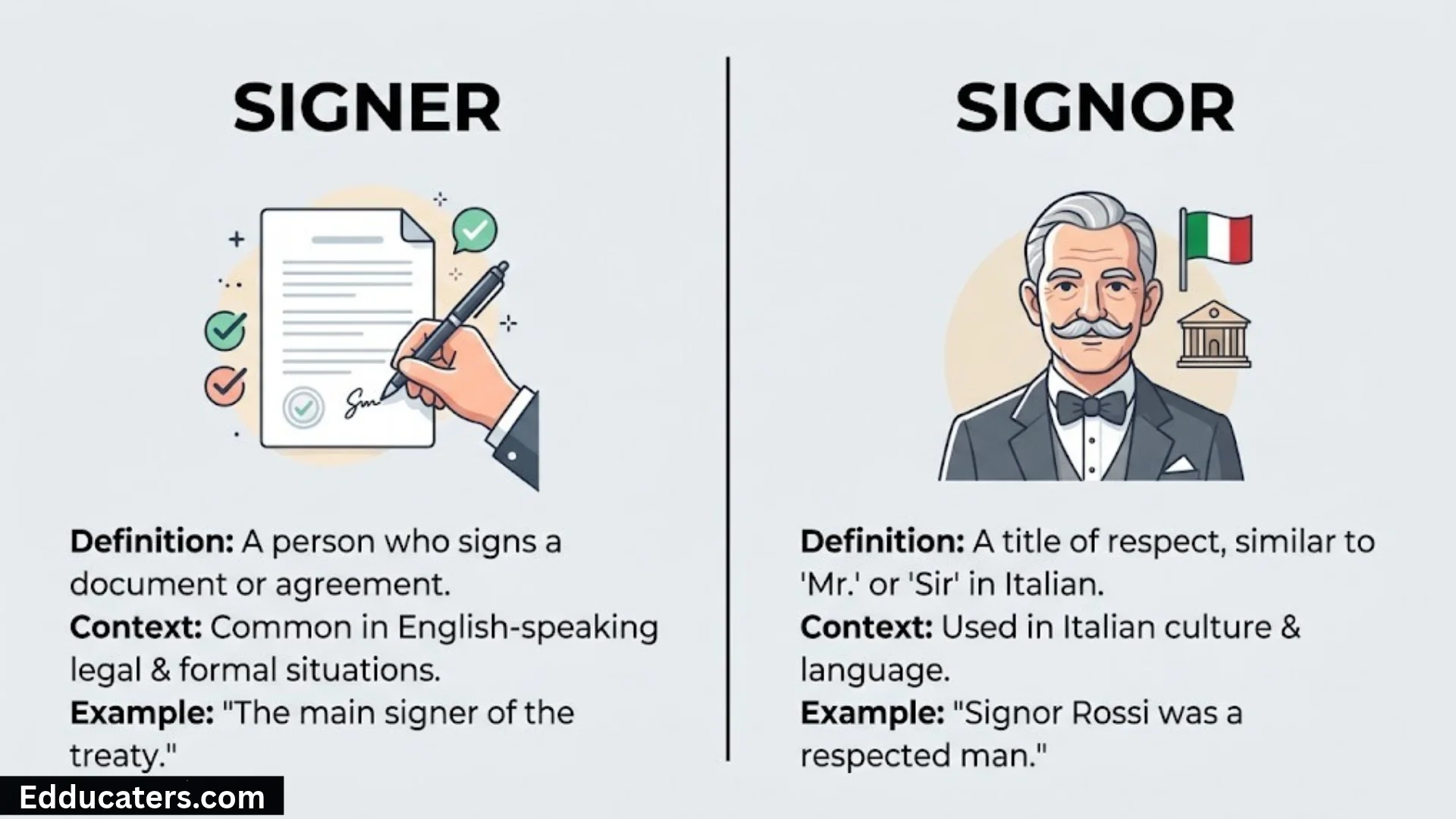
Have you ever wondered whether to write signer or signor? Although these words look and sound somewhat alike, they have completely different meanings. Choosing the wrong one can change the message you’re trying to communicate.
The distinction is actually simple. Signer refers to someone who signs a document, contract, agreement, or other written material. Signor, on the other hand, is an Italian title of respect for a man, equivalent to Mr. in English.
For example, a person who signs a business agreement is a signer. An Italian gentleman addressed as Signor Rossi receives a respectful title.
Both spellings are legitimate, but you cannot use them interchangeably. Their meanings, linguistic origins, pronunciation, and grammatical functions set them apart.
Let’s explore the difference between signer or signor, including their definitions, examples, pronunciation, history, and correct usage.
Signer or Signor: Quick Difference
The main difference between signer or signor concerns what each word represents. One identifies a person performing an action, while the other functions as a title of respect.
| Feature | Signer | Signor |
| Meaning | A person who signs something | An Italian title equivalent to Mr. |
| Language | English | Italian (also used in English) |
| Part of speech | Noun | Noun and title |
| Pronunciation | SY-ner | See-NYOR |
| Related word | Sign | Signore |
| Typical context | Contracts, documents, and agreements | Italian names and formal address |
| Example | The signer approved the contract. | Signor Rossi welcomed us. |
Remember this simple rule:
- Use signer when talking about someone who writes or places their signature on something.
- Use signor when referring to an Italian man with a respectful title.
For instance, if someone signs a lease agreement, that person is a signer. If you address an Italian gentleman as Mr. Bianchi, you can use Signor Bianchi.
Understanding this distinction will help you avoid spelling mistakes in professional documents, everyday writing, and discussions about Italian culture.
What Does Signer Mean?
Signer is a noun that describes someone who signs a document, agreement, letter, or other written material. The word identifies the person responsible for placing a signature on something.
A signer might be an individual, a business representative, or another person participating in an agreement. The specific role depends on the document and the circumstances surrounding the signature.
For example, when two people enter into a partnership agreement, both may sign the document. Each person who signs it is a signer.
The word comes from the English verb sign, which means to write your name or make an identifying mark to show agreement, approval, or acknowledgment.
Here are some common situations involving signers:
- Legal documents: People who sign contracts, affidavits, or other official paperwork.
- Business agreements: Individuals who approve and sign partnership or employment agreements.
- Financial documents: People who sign checks or authorize certain financial transactions.
- Government forms: Applicants who sign official applications and declarations.
- Personal correspondence: Individuals who sign letters, certificates, or written statements.
Consider these examples:
- Every signer must review the agreement before accepting its terms.
- The authorized signer approved the company’s new partnership contract.
- Each signer received a copy of the completed document.
- The bank requires the signer to provide valid identification.
- Both signers agreed to the conditions of the lease.
In each sentence, signer identifies someone who places a signature on a document.
Signer in Legal and Professional Contexts
The word signer frequently appears in legal, financial, and professional settings. It helps identify the people who sign documents and participate in formal agreements.
However, signing a document and having the authority to sign it are not always the same thing.
For example, an employee might physically sign a company document as a witness. That doesn’t automatically mean the employee has authority to approve the agreement on behalf of the business.
Similarly, a company may appoint specific employees to sign financial documents or authorize transactions.
Some common expressions include:
- Contract signer: A person who signs a contract.
- Authorized signer: Someone who has permission to sign on behalf of an individual or organization.
- Primary signer: The principal person identified as a signer in a particular process.
- Joint signers: Two or more people who sign the same document.
- Signing authority: The legal or organizational permission to sign particular documents.
A signer may appear in several types of documents, including:
| Document | Signer’s role |
| Employment contract | Signs the employment agreement |
| Lease agreement | Signs the rental contract |
| Partnership agreement | Signs the terms of the partnership |
| Bank check | Writes or authorizes the signature |
| Government form | Signs to confirm the submitted information |
| Business contract | Signs the agreed terms |
| Legal affidavit | Signs a sworn written statement |
Important: A signature can carry legal consequences, but the word signer alone doesn’t establish someone’s legal responsibilities. Those depend on the document, the person’s authority, and applicable law.
Signer as a Noun and Its Related Verb
One common source of confusion involves the relationship between signer, sign, and signature.
Although these words share a common linguistic connection, they perform different grammatical functions.
- Sign: A verb describing the action of writing or placing a signature.
- Signer: A noun identifying the person who signs.
- Signature: A written name or identifying mark used to authenticate or acknowledge something.
- Signatory: A person or party that formally signs an agreement or document.
Look at these examples:
- Please sign the agreement before Friday.
- Every signer must provide the required information.
- Your signature appears at the bottom of the page.
- Each signatory accepted the terms of the treaty.
The distinction is straightforward. You sign a document, your signature appears on it, and you become one of its signers.
What Does Signor Mean?
Signor is an Italian title of respect used for a man. It corresponds to Mr. in English and traditionally appears before a man’s first name or surname.
The word comes from Italian signore, a term that can mean a gentleman, man, or lord depending on the context.
In ordinary Italian usage, signor is a shortened form of signore. It commonly appears before a man’s name as a polite title.
For example:
- Signor Rossi
- Signor Bianchi
- Signor Marco
- Signor Antonio
If you encounter the name Signor Rossi in an Italian novel, the title communicates respect rather than describing someone who signs documents.
The word also appears in English-language writing, particularly in literature, historical discussions, and references to Italian people or customs.
Consider these examples:
- Signor Rossi welcomed the visitors into his home.
- We addressed the gentleman as Signor Bianchi.
- Signor Marco introduced himself during the meeting.
- The novel describes a wealthy Italian merchant named Signor Bellini.
In these examples, signor functions as a respectful title. It has nothing to do with contracts, signatures, or document approval.
Signor in Italian Language and Culture
Italian uses several titles to express politeness and respect. Signor is one of the most recognizable forms, especially in written introductions and formal references.
It generally corresponds to Mr. when placed before a man’s name.
For example:
- Signor Rossi means Mr. Rossi.
- Signor Bianchi means Mr. Bianchi.
- Signor Antonio means Mr. Antonio.
Italian speakers also use signore in other grammatical and conversational situations.
The distinction between signor and signore matters because the two forms aren’t always interchangeable.
In particular, signor commonly appears before a name, while signore can function as a standalone respectful form of address or as a general noun meaning man or gentleman.
For example:
- Buongiorno, Signor Rossi. (Good morning, Mr. Rossi.)
- Buongiorno, signore. (Good morning, sir.)
The title reflects a tradition of respectful address in Italian. However, modern conversations don’t always require formal titles. The appropriate choice depends on the relationship between the speakers and the situation.
You’ll also encounter Italian forms of address in literature, historical accounts, films, and translations. Writers sometimes retain the original Italian title to preserve a character’s cultural background.
Signor, Signora, and Signorina: Understanding Italian Titles
Italian has different traditional titles for men and women. Although these expressions look similar, they serve different purposes.
| Italian title | Meaning | Traditional use |
| Signor | Mr. | Respectful title for a man before his name |
| Signore | Sir, gentleman, or Mr. | Respectful address or general reference to a man |
| Signora | Mrs. or Madam | Respectful title for an adult woman |
| Signorina | Miss | Traditional title for an unmarried or young woman |
Here are a few examples:
- Signor Rossi: Mr. Rossi.
- Signora Rossi: Mrs. Rossi.
- Signorina Rossi: Miss Rossi.
- Buongiorno, signore: Good morning, sir.
- Buongiorno, signora: Good morning, madam.
One important detail concerns modern usage. Signorina traditionally refers to an unmarried or young woman, but many contemporary speakers prefer signora as a general respectful title for adult women.
These expressions belong to Italian vocabulary. They aren’t alternative spellings of the English word signer.
Signer or Signor: Key Differences Explained
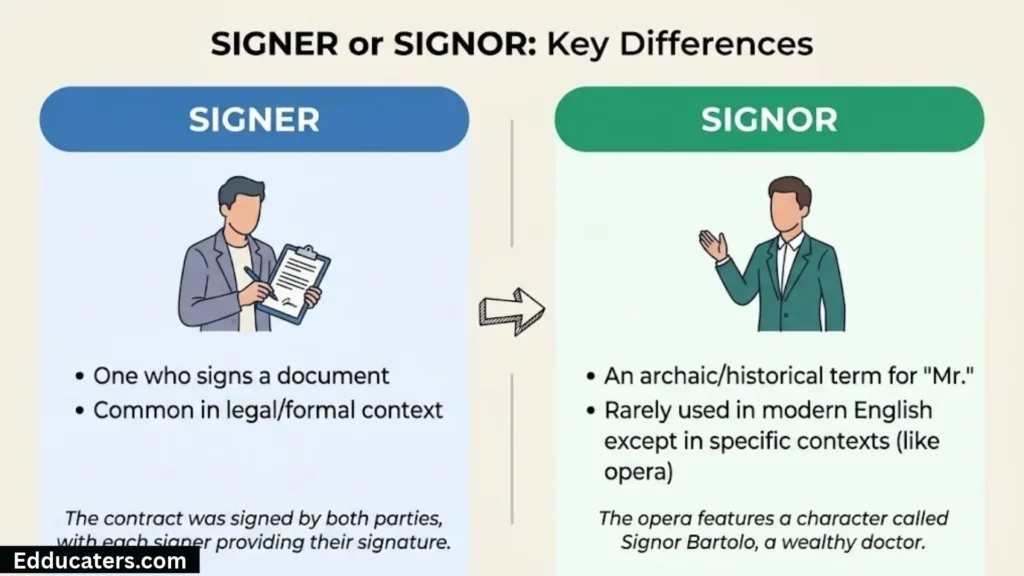
Although signer or signor differ by only one letter, their meanings are entirely separate. Understanding their differences requires looking at their definitions, grammatical roles, pronunciation, and contexts.
The following distinctions make the correct choice easier.
Meaning and Definition
A signer is someone who signs a document or other written material. The word describes a person’s involvement in a signing process.
A signor is an Italian title equivalent to Mr. It identifies or addresses a man respectfully.
For example:
- The signer completed the employment agreement.
- Signor Rossi attended the business meeting.
The first sentence describes an action involving a document. The second identifies a person using an Italian title.
Language and Origin
Signer belongs to English vocabulary and comes from the verb sign.
Signor comes from Italian signore. English adopted the Italian expression while retaining its original spelling and cultural association.
This difference explains why the words don’t share the same meaning despite their similar appearance.
Grammatical Function
Both words function as nouns, but they serve different purposes.
A signer identifies a person performing the action of signing. Signor functions as a title or respectful designation before a man’s name.
For example:
- The signer checked the final document.
- Signor Bianchi arrived early.
Context and Usage
The context provides the clearest indication of which word belongs in a sentence.
Use signer when discussing:
- Contracts and agreements.
- Official paperwork.
- Financial documents.
- Written approvals.
- Signatures and signing authority.
Use signor when discussing:
- Italian names and titles.
- Formal Italian address.
- Italian literature.
- Cultural references.
- Respectful introductions.
The easiest way to remember the difference is to associate signer with signatures and signor with Italian respect.
Signer or Signor: Pronunciation Differences
Pronunciation offers another useful clue when distinguishing these words.
Although their written forms look similar, English speakers pronounce them differently.
How to Pronounce Signer
The word signer is pronounced SY-ner.
Its standard American English pronunciation is:
- IPA: /ˈsaɪnər/
- Syllables: sign-er
- Stress: First syllable.
The first syllable rhymes with fine, while the second contains a relaxed vowel sound.
The pronunciation follows the English verb sign. The letter combination doesn’t create an unusual sound.
How to Pronounce Signor
The word signor has an Italian pronunciation commonly represented as see-NYOR.
Its Italian pronunciation is approximately:
- IPA: /siɲˈɲor/
- Syllables: si-gnor
- Stress: Final syllable.
The Italian consonant combination gn represents a palatal nasal sound, similar to the sound in the middle of the Spanish word señor.
English dictionaries also record English pronunciations of signor. These can differ from the original Italian pronunciation.
For that reason, pronunciation may depend on whether you’re speaking Italian or using the borrowed English word.
Pronunciation Comparison
| Feature | Signer | Signor |
| Pronunciation | SY-ner | See-NYOR |
| First sound | Long I sound | Long E sound |
| Syllable stress | First syllable | Final syllable in Italian |
| Language context | English | Italian |
| Main distinction | Signature-related word | Respectful title |
Don’t assume that similar spelling means similar pronunciation. These words follow different linguistic patterns.
Signer or Signor: Origins and Etymology
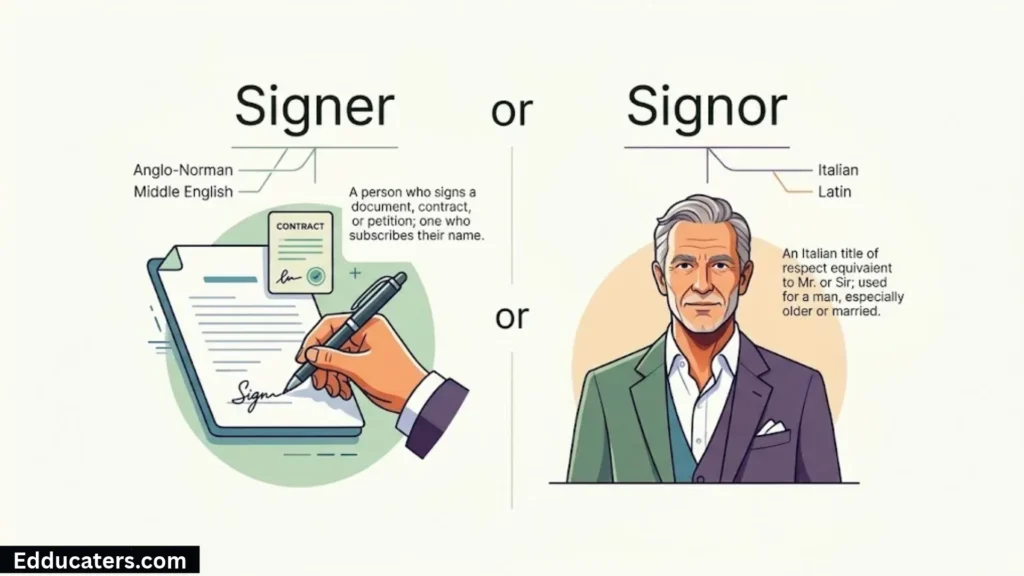
The histories of signer and signor reveal why their meanings differ so much.
Although both words have historical connections to older languages, they developed through separate linguistic paths.
Origin and History of Signer
The word signer developed from the English verb sign.
The verb sign ultimately traces back to Latin signum, meaning a mark, sign, or identifying symbol. Latin signare means to mark or designate.
These historical connections relate to the modern idea of making a mark or signature to identify something or confirm an action.
Over time, English developed signer by adding the agent suffix -er to the verb sign.
This suffix commonly identifies someone who performs an action.
Consider a few familiar examples:
- Write → Writer
- Teach → Teacher
- Drive → Driver
- Sign → Signer
The same word-building pattern explains the meaning of signer. It identifies the person who performs the action of signing.
Origin and History of Signor
The word signor comes from Italian signore, which developed from Latin senior.
The Latin word senior originally referred to an older person or someone of higher standing. It later developed into a title of respect.
Italian adopted this historical form and developed signore, which acquired several meanings, including gentleman, lord, and respectful title.
The shortened form signor became a conventional title used before men’s names.
English borrowed the Italian word during the sixteenth century. Historical records trace its use in English to the late 1500s.
Interestingly, signor and English senior have a distant historical connection through Latin. However, their modern meanings are different.
Why Their Origins Matter
Their etymologies explain why you shouldn’t treat these words as spelling alternatives.
- Signer developed from an English verb associated with marking or signing.
- Signor developed from an Italian title associated with respect and status.
- Signare relates to marking or designating.
- Latin senior contributed to the development of Italian signore.
Their histories lead to two entirely different meanings.
When to Use Signer or Signor
Choosing between these words becomes easy when you consider what you’re trying to communicate.
Ask yourself one simple question: Are you referring to someone who signs a document or addressing an Italian man?
Your answer determines the correct spelling.
When to Use Signer
Choose signer whenever you mean a person who signs something.
This word works in everyday English, business communication, legal writing, and professional documents.
Use it in situations such as:
- Identifying someone who signs a contract.
- Describing people participating in a written agreement.
- Referring to an individual signing an official form.
- Discussing authorized people who sign business documents.
- Identifying someone who signs a financial document.
Examples:
Correct: Every signer must read the contract carefully.
Correct: The final signer approved the agreement.
Correct: Each signer received a copy of the completed paperwork.
In all these examples, signer identifies someone involved in signing a document.
When to Use Signor
Choose signor when referring to an Italian man using a respectful title.
It’s especially appropriate when writing about Italian people, translating Italian expressions, or preserving an Italian cultural setting.
Use it when:
- Addressing an Italian man formally.
- Referring to someone by an Italian title.
- Writing dialogue involving Italian characters.
- Discussing Italian literature or history.
- Reproducing an Italian form of address.
Examples:
Correct: Signor Rossi owns a small restaurant in Rome.
Correct: We thanked Signor Bianchi for his hospitality.
Correct: The story follows the adventures of Signor Bellini.
In these sentences, signor introduces a man’s name rather than identifying someone who signs a document.
Signer or Signor in Example Sentences
Seeing both words in context makes their meanings easier to remember.
The following examples demonstrate how each spelling works in ordinary writing.
Examples of Signer in a Sentence
- Every signer must review the agreement before signing it.
- The authorized signer approved the company’s financial transaction.
- Each signer received a copy of the partnership agreement.
- The bank asked the signer to verify their identity.
- Both signers accepted the conditions of the lease.
- The final signer completed the paperwork yesterday.
- Every signer must provide a valid signature.
- The company identified its authorized signer before preparing the contract.
- The signer added the date beside the signature.
- Each signer confirmed their agreement with the written terms.
Notice how every sentence connects signer with a signature, document, or agreement.
Examples of Signor in a Sentence
- Signor Rossi welcomed the visitors to his home.
- We addressed the Italian gentleman as Signor Bianchi.
- Signor Marco introduced himself at the reception.
- The letter began with a respectful greeting to Signor Antonio.
- Signor Bellini discussed the history of his hometown.
- The novel features a wealthy merchant named Signor Lorenzo.
- Everyone greeted Signor Rossi when he entered the room.
- The traveler asked Signor Bianchi for directions.
- Signor Giuseppe invited his guests to dinner.
- The historical account describes Signor Conti as a respected landowner.
Here, signor introduces or identifies an Italian man.
Comparing Incorrect and Correct Usage
A few contrasting examples make the difference especially clear.
| Incorrect sentence | Correct sentence | Explanation |
| The signor signed the contract. | The signer signed the contract. | A person who signs is a signer. |
| Signer Rossi greeted the guests. | Signor Rossi greeted the guests. | Signor is the Italian title. |
| Every signor must approve the agreement. | Every signer must approve the agreement. | The sentence refers to people signing. |
| We welcomed Signer Bianchi. | We welcomed Signor Bianchi. | The sentence uses an Italian title. |
One important point: a sentence can contain both words correctly when it discusses an Italian gentleman who signs a document.
For example:
Signor Rossi was the final signer of the agreement.
Here, Signor is his Italian title, while signer describes his role in the agreement.
Common Mistakes When Using Signer or Signor
Even experienced writers sometimes confuse these words because they look nearly identical. However, a small spelling difference creates a completely different meaning.
Understanding the most common mistakes can help you choose the right word.
Using Signor Instead of Signer
This mistake happens when someone writes signor while referring to a person who signs a document.
For example:
Incorrect: The signor must complete the agreement before Friday.
Correct: The signer must complete the agreement before Friday.
The corrected sentence identifies the person responsible for signing the agreement.
Using Signer Instead of Signor
Another common mistake occurs when writers use signer as an Italian title.
For example:
Incorrect: Signer Rossi welcomed everyone to his home.
Correct: Signor Rossi welcomed everyone to his home.
The second sentence uses the appropriate Italian title.
Assuming Both Words Have the Same Meaning
Similar spelling doesn’t necessarily indicate similar meaning.
Signer and signor belong to different linguistic contexts. One relates to written signatures, while the other represents a traditional Italian form of address.
Confusing Signor With Senior
Some writers assume that signor and senior are alternative spellings.
Although they have a historical linguistic connection, their modern meanings differ.
Senior generally describes someone older, more experienced, or higher-ranking. Signor is an Italian title of respect.
Ignoring Context
Context determines the correct spelling more reliably than appearance alone.
Before choosing either word, consider whether you’re describing a signing action or referring to an Italian title.
This simple habit can prevent mistakes in professional correspondence, academic writing, and everyday communication.
Signer vs Signatory: What’s the Difference?
Signer and signatory have closely related meanings. Both can describe someone who signs a document or agreement.
However, they differ slightly in usage and formality.
A signer is a person who signs something. It’s a straightforward term used in everyday English and professional communication.
A signatory is a person or party that formally signs an agreement, treaty, or other official document.
The term often appears in legal, diplomatic, and institutional contexts.
For example:
- The signer completed the employment contract.
- Each signatory agreed to the terms of the international treaty.
Both sentences describe people or parties that sign documents. However, signatory often emphasizes formal participation in an agreement.
Key Differences Between Signer and Signatory
| Feature | Signer | Signatory |
| Meaning | Someone who signs | A person or party that formally signs |
| Part of speech | Noun | Noun |
| Common usage | Everyday and professional writing | Formal, legal, and diplomatic writing |
| Context | Contracts, forms, and documents | Treaties, agreements, and official documents |
| Example | The signer approved the form. | The country became a signatory to the treaty. |
One additional distinction matters in international law.
A country can become a signatory to an international treaty. In this situation, signatory refers to the country or state that formally signs the agreement.
Remember: A signer and a signatory can describe the same person, but the appropriate term depends on the context and level of formality.
Signor vs Senior: Are They Related?
Signor and senior look somewhat similar, and their histories share an interesting connection.
However, their modern meanings are different.
Signor is an Italian title of respect for a man. Senior is an English word that describes someone older, more experienced, or higher in rank.
For example:
- Signor Rossi owns a business in Italy.
- My senior colleague has worked here for twenty years.
The first sentence uses an Italian title. The second describes a person’s experience and position.
Why Are Signor and Senior Historically Related?
The connection comes from Latin senior, which referred to an older person.
Italian developed signore from this Latin word. Over time, the Italian expression acquired meanings associated with a gentleman, lord, or respected man.
English borrowed signor from Italian during the sixteenth century.
Therefore, the words share a distant historical relationship even though their present-day meanings differ.
Signor and Senior in Example Sentences
Signor:
- Signor Bianchi owns a beautiful home in Florence.
- We welcomed Signor Rossi at the reception.
- Signor Antonio spoke about Italian history.
Senior:
- My senior manager approved the proposal.
- She is a senior member of the research team.
- The senior students graduated last week.
The distinction is clear: use signor as an Italian title and senior when discussing age, experience, or rank.
Frequently Asked Questions About Signer or Signor
Is Signor an English Word?
Yes. Signor is an Italian word that English has borrowed and recognizes as a title of respect for a man.
It appears in English dictionaries and literature, particularly when writers discuss Italian people, names, and cultural settings.
Although it comes from Italian, English speakers can use it when the context calls for an Italian title.
Can Signor Ever Mean Someone Who Signs?
No. Signor doesn’t mean someone who signs a document.
The correct English word for a person who signs an agreement, contract, or form is signer.
For example, write, “The signer approved the contract,” rather than “The signor approved the contract,” when referring to someone performing the signing action.
Is Signer a Noun or a Verb?
Signer is a noun. It identifies a person who signs something.
Its related verb is sign, which describes the action of writing or placing a signature.
For example, in “The signer signed the agreement,” signer identifies the person, while signed describes the action.
Is Signor the Same as Senior?
No. Signor and senior have different modern meanings.
Signor is an Italian title equivalent to Mr. Meanwhile, senior describes someone older, more experienced, or higher-ranking.
However, they have a historical connection because Italian signore developed from Latin senior.
Can I Use Signor in Formal English Writing?
Yes, you can use signor in formal English writing when referring to an Italian man using his traditional title.
For example, “Signor Rossi will attend the ceremony” is appropriate when preserving the Italian form of address.
However, Mr. is generally more natural in ordinary English correspondence unless you specifically want the Italian title.
Which Word Should I Use in Contracts?
Use signer when referring to someone who signs a contract.
For example:
“Each signer must provide a valid signature before the agreement becomes effective.”
The word signor is inappropriate in this context because it represents an Italian title rather than a person performing a signing action.
What Is the Difference Between Signer or Signatory?
Both words can refer to someone who signs a document.
However, signer is a general term, while signatory often appears in formal agreements, treaties, and legal or diplomatic contexts.
For example, a person who signs an employment contract is a signer. A country that formally signs an international treaty can be described as a signatory.
What Is the Italian Equivalent of Mr.?
Signor and signore are Italian forms associated with the English title Mr.
Signor commonly appears before a man’s name, as in Signor Rossi. Signore can also mean gentleman or sir and functions as a respectful form of address.
The correct form depends on the grammatical structure and context.
How Do You Pronounce Signer and Signor?
In American English, signer is pronounced SY-ner, with IPA /ˈsaɪnər/.
Italian signor is approximately pronounced see-NYOR, with IPA /siɲˈɲor/.
The two words have different vowel sounds, syllable patterns, and stress.
Is Signer a Legal Term?
Signer is commonly used in legal and professional documents to identify someone who signs an agreement or other written instrument.
However, it’s a general English noun rather than a term that automatically establishes a person’s legal authority or responsibilities.
Words such as signatory and authorized signer may provide more specific descriptions depending on the document.
Where Is Signor Commonly Used?
Signor is associated with Italian language and culture. It appears in Italy and Italian-language settings, as well as English writing that refers to Italian people.
You’ll commonly encounter it in Italian names, literature, historical accounts, and formal introductions.
Conclusion: Signer or Signor?
Although signer or signor may look like a simple spelling choice, these words have completely different meanings.
Signer refers to someone who signs a document, contract, agreement, or other written material. It belongs to everyday English vocabulary and frequently appears in legal, business, and professional contexts.
Signor, meanwhile, is an Italian title of respect equivalent to Mr. It commonly appears before a man’s name, as in Signor Rossi or Signor Bianchi.
Their pronunciation and linguistic origins also differ. Signer comes from the English verb sign, while signor comes from Italian signore, which traces back to Latin senior.
Here’s the easiest way to remember the distinction:
- Signer = Someone who signs a document.
- Signor = An Italian title equivalent to Mr.
Keep this simple difference in mind whenever you write about contracts, signatures, Italian names, or formal titles. You’ll choose the correct word without second-guessing yourself.

Hi, I’m Nathan Whitmore, and I enjoy making English grammar easy for learners of all ages. I believe grammar should be practical, not confusing. I write simple, well-researched guides that help readers improve their writing, speaking, and overall communication skills.
I spend a lot of time studying grammar patterns, sentence construction, punctuation, and modern English usage. My goal is to create lessons that anyone can understand, whether they are students, teachers, or professionals.
Books
Clear English Grammar
The Smart Writer’s Grammar Handbook
 Julian Mercer