Have you ever stopped while writing a sentence because you couldn’t decide between wich or which? You’re not alone. English contains many words that sound similar but have different spellings, meanings, and grammatical functions. This particular spelling mistake often happens when people type quickly or forget a letter.
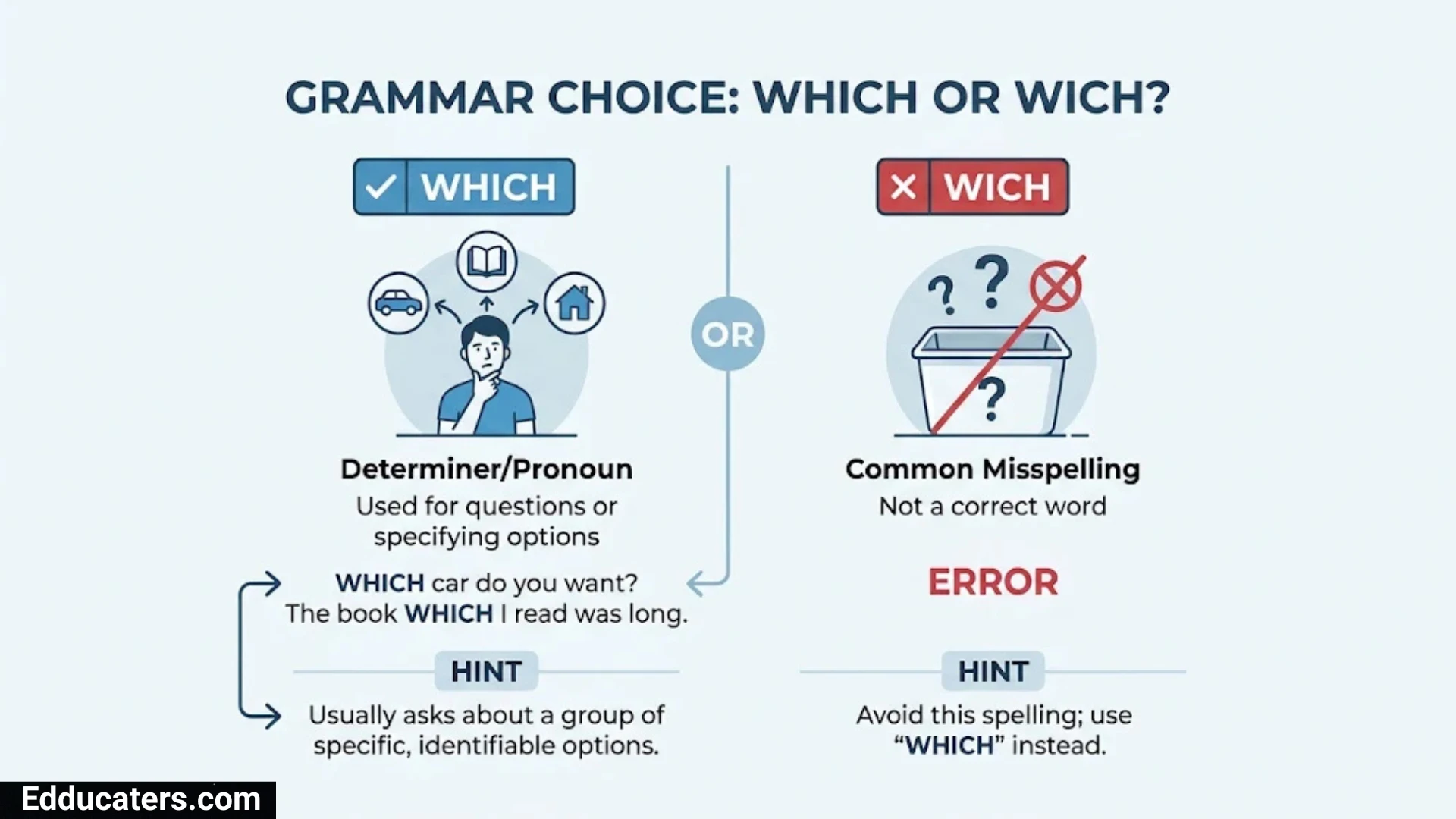
The correct spelling is which, not wich, when you want to ask about a choice or identify something. The letter h makes the difference between the standard English word and a common spelling error.
However, there’s a small detail worth knowing. Although wich isn’t a standard replacement for which, it does appear in certain historical place names, such as Norwich and Sandwich. These proper names follow a different naming history.
Understanding this distinction can help you avoid spelling mistakes in emails, school assignments, professional documents, and everyday messages. Let’s explore the correct spelling, meaning, pronunciation, grammatical rules, and practical examples.
Wich or Which: Quick Answer
Which is the correct spelling in standard English when you’re asking someone to identify or choose something. Wich is an incorrect spelling when used as a substitute for this word.
The difference is one letter: which contains an h after the letter w, while wich doesn’t.
Here’s a quick comparison:
| Word | Correct or Incorrect? | Meaning |
| Which | Correct | Used to ask questions or introduce relative clauses. |
| Wich | Incorrect in ordinary usage | Common misspelling of which. |
| Witch | Correct | A person traditionally associated with magic. |
Consider these examples:
- Correct: Which book would you like to read?
- Incorrect: Wich book would you like to read?
- Correct: Which restaurant serves Italian food?
- Incorrect: Wich restaurant serves Italian food?
The correct form always includes the letter h when you’re using the ordinary English word.
Remember this simple rule: If you’re asking someone to choose between options, write which.
What Does Which Mean?
The word which is a standard English interrogative word and relative pronoun. It helps you identify a particular person, animal, thing, or option.
You commonly use it when someone must select something from a known or limited group. It can also introduce additional information about a noun or an entire statement.
For example:
- Which color do you prefer?
- Which movie should we watch?
- Which answer is correct?
- I bought a laptop, which came with a two-year warranty.
In the first three examples, which helps someone identify a particular choice. In the final example, it introduces additional information about the laptop.
The word has several grammatical functions. Understanding them makes it easier to use which correctly in different sentence structures.
Which as a Question Word
You use which to ask about a particular person or thing from a limited selection.
Unlike what, which often allows a broad range of possible answers, which usually suggests that the available choices are restricted or identifiable.
For example:
- Which dress should I wear?
- Which bus goes to the airport?
- Which restaurant did you visit?
- Which answer did your teacher select?
- Which route is shorter?
Each question asks someone to identify a particular option.
You can also use which when the available choices aren’t explicitly mentioned but are understood from the conversation.
For instance:
“Would you like tea or coffee?”
“Which do you prefer?”
The second speaker already knows the available options. Therefore, which fits naturally.
Which as a Relative Pronoun
A relative pronoun introduces a relative clause that provides information about a noun or something mentioned earlier.
You commonly use which to refer to animals and things. It can introduce both restrictive and nonrestrictive relative clauses.
Consider these examples:
- The phone which I bought yesterday has an excellent camera.
- My car, which is almost ten years old, still runs smoothly.
- She showed me a painting which her grandfather created.
- He missed the train, which made him late for work.
Notice how which connects different parts of each sentence.
It helps readers understand what the speaker means without repeating the same noun unnecessarily.
Which as an Interrogative Determiner or Pronoun
The grammatical role of which changes depending on how you use it.
It can function as an interrogative determiner when it comes before a noun. It functions as an interrogative pronoun when it replaces a noun.
Interrogative determiner:
- Which book belongs to you?
- Which jacket looks better?
- Which restaurant should we visit?
In these examples, which modifies the nouns book, jacket, and restaurant.
Interrogative pronoun:
- Which belongs to you?
- Which should we choose?
- Which is your favorite?
Here, which stands independently instead of modifying a noun.
Both uses are grammatically correct. The difference lies in the word’s function within the sentence.
What Does Wich Mean?
The spelling wich doesn’t function as a standard replacement for which in ordinary modern English sentences.
If you write “Wich book should I buy?” you’re making a spelling mistake. The correct sentence is “Which book should I buy?”
However, saying that wich never appears anywhere in English would be inaccurate.
The spelling occurs in certain proper nouns, particularly historical English place names. These names developed through older naming traditions and aren’t ordinary examples of the word which.
Consider these examples:
- Norwich: A historic city in Norfolk, England.
- Sandwich: A town in Kent, England.
- Ipswich: A town in Suffolk, England.
- Greenwich: A district in southeast London.
- Middlewich: A historic town in Cheshire, England.
The letters wich in these geographical names have historical origins. They don’t represent misspellings of the modern question word.
Historically, the element wich could refer to a settlement, trading center, or salt-producing place, depending on the location and its linguistic history.
This distinction matters because spelling depends on context. A geographical name can legitimately contain wich even though the spelling is incorrect when someone intends to write which.
The practical rule: Use which in ordinary sentences when asking questions or introducing relative clauses. Preserve wich when it forms part of an established proper name.
Wich or Which: Examples in Sentences
Examples make the spelling difference easier to recognize. Once you understand how which works in everyday sentences, you’ll be less likely to leave out its silent-looking letter.
Here are several examples involving common situations.
Correct Examples With Which
The following sentences demonstrate the correct spelling and natural usage of which.
| Sentence | How Which Is Used |
| Which book do you want to read? | Asking someone to select a book. |
| Which color looks better? | Asking about a color choice. |
| Which movie should we watch tonight? | Choosing between movies. |
| Which restaurant serves Italian food? | Identifying a restaurant. |
| Which document should I submit? | Identifying a particular document. |
| Which method works best? | Asking about a preferred method. |
| Which route should we take? | Choosing a travel route. |
| Which jacket belongs to you? | Identifying ownership. |
| Which bus goes downtown? | Identifying a particular bus. |
| Which file contains the report? | Identifying a specific file. |
You can also use which in statements rather than direct questions.
For example:
- I don’t remember which restaurant we visited last weekend.
- She couldn’t decide which dress to wear.
- Tell me which method you prefer.
- He explained which road leads to the airport.
- We selected the computer which offered better performance.
All these examples use the standard spelling correctly.
Incorrect Examples With Wich
The following sentences contain a common spelling error.
| Incorrect Sentence | Correct Sentence |
| Wich book do you want? | Which book do you want? |
| Wich color looks better? | Which color looks better? |
| Wich movie should we watch? | Which movie should we watch? |
| Wich restaurant serves Italian food? | Which restaurant serves Italian food? |
| Wich document should I submit? | Which document should I submit? |
| Wich method works best? | Which method works best? |
| Wich route should we take? | Which route should we take? |
The grammatical structure of these sentences isn’t the problem. The spelling is.
Simply adding the missing h corrects each example.
Common Phrases With Which
Some expressions appear frequently in everyday English. Learning their correct spelling can help you avoid mistakes when writing messages, emails, and questions.
Common examples include:
- Which one?
- Which book?
- Which way?
- Which option?
- Which answer?
- Which color?
- Which movie?
- Which dress?
- Which shirt?
- Which restaurant?
- Which document?
- Which method?
- Which route?
- Which jacket?
- Which bus?
- Which road?
- Which file?
Remember that wich one, wich book, and wich way are incorrect spellings when you intend to use the ordinary question word.
Which or Witch: What’s the Difference?
Which and witch are two correctly spelled English words. However, they have completely different meanings.
People sometimes confuse these words because they sound identical in many English accents. This makes them common examples of homophones.
Homophones are words that share the same pronunciation but have different meanings or spellings.
Here’s how they differ:
| Word | Meaning | Example |
| Which | Used to identify something or ask about a choice. | Which book should I buy? |
| Witch | A person traditionally associated with magic. | The witch appeared in the old story. |
What Does Which Mean?
As explained earlier, which helps identify something or introduce additional information.
Examples:
- Which road leads to the village?
- Which dress belongs to Sarah?
- I bought a camera, which takes excellent pictures.
It has grammatical functions in questions and relative clauses.
What Does Witch Mean?
A witch traditionally refers to a person believed to practice magic or possess supernatural powers.
The word frequently appears in folklore, fairy tales, fantasy literature, and Halloween traditions.
Examples:
- The witch lived in a small cottage.
- The children dressed as witches for Halloween.
- The story describes a powerful witch who could cast spells.
Unlike which, the word witch refers to a person or a fictional character associated with magic.
Which Witch Is Which?
The expression “which witch is which” is a playful phrase that combines two homophones.
It uses which to ask for identification and witch to refer to a person associated with magic.
For example:
“Which witch is which in this Halloween photograph?”
The speaker wants to identify the different witches in the picture.
This phrase also demonstrates why spelling matters. Although the two words sound alike, their meanings depend on their written forms and sentence contexts.
How to Use Which Correctly in a Sentence
Knowing the spelling is only the beginning. You should also understand how to place which correctly within different sentence structures.
It can introduce direct questions, indirect questions, and relative clauses. Each construction follows its own grammatical pattern.
Using Which in Direct Questions
A direct question asks someone for specific information.
You can use which when the available answers belong to a limited or identifiable group.
Examples:
- Which phone should I purchase?
- Which team won the match?
- Which color do you like?
- Which road takes us to the station?
- Which answer should I select?
The word generally appears at the beginning of the question.
However, its position can change when the sentence contains a preposition or additional grammatical elements.
For example:
- In which room did you leave your bag?
- To which school does your brother go?
These constructions are grammatically correct and often sound more formal than their alternatives.
Using Which in Indirect Questions
An indirect question appears inside a larger statement or question.
Unlike direct questions, indirect questions don’t necessarily end with a question mark.
Examples:
- I don’t know which bus goes to the airport.
- She asked which restaurant we preferred.
- Can you tell me which file contains the information?
- He couldn’t decide which option offered better value.
- We need to find out which road is closed.
Notice that indirect questions usually follow normal statement word order.
Compare:
Direct question: Which restaurant serves breakfast?
Indirect question: I wonder which restaurant serves breakfast.
You don’t need to rearrange the words into direct-question order after expressions such as I wonder, I know, or Can you tell me.
This distinction helps you avoid common sentence-construction mistakes.
Using Which in Relative Clauses
A relative clause provides information about a noun or another part of a sentence.
You can use which to introduce a clause referring to animals, things, or an entire preceding statement.
Examples:
- The laptop which I purchased yesterday works perfectly.
- She opened the package, which contained several books.
- The museum, which opened in 1920, attracts many visitors.
- He forgot his keys, which caused a serious problem.
In these sentences, which connects related information and makes the writing flow naturally.
It can function as the subject or object of the relative clause.
As a subject:
The computer which belongs to my brother is expensive.
Here, which performs the action or serves as the subject of the verb belongs.
As an object:
The computer which I purchased is expensive.
Here, which refers to the computer and functions as the object of purchased.
Using Commas With Which
Punctuation can change how readers understand a relative clause.
One important distinction involves restrictive and nonrestrictive relative clauses.
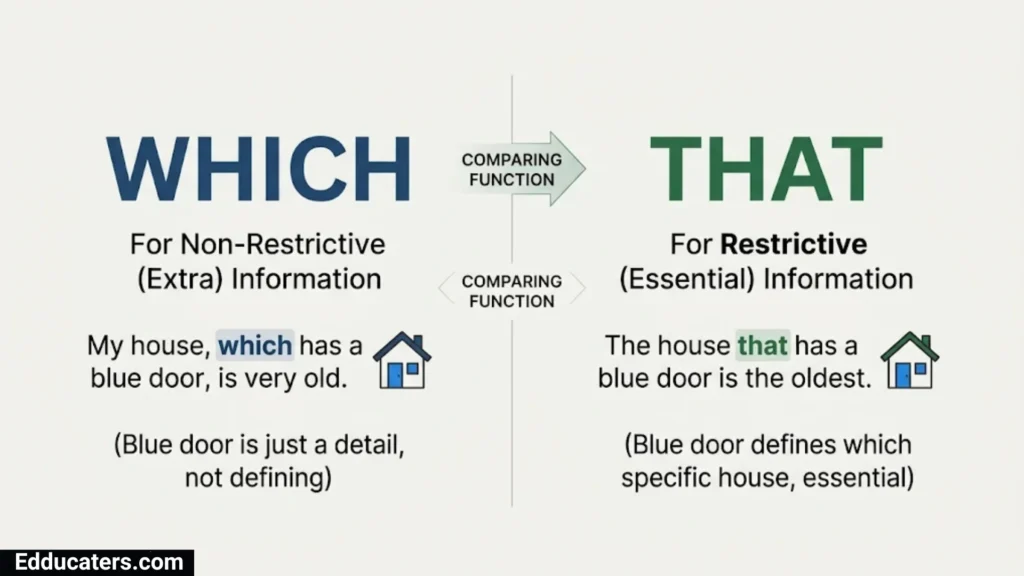
A restrictive clause identifies the particular noun you’re discussing. Without it, readers might not understand which person or thing you mean.
Example:
The car that I bought yesterday is red.
The relative clause identifies the specific car.
A nonrestrictive clause adds extra information that readers don’t need to identify the noun.
Example:
My car, which I bought yesterday, is red.
The commas show that the additional information isn’t essential to identifying the car.
In standard American English editing, writers commonly follow this convention:
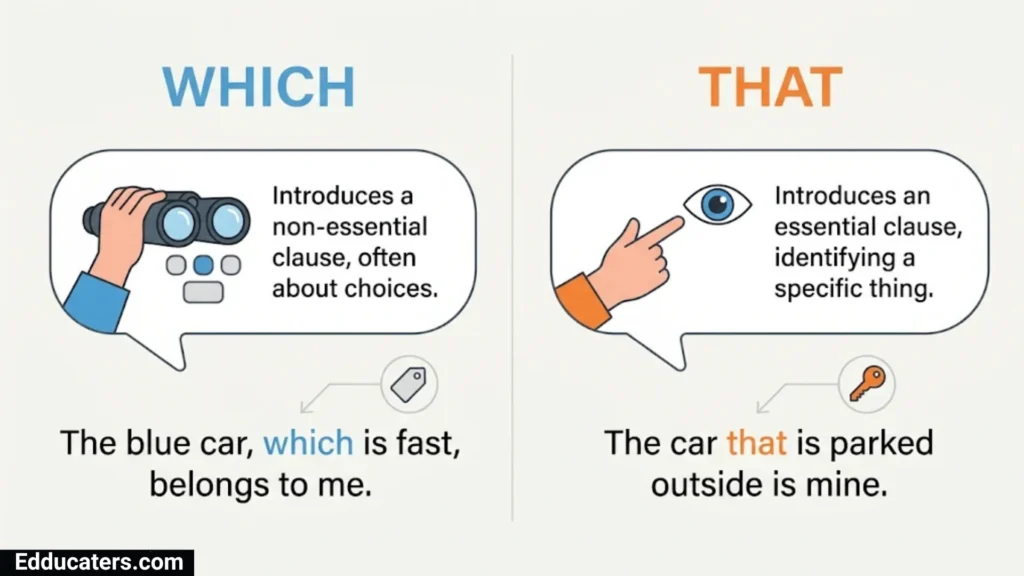
- Use that for restrictive clauses.
- Use which for nonrestrictive clauses.
- Place commas around nonrestrictive clauses.
However, this isn’t an absolute rule for every variety of English. British English also commonly uses which in restrictive clauses.
The important point is to maintain clear meaning and consistent punctuation.
Which or That: What’s the Difference?
Which and that can both introduce relative clauses. However, they don’t always perform the same grammatical job.
Understanding their differences helps you choose the correct word in formal writing, academic assignments, and everyday communication.
In American English, many traditional grammar and editorial guides recommend using that for restrictive clauses and which for nonrestrictive clauses.
When to Use That
Use that when the relative clause provides essential information about the noun.
Example:
The book that I borrowed belongs to Sarah.
The phrase that I borrowed identifies which book belongs to Sarah.
Without this information, the sentence loses an important detail.
More examples:
- The shirt that I purchased is blue.
- The restaurant that we visited serves excellent food.
- The road that leads to the airport is closed.
- The computer that I use needs an update.
Each relative clause helps identify the specific noun.
When to Use Which
Use which to introduce a nonrestrictive clause that adds extra information.
Example:
My laptop, which I bought last year, still works perfectly.
The phrase which I bought last year adds information about the laptop. It doesn’t identify which laptop the speaker means.
More examples:
- My car, which is ten years old, still runs smoothly.
- The library, which opened recently, has modern facilities.
- Her new phone, which has a large screen, looks impressive.
- The meeting, which lasted two hours, covered several important topics.
Comparison Between Which and That
| Feature | Which | That |
| Main function | Introduces relative clauses and questions. | Introduces relative clauses and other grammatical constructions. |
| Restrictive clauses | Used in many varieties of English. | Commonly used in American English. |
| Nonrestrictive clauses | Used with commas. | Not used in standard nonrestrictive relative clauses. |
| Refers to things | Yes. | Yes. |
| Direct questions | Yes. | No, not in the same interrogative function. |
One useful distinction is that which can refer to an entire preceding clause.
For example:
She missed the appointment, which disappointed her manager.
Here, which refers to the situation described in the preceding clause.
You wouldn’t normally replace it with that in this construction.
Why Do People Misspell Which as Wich?
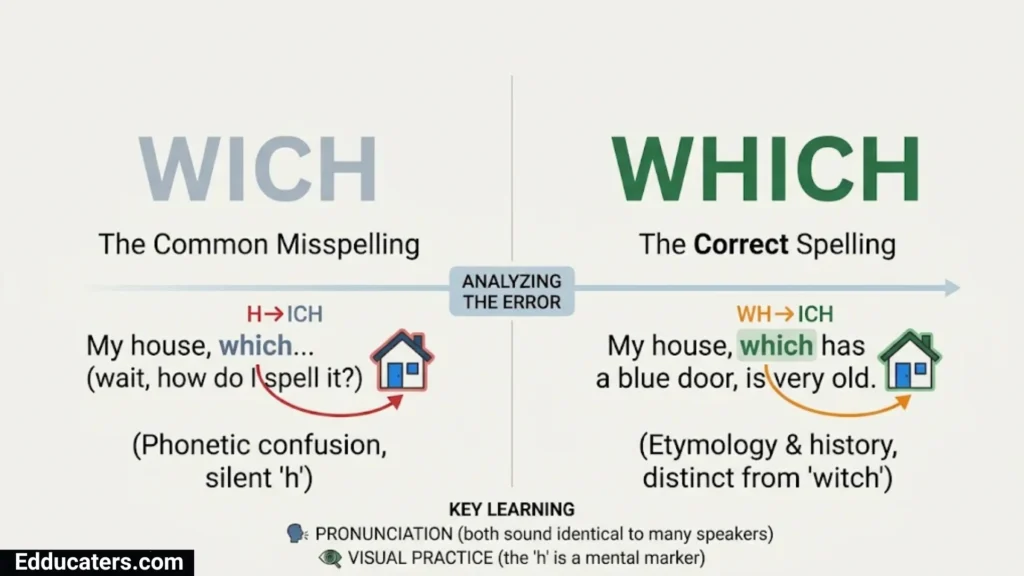
The spelling mistake wich instead of which usually happens because writers overlook one letter.
Although the error seems small, it can affect the clarity and professionalism of written communication.
Several everyday habits contribute to this mistake.
Typing Too Quickly
When people type quickly, they sometimes leave out letters without noticing.
This happens especially when writing familiar words that appear frequently in everyday communication.
For example, someone might type:
“Wich option do you prefer?”
The writer knows the intended word but accidentally skips the letter h.
Slowing down slightly and proofreading can prevent this mistake.
Forgetting the Letter H
Some writers remember the sound of a word but don’t recall its exact spelling.
Because the h doesn’t represent a separate spoken sound in the usual pronunciation, people may overlook it.
However, the correct written form always includes this letter.
Relying on Pronunciation
English spelling doesn’t always follow pronunciation perfectly.
The words which and witch sound alike in many accents. Their spelling also requires memorization rather than relying entirely on sound.
The same issue can occur with other commonly confused English words.
Autocorrect and Typing Habits
Typing habits can reinforce spelling mistakes when people repeatedly use incorrect forms.
Autocorrect may correct some errors, but you shouldn’t depend on it completely.
A spelling checker might miss an error when the incorrect form resembles a valid name or another recognized expression.
Confusion With Witch
The words which and witch share the same pronunciation in many accents.
Although this doesn’t directly explain the missing letter in wich, it can contribute to uncertainty about their spelling.
Remember their meanings:
- Which: Used to ask about a choice.
- Witch: A person associated with magic.
Once you connect each spelling with its meaning, choosing the correct word becomes easier.
How to Remember the Correct Spelling of Which
A simple memory technique can help you avoid writing wich when you mean which.
You don’t need complicated spelling exercises. A few practical habits can make the correct spelling easier to remember.
Remember the WH Pattern
The word which belongs to the familiar group of English question words beginning with wh.
Consider these examples:
- What
- When
- Where
- Who
- Why
- Which
Remembering this group can help you recognize the correct spelling.
When you’re writing a question about a choice, think of the WH question words and include the missing h.
Connect the Spelling With Its Meaning
Associate which with choosing or identifying something.
For example:
- Which one?
- Which book?
- Which option?
- Which answer?
- Which way?
Every phrase contains the same spelling.
Repeating these expressions during ordinary writing can strengthen your spelling memory.
Practice Common Sentences
Write a few simple sentences using which.
For example:
- Which color do you prefer?
- Which movie should we watch?
- Which restaurant is closer?
- Which road leads home?
- Which answer is correct?
Practicing complete sentences helps you understand how the word works rather than memorizing isolated letters.
Proofread Your Writing
Before submitting an assignment or sending a professional email, check your spelling.
Pay particular attention to short, frequently used words. Their familiarity can make small mistakes surprisingly easy to overlook.
You can also use a spelling checker to identify missing letters.
However, always review suggested corrections because automated tools don’t understand every sentence perfectly.
Common Mistakes to Avoid When Using Which
Even when you know the correct spelling, you can still make grammatical mistakes.
Here are several problems worth avoiding.
Writing Wich Instead of Which
This is the central spelling mistake.
Incorrect: Wich one belongs to you?
Correct: Which one belongs to you?
Always include the letter h when using the standard question word.
Confusing Which With Witch
These words sound alike but have different meanings.
Incorrect: The wich lives in the forest.
Correct: The witch lives in the forest.
However, if you’re asking someone to identify something, use which.
Example: Which house belongs to the witch?
Using Which Instead of Who
Use who when referring to people in ordinary relative clauses.
Incorrect: The woman which called yesterday is my teacher.
Correct: The woman who called yesterday is my teacher.
Use which primarily for things and animals in standard relative-clause usage.
Forgetting Commas Around Nonrestrictive Clauses
A nonrestrictive relative clause adds extra information and requires appropriate punctuation.
Incorrect: My brother which lives in Texas is visiting.
Correct: My brother, who lives in Texas, is visiting.
For a thing:
Incorrect: My phone which I bought last year still works.
Correct: My phone, which I bought last year, still works.
The commas help readers recognize the additional information.
Confusing Which and What
Both words can introduce questions, but their usual meanings differ.
Use which when the available choices are limited or identifiable.
Example:
Which flavor would you like, chocolate or vanilla?
Use what when the possible answers are more open-ended.
Example:
What flavor do you like?
This distinction isn’t absolute in every conversation, but it provides a useful starting point.
Frequently Asked Questions
Is It Wich or Which?
Which is the correct spelling when asking someone to identify or choose something. Wich is a common misspelling in ordinary English sentences. Always include the letter h when using the standard question word.
Is Wich Ever a Correct English Word?
The spelling wich appears in certain historical place names and proper nouns, including Norwich, Sandwich, and Ipswich. However, it isn’t a standard substitute for which in ordinary modern English writing.
How Do You Spell Which Correctly?
The correct spelling is W-H-I-C-H. Remember the letter h immediately after w. For example, write “Which book do you want?” rather than “Wich book do you want?”
What Does Which Mean in English?
Which is an interrogative determiner or pronoun used to identify something from a limited or known group. It also functions as a relative pronoun that introduces clauses providing information about things or animals.
What Does Wich Mean?
Wich doesn’t have the ordinary grammatical meaning of which in standard modern English. It can appear as part of historical geographical names and certain proper nouns, but you shouldn’t use it as a replacement for which.
Is Which a Question Word?
Yes. Which is a standard English WH-question word. You use it to ask about a particular choice or identify something from a group.
For example: Which restaurant should we visit?
Is Which an Interrogative Pronoun?
Yes. Which functions as an interrogative pronoun when it replaces a noun in a question.
For example: Which should I choose?
It also functions as an interrogative determiner when it modifies a noun, as in “Which book should I buy?”
Are Which and Witch Pronounced the Same?
Yes. In most English accents, which and witch are homophones. Both commonly have the pronunciation /wɪtʃ/. However, their meanings and spellings are different.
Can You Use Which in Formal Writing?
Absolutely. Which is appropriate in academic writing, professional emails, reports, business documents, and everyday communication.
You can use it in questions and relative clauses. Just make sure the sentence structure and punctuation are correct.
Can Which Introduce a Relative Clause?
Yes. Which introduces relative clauses that refer to animals, things, or an entire preceding statement.
Example: The project, which took six months to complete, was successful.
Why Does Which Have an H?
The letter h is part of the established spelling of which. English spelling preserves historical forms and conventions that don’t always match modern pronunciation. Therefore, you must memorize the complete spelling rather than rely only on sound.
Is Which One Grammatically Correct?
Yes. Which one is a grammatically correct expression used to identify a particular person or thing from a group.
Examples:
- Which one do you want?
- Which one is yours?
- Which one should I choose?
What Is the Difference Between Which and That?
In relative clauses, which commonly introduces nonrestrictive clauses in American English, while that commonly introduces restrictive clauses. However, which can also introduce restrictive clauses in other English varieties and certain American writing styles.
How Can I Remember the Spelling of Which?
Remember that which belongs to the WH question-word family alongside what, when, where, who, and why. Practice expressions such as which one, which book, and which option to reinforce the correct spelling.
Conclusion: Wich or Which?
When deciding between wich or which, always choose which when you’re using the standard English question word or relative pronoun.
The difference is simple: which contains the letter h, while wich is generally a spelling mistake in ordinary sentences.
Remember that which helps you identify something, ask about a choice, or introduce additional information through a relative clause. Meanwhile, witch refers to someone traditionally associated with magic.
You may encounter wich in historical place names such as Norwich and Sandwich, but those uses don’t make it an acceptable substitute for which.
Keep the correct spelling in mind whenever you’re writing questions, emails, assignments, or professional documents. A single letter makes all the difference.

Hello, I’m Claire Holloway. I have always been passionate about the English language and enjoy turning complex grammar rules into simple, easy-to-follow lessons. I believe that every learner can become a confident English writer with the right guidance.
I create educational content focused on grammar, vocabulary, sentence structure, and writing improvement. Every article I publish is designed to help readers learn with confidence and accuracy.
Books
Grammar Without Confusion
Modern English Usage Guide
 Julian Mercer