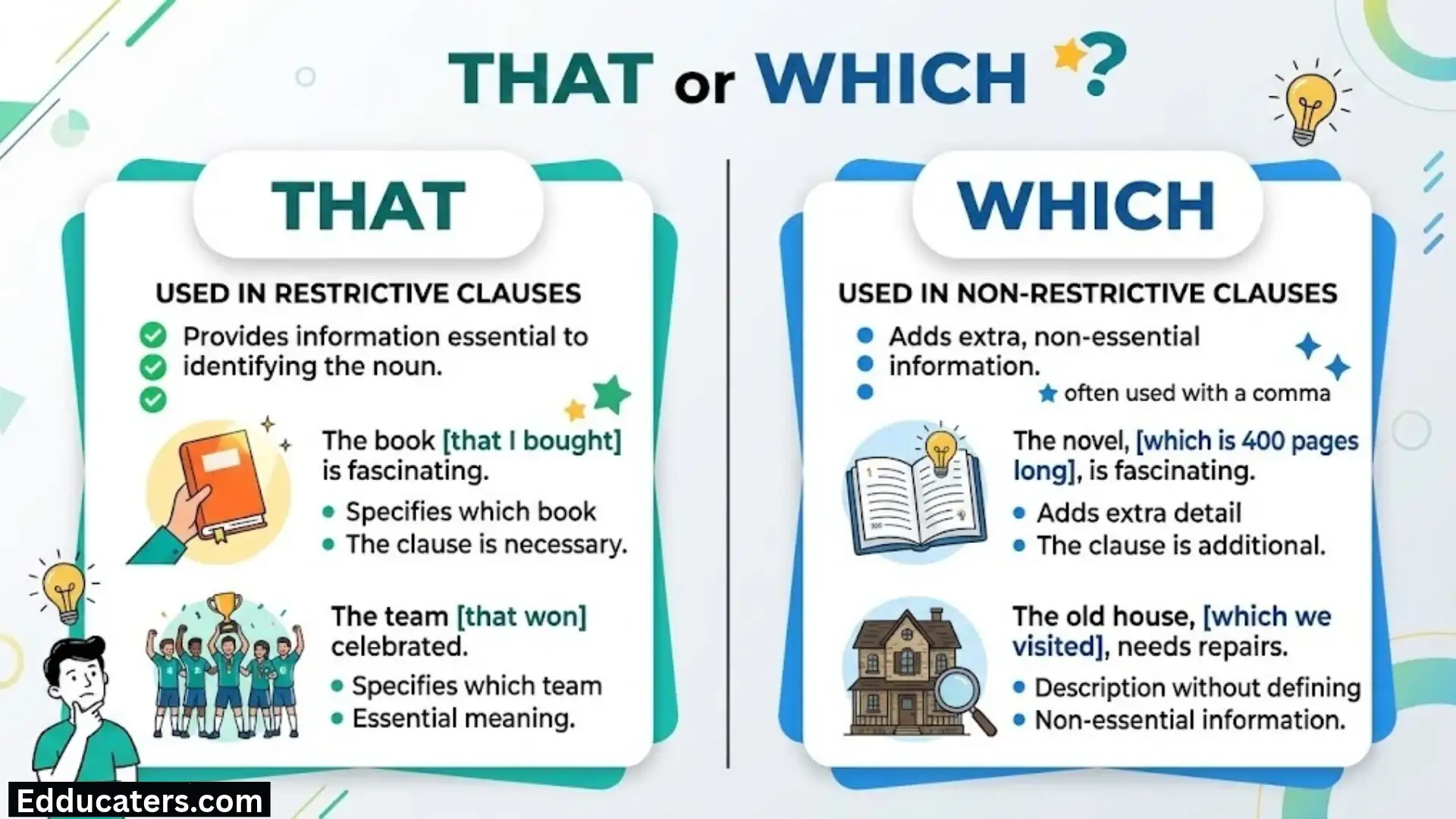
Have you ever paused while writing a sentence because you couldn’t decide whether to use that or which? You’re not alone. These two words often introduce similar phrases, yet the choice can affect punctuation, meaning, and writing style.
The good news is that you don’t need to memorize dozens of complicated grammar rules. Once you understand the difference between restrictive relative clauses and nonrestrictive relative clauses, choosing between that and which becomes much easier.
In traditional American English editorial style, use that for information that identifies the noun you’re discussing. Use which for additional information that you set apart with commas. However, British English and some American writing also use which in restrictive clauses.
Consider these examples:
- That: The laptop that I ordered arrived yesterday.
- Which: My laptop, which I ordered last week, arrived yesterday.
The first sentence identifies the laptop by telling you which one arrived. The second sentence identifies the laptop independently and adds information about when the writer ordered it.
That’s the central difference. The sections below explain the rules, exceptions, punctuation, regional variations, and common mistakes so you can use both words confidently.
What Is the Difference Between That or Which?
The main difference between that or which depends on the type of relative clause each word introduces and the style conventions you’re following.
Both words can act as a relative pronoun. A relative pronoun connects a clause to a noun or pronoun that the clause describes. That noun is called the antecedent.
For example, in the sentence “The book that I borrowed was fascinating,” the word book is the antecedent. The clause that I borrowed tells you which book the writer means.
Here’s a quick comparison.
| Feature | That | Which |
| Main use in traditional American style | Introduces a restrictive clause | Introduces a nonrestrictive clause |
| Restrictive clause | Yes | Also possible in broader English usage |
| Nonrestrictive clause | Generally not used | Standard choice |
| Commas around the clause | Not used for a restrictive clause | Used for a nonrestrictive clause |
| Refers to things | Yes | Yes |
| Refers to people | Possible in restrictive clauses | Generally not used for people |
| Refers to an entire preceding idea | Generally not in this construction | Yes |
The most important point is that the clause’s meaning matters more than the word alone. Punctuation helps readers recognize that meaning.
When to Use That
Use that when a clause identifies or limits the noun it follows. In traditional American editorial style, this is the preferred choice for a restrictive relative clause.
A restrictive clause supplies information that readers need to identify the intended person or thing.
Examples:
- The jacket that has silver buttons belongs to Emma.
- The laptop that I ordered arrived this morning.
- The restaurant that serves breakfast opens at 7 a.m.
- The report that explains the problem is on my desk.
- The keys that are on the kitchen counter belong to my roommate.
Each bolded clause narrows the meaning of the noun.
Suppose you have three jackets in a room. Saying “the jacket” might not tell someone which one you mean. Adding “that has silver buttons” identifies it.
You generally don’t place commas around this type of clause in standard American editorial writing.
Remember: Use that when the clause answers the question “Which one?” and you want to follow the traditional American distinction.
When to Use Which
Use which to introduce a nonrestrictive clause that adds information about a noun you’ve already identified. Put a comma before the clause when it appears at the end of a sentence, or use commas on both sides when it interrupts the sentence.
Examples:
- My laptop, which I ordered last week, arrived yesterday.
- The museum, which opened in 1925, attracts thousands of visitors.
- Our conference, which lasted three days, ended on Friday.
- Her phone, which has a larger screen, is easier to read.
- The recipe, which you recommended, turned out beautifully.
In each example, the main sentence identifies the subject without the additional clause. The relative clause adds context rather than distinguishing that subject from other possible subjects.
For instance, “The museum attracts thousands of visitors” is already a complete statement. The clause about when the museum opened adds a useful historical detail.
However, which can also introduce restrictive clauses in British English and other accepted English usage. The traditional American distinction is a style convention for restrictive clauses, not a universal rule followed by every English speaker.
Can That or Which Be Interchangeable?
Sometimes, but not in every construction.
In a restrictive clause, both words can work grammatically in broader English usage:
- The book that I borrowed was fascinating.
- The book which I borrowed was fascinating.
The second example is accepted in British English and appears in American English too. However, many American editors prefer the first version.
In a nonrestrictive clause, use which rather than that:
- Correct: My book, which I borrowed yesterday, is fascinating.
- Generally incorrect: My book, that I borrowed yesterday, is fascinating.
The comma signals that the clause adds extra information. Under the standard restrictive/nonrestrictive distinction, that doesn’t introduce this type of supplementary clause.
A useful approach is to choose that for restrictive clauses and which for nonrestrictive clauses when writing for an American audience. This convention gives readers a consistent signal about the relationship between clauses.
The That or Which Rule: Restrictive or Nonrestrictive Clauses
To understand that or which grammar, you need to recognize two kinds of relative clauses: restrictive and nonrestrictive.
These clauses modify nouns, but they don’t do the same job. One identifies the noun. The other adds information about a noun that readers can already identify.
What Is a Restrictive Relative Clause?
A restrictive relative clause, also called a defining relative clause, provides identifying information about a noun. Without that information, readers may not know which person or thing the sentence refers to.
Consider this example:
The shoes that were too small went back to the store.
The clause that were too small identifies which shoes went back. The sentence doesn’t necessarily refer to every pair of shoes.
Compare these additional examples:
- The film that we watched last night was excellent.
- The hotel that had the best location cost more than expected.
- The recipe that you recommended uses fresh herbs.
- The bicycle that I bought last year needs new tires.
- The employees who work remotely must attend the online meeting.
Notice that the last example uses who because it refers to people. The same principle of restrictive clauses applies even when a different relative pronoun introduces the clause.
Restrictive clauses usually appear without commas because their information forms part of the sentence’s intended meaning.
In a sentence such as “The files that are marked urgent need attention,” the clause identifies the files requiring attention. Removing it changes the scope of the statement.
What Is a Nonrestrictive Relative Clause?
A nonrestrictive relative clause, also called a non-defining relative clause, adds information that doesn’t identify which noun the writer means.
For example:
My bicycle, which I bought last year, needs new tires.
The sentence already identifies the bicycle as my bicycle. The clause about when the writer bought it supplies extra information.
Other examples include:
- My sister, who lives in Chicago, is visiting next month.
- The museum, which opened in 1925, has a new exhibition.
- Our flight, which was delayed by two hours, finally departed.
- The book, which won three awards, became a bestseller.
- Their office, which overlooks the river, has large windows.
These clauses can often be removed without changing the basic reference of the sentence.
For example, “Our flight finally departed” remains a complete statement if you remove the information about the delay. You lose a detail, but the sentence still identifies the flight.
Nonrestrictive clauses are set off with commas when they appear within or at the end of a sentence. If the clause begins in the middle, use a pair of commas to mark its boundaries.
Defining vs. Non-Defining Clauses
The terms defining and non-defining describe the same broad distinction as restrictive and nonrestrictive. The terminology differs, but the core principle remains the same.
| Feature | Defining or restrictive | Non-defining or nonrestrictive |
| Purpose | Identifies or limits the noun | Adds information about an identified noun |
| Importance to intended reference | Essential | Supplementary |
| Typical relative pronoun in traditional American style | That | Which |
| Commas | Normally no commas | Commas mark the clause |
| Can the clause be removed? | Often changes the intended reference | Usually preserves the main reference |
| Example | The book that has a red cover is mine. | My book, which has a red cover, is on the desk. |
The phrase essential information doesn’t mean that a fact is important in every possible sense. It means that the clause helps define which noun the writer intends.
Likewise, additional information may be very interesting or useful. It simply doesn’t serve the same identifying role.
How Removing a Clause Changes Meaning
Removing a relative clause can reveal whether it identifies the noun or adds supplementary detail. However, you should also consider the context.
Compare these sentences:
Restrictive:
The students who passed the exam received certificates.
This sentence refers to the students who passed. It doesn’t necessarily say that every student passed or received a certificate.
Nonrestrictive:
The students, who passed the exam, received certificates.
This version presents passing the exam as additional information about the students. It suggests that the students being discussed passed the exam and received certificates.
The difference is subtle but important. Commas can change the scope and meaning of a sentence by showing whether a clause narrows the reference or adds a comment.
The same distinction applies to everyday writing:
- The cars that need repairs are parked outside.
- The cars, which need repairs, are parked outside.
The first identifies the cars needing repairs. The second presents the need for repairs as additional information about the cars already under discussion.
When you edit a sentence, ask yourself whether the clause helps readers identify the noun. If it does, you’re probably dealing with a restrictive clause.
That or Which Punctuation: The Comma Rule
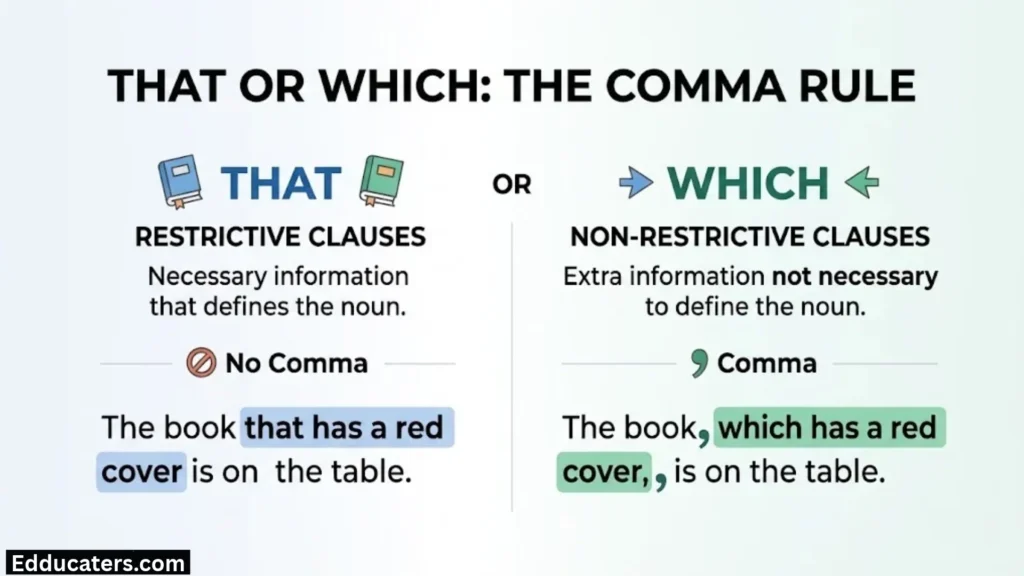
The that or which comma rule is one of the most common sources of confusion in English grammar. The key is to understand the clause first and then apply the appropriate punctuation.
In traditional American editorial style, restrictive clauses take that without commas, while nonrestrictive clauses take which with commas. Other varieties of English allow which in restrictive clauses as well.
When to Use That Without a Comma
Use that without a comma when the clause identifies the noun in traditional American usage.
Examples:
- The restaurant that serves breakfast opens early.
- The laptop that I ordered arrived today.
- The book that fell off the shelf belongs to Maya.
- The flight that leaves at noon is fully booked.
- The report that contains the final results needs approval.
In each sentence, the clause helps readers identify the intended restaurant, laptop, book, flight, or report.
Don’t add a comma simply because the sentence contains a long clause. The clause’s grammatical function determines whether you need punctuation.
For example:
- Incorrect under the traditional American convention: The report, that contains the final results, needs approval.
- Better: The report that contains the final results needs approval.
The second sentence treats the clause as identifying information. The first incorrectly sets off that restrictive clause with commas.
When to Use Which With Commas
Use which with commas when it introduces a nonrestrictive clause.
Examples:
- My laptop, which I ordered yesterday, arrived today.
- The restaurant, which serves breakfast, opens at 7 a.m.
- The flight, which leaves at noon, is fully booked.
- The report, which contains the final results, needs approval.
The commas tell readers that the clause supplies supplementary information.
If the clause appears in the middle of a sentence, use two commas:
The report, which contains the final results, needs approval.
If it appears at the end, one comma before the clause is normally enough:
The report needs approval, which may take several days.
In the second sentence, which refers to the preceding idea that the report needs approval. This is a different grammatical pattern from one in which which modifies a single noun.
Can You Use Which Without a Comma?
Yes. You can use which without a comma when it introduces a restrictive clause in English varieties and styles that accept this construction.
For example:
The bicycle which I bought last year needs new tires.
Here, which I bought last year identifies the bicycle. It doesn’t add a separate comment about a bicycle already identified.
This construction is common in British English. It also appears in American writing, although many US editors prefer that in this context.
The Chicago Manual of Style Online+1
Compare the two forms:
| Sentence | Interpretation | Traditional American preference |
| The bicycle that I bought last year needs new tires. | Identifies the bicycle | Preferred |
| The bicycle which I bought last year needs new tires. | Identifies the bicycle | Often replaced with that |
| My bicycle, which I bought last year, needs new tires. | Adds information about my bicycle | Preferred |
Therefore, which without a comma is not automatically incorrect. You must consider the clause type, regional conventions, and the style guide you’re following.
Can You Use That After a Comma?
Usually not when the comma introduces a nonrestrictive relative clause.
For example:
- Incorrect: My laptop, that I bought yesterday, is already broken.
- Correct: My laptop, which I bought yesterday, is already broken.
The second sentence uses which to add supplementary information about the laptop.
However, don’t interpret this as a rule that the word that can never appear after a comma. A comma might separate two independent clauses, and that could begin a different grammatical construction later in the sentence.
The important restriction concerns that introducing a nonrestrictive relative clause. The problem isn’t the mere presence of a comma somewhere before the word.
That or Which in American English or British English
The that or which in American English question often comes down to the difference between grammatical possibility and editorial preference.
American and British writers generally agree that which can introduce nonrestrictive clauses. The main difference concerns whether which can also introduce restrictive clauses.
That or Which in American English
In traditional American editorial style, writers generally follow this pattern:
- Use that for restrictive clauses.
- Use which for nonrestrictive clauses.
- Omit commas around restrictive clauses.
- Set off nonrestrictive clauses with commas.
For example:
The jacket that has silver buttons belongs to Emma.
The relative clause identifies the jacket.
Emma’s jacket, which has silver buttons, is hanging by the door.
The second sentence treats the jacket as already identified. The clause adds a detail about it.
This convention appears in resources such as The Chicago Manual of Style and several American editorial guides. However, it doesn’t mean every American writer who uses restrictive which has made a grammatical error. The form has a long history in English and remains acceptable in many contexts.
If you’re writing an academic paper, business report, or article for an American publication, check the relevant style guide. Following the publication’s preference helps keep your writing consistent.
That or Which in British English
British English generally allows both that or which to introduce restrictive clauses.
For example:
- The phone that I bought has a larger screen.
- The phone which I bought has a larger screen.
Both constructions are acceptable in British English. The choice may depend on rhythm, personal preference, or the conventions of a particular publication.
For nonrestrictive clauses, which remains the standard choice:
The phone, which I bought yesterday, has a larger screen.
The commas show that the clause adds information rather than identifying which phone the writer means.
British English doesn’t eliminate the need to understand restrictive and nonrestrictive clauses. It simply gives writers more flexibility in choosing which for restrictive clauses.
Which Rule Should You Follow in Formal Writing?
Your best choice depends on your audience and the type of document you’re writing.
| Writing situation | Recommended approach |
| American academic paper | Follow the required style guide; the traditional distinction is a safe choice |
| American professional report | Prefer that for restrictive clauses and which for nonrestrictive clauses |
| British English article | Both forms can introduce restrictive clauses |
| Informal conversation or messaging | Choose natural, clear wording |
| International audience | The traditional distinction is a useful way to reduce ambiguity |
The safest approach for many American writers is simple: use that for identifying clauses and which for supplementary clauses.
This approach helps readers interpret your sentences quickly. It also avoids disagreements about restrictive which in publications that enforce the traditional American convention.
That or Which in a Sentence: Examples and Comparisons
Rules become easier to understand when you see how writers use them in everyday sentences. The following examples cover common situations involving books, phones, restaurants, reports, travel, and other familiar subjects.
That or Which Examples for Restrictive Clauses
A restrictive clause identifies the specific person or thing you’re discussing. In traditional American usage, introduce this clause with that when it refers to a thing.
| Example sentence | What the clause identifies |
| The laptop that I ordered arrived today. | The laptop I ordered |
| The recipe that you recommended uses fresh herbs. | The recommended recipe |
| The restaurant that serves breakfast opens early. | The breakfast-serving restaurant |
| The film that won three awards is available online. | The award-winning film |
| The keys that are on the kitchen counter belong to Mia. | The keys on the counter |
| The hotel that had the best location cost more. | The hotel with the best location |
| The report that explains the problem is on my desk. | The report explaining the problem |
These examples demonstrate how that or which in a sentence can affect identification.
Consider the sentence “The keys that are on the kitchen counter belong to Mia.” If several sets of keys exist, the clause identifies the correct set.
In British English, you could also write “The keys which are on the kitchen counter belong to Mia.” The restrictive meaning remains the same.
That or Which Examples for Nonrestrictive Clauses
A nonrestrictive clause adds detail about a noun that the sentence has already identified.
| Example sentence | Additional information |
| My laptop, which I ordered last week, arrived today. | When the laptop was ordered |
| The museum, which opened in 1925, attracts many visitors. | The museum’s opening year |
| Our conference, which lasted three days, ended Friday. | The conference’s duration |
| My phone, which has a larger screen, is easier to read. | A feature of the phone |
| The bicycle, which I bought last year, needs repairs. | When the bicycle was purchased |
| The restaurant, which serves breakfast, opens at 7 a.m. | The restaurant’s breakfast service |
The clause in each sentence adds context without defining which noun the writer means.
For example, “The museum attracts many visitors” still communicates the main point. The opening year is useful information, but it doesn’t identify the museum within the sentence.
Sentences Where Punctuation Changes Meaning
Sometimes, changing the punctuation changes the sentence’s scope. This is especially important when a noun could refer to several people or things.
Consider these examples:
Restrictive:
The employees who work remotely receive a travel allowance.
This sentence refers to the employees who work remotely. It doesn’t necessarily include employees who work at the office.
Nonrestrictive:
The employees, who work remotely, receive a travel allowance.
This sentence presents remote work as additional information about the employees being discussed. It suggests that the employees in question work remotely and receive the allowance.
Here’s another comparison:
- The films that won awards are available online.
- The films, which won awards, are available online.
The first sentence identifies the award-winning films as a group. The second suggests that the films already under discussion won awards.
The distinction isn’t merely cosmetic. It changes how readers understand the relationship between the clause and the noun.
Practical tip: When a comma could change the intended meaning, rewrite the sentence if necessary. A slightly longer sentence is better than an ambiguous one.
Can You Use That or Which for People or Things?
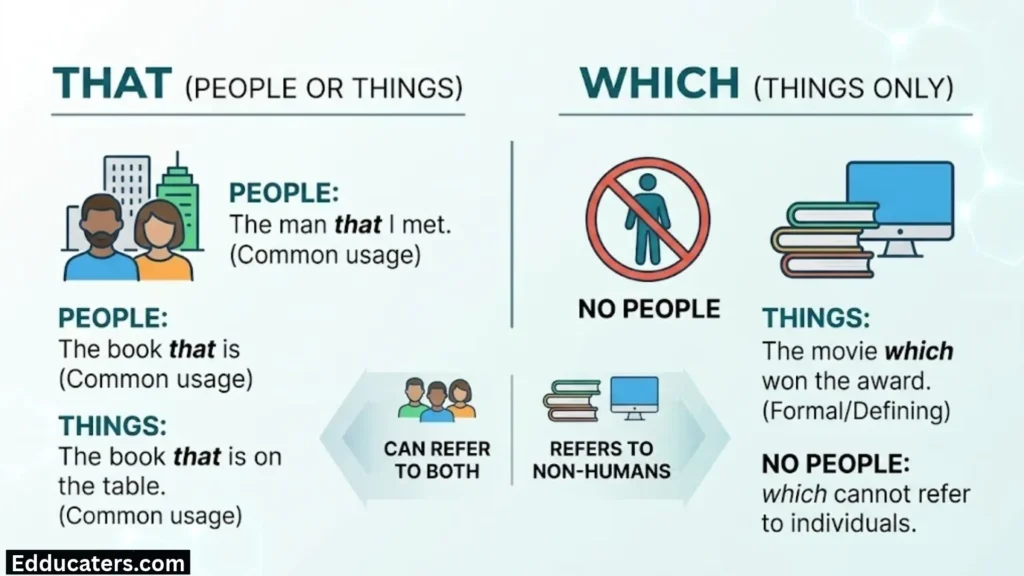
The choice between that or which also depends on what the relative clause describes. Both words can refer to things, but neither is the usual choice for a person in standard formal writing.
Can That Refer to People?
Yes. That can refer to people in restrictive relative clauses, especially in informal English.
For example:
- She’s the person that helped me.
- He’s the only employee that knows the password.
- I know someone that can repair your laptop.
These sentences are understandable and occur in everyday English. However, who often sounds more natural when you’re referring to people, particularly in formal writing.
For example:
- More natural in many contexts: She’s the person who helped me.
- Also possible: She’s the person that helped me.
The choice depends on the sentence and the tone you want. If you’re writing an academic paper or professional document, who is generally the safer choice for people.
Can Which Refer to People?
Generally, no. In standard English, which refers to things, animals, or ideas rather than directly identifying a person.
Use who when the person acts as the subject of the relative clause:
- The teacher who explained the lesson was helpful.
- The student who won the award thanked her parents.
Use whom when the person acts as the object in formal constructions:
– The author whom I interviewed was friendly.
In everyday English, many writers use who instead of whom. You can also omit an object relative pronoun in certain restrictive clauses:
– The author I interviewed was friendly.
Which Relative Pronoun Should You Use?
Several relative pronouns can introduce clauses, but each serves a different purpose.
| Relative pronoun | Main use | Example |
| That | Often identifies people or things in restrictive clauses | The book that I borrowed is missing. |
| Which | Refers to things or ideas | The book, which is on the desk, is mine. |
| Who | Refers to people as subjects | The woman who called is my aunt. |
| Whom | Refers to people as objects in formal usage | The person whom I called answered. |
| Whose | Shows possession | The student whose bag disappeared reported it. |
Other relative words, such as where and when, can introduce clauses about places and times.
For example, “The office where she works is downtown” uses where to refer to a place. You could also write “The office in which she works is downtown.”
Choose the relative word that fits the noun and the grammatical role it plays. Don’t select that or which simply because both appear frequently in sentences about things.
When Can You Omit That or Which?
Sometimes, you can leave out a relative pronoun without changing the essential meaning of a sentence. This practice is called relative pronoun omission.
However, omission depends on the pronoun’s grammatical function. You can often omit an object relative pronoun in a restrictive clause, but you generally can’t omit a subject relative pronoun.
Omitting That or Which as an Object
You can often omit that or restrictive which when it serves as the object of the verb in its clause.
Compare these sentences:
- The book that I borrowed was fascinating.
- The book which I borrowed was fascinating.
- The book I borrowed was fascinating.
All three convey the same basic meaning. In the last sentence, the reader understands that the writer borrowed the book even though the relative pronoun doesn’t appear.
More examples include:
- The laptop (that) I ordered arrived today.
- The film (that) we watched last night was excellent.
- The recipe (that) you recommended worked perfectly.
- The person (whom) I interviewed was helpful.
In each case, the verb has an object relationship with the missing relative pronoun.
This pattern is common in conversational English because it allows writers to keep sentences concise. It’s also acceptable in many forms of standard written English.
Why You Cannot Omit a Subject Relative Pronoun
You generally cannot omit the relative pronoun when it serves as the subject of its clause.
For example:
- Correct: The book that fell belongs to me.
- Incorrect: The book fell belongs to me.
In the incorrect version, removing that leaves two verbs without the intended grammatical connection.
The relative pronoun that acts as the subject of fell. It tells readers what performed the action.
Compare that with an object construction:
- The book that I dropped belongs to me.
- The book I dropped belongs to me.
In the second pair, I is already the subject of dropped. The missing relative pronoun would have served as the verb’s object, so omission works.
Easy rule: If the relative clause already has its own subject, you can often omit an object relative pronoun. If the relative pronoun itself supplies the subject, keep it.
Can You Omit Relative Pronouns in Nonrestrictive Clauses?
Generally, no. Nonrestrictive relative clauses normally retain their relative pronoun.
For example:
- Correct: My laptop, which I ordered yesterday, arrived today.
- Incorrect: My laptop, I ordered yesterday, arrived today.
The second version doesn’t work as a standard nonrestrictive relative clause. Without the pronoun, the phrase may be interpreted as an awkward interruption or as a different sentence structure.
The same principle applies to clauses about people:
- Correct: My sister, who lives in Chicago, is visiting.
- Incorrect: My sister, lives in Chicago, is visiting.
If you want a natural, concise sentence, you can often rewrite it instead:
“My sister lives in Chicago and is visiting next month.”
This version avoids the nonrestrictive clause entirely while preserving the intended information.
That or Which After Prepositions
Prepositions introduce another important part of that or which grammar rules. Words such as in, on, at, with, and for can appear before which in relative clauses.
However, you generally can’t place a preposition directly before that in the same construction.
Using Which After a Preposition
In formal English, you can place a preposition directly before which.
Examples:
- The office in which she works is downtown.
- The building in which they met has been renovated.
- The subject about which we spoke was complicated.
- The chair on which I sat was uncomfortable.
These constructions often sound more formal than everyday alternatives.
For example:
The office in which she works is downtown.
In conversational English, you might say:
The office which she works in is downtown.
Both sentences are grammatical. The first places the preposition before the relative pronoun, while the second leaves the preposition at the end of the clause.
Why That Cannot Directly Follow a Fronted Preposition
You can’t normally place that immediately after a preposition in this type of relative clause.
For example:
- Incorrect: The office in that she works is downtown.
- Correct: The office in which she works is downtown.
- Also correct: The office that she works in is downtown.
- Also correct: The office she works in is downtown.
These examples show three valid ways to express the same basic idea.
The difference concerns sentence structure, not just word preference. The construction in which she works places the preposition before the relative pronoun. The construction that she works in places the preposition at the end.
When you’re writing formally, in which may be the best choice. In everyday communication, that she works in often sounds more natural.
That After Superlatives or Expressions Such as First and Best
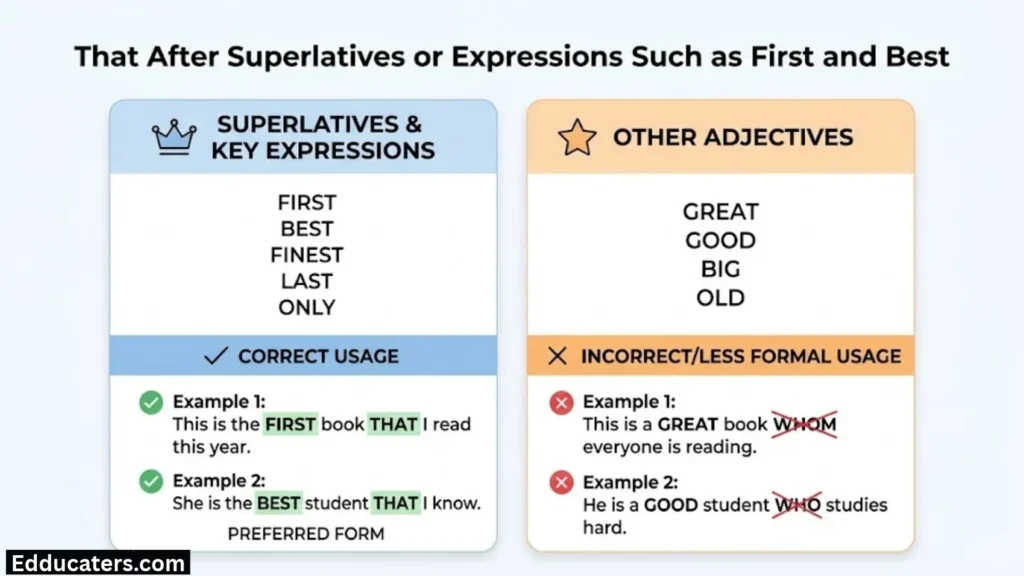
You may notice that writers frequently use that after superlatives and ranking expressions such as best, first, last, and only.
This pattern is useful to recognize, but it isn’t an absolute rule that makes which incorrect in every possible construction.
That After the Best, First, or Only
Examples:
- That was the best concert that I had ever attended.
- She was the first person that arrived.
- This is the only book that explains the topic clearly.
- It was the most interesting film that we watched.
- He’s the last employee that left the building.
In these examples, the relative clause identifies or completes the description of the noun or expression.
The word that is a common choice because the clause usually has a restrictive function. It identifies the particular concert, person, book, film, or employee under discussion.
You can also find constructions with who when the antecedent refers to a person:
– She was the first person who arrived.
Both that and who can work in this type of sentence, although who may sound more natural when referring to people.
Is Which Always Wrong After a Superlative?
No. The presence of a superlative doesn’t automatically make which incorrect.
Consider:
This is the best book, which also happens to be the shortest.
Here, which also happens to be the shortest adds supplementary information about the book. It doesn’t identify which book is the best.
The clause type determines the construction. A superlative may favor that when the clause identifies a particular item, but which remains appropriate when it introduces a nonrestrictive comment.
The key is to avoid memorizing isolated word combinations without considering the sentence’s meaning.
When Which Refers to a Whole Preceding Clause or Idea
One of the most useful features of which is its ability to refer to an entire preceding clause, event, or situation rather than just one noun.
This pattern often appears when writers explain the result of an action or comment on something that happened.
Which Referring to an Entire Sentence
Consider this example:
The flight was canceled, which disappointed everyone.
Here, which disappointed everyone refers to the fact that the flight was canceled. It doesn’t simply describe the flight.
Other examples include:
- The meeting lasted three hours, which surprised the team.
- She forgot her passport, which delayed the trip.
- The company reduced its prices, which attracted more customers.
- He missed the deadline, which created additional problems.
- The museum closed early, which upset several visitors.
In each sentence, which refers to the preceding situation or event.
This use is common in formal writing, reports, news articles, and everyday communication. It helps writers connect ideas without repeating an entire statement.
Why That Cannot Replace Which in This Construction
In this construction, that can’t normally replace which because the two words perform different grammatical roles.
For example:
- Correct: The flight was canceled, which disappointed everyone.
- Incorrect: The flight was canceled, that disappointed everyone.
The second version incorrectly uses that to introduce a supplementary comment about the whole preceding clause.
You could rewrite the sentence to use that in a different grammatical structure:
“The cancellation that disappointed everyone occurred yesterday.”
Here, that disappointed everyone modifies the noun cancellation. It no longer refers directly to the whole preceding clause.
This distinction matters because which referring to a whole preceding clause connects ideas differently from a relative clause that modifies one noun.
If your which clause comments on an entire event, make sure the sentence clearly identifies what which refers to. Otherwise, readers may misunderstand the connection.
Common That or Which Grammar Mistakes
Even experienced writers sometimes confuse these words. Most errors happen when writers focus on a memorized shortcut instead of the clause’s meaning.
Here are the most common mistakes and how to correct them.
Using That to Introduce a Nonrestrictive Clause
Incorrect:
My car, that is blue, is parked outside.
Better:
My car, which is blue, is parked outside.
The second sentence uses which to add a descriptive detail about the car. The commas show that the information is supplementary.
Adding Commas Around Essential Information
Incorrect under the traditional American convention:
The employees, that work remotely, receive a travel allowance.
Better:
The employees that work remotely receive a travel allowance.
The restrictive clause identifies which employees receive the allowance. It shouldn’t be separated from the noun with commas.
If the writer means that all the employees work remotely and receive the allowance, a nonrestrictive construction is possible:
The employees, who work remotely, receive a travel allowance.
Notice that who is more suitable for people in this construction.
Assuming Which Always Needs a Comma
Incorrect assumption: Every use of which requires a comma.
In reality, restrictive which is accepted in British English and appears in other English contexts.
For example:
The book which I borrowed is missing.
This sentence can be grammatical without a comma. If you’re following traditional American editorial style, however, that I borrowed is the preferred version.
Omitting a Subject Relative Pronoun
Incorrect:
The book fell belongs to me.
Correct:
The book that fell belongs to me.
The word that acts as the subject of fell. Removing it breaks the intended clause structure.
By contrast, you can write “The book I dropped belongs to me” because I already serves as the subject of dropped.
Choosing a Word Without Considering Meaning
A writer may choose that simply because a grammar tip says to use it for things. Another writer may choose which because they believe it always sounds more formal.
Both approaches overlook the main issue.
Consider:
- The phone that has a larger screen is mine.
- My phone, which has a larger screen, is mine.
The first identifies the phone by its screen size. The second adds a detail about a phone already identified.
When you edit, ask yourself three questions:
- Does the clause identify which noun I mean?
- Does it add supplementary information about a noun I’ve already identified?
- Which regional or editorial convention should I follow?
These questions are more reliable than choosing a word based on appearance alone.
That or Which Practice Questions With Answers
Use the following exercises to test your understanding of that or which usage. Choose the most appropriate option for each sentence. For restrictive clauses, the American editorial convention is the default unless a question specifies otherwise.
Choose That or Which
Question 1: The laptop _____ I ordered arrived yesterday.
Question 2: My laptop, _____ I ordered yesterday, arrived this morning.
Question 3: The restaurant _____ serves breakfast opens at 7 a.m.
Question 4: The museum, _____ opened in 1925, attracts thousands of visitors.
Question 5: The flight was canceled, _____ disappointed everyone.
Question 6: The office _____ she works in is downtown.
Question 7: This is the best book _____ I’ve read this year.
Question 8: The book _____ fell off the shelf belongs to Mia.
Answer Key With Explanations
| Question | Answer | Explanation |
| 1 | That | The restrictive clause identifies the laptop. |
| 2 | Which | The nonrestrictive clause adds information about the laptop. |
| 3 | That | The clause identifies the restaurant. |
| 4 | Which | The clause adds supplementary information and uses commas. |
| 5 | Which | The pronoun refers to the whole preceding situation. |
| 6 | That or omitted | Both “the office that she works in” and “the office she works in” are acceptable. |
| 7 | That | The restrictive clause identifies the book in the traditional American pattern. |
| 8 | That | The pronoun serves as the subject of fell and can’t be omitted. |
Remember that some answers depend on regional usage. For example, which can replace that in several restrictive constructions in British English.
The goal isn’t to memorize one answer for every sentence. It’s to understand how the clause works and select the form that fits your intended meaning.
Frequently Asked Questions About That or Which
Is that or which a choice between two correct words?
Sometimes. Both can introduce restrictive clauses in broader English usage, although traditional American editorial style generally prefers that. For nonrestrictive clauses, which is the standard choice.
Should I use that or which after a comma?
When a comma introduces a nonrestrictive relative clause, use which rather than that for things. For example, “My laptop, which I bought yesterday, is already broken.”
Is which without a comma grammatically correct?
Yes. Restrictive which is grammatical in British English and appears in other varieties of English. However, many American style guides prefer that for restrictive clauses.
Can that refer to people?
Yes. That can refer to people in restrictive clauses, especially in informal English. However, who is generally the better choice in formal writing when referring to people.
Can I leave out that or which?
You can often omit an object relative pronoun in a restrictive clause. For example, “The book I borrowed was fascinating.” You generally can’t omit the pronoun when it serves as the clause’s subject.
Can which refer to an entire preceding sentence?
Yes. For example, “The meeting ran late, which frustrated everyone.” Here, which refers to the situation described by the preceding clause.
Can that follow a preposition?
You generally can’t place that directly after a fronted preposition in a relative clause. Write “the office in which she works” or “the office that she works in.”
Can British English use which in restrictive clauses?
Yes. British English commonly allows which in restrictive clauses without commas. Writers should still use commas to distinguish nonrestrictive clauses.
Can American English use restrictive which?
Yes, restrictive which appears in American English, although traditional American editorial styles often prefer that. Follow your publication’s style guide when one applies.
What is the easiest way to remember that or which?
For traditional American writing, remember this shortcut: that identifies; which adds information. Use that for restrictive clauses and which for nonrestrictive clauses set off with commas. Keep regional variations in mind.
Conclusion: How to Choose That or Which
Choosing between that and which becomes easier once you focus on what the relative clause does.
Use that for identifying information when following traditional American editorial style. Use which for supplementary information and set off the clause with commas. In British English and some other contexts, restrictive which is also acceptable.
Before finalizing a sentence, ask yourself whether the clause identifies a particular noun or simply adds a detail. Then check the punctuation and make sure the sentence expresses your intended meaning.
The simplest rule to remember is this: identify with that; add information with which. Follow the appropriate style convention, and your writing will be clearer, more consistent, and easier to understand.

Hi, I’m Nathan Whitmore, and I enjoy making English grammar easy for learners of all ages. I believe grammar should be practical, not confusing. I write simple, well-researched guides that help readers improve their writing, speaking, and overall communication skills.
I spend a lot of time studying grammar patterns, sentence construction, punctuation, and modern English usage. My goal is to create lessons that anyone can understand, whether they are students, teachers, or professionals.
Books
Clear English Grammar
The Smart Writer’s Grammar Handbook
 Julian Mercer