The English language is filled with pitfalls that can catch even the most seasoned writers off guard. Among the most frequent sources of confusion are homophones words that sound exactly alike but possess different spellings, meanings, and grammatical functions. The phrase “to many” or “too many” is a classic example of this linguistic challenge. Whether you are drafting a formal business proposal, composing a heartfelt email, or simply trying to refine your daily social media communication, understanding the distinction between these two phrases is paramount to your credibility.
Many people struggle with this because the error is often overlooked by standard spellcheckers, which might not detect the misuse if the sentence structure remains technically coherent despite the wrong word choice.
In this comprehensive guide, we will dissect the grammatical foundations of these two terms, provide clear, actionable rules for their usage, and equip you with memory techniques that will ensure you never make this mistake again. By the end of this article, you will possess a complete understanding of how to wield these words with professional precision.
Quick Answer
Use too many when you are quantifying an excessive amount of countable nouns (e.g., “too many books”). The adverb “too” implies a surplus or an “overly” high amount. Conversely, use “to many when “to” is a preposition indicating direction, destination, or a recipient (e.g., “give the files to many people”).
Comparison Table
| Feature | Too Many | To Many |
| Meaning | An excessive, surplus quantity | Direction toward a group or recipient |
| Part of Speech | Adverb (too) + Determiner (many) | Preposition (to) + Pronoun/Adj (many) |
| Grammar Rule | Quantifier for countable items | Prepositional phrase connecting to a group |
| Correct Usage | “There are too many rules.” | “Send the letter to many clients.” |
| Incorrect Usage | “It is to many complicated.” | “Too many the store.” |
| Replacement Test | Replace “too” with “excessively.” | Replace “to” with “toward.” |
| Memory Tip | “Too” has an extra ‘o’ for “extra.” | “To” shows movement/direction. |
Also Check This Post: Moulding or Molding: Which Spelling Is Correct in English?
Meaning of Each Word
Defining “Too Many”
The phrase “too many” acts as a quantifier. The adverb “too” modifies “many” to express that a specific number of items has crossed the threshold of what is reasonable, necessary, or desired. It is used exclusively with countable nouns items that can be counted individually, such as pencils, days, dollars, or people.
When you use “too many,” you are making a judgment call about volume. You are stating that there is an abundance that is perhaps problematic or unnecessary.
- Examples:
- “We have too many chairs for this small office.”
- “She made too many mistakes in her final draft.”
Defining “To Many”
The phrase “to many” is not a single grammatical unit in the same way. It is a sequence consisting of the preposition “to” followed by the word “many.” Here, “to” is used to show a relationship, such as an action being directed toward a collective group of people or things.
Unlike the adverbial usage of “too,” this “to” is almost always followed by a noun phrase or used as part of a verb phrase where the action travels toward the objects.
- Examples:
- “Please distribute these flyers to many different neighborhoods.”
- “The manager delegated tasks to many employees.”
Key Differences
To differentiate these effectively, consider these three structural pillars:
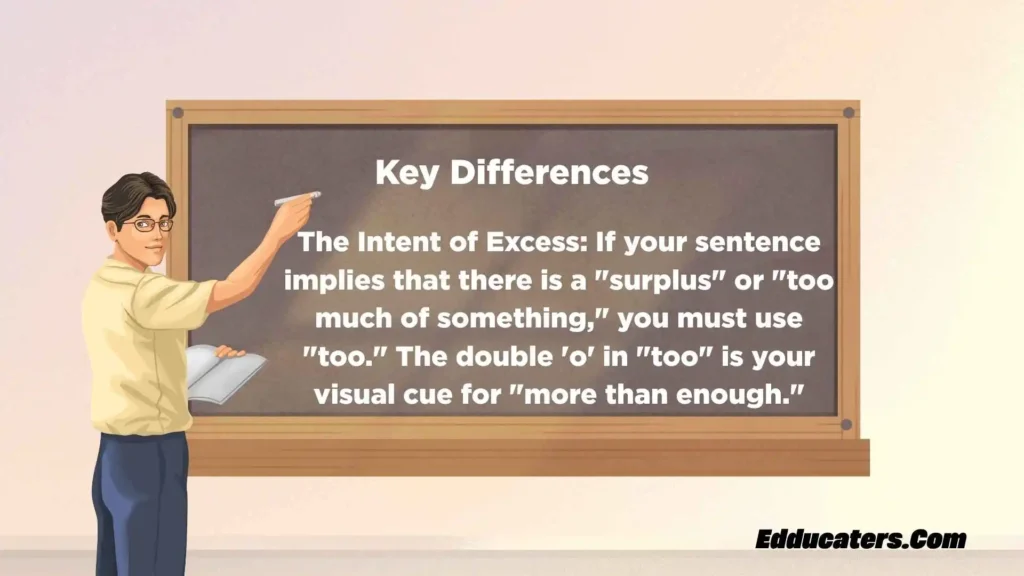
- The Intent of Excess: If your sentence implies that there is a “surplus” or “too much of something,” you must use “too.” The double ‘o’ in “too” is your visual cue for “more than enough.”
- The Intent of Direction: If your sentence involves movement, delegation, giving, or pointing toward a group, use “to.” The single ‘o’ is part of a prepositional structure indicating that the “many” are the recipients of an action.
- The Syntactic Replacement: Try inserting “excessively” into the phrase. If the sentence retains its meaning (e.g., “There are [excessively] many people here”), you are dealing with “too many.” If the sentence becomes nonsensical, you are likely looking for “to many.”
Grammar Rules and Nuances
The fundamental rule governing this confusion is the distinction between adverbs and prepositions. “Too” is an adverb that modifies adjectives, adverbs, or quantifiers to suggest an extreme degree. “To,” on the other hand, is a preposition that establishes a relationship between a noun and another part of the sentence, often indicating place, time, or direction.
The Countable Noun Exception
It is important to note that “too many” only works with countable nouns. If you are referring to something that cannot be counted (like water, air, or happiness), the rule changes. You must use “too much” instead.
- Correct: “There is too much water on the floor.”
- Incorrect: “There is too many water on the floor.”
This distinction is vital. If you find yourself wanting to use “too” but the object is uncountable, shift your phrasing to “too much.” If the object is countable, “too many” is the gold standard.
When to Use Each Word
In Professional and Business Writing
In business, clarity is your highest currency. Misusing these terms can make your communication appear careless. Use “too many” to highlight inefficiencies or bottlenecks (e.g., “There are too many steps in this workflow”). Use “to many” when discussing professional outreach or resource allocation (e.g., “We sent the updated policies to many departments”).
In Academic and Formal Writing
Academic standards require high precision. In your research papers or essays, “too many” should only be used when quantifying data or discussing limitations. “To many” will appear in sentences describing the scope of your research, such as “This study provides insights to many scholars in the field.”
In Daily Conversation and Emails
While informal settings are more forgiving, maintaining correct usage builds your reputation as a competent communicator. In emails, “too many” is your go-to for addressing problems, while “to many” serves your needs when you are coordinating with a team.
Also Check This Post: Lying or Laying: A Complete Comparison With Simple Examples
Common Mistakes and How to Avoid Them
The most prevalent mistake is simply the failure to recognize the double ‘o’. This is often a typographical error rather than a misunderstanding of the rules. However, writers also struggle when they mistake “to” for an adverb.
The “Mistake Trap”:
Many writers confuse the two when they are unsure if a word is acting as a quantifier or a destination.
- Incorrect: “I spoke to many people about the issue.” (Wait, is it ‘too’?)
- Analysis: Ask: Am I saying there are “excessively” many people? Or am I saying that I spoke “to” a large group?
- Correction: In this context, you are directing an action (speaking) toward a group (many people). Therefore, “to” is correct.
Original Examples for Mastery
To fully grasp the nuances, review these diverse examples across various contexts:
- Workplace: There are too many pending items on the agenda for today’s meeting.
- Business: The proposal was circulated to many stakeholders before the final vote.
- Conversation: I think we have too many plans for a single weekend.
- News: The journalist reported the story to many international agencies simultaneously.
- Social Media: My feed has too many advertisements these days.
- Education: The professor gave extra time to many students who requested it.
- Literature: The author dedicated the book to many people who inspired her journey.
- Everyday Life: I have too many keys on my keychain, making it impossible to find the right one.
- Business: We are shifting the focus to many emerging markets this year.
- Conversation: That store sells too many items that I do not actually need.
- Academic: The survey results were presented to many researchers at the conference.
- Workplace: Do we really have too many consultants on this project?
- Formal: The invite was sent to many dignitaries from abroad.
- Everyday: I found too many typos in the final version of the manuscript.
- Business: We are outsourcing the production to many different local vendors.
- Casual: There are too many songs on this playlist that I dislike.
- Education: The scholarship was offered to many deserving candidates.
- Social Media: I have followed too many accounts, and my feed is cluttered.
- Formal: The benefits of this program extend to many citizens in the rural districts.
- Conversation: I realized I had too many expectations for the event.
Memory Trick: The “Extra O” Method
If you are ever in doubt, use the “Extra O” method.
- Think of the double ‘o’ in “too” as a pair of magnifying glasses or a pile of extra items.
- Because you have “extra” items, you use the word with the “extra” ‘o’.
- If you are just directing a message or an item toward someone (a “to” movement), you don’t need the extra ‘o’ because no quantity is being measured.
Mini Quiz: Test Your Knowledge
- We provided snacks ______ people at the workshop.
A) too many
B) to many - I am sorry, but there are ______ errors in this document.
A) too many
B) to many - She mentioned her concerns ______ different managers.
A) too many
B) to many - There were ______ boxes stacked in the hallway.
A) too many
B) to many - The gift was sent ______ friends and family.
A) too many
B) to many
Answers: 1(B), 2(A), 3(B), 4(A), 5(B).
Frequently Asked Questions
Why does my spellchecker not always catch “to many” when it should be “too many”?
Spellcheckers identify misspelled words. Since both “to” and “too” are correctly spelled words, the software cannot always determine the intent of the sentence. It can only flag grammatical errors based on rigid patterns. This is why human proofreading remains essential.
Can “too many” ever be used as a noun?
No, “too many” functions as a determiner and noun phrase combination. It is not a noun itself. You would say, “I have too many,” where “many” acts as a pronoun, but the phrase as a whole describes the quantity.
Is it okay to start a sentence with “Too many”?
Yes, it is perfectly grammatically correct. For example: “Too many cooks in the kitchen can cause problems.” It serves as the subject of the sentence.
Does the rule change in British English?
No, the usage of “too many” versus “to many” is identical in all standard forms of English, including American, British, and Australian English.
What if I am not sure if something is “many” or “much”?
Test if you can count the item. If you can say “one chair, two chairs,” it is countable, so use “many.” If you have to say “one water, two waters,” that usually sounds wrong, so use “much.”
Are there any other confusing homophones like this?
Yes, “to,” “too,” and “two” are all related. “Two” refers specifically to the number 2. Remembering that “too” means “extra” and “to” means “toward” will help you distinguish between the three.
Key Takeaways
- Too many: Always refers to an excessive quantity. Think of the extra ‘o’ as an extra amount.
- To many: Always refers to direction or a recipient. Think of “to” as a movement toward a group.
- Countable vs. Uncountable: “Too many” is for countable items only.
- Replacement Test: Use “excessively” to check if “too” is the correct choice.
- Precision matters: Using the correct form enhances your professional credibility and ensures your message is clear.
Conclusion
Navigating the nuances of English grammar does not have to be an overwhelming task. By understanding that “too many” acts as a quantifier for excessive countable nouns and “to many” acts as a prepositional link to a recipient, you have already conquered the hardest part. Remember to use the “Extra O” memory trick whenever you feel a moment of hesitation.
Mastering these small but significant differences elevates your writing from good to professional. Whether you are addressing a large audience or correcting a simple report, applying these rules ensures that you always express yourself with the precision and authority your work deserves.
Also Check This Post: Neice or Niece: What Is the Correct Word to Use?

Hi, I’m Nathan Whitmore, and I enjoy making English grammar easy for learners of all ages. I believe grammar should be practical, not confusing. I write simple, well-researched guides that help readers improve their writing, speaking, and overall communication skills.
I spend a lot of time studying grammar patterns, sentence construction, punctuation, and modern English usage. My goal is to create lessons that anyone can understand, whether they are students, teachers, or professionals.
Books
Clear English Grammar
The Smart Writer’s Grammar Handbook
 Claire Holloway
 Julian Mercer