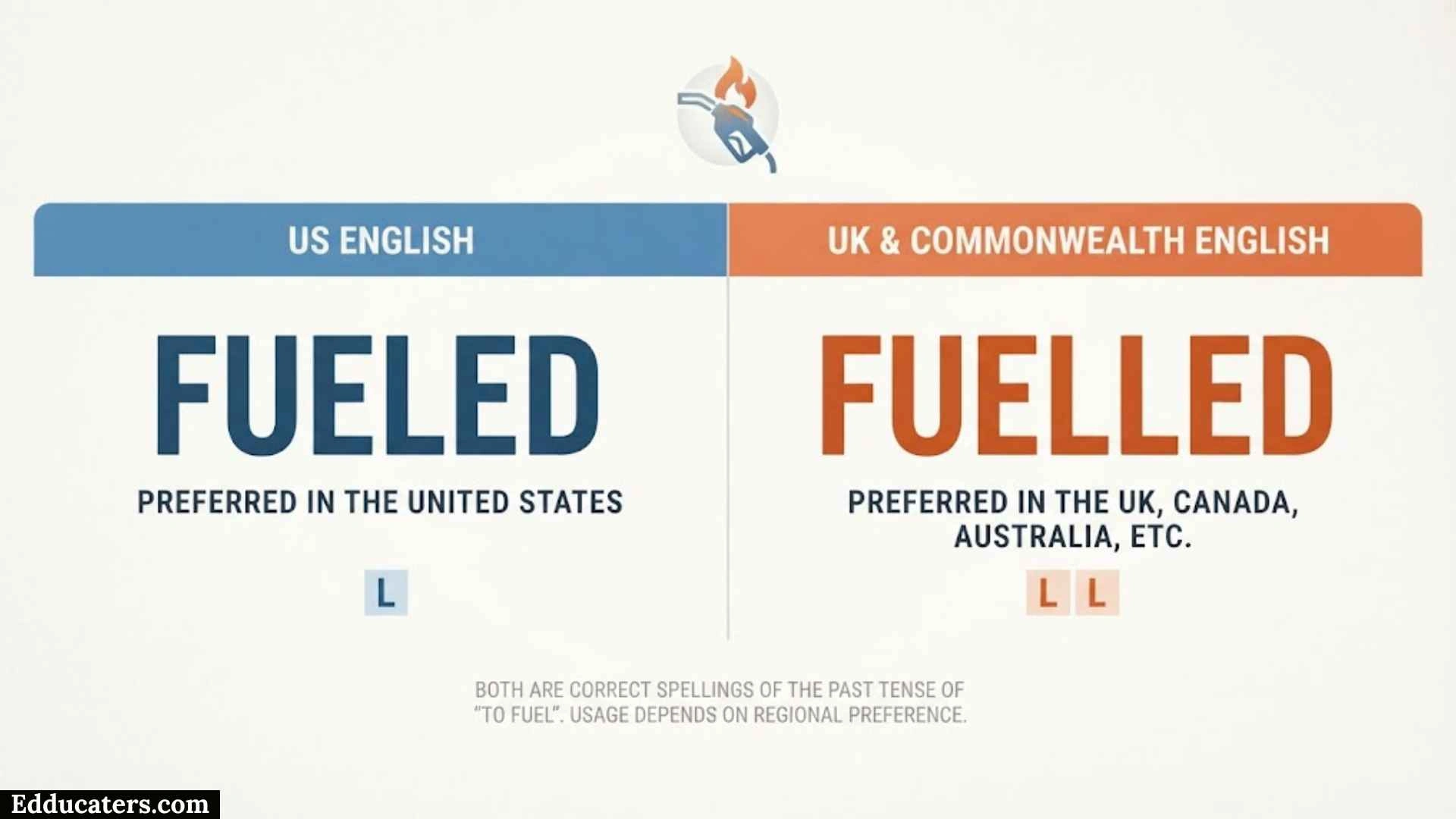
If you have come across both fueled or fuelled, you may wonder whether one is a spelling mistake or whether they have different meanings. The answer is straightforward: both are correct spellings.
The difference is primarily regional. Fueled is the standard spelling in American English, while fuelled is the standard spelling in British English and is also used in several other varieties that follow British spelling conventions.
The two forms are the past tense and past participle of the verb fuel. They have the same meaning and are normally pronounced the same way. The only visible difference is the additional l in fuelled.
For example:
- American English: The announcement fueled speculation about the company’s future.
- British English: The announcement fuelled speculation about the company’s future.
Both sentences are correct. You should choose the spelling that matches the variety of English or style guide you are following.
Fueled or Fuelled: The Quick Answer
Fueled or fuelled mean exactly the same thing. The difference is spelling rather than meaning.
| Feature | Fueled | Fuelled |
| Standard variety | American English | British English |
| Basic meaning | Supplied with fuel or intensified something | Supplied with fuel or intensified something |
| Base verb | fuel | fuel |
| Past tense | fueled | fuelled |
| Past participle | fueled | fuelled |
| Pronunciation | Normally the same | Normally the same |
| Present participle | fueling | fuelling |
| Main spelling difference | One l | Two ls |
So, if you are writing for an American audience, fueled is usually the right choice. If you are writing according to British English conventions, use fuelled.
Neither form should be treated as a universal “correct” spelling while the other is called wrong.
Why Are There Two Spellings?
The difference comes from regional spelling conventions, particularly conventions concerning words ending in l when endings such as -ed and -ing are added.
American English commonly writes:
- fuel → fueled
- fuel → fueling
British English commonly writes:
- fuel → fuelled
- fuel → fuelling
This is part of a broader pattern found in a number of English words. For example, American English commonly uses traveled, canceled, and labeled, while British English commonly uses travelled, cancelled, and labelled.
However, it is important not to turn this observation into an overly simple rule that says British English always doubles l and American English never does. English spelling has a number of historical and word-specific conventions. For fuel, though, the regional distinction is clear and well established.
The extra l does not represent an additional sound. It is simply part of the spelling convention.
What Does Fuel Mean?
Understanding the base verb makes the difference between fueled or fuelled easier to understand.
As a verb, fuel has a literal meaning: to provide something with the fuel it needs to operate.
For example:
The workers fueled the generator before the storm.
In British spelling:
The workers fuelled the generator before the storm.
The verb also has an important figurative meaning. To fuel something can mean to make it stronger, increase it, or help it continue.
For example:
The report fueled public concern.
Here, the report did not provide physical fuel. Instead, it increased public concern.
This figurative use is extremely common in modern English. People can fuel:
- speculation
- anger
- fear
- interest
- demand
- growth
- debate
- conflict
- criticism
- enthusiasm
- innovation
- uncertainty
The British spelling simply changes the written form:
The report fuelled public concern.
The meaning remains unchanged.
When to Use Fueled
Use fueled when writing in standard American English.
This applies whether the word is being used literally or figuratively.
Literal Examples
The driver fueled the car before beginning the journey.
The aircraft was fueled before takeoff.
The emergency generator was fueled and ready to operate.
The workers fueled the machinery before the shift began.
Figurative Examples
The announcement fueled speculation about a possible merger.
Her success fueled her determination to improve.
Rising prices fueled concerns about inflation.
The article fueled public interest in the subject.
The disagreement fueled an already heated debate.
In all these examples, fueled is appropriate for American English.
It does not matter whether the writing is casual or formal. A newspaper, academic paper, business report, or everyday message written in American English can use fueled.
When to Use Fuelled
Use fuelled when writing in standard British English.
It can be used in exactly the same grammatical and semantic situations as fueled.
Literal Examples
The driver fuelled the car before beginning the journey.
The aircraft was fuelled before takeoff.
The emergency generator was fuelled and ready to operate.
The workers fuelled the machinery before the shift began.
Figurative Examples
The announcement fuelled speculation about a possible merger.
Her success fuelled her determination to improve.
Rising prices fuelled concerns about inflation.
The article fuelled public interest in the subject.
The disagreement fuelled an already heated debate.
The difference between these examples and the American versions is purely regional spelling.
The Difference Between Fueled and Fuelled in Context
One useful way to understand the distinction is to place the two forms in identical sentences.
| American English | British English |
| The news fueled speculation. | The news fuelled speculation. |
| The company fueled growth through investment. | The company fuelled growth through investment. |
| The vehicle was fueled before departure. | The vehicle was fuelled before departure. |
| The comments fueled public anger. | The comments fuelled public anger. |
| The discovery fueled further research. | The discovery fuelled further research. |
The change in spelling does not alter the sentence’s meaning.
This is why it is better to think of fueled and fuelled as regional variants of the same word rather than as two different vocabulary items.
Fueled and Fuelled in Literal Use
The original, physical sense of fuel relates to supplying energy.
A vehicle may be fueled or fuelled with petrol, gasoline, diesel, or another suitable fuel. An aircraft can be fueled or fuelled before a flight. A generator can be fueled or fuelled before it is needed.
For example:
The bus was fueled before leaving the depot.
The bus was fuelled before leaving the depot.
Both sentences describe the same action.
The noun used for the fuel itself can vary between varieties of English. For example, American English generally uses gasoline where British English commonly uses petrol. That vocabulary difference is separate from the spelling of fueled/fuelled.
This distinction matters because fueled and fuelled themselves do not represent an American-versus-British difference in meaning. They represent a spelling difference.
Fueled and Fuelled in Figurative Use
The figurative use of fuel is arguably just as common as its literal use.
When something fuels a situation, it gives that situation more energy or makes it more intense. This is why English speakers use the verb with abstract nouns.
Fueling Speculation
The unexplained decision fueled speculation about what would happen next.
British English:
The unexplained decision fuelled speculation about what would happen next.
Fueling Anger
The new policy fueled anger among residents.
British English:
The new policy fuelled anger among residents.
Fueling Growth
Investment in technology fueled rapid growth.
British English:
Investment in technology fuelled rapid growth.
Fueling Interest
The documentary fueled interest in the history of the region.
British English:
The documentary fuelled interest in the history of the region.
Fueling Conflict
The inflammatory comments fueled further conflict.
British English:
The inflammatory comments fuelled further conflict.
These combinations are natural because the metaphor is easy to understand: just as physical fuel supplies energy to a fire or machine, something figuratively described as “fuel” gives energy or momentum to a situation.
What About Fueling or Fuelling?
The same spelling distinction appears when -ing is added.
American English uses:
fueling
British English uses:
fuelling
For example:
The company is fueling demand with a new advertising campaign.
The company is fuelling demand with a new advertising campaign.
And in a literal context:
Workers are fueling the aircraft.
Workers are fuelling the aircraft.
The pronunciation remains essentially the same despite the spelling difference.
If you remember fueled/fuelled, it is useful to remember this related pair at the same time:
| American English | British English |
| fueled | fuelled |
| fueling | fuelling |
These forms follow the same regional spelling preference.
Is Fueled a Misspelling of Fuelled?
No.
Fueled is not a misspelling when it is used in American English. It is the standard American form.
For example:
The report fueled concerns about the economy.
There is nothing incorrect about this sentence in American English.
Likewise, fuelled is not a misspelling in British English:
The report fuelled concerns about the economy.
The extra l is expected under the conventional British spelling.
A common source of confusion is familiarity. Someone who normally reads American English may instinctively expect fueled, while someone accustomed to British English may expect fuelled. An unfamiliar spelling can look wrong even when it is completely standard in another variety.
The spelling should therefore be judged in context.
British English, American English, and Other Varieties
The clearest distinction is between American and British English:
- American English: fueled
- British English: fuelled
The British-style spelling is also found in other English varieties that commonly use British spelling conventions, including Australian and New Zealand English.
Canadian English deserves a little more caution because Canadian spelling can combine features associated with British and American conventions, depending on the word and the style being followed. It is therefore better not to assume that every Canadian publication will follow exactly the same spelling pattern as either the United States or the United Kingdom.
For practical writing, the best rule is to follow the style used by your intended publication or audience.
If a publication uses colour, travelling, and organise, its overall spelling system may indicate a preference for British-style conventions. If it uses color, traveling, and organize, American conventions are more likely.
The important thing is consistency rather than trying to declare one spelling universally superior.
Pronunciation of Fueled and Fuelled
Fueled and fuelled are normally pronounced the same way.
They are commonly represented in pronunciation dictionaries with a form close to:
/ˈfjuːəld/
A simple approximation for English learners is FYOO-uhld.
The additional l in the spelling fuelled does not normally create an additional syllable or a separate pronunciation.
So you should not pronounce them as though the British spelling contains an extra spoken “l.”
Regional accents can naturally affect the precise vowel and consonant sounds, but the one-letter spelling difference does not establish two different standard pronunciations.
Common Expressions With Fuel
Because fuel has both literal and figurative meanings, it appears in many common expressions.
Some particularly useful combinations include:
- fuel speculation — increase speculation
- fuel demand — increase demand
- fuel growth — contribute to growth
- fuel interest — increase interest
- fuel anger — make anger stronger
- fuel fears — increase fears
- fuel a debate — intensify a debate
- fuel a conflict — contribute to or intensify a conflict
- fuel innovation — encourage or stimulate innovation
The spelling of the past tense depends on the variety of English:
The announcement fueled fears.
American English
The announcement fuelled fears.
British English
The same principle applies whether the noun is concrete or abstract.
Common Mistakes to Avoid
Treating Fuelled as Incorrect
A reader familiar with American English may assume that the second l is unnecessary. In British English, however, fuelled is standard.
Treating Fueled as Incorrect
The reverse mistake is equally common. Fueled is the standard American form, so the missing second l does not make it incorrect.
Mixing the Regional Forms Without a Reason
A piece of writing can look inconsistent if it uses different spelling systems without following a deliberate style.
For example, using fueled alongside travelled and cancelled may attract attention if the text is otherwise clearly following British conventions.
The best solution is to identify the English variety required by the context and follow it consistently.
Assuming the Extra L Changes the Meaning
It does not.
Fueled and fuelled have the same meaning. The extra l is a spelling difference.
Confusing Fuel With Feel
Because fuel and feel look somewhat similar, learners sometimes confuse their forms.
Fuel relates to providing energy or intensifying something:
The news fueled speculation.
Feel relates to experiencing a sensation or emotion:
I feel tired.
They are completely different verbs.
How to Choose the Right Spelling
You do not need to memorize two different meanings. Instead, ask one question:
Which variety of English am I using?
If the answer is American English, choose:
fueled
If the answer is British English, choose:
fuelled
If you are writing for an organization, publication, university, or employer, check its preferred style if one is provided.
This is especially important in longer documents. Once you choose a spelling system, maintain it throughout the document rather than switching between regional conventions unnecessarily.
For example, an American-style sentence might read:
The discovery fueled interest in renewable energy and encouraged further research.
A British-style version would be:
The discovery fuelled interest in renewable energy and encouraged further research.
Both are polished and correct within their respective varieties.
Frequently Asked Questions
Is Fueled or Fuelled Correct?
Both are correct. Fueled is the standard American English spelling, while fuelled is the standard British English spelling.
Is Fueled American English?
Yes. Fueled is the standard spelling used in American English.
Is Fuelled British English?
Yes. Fuelled is the conventional British English spelling.
Do Fueled and Fuelled Have Different Meanings?
No. They have the same meanings. Both can mean supplying something with fuel or figuratively making something stronger or more intense.
Is Fueling or Fuelling Correct?
Both are correct. Fueling is standard American English, while fuelling is standard British English.
Are Fueled and Fuelled Pronounced the Same?
Normally, yes. The spelling difference does not normally create a difference in pronunciation.
Is Fueled a Misspelling in British English?
No, it is not inherently a misspelling, but fuelled is the conventional British form. If you are following standard British spelling, fuelled is the preferred choice.
Is Fuelled a Misspelling in American English?
No, but it is not the standard American spelling. American English normally uses fueled.
Which Spelling Should I Use in a Formal Document?
Use the spelling required by the variety or style guide of your document. Fueled is appropriate for American English, while fuelled is appropriate for British English.
Does Fuelled Have an Extra Syllable?
No. The extra l in fuelled is a spelling difference and does not normally add another syllable.
Final Takeaway
The choice between fueled and fuelled is not a question of right versus wrong. It is primarily a question of regional spelling.
Fueled is standard in American English.
Fuelled is standard in British English.
Both forms are the past tense and past participle of fuel, both have the same meanings, and both are normally pronounced the same way. The related -ing forms follow the same pattern: fueling in American English and fuelling in British English.
If you are unsure which one to use, identify the English variety required by your audience or style guide. Once you choose it, use that spelling consistently. That simple approach will keep your writing accurate, natural, and appropriate for its intended readers.

Hello, I’m Claire Holloway. I have always been passionate about the English language and enjoy turning complex grammar rules into simple, easy-to-follow lessons. I believe that every learner can become a confident English writer with the right guidance.
I create educational content focused on grammar, vocabulary, sentence structure, and writing improvement. Every article I publish is designed to help readers learn with confidence and accuracy.
Books
Grammar Without Confusion
Modern English Usage Guide
 Julian Mercer