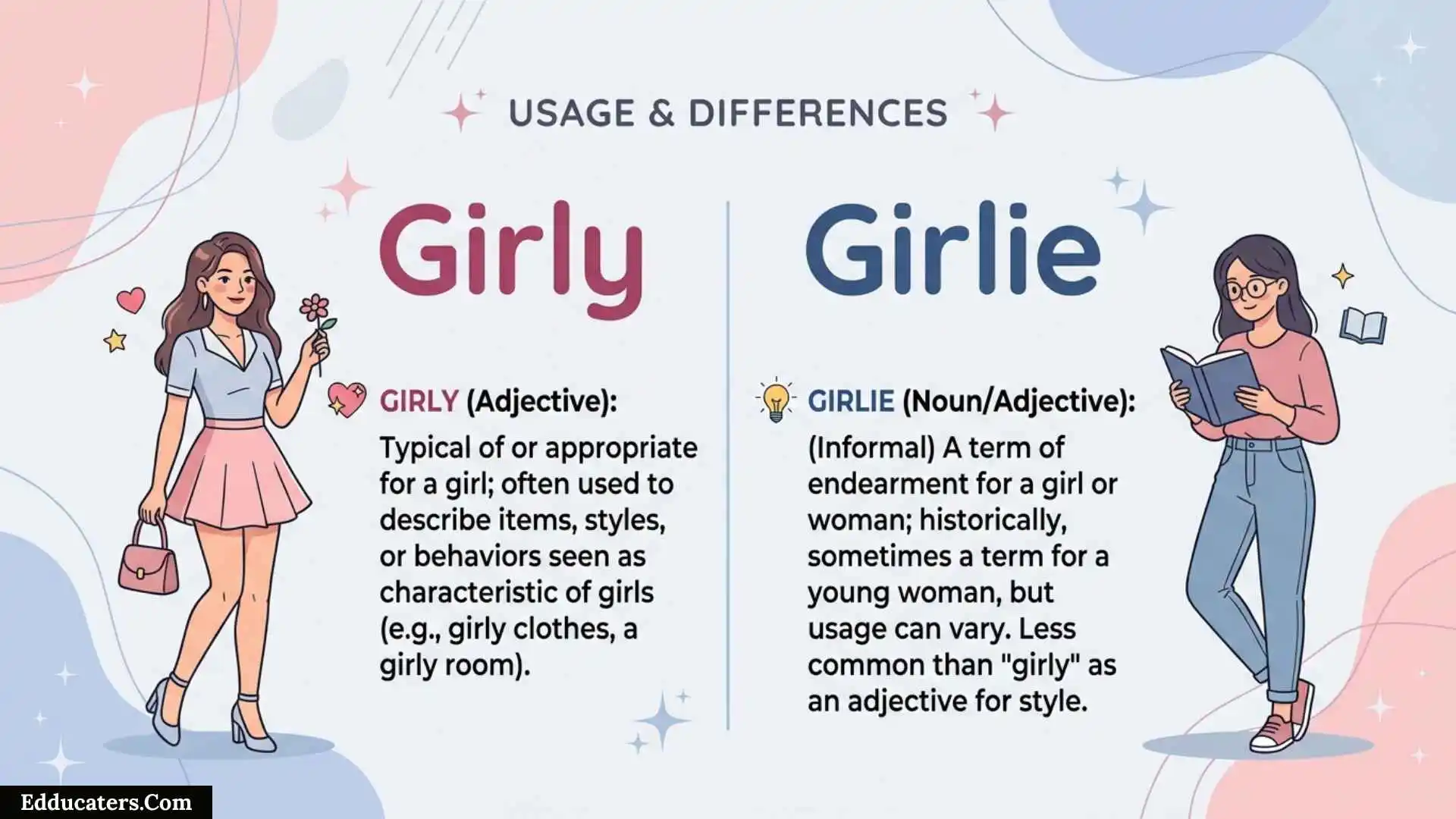
If you have ever wondered whether girly or girlie is the correct spelling, you are not alone. Both forms appear in English, especially in casual conversations, social media, fashion writing, lifestyle content, books, magazines, product descriptions, plus everyday speech.
The good news is simple: both “girly” or “girlie” are real English words. The main difference comes from usage, tone, context, plus the meaning intended by the writer.
In modern American English, girly is generally the more useful choice when you want to describe something traditionally associated with girls or women. Girlie is also correct, but it can sound more informal. In some contexts, it may carry an older or sexualized meaning, so choosing the right form matters.
This guide explains girly or girlie, including their meanings, grammar, examples, regional usage, common mistakes, formal alternatives, plus a simple way to choose the right word.
Girly or Girlie: Quick Answer
Girly is the most common choice when describing something considered traditionally feminine or associated with girls.
Examples include:
- girly clothes
- a girly room
- girly colors
- a girly style
- girly music
- a girly personality
Girlie is also a legitimate spelling. Cambridge Dictionary lists girlie as another form of girly.
However, girlie can have additional meanings. Merriam-Webster records a sense connected with material featuring scantily dressed women, such as older expressions involving “girlie” magazines or shows.
The easiest rule
Use girly for everyday modern writing when you mean feminine, traditionally associated with girls, or stereotypically feminine.
Use girlie when it fits the intended style, especially in casual language or when referring to an established expression.
What Does Girly Mean?
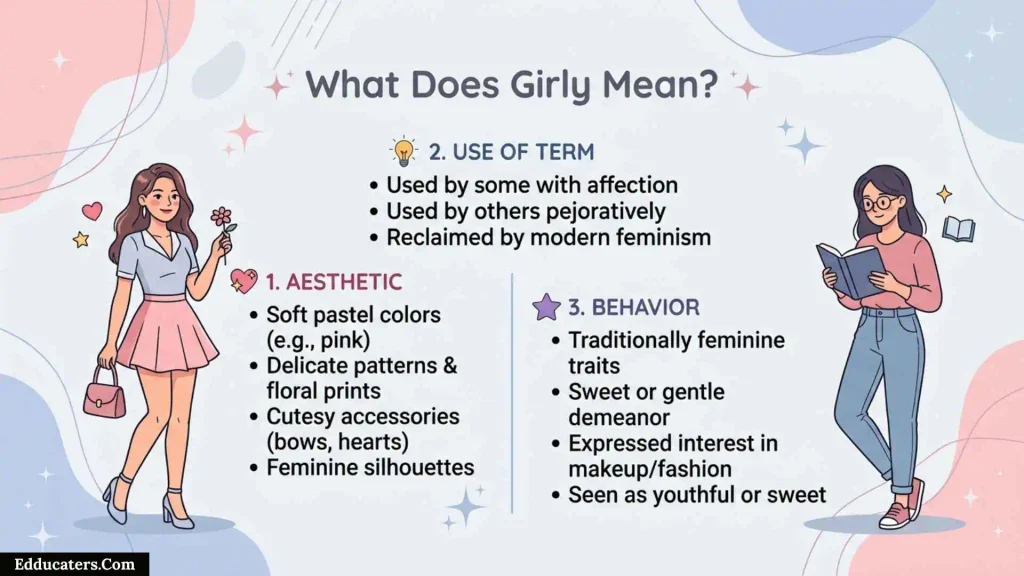
Girly is an informal adjective. It describes something considered typical of girls or traditionally associated with girls or women.
Cambridge Dictionary defines girly as something involving women or girls, or something considered typical of women or girls.
For example:
- She has a very girly style.
- The bedroom has a cute, girly design.
- Pink is sometimes described as a girly color.
- They planned a fun girly weekend.
- She enjoys girly accessories.
The word does not automatically mean something is good or bad. Tone matters.
Can Girly Describe a Person?
Yes. You can say:
She has a girly personality.
You might also hear:
She is very girly.
The second sentence usually suggests that the person enjoys or displays qualities traditionally linked with femininity.
Still, context matters. Some dictionaries note that girly can sound disapproving when used to describe a person who enjoys things traditionally associated with girls or women.
What Does Girlie Mean?
Girlie is also an adjective. It can carry the same basic meaning as girly, particularly in informal English.
For example:
- a girlie dress
- a girlie room
- a girlie style
- a girlie outfit
Oxford lists girlie as an informal adjective that can mean suitable for or typical of girls.
However, girlie has an important additional meaning.
It can refer to older forms of entertainment or media featuring scantily clothed women. Merriam-Webster records this usage, while Oxford also identifies the older sexualized sense.
Because of this second meaning, girlie may sound less neutral than girly in modern everyday writing.
Are Girly and Girlie Interchangeable?
Sometimes, yes.
If you are describing something as traditionally feminine, either form can work in informal language.
For example:
- a girly dress
- a girlie dress
Both can communicate a similar idea.
Another example:
- She loves girly things.
- She loves girlie things.
The first version usually sounds more natural to many modern American English readers.
This is why girly is often the safer default for general content.
Why Context Matters
Words can have more than one meaning. Girlie demonstrates this clearly.
A fashion blogger discussing a “girlie summer outfit” may simply mean feminine or playful.
An older magazine reference involving “girlie” may have a completely different meaning.
Therefore, writers should consider the audience before choosing the spelling.
Girly or Girlish: Are They the Same?
Although girly or girlish are related, they are not always interchangeable.
Girlish generally describes behavior, appearance, mannerisms, or qualities that resemble those traditionally associated with a girl.
Examples include:
- a girlish laugh
- a girlish voice
- a girlish smile
- girlish enthusiasm
Cambridge defines girlish as describing behavior or characteristics typical of a girl.
Girly has a broader casual feel.
Compare these examples:
She decorated her room with a girly style.
This sounds casual, modern, conversational.
She gave a girlish laugh.
This focuses more on the quality of the laugh.
Which Word Sounds More Natural?
For casual lifestyle content, girly is usually more natural.
For descriptive writing focused on someone’s behavior, appearance, manner, or youthful qualities, girlish may be a better choice.
Is Girlie a Correct Word?
Yes. Girlie is a correct English word.
It is not simply a spelling mistake.
Major dictionaries recognize it as an adjective. Oxford lists girlie as an informal adjective, while Cambridge lists it as another form of girly.
The issue is not correctness. The issue is which form fits the context better.
If you are writing a general article for an American audience, girly will usually be the clearer option.
If you are writing dialogue, casual content, older-style material, or a phrase where girlie is established, girlie can work well.
Is Girly a Correct Word?
Yes. Girly is completely correct.
It is an established informal English adjective. Cambridge Dictionary provides examples involving “girly stuff,” “girly things,” “girly chat,” plus “girly weekend.”
It can also function as a noun in informal usage, although this use is less important for most modern writing.
For everyday content, the adjective is the form you will encounter most often.
Girly in American English
For readers in the United States, girly is generally the best default spelling when you mean feminine or traditionally associated with girls.
Examples:
- girly fashion
- girly bedroom ideas
- girly birthday themes
- girly phone cases
- girly outfits
- girly accessories
The word feels natural in casual American English, especially in fashion, beauty, lifestyle, social media, plus entertainment contexts.
Girlie is still understandable in American English, but it may sound more playful, old-fashioned, informal, or context-dependent.
Girly in British English
British English also recognizes both girly and girlie.
Oxford Learner’s Dictionaries lists girly as an informal adjective, with girlie as another form. It also notes that girlie can have a more specific meaning in some contexts.
This means British readers generally understand both forms.
The spelling choice depends more on style plus context than basic correctness.
What About International English?
English users across countries may encounter both spellings.
For international websites, girly is usually the safer option when you want a clear, modern meaning.
Why?
Because girly communicates the intended feminine meaning with fewer possible interpretations.
If your website targets readers from several countries, using the more familiar form can reduce confusion.
Is Girly a Misspelling of Girlie?
No.
Girly is not a shortened mistake of girlie.
Both are established English forms.
The same applies in reverse: girlie is not simply a spelling error for girly.
Dictionaries recognize both forms, although their usage patterns differ.
The safest approach is to choose one spelling based on your intended meaning, audience, plus tone.
Is Girly Formal English?
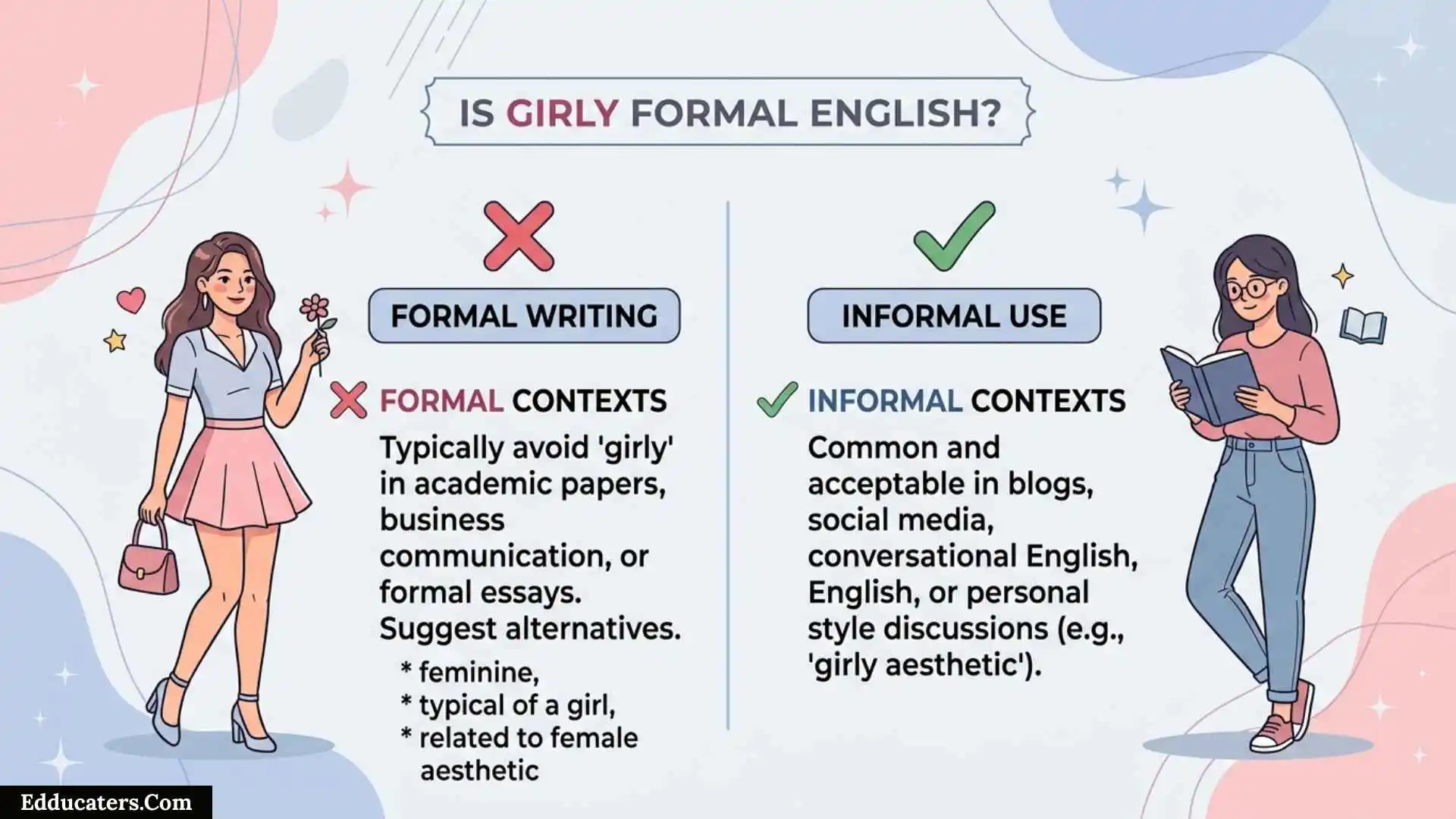
Usually, no.
Girly is an informal word.
It works well in:
- blogs
- social media
- casual conversations
- fashion articles
- lifestyle content
- product descriptions
- entertainment writing
For formal academic or professional writing, another adjective may be more precise.
Instead of:
The design is very girly.
You could write:
The design has traditionally feminine characteristics.
Or:
The design uses traditionally feminine visual elements.
The best alternative depends on your exact meaning.
Better Alternatives to Girly
Sometimes you may want a more specific word.
Feminine
Use feminine when you want a neutral or more formal description.
Example:
The collection has a feminine aesthetic.
Girlish
Use girlish when describing qualities associated with a girl.
Example:
Her girlish laugh filled the room.
Playful
Use playful when you mean cheerful, cute, colorful, or fun rather than specifically feminine.
Example:
The website uses a playful design.
Delicate
Use delicate when you mean soft, light, refined, or subtle.
Example:
The room has a delicate floral design.
Choosing a more precise alternative can make your writing stronger.
When Should You Use Girly?
Choose girly when:
- You are writing casual English.
- You mean traditionally feminine.
- You are discussing fashion or beauty.
- You are describing a feminine aesthetic.
- You are targeting general American readers.
- You want a familiar modern expression.
Examples:
She loves girly dresses.
The brand has a cute, girly aesthetic.
They created a girly bedroom makeover.
She wanted a girly birthday theme.
When Should You Use Girlie?
Choose girlie when:
- The informal tone suits the content.
- The spelling fits a particular phrase.
- You are reproducing dialogue or a character’s natural speech.
- You are discussing an older expression where girlie has a specific established meaning.
- You deliberately want a playful or old-fashioned tone.
Be careful when the word could create an unintended sexualized interpretation.
Common Mistakes With Girly or Girlie
Mistake 1: Calling Girly Incorrect
It is incorrect to claim that only girlie is a real English word.
Girly is fully established.
Mistake 2: Calling Girlie a Simple Typo
Girlie is also a recognized English word.
It has its own dictionary entries plus usage patterns.
Mistake 3: Ignoring Context
A writer may choose girlie without realizing that it can carry an older sexualized meaning.
Always consider the audience plus surrounding words.
Mistake 4: Using Girly as a Universal Synonym
Girly does not always mean cute.
It can mean feminine, traditionally associated with girls, or characteristic of girls. The exact interpretation depends on context.
A Simple Decision Guide
If you are unsure which spelling to choose, use this quick guide:
Do you mean traditionally feminine?
→ Choose girly.
Are you writing casual American English?
→ Choose girly.
Are you describing a youthful quality or behavior?
→ Consider girlish.
Do you specifically want an informal or playful tone?
→ Girlie may work.
Could the word create an older or sexualized interpretation?
→ Choose a clearer alternative.
Are you writing formal content?
→ Consider feminine, girlish, delicate, playful, or another precise adjective.
Real Examples of Girly
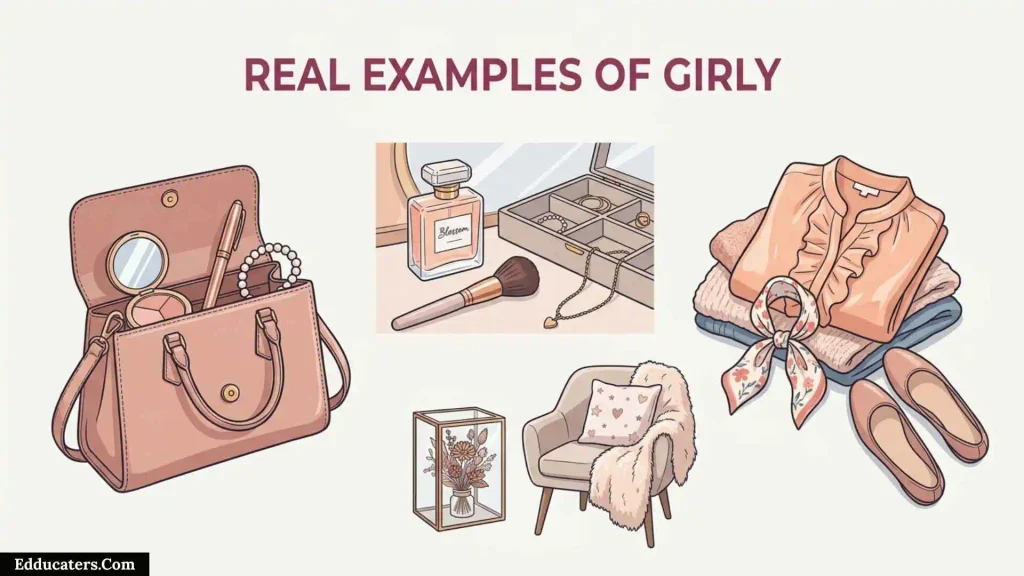
Here are natural examples using girly:
She chose a girly floral dress for the party.
Her bedroom has a soft, girly aesthetic.
The store sells cute girly accessories.
They planned a girly weekend with movies, snacks, plus shopping.
She prefers a girly style with pastel colors.
These examples use girly in the modern informal sense.
Real Examples of Girlie
Examples using girlie include:
She chose a girlie dress for the casual event.
The character has a playful, girlie personality.
The phrase has an old-fashioned girlie feel.
The word can work, but modern readers may interpret it differently depending on context.
FAQs About Girly or Girlie
Is girly or girlie correct?
Both are correct English words. Girly is generally the safer modern choice for describing something traditionally feminine. Girlie is also correct but can have additional meanings.
Is girlie just another spelling of girly?
In some contexts, yes. Dictionaries recognize girlie as a variant of girly. However, girlie also has separate usage patterns, including an older sexualized sense.
Which spelling is more common in modern casual writing?
Girly is generally the safer modern choice, especially for general American English.
Is girly a negative word?
Not necessarily. It can be neutral or positive in casual contexts. However, describing a person as “girly” can sometimes sound judgmental depending on tone and context. Cambridge notes that the word can be disapproving in some uses.
Is girlish the same as girly?
Not always. Girlish usually focuses on qualities, behavior, appearance, or manner associated with a girl. Girly is broader plus more casual.
Can I use girly in formal writing?
You can, but it may sound informal. Feminine is often a better choice for formal or academic writing.
Does girly mean cute?
Not exactly. Something described as girly may be cute, colorful, soft, feminine, decorative, or traditionally associated with girls. The exact meaning depends on context.
Is girlie offensive?
Not automatically. However, some dictionary entries identify noun uses of girlie as offensive or dismissive when referring to a girl or young woman.
Key Takeaways
The answer to girly or girlie is not simply that one is correct while the other is wrong.
Both forms exist in English.
Girly is usually the better modern choice when you mean traditionally feminine or associated with girls.
Girlie is also correct, but it can sound more informal. It can also carry older or sexualized meanings in certain contexts.
For most modern websites, blogs, social posts, fashion content, plus lifestyle articles, girly is the clearest default.
When you need a formal alternative, feminine may be more suitable. When you want to describe behavior or qualities resembling those of a girl, girlish may provide greater precision.
Conclusion
So, girly or girlie?
The simplest answer is: both are correct, but “girly” is usually the better modern choice.
Use girly for casual descriptions of feminine styles, designs, clothing, interests, rooms, colors, plus aesthetics.
Use girlie when the informal tone fits or when a specific expression calls for it. Always consider context because girlie can carry meanings that girly normally does not.
If your goal is clear, natural English for a broad audience, girly is the safest option in most situations.

I’m Julian Mercer, an English language writer dedicated to helping people master grammar through practical examples and clear explanations. I enjoy teaching grammar in a way that is both engaging and easy to remember.
My work focuses on grammar rules, punctuation, word usage, and writing techniques that readers can apply in everyday life. I believe learning English should be simple, enjoyable, and useful.
Books
English Grammar in Practice
Writing with Precision
 Claire Holloway