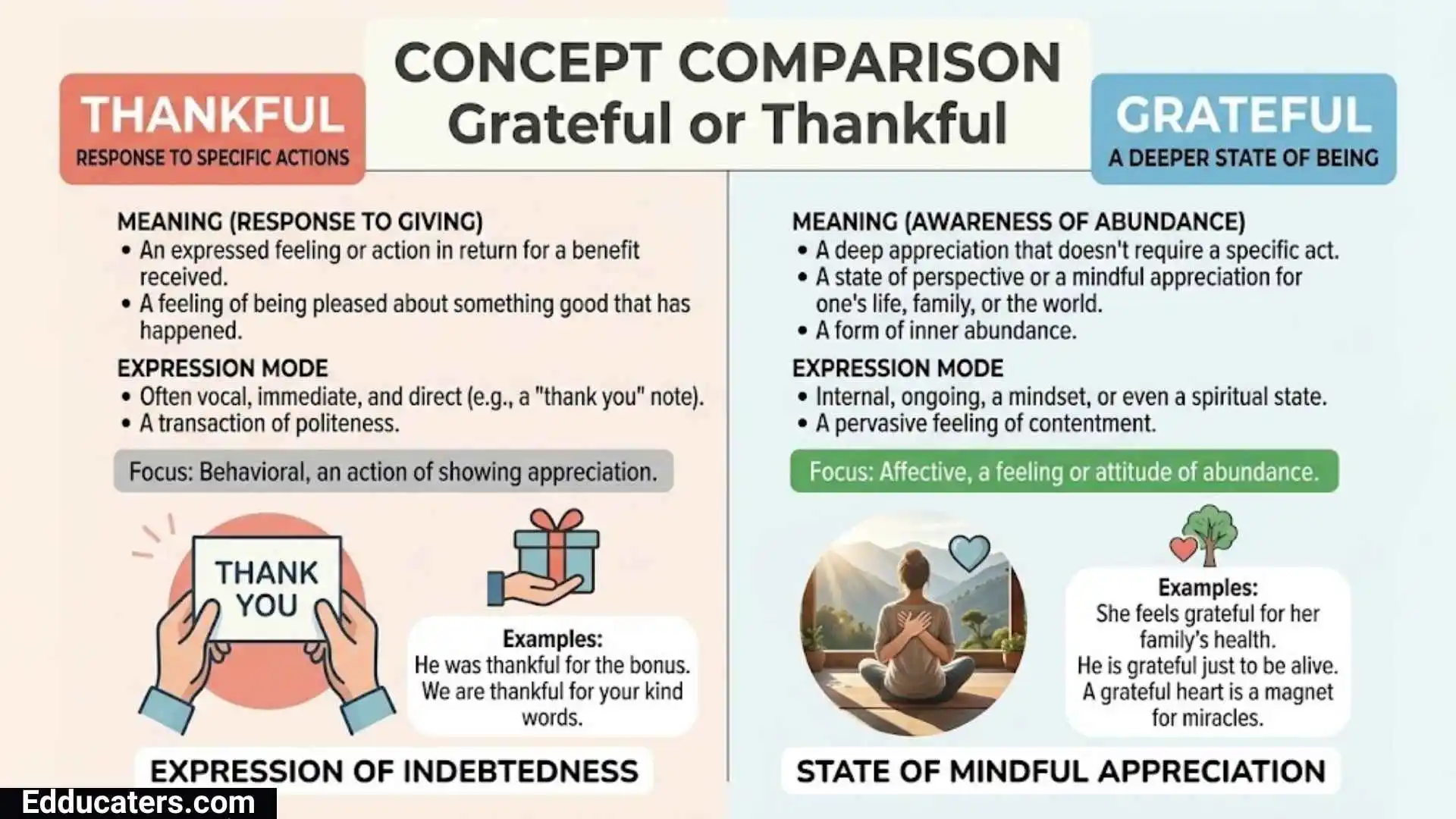
If you’re wondering whether to say grateful or thankful, both words are correct. They have very similar meanings and are often interchangeable, but they can carry slightly different shades of meaning depending on the situation. Grateful often emphasizes a deep appreciation for something someone has done or something you have received, while thankful can emphasize relief, appreciation, or a feeling of thanks.
For example, you might say, “I’m grateful for your support” when expressing sincere appreciation for someone’s help. You might say, “I’m thankful that everyone arrived safely” when expressing relief about a positive outcome.
So, grateful or thankful isn’t usually a matter of correct versus incorrect English. Both are standard adjectives. The better choice depends on the meaning and tone you want to convey.
Grateful or Thankful: What Is the Difference?
Grateful or thankful both describe a feeling of appreciation or gratitude. In many everyday sentences, either word can be used without changing the basic meaning.
| Word | Main Meaning | Common Use | Example |
| Grateful | Feeling deep appreciation | Appreciation for a person, action, opportunity, or benefit | I’m grateful for your help. |
| Thankful | Feeling or expressing thanks, appreciation, or relief | Appreciation, especially for a positive situation or outcome | I’m thankful that you’re safe. |
The distinction is subtle rather than absolute.
Grateful often sounds a little more personal or heartfelt. It commonly focuses on what or whom you appreciate.
I’m grateful for everything you’ve done for me.
Thankful can also express appreciation, but it is especially natural when you are relieved that something bad did not happen or that something good happened.
I’m thankful that we made it home safely.
However, these meanings overlap considerably. You can also say:
I’m thankful for everything you’ve done for me.
And:
I’m grateful that we made it home safely.
Both sentences are grammatically correct.
Is It Grateful or Thankful?
The answer is both. Grateful or thankful are both correct English words.
Choose grateful when you want to emphasize sincere appreciation, especially toward a person, for something they have done or given you.
- I’m grateful for your kindness.
- We are grateful for your support.
- She was grateful to her parents.
- I’m deeply grateful for this opportunity.
Choose thankful when you want to express appreciation or relief, particularly about a situation or outcome.
- I’m thankful that nobody was hurt.
- We’re thankful for another chance.
- I’m thankful you called.
- She was thankful to be home.
These are tendencies, not strict grammar rules. Native speakers regularly use both words in overlapping contexts.
What Does Grateful Mean?
Grateful is an adjective meaning that you feel or express sincere appreciation for something or someone.
It is often used when another person has helped you, supported you, given you something, or done something beneficial.
Examples of Grateful
- I’m grateful for your advice.
- She was grateful to her friends for their support.
- We are grateful for the opportunity.
- He felt grateful for everything his family had done.
- I’ll always be grateful to you.
- They were grateful for the generous donation.
The word can also describe a broader attitude of appreciating the good things in life.
I try to be grateful for the little things.
Here, grateful describes an ongoing feeling of appreciation rather than a response to one specific favor.
What Does Thankful Mean?
Thankful is also an adjective. It means feeling or expressing thanks, appreciation, or relief.
It is frequently used when someone is pleased or relieved about a particular situation.
Examples of Thankful
- I’m thankful for your help.
- We’re thankful that everyone is safe.
- She was thankful for the extra time.
- I’m thankful you remembered.
- He felt thankful to have another opportunity.
- They were thankful for the support they received.
Thankful is particularly natural when the speaker is relieved about something.
I’m thankful that the storm passed without causing serious damage.
The sentence expresses more than appreciation. It also suggests relief that the outcome was positive.
Grateful or Thankful for Someone?
Both grateful for or thankful for can be used when talking about someone or something you appreciate.
For example:
I’m grateful for you.
I’m thankful for you.
Both sentences are grammatically correct, although I’m grateful for you can sound especially heartfelt or emotionally expressive.
You can also say:
I’m grateful to you for helping me.
Here, to you identifies the person receiving the appreciation, while for helping me explains the reason.
Similarly:
I’m thankful to you for being there when I needed help.
In everyday English, grateful to someone for something is a very common structure.
Grateful for vs Grateful to
Use grateful for when identifying the thing, action, opportunity, or circumstance you appreciate.
I’m grateful for your kindness.
Use grateful to when identifying the person you appreciate.
I’m grateful to my parents.
You can combine them:
I’m grateful to my parents for their support.
The same basic pattern can be used with thankful:
I’m thankful to my parents for their support.
However, thankful for is particularly common when referring to a situation:
I’m thankful for the opportunity.
I Am Grateful or Thankful: Which Sounds Better?
Both I am grateful or I am thankful are correct.
The choice depends mainly on tone and context.
I am grateful can sound more deliberate, sincere, or deeply appreciative:
I am grateful for your continued support.
I am thankful can sound warmer, more conversational, or more focused on appreciation or relief:
I am thankful that you were there.
Neither expression is grammatically better than the other.
In formal writing, grateful is often a natural choice when expressing appreciation:
I am grateful for the opportunity to work with your team.
In everyday conversation, both are perfectly natural:
I’m grateful for your help.
I’m thankful for your help.
Grateful or Thankful Examples
Here are examples showing how both words work in natural sentences.
Sentences With “Grateful”
- I’m grateful for everything you’ve done.
- She is grateful to her family for their support.
- We’re grateful for this opportunity.
- He felt grateful for the kindness of his neighbors.
- I’ll always be grateful to you.
- They were grateful for the extra time.
- I’m deeply grateful for your encouragement.
- She was grateful to have another chance.
- We are grateful for everyone who helped.
- He remains grateful for the experience.
Sentences With “Thankful”
- I’m thankful for your help.
- She was thankful that her family was safe.
- We’re thankful for another opportunity.
- I’m thankful you called when you did.
- He was thankful for the warning.
- They were thankful that the problem was resolved.
- I’m thankful to have such supportive friends.
- She felt thankful for the kindness she received.
- We’re thankful that nobody was injured.
- He was thankful to be home.
When Should You Use Grateful?
Grateful is a strong choice when you want to emphasize genuine appreciation.
It works particularly well when talking about:
- Someone’s kindness
- Help or support
- An opportunity
- A gift
- A favor
- A meaningful experience
- Something you deeply appreciate
For example:
I’m grateful for your friendship.
We’re grateful for the opportunity to be part of this project.
She was grateful to everyone who supported her.
The word can also describe a lasting feeling:
I’ll always be grateful for what you taught me.
This sentence suggests that the appreciation will continue into the future.
When Should You Use Thankful?
Thankful is a good choice when you want to express appreciation, especially when you are relieved about a particular outcome.
For example:
I’m thankful that everyone arrived safely.
The speaker is expressing relief as well as appreciation.
It is also common in expressions involving blessings and positive circumstances:
I’m thankful for my family.
We’re thankful for another day together.
She was thankful for the opportunity.
Again, these are tendencies rather than rigid rules. Grateful can also express these ideas.
Grateful or Thankful to God
Both grateful to God or thankful to God are grammatically correct.
For example:
I’m grateful to God for giving me strength.
I’m thankful to God for protecting my family.
Both sentences express appreciation toward God.
Thankful to God is especially common in religious and devotional language, particularly when someone is expressing thanks for a blessing, protection, answered prayer, or favorable outcome.
Grateful to God can communicate the same idea and may emphasize a deep or lasting sense of appreciation.
You can also use:
I’m grateful to God for everything I have.
I’m thankful to God for this blessing.
There is no general grammar rule requiring one expression over the other.
Is There a Biblical Difference Between Grateful or Thankful?
The Bible was written in Hebrew and Greek, with English translations using words such as thankful, thanksgiving, thanks, or grateful to communicate related ideas. Therefore, there isn’t a universal biblical rule that says grateful has one fixed meaning while thankful has another.
In Christian usage, both words can describe appreciation toward God.
Thankfulness is frequently associated with giving thanks to God, while gratitude is commonly used in Christian teaching to describe an attitude or condition of appreciating God’s blessings.
The distinction is therefore more about English usage and theological context than a strict grammatical difference between the two English adjectives.
For example:
Christians are encouraged to be thankful to God.
And:
Christians are encouraged to be grateful for God’s blessings.
Both statements communicate appreciation, although the wording places slightly different emphasis on the action of giving thanks versus the feeling of gratitude.
Grateful or Thankful for Thanksgiving
Both grateful or thankful are strongly associated with Thanksgiving because the holiday centers on giving thanks and expressing appreciation.
You might say:
I’m grateful for my family this Thanksgiving.
Or:
I’m thankful for my family this Thanksgiving.
Both are correct.
For Thanksgiving messages, cards, social posts, or personal reflections, grateful often gives the sentence a warm, reflective tone:
Feeling grateful for family, friendship, and all the little moments that make life special.
Thankful is equally natural:
Feeling thankful for the people who make every day brighter.
There is no grammatical requirement to use one word rather than the other.
Grateful or Thankful Quotes
Both words work naturally in expressions about appreciation.
Examples of original sentences you could use as gratitude messages include:
- I’m grateful for the people who make life meaningful.
- Stay thankful for the small things; they often become the big things.
- I’m grateful for every lesson, every opportunity, and every person who helped me along the way.
- There is always something to be thankful for.
- I’m forever grateful for your kindness.
- A grateful heart notices the good that might otherwise go unnoticed.
- I’m thankful for today and hopeful for tomorrow.
The choice between grateful or thankful depends on the feeling you want to emphasize. Grateful can sound especially heartfelt, while thankful can sound warm, simple, and conversational.
Forever Grateful or Forever Thankful?
Both forever grateful or forever thankful are correct phrases.
However, forever grateful is generally more common when expressing a deep and lasting appreciation for a person, experience, or act of kindness.
For example:
I’ll be forever grateful for your support.
I’m forever grateful that you believed in me.
Forever thankful is also perfectly understandable and grammatical:
I’ll be forever thankful for everything you’ve done.
If you want to emphasize a lasting personal appreciation, forever grateful is often the more natural-sounding choice.
Is Grateful a Synonym for Thankful?
Yes. Grateful or thankful are synonyms in many contexts.
Other related words include:
- Appreciative
- Obliged
- Indebted
- Thankful
- Grateful
- Appreciative of
- Beholden to
However, these words aren’t always interchangeable.
Appreciative can emphasize recognition of value or quality:
We’re appreciative of your efforts.
Indebted can suggest that you feel you owe someone because of what they have done:
I’m deeply indebted to her for her guidance.
Grateful usually expresses sincere appreciation.
Thankful usually expresses thanks, appreciation, or relief.
So, if you’re looking for another word for grateful or thankful, appreciative is often one of the closest general alternatives.
Common Mistakes With Grateful or Thankful
Because the two words have similar meanings, people sometimes use them in awkward or incorrect structures.
Incorrect: I am grateful you for your help.
Correct: I am grateful to you for your help.
The person receiving the appreciation is introduced with to.
Incorrect: I am thankful to your help.
Correct: I am thankful for your help.
The thing being appreciated is introduced with for.
Correct: I am thankful to you for your help.
This sentence identifies both the person and the reason for the thanks.
Another common issue is assuming that one word must always replace the other. That’s not the case.
I’m grateful for your support.
I’m thankful for your support.
Both are correct.
The difference is usually one of emphasis or style rather than grammar.
Can Grateful or Thankful Be Used Interchangeably?
Often, yes.
Consider:
I’m grateful for your kindness.
I’m thankful for your kindness.
Both sentences are natural.
Now consider:
I’m thankful that nobody was hurt.
This strongly emphasizes relief about a positive outcome. Grateful can still work:
I’m grateful that nobody was hurt.
But thankful may feel especially natural in this context.
Likewise:
I’m forever grateful for your friendship.
Forever thankful is possible, but forever grateful often sounds more idiomatic when describing a deep, lasting appreciation.
The words overlap, but their emotional emphasis can differ slightly.
Grateful or Thankful: Which One Should You Use?
Use grateful when you want to emphasize sincere or deep appreciation, especially for someone’s kindness, support, help, or an important opportunity.
Use thankful when you want to express thanks or relief, particularly when referring to a positive situation or outcome.
A simple way to remember the difference is:
- Grateful → deep appreciation
- Thankful → appreciation or relief
But don’t treat this as an absolute rule. English speakers use the two words interchangeably in many situations.
If you’re writing a formal message of appreciation, grateful is often an excellent choice:
I’m grateful for your time and support.
If you’re talking about a fortunate outcome, thankful may sound especially natural:
I’m thankful that everything worked out.
When both choices sound appropriate, choose the one that best matches the tone you want.
Frequently Asked Questions
Is it grateful or thankful?
Both grateful or thankful are correct. They are closely related adjectives that express appreciation. Grateful often emphasizes sincere or deep appreciation, while thankful can emphasize appreciation or relief.
Is it better to say grateful or thankful?
Neither word is universally better. Grateful is often preferred when expressing deep appreciation, while thankful is especially natural when expressing thanks or relief about a situation. In many sentences, either word works.
What is the difference between grateful or thankful?
The difference is mainly one of nuance. Grateful often focuses on a strong feeling of appreciation, particularly toward someone or for something meaningful. Thankful can express appreciation but is also commonly used for relief about a positive outcome.
Can I say “I am grateful for you”?
Yes. I am grateful for you is grammatically correct and is often used to express sincere appreciation for someone’s presence, support, friendship, or importance in your life.
Can I say “I am thankful for you”?
Yes. I am thankful for you is also correct. It expresses appreciation for having that person in your life.
Is “grateful to God” correct?
Yes. Grateful to God is a standard English expression used to express appreciation toward God. For example, “I’m grateful to God for this blessing.”
Is “thankful to God” correct?
Yes. Thankful to God is also correct and commonly used in religious contexts. For example, “I’m thankful to God for protecting my family.”
What is another word for grateful or thankful?
Appreciative is one of the closest general synonyms for both words. Depending on the context, words such as obliged, indebted, or beholden can also express related ideas, although their meanings are not identical.
Is “forever grateful” correct?
Yes. Forever grateful is a common and natural expression meaning that you will continue to feel appreciation for someone or something. For example, “I’ll be forever grateful for your support.”
Is “forever thankful” correct?
Yes. Forever thankful is also grammatically correct. It expresses a lasting feeling of thanks. However, forever grateful is often more natural when emphasizing deep, enduring appreciation.
Conclusion
Grateful or thankful? Both are correct. The two words overlap significantly, so there is no general rule that makes one right and the other wrong.
Use grateful when you want to emphasize sincere, deep, or lasting appreciation. Use thankful when expressing appreciation or relief, especially about a positive situation or outcome.
For example:
I’m grateful for your friendship.
I’m thankful that everyone is safe.
But these words can often switch places without making the sentence incorrect. The best choice depends on the context, tone, and feeling you want to express.
When you’re unsure, remember that grateful or thankful are both standard English words. The real difference is usually nuance, not correctness.

Hello, I’m Claire Holloway. I have always been passionate about the English language and enjoy turning complex grammar rules into simple, easy-to-follow lessons. I believe that every learner can become a confident English writer with the right guidance.
I create educational content focused on grammar, vocabulary, sentence structure, and writing improvement. Every article I publish is designed to help readers learn with confidence and accuracy.
Books
Grammar Without Confusion
Modern English Usage Guide
 Nathan Whitmore
 Julian Mercer