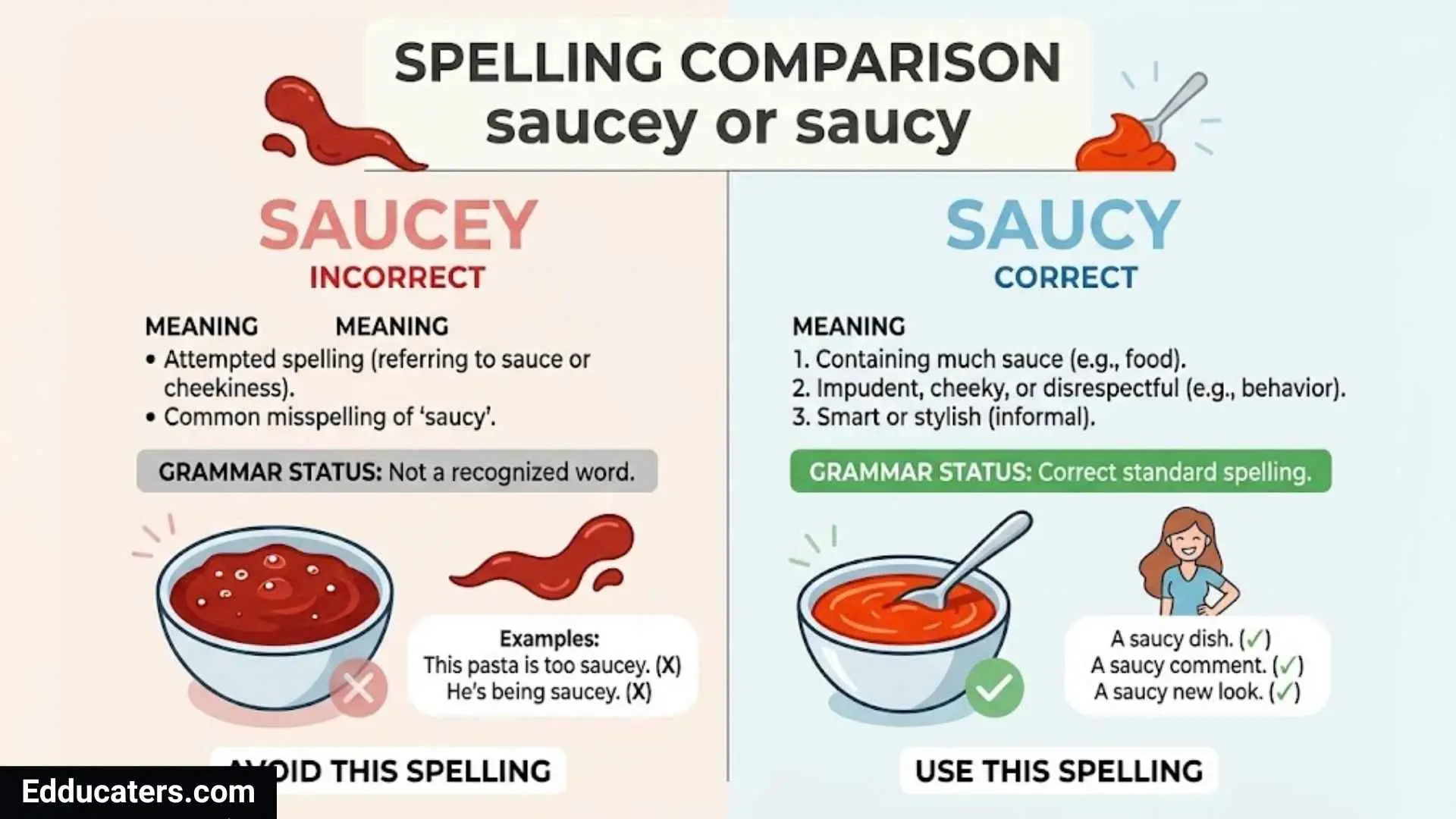
If you’ve come across saucey or saucy, you may be wondering whether both spellings are correct or whether one is simply a common misspelling. The short answer is that saucy is the standard spelling in modern English. Saucey is generally considered a misspelling when you mean the adjective saucy.
The word saucy has several meanings. It can describe food with plenty of sauce, but it can also describe someone who is cheeky, bold, playful, or slightly disrespectful. The pronunciation is the same regardless of the intended meaning: SAW-see.
Saucy or Saucey: Quick Answer
If you’re looking for the correct spelling, the answer is simple:
Saucy is the standard spelling. Saucey is generally a misspelling.
Saucy can describe food containing plenty of sauce, or it can describe someone or something as cheeky, bold, playful, or slightly provocative.
The word is pronounced SAW-see, and the pronunciation doesn’t change between these meanings.
Saucey or Saucy: Which Is Correct?
Saucy is the correct standard spelling. Saucey is not the usual standard spelling of the adjective.
| Form | Correct Standard Spelling? | Meaning | Example |
| Saucy | Yes | Containing or covered with sauce; cheeky or bold | The pasta was rich and saucy. |
| Saucey | No, generally | Usually a misspelling of saucy | Use saucy instead. |
So, if you’re writing standard English, choose saucy.
For example:
- Correct: The chicken was delicious and saucy.
- Correct: She gave him a saucy smile.
- Incorrect: The chicken was delicious and saucey.
- Incorrect: She gave him a saucey smile.
There is no standard British-American spelling difference that makes saucey the correct alternative to saucy.
What Does Saucy Mean?
Saucy is an adjective with more than one common meaning.
The meaning depends on the context.
Saucy Meaning When Talking About Food
When saucy describes food, it usually means that the food contains a generous amount of sauce or is covered in a flavorful sauce.
For example:
- The restaurant serves saucy chicken wings.
- I prefer my pasta saucy rather than dry.
- The noodles were hot, spicy, and saucy.
- We ordered a saucy barbecue chicken dish.
In this context, saucy is related to sauce.
It doesn’t mean that the food is being cheeky or rude. Instead, it describes its texture or the amount of sauce accompanying it.
Saucy Meaning When Describing a Person
When saucy describes a person, it can mean cheeky, bold, impudent, or slightly disrespectful, often in a playful way.
For example:
The saucy child answered back with a grin.
Here, saucy suggests that the child was being cheeky or unusually bold.
Depending on the context and tone, describing an adult as saucy can also suggest that the person is playful, flirtatious, or somewhat provocative.
For example:
She gave him a saucy smile.
The exact meaning depends heavily on the situation.
Saucy as a Description of Food
One of the most common modern uses of saucy is for food.
If someone says a dish is saucy, they generally mean that it has plenty of sauce or that the sauce is an important part of the dish.
For example:
- The ribs were tender and saucy.
- This pasta is wonderfully saucy.
- I love saucy noodles.
- The wings have a sweet and spicy sauce.
- The burger comes with a saucy barbecue topping.
Does Saucy Mean “Full of Sauce”?
Usually, yes.
In food-related contexts, saucy can mean containing, covered with, or served with a substantial amount of sauce.
However, it doesn’t necessarily mean that the food is literally overflowing with sauce. It can simply emphasize that the sauce is prominent.
For example:
This chicken is much saucier than the grilled chicken we had yesterday.
This means the chicken has more sauce or a more prominent sauce.
What Does “Saucy Girl” Mean?
The phrase saucy girl usually describes a girl or young woman who is cheeky, bold, lively, or playfully disrespectful.
For example:
She’s a saucy girl who always has a clever reply.
Here, saucy suggests that she is confident and cheeky.
The phrase can also have a playful or flirtatious meaning when used about an adult woman, depending on the context.
Because saucy can carry different shades of meaning, you should consider the situation before using it to describe someone.
What Does “Saucy Person” Mean?
A saucy person is generally someone who behaves in a cheeky, bold, or slightly impudent way.
For example:
That saucy person always finds a way to make everyone laugh.
The word doesn’t necessarily mean that the person is seriously rude. Saucy can describe playful behavior rather than genuine disrespect.
The tone matters.
Compare:
- He made a saucy comment. — He made a cheeky or slightly inappropriate comment.
- She gave me a saucy grin. — She gave a playful, cheeky, or possibly flirtatious smile.
- That saucy child talked back to his teacher. — The child behaved boldly or disrespectfully.
How Do You Pronounce Saucy?
Saucy is commonly pronounced:
SAW-see
In IPA, it can be represented as:
/ˈsɔːsi/ in many varieties of English.
It has two syllables:
sau-cy
The first syllable is stressed:
SAW-see
The pronunciation does not change because of the meaning. Whether you are talking about saucy pasta or a saucy person, the word is pronounced the same way.
Is “Saucey” Pronounced Differently?
No.
If someone writes saucey intending the word saucy, they generally mean the same pronunciation. The problem is the spelling, not the pronunciation.
The standard spelling is:
saucy
not:
saucey
Why Do People Spell It “Saucey”?
The spelling saucey is an understandable mistake because the word is closely associated with sauce.
The noun is:
sauce
The adjective is:
saucy
It can therefore be tempting to add -y directly to sauce and write saucey. Standard English, however, uses saucy.
This is similar to other spelling patterns in English where adding a suffix changes the spelling of the original word.
So although saucey looks logical at first glance, saucy is the conventional spelling.
Saucy vs Sauce: Understanding the Word Forms
It’s useful to distinguish sauce, saucy, and sauced because they have different grammatical roles and meanings.
| Word | Part of Speech | Meaning | Example |
| Sauce | Noun | A liquid or semi-liquid food accompaniment | The sauce was spicy. |
| Saucy | Adjective | Having plenty of sauce; cheeky or bold | The noodles were saucy. |
| Sauced | Adjective/verb form | Covered with or containing sauce; also has other meanings depending on context | The chicken was well sauced. |
For example:
The sauce was delicious.
Here, sauce is a noun.
The pasta was saucy.
Here, saucy is an adjective describing the pasta.
This distinction helps explain why saucey isn’t the standard spelling of the adjective.
Saucy Synonyms
The best synonym for saucy depends on which meaning you have in mind.
Synonyms for Saucy Food
When talking about food, possible alternatives include:
- sauced
- covered in sauce
- rich in sauce
- juicy
- moist
- flavorful
Not all of these are exact synonyms. For example, juicy describes moisture rather than specifically referring to sauce.
Synonyms for a Saucy Person
When describing someone’s behavior, possible synonyms include:
- cheeky
- bold
- impudent
- brash
- playful
- mischievous
- sassy
- flirtatious
Again, the exact choice depends on the context.
For example, cheeky often works well when someone is playfully disrespectful, while flirtatious emphasizes romantic or suggestive behavior.
Saucy or Saucey in English: Which Should You Use?
If you’re writing standard English, use saucy.
This applies to both major meanings of the word:
The wings are saucy.
and:
He made a saucy remark.
In both cases, saucy is the standard spelling.
You should generally avoid saucey in formal writing, educational writing, professional communication, and standard website content.
Common Mistakes With Saucy
Incorrect: The pasta is saucey.
Correct: The pasta is saucy.
The adjective is spelled saucy, not saucey.
Incorrect: She gave him a saucey look.
Correct: She gave him a saucy look.
Here, saucy means cheeky, bold, playful, or possibly flirtatious.
Incorrect: This is a very saucey dish.
Correct: This is a very saucy dish.
When describing food with plenty of sauce, use saucy.
Sentences With “Saucy”
Here are some natural examples showing the different uses of saucy:
- The restaurant is known for its saucy chicken wings.
- I like my pasta rich and saucy.
- The noodles were spicy, flavorful, and saucy.
- She gave him a saucy smile.
- The saucy child refused to apologize.
- He made a saucy comment during dinner.
- These ribs are much saucier than the ones we had last week.
- The recipe produces a thick and saucy curry.
- Don’t be so saucy with your teacher.
- She gave her friend a saucy reply.
These examples show why context matters. Saucy can describe food, behavior, comments, expressions, and people.
Is Saucy a Formal or Informal Word?
Saucy is a standard English word, but its suitability depends on how you’re using it.
When describing food, it is completely ordinary:
The restaurant serves saucy barbecue ribs.
When describing a person’s behavior, it can sound playful, old-fashioned, humorous, or mildly disapproving depending on the context:
Don’t get saucy with me.
It can also have a flirtatious or suggestive sense:
She gave him a saucy smile.
So the word itself is not incorrect or inherently informal. Its tone changes according to context.
Is Saucey a Word?
Saucey is not the standard spelling of the adjective normally intended by people searching for saucey or saucy.
In most ordinary English writing, if you mean the adjective pronounced SAW-see, write:
saucy
The spelling saucey may occasionally appear as a creative spelling, brand name, username, business name, or other proper-name usage. Such uses don’t change the standard spelling of the English adjective.
Is Saucy a British or American Spelling?
Saucy is used in both British English and American English.
Unlike pairs such as colour/color or tyre/tire, there is no standard British-American spelling distinction between saucy and saucey.
So you don’t need to choose one based on your variety of English.
Use:
saucy in both British and American English.
Frequently Asked Questions
Is “saucey” or “saucy” correct?
Saucy is the standard correct spelling. Saucey is generally a misspelling of saucy when used as the adjective.
What does saucy mean in food?
When used for food, saucy means containing, covered with, or served with a noticeable amount of sauce. For example, saucy chicken wings are chicken wings with plenty of sauce.
What does a saucy girl mean?
A saucy girl usually means a girl or woman who is cheeky, bold, lively, or playfully disrespectful. Depending on context, saucy can also have a flirtatious meaning.
What does saucy person mean?
A saucy person is someone who behaves in a cheeky, bold, impudent, or playful way. The word can be mildly negative or playful depending on the speaker’s tone.
How do you pronounce saucy?
Saucy is pronounced approximately SAW-see, with two syllables and stress on the first syllable. A common IPA representation is /ˈsɔːsi/.
Is saucey a misspelling?
In standard English, saucey is generally a misspelling of saucy. The standard adjective is spelled saucy.
Is saucy a British word?
Yes. Saucy is used in both British and American English. There is not a spelling difference between the two varieties.
What is another word for saucy?
For a person, possible synonyms include cheeky, sassy, bold, impudent, playful, or flirtatious, depending on the context. For food, alternatives might include sauced or rich in sauce, although these aren’t always exact synonyms.
Conclusion
When choosing between saucey or saucy, use saucy in standard English. It is the correct conventional spelling of the adjective.
The word has two especially common uses. For food, saucy means containing or covered with plenty of sauce. When describing a person, expression, or comment, it can mean cheeky, bold, playful, impudent, or flirtatious, depending on context.
Remember the spelling as s-a-u-c-y: saucy, not saucey.

I’m Julian Mercer, an English language writer dedicated to helping people master grammar through practical examples and clear explanations. I enjoy teaching grammar in a way that is both engaging and easy to remember.
My work focuses on grammar rules, punctuation, word usage, and writing techniques that readers can apply in everyday life. I believe learning English should be simple, enjoyable, and useful.
Books
English Grammar in Practice
Writing with Precision
 Nathan Whitmore
 Claire Holloway