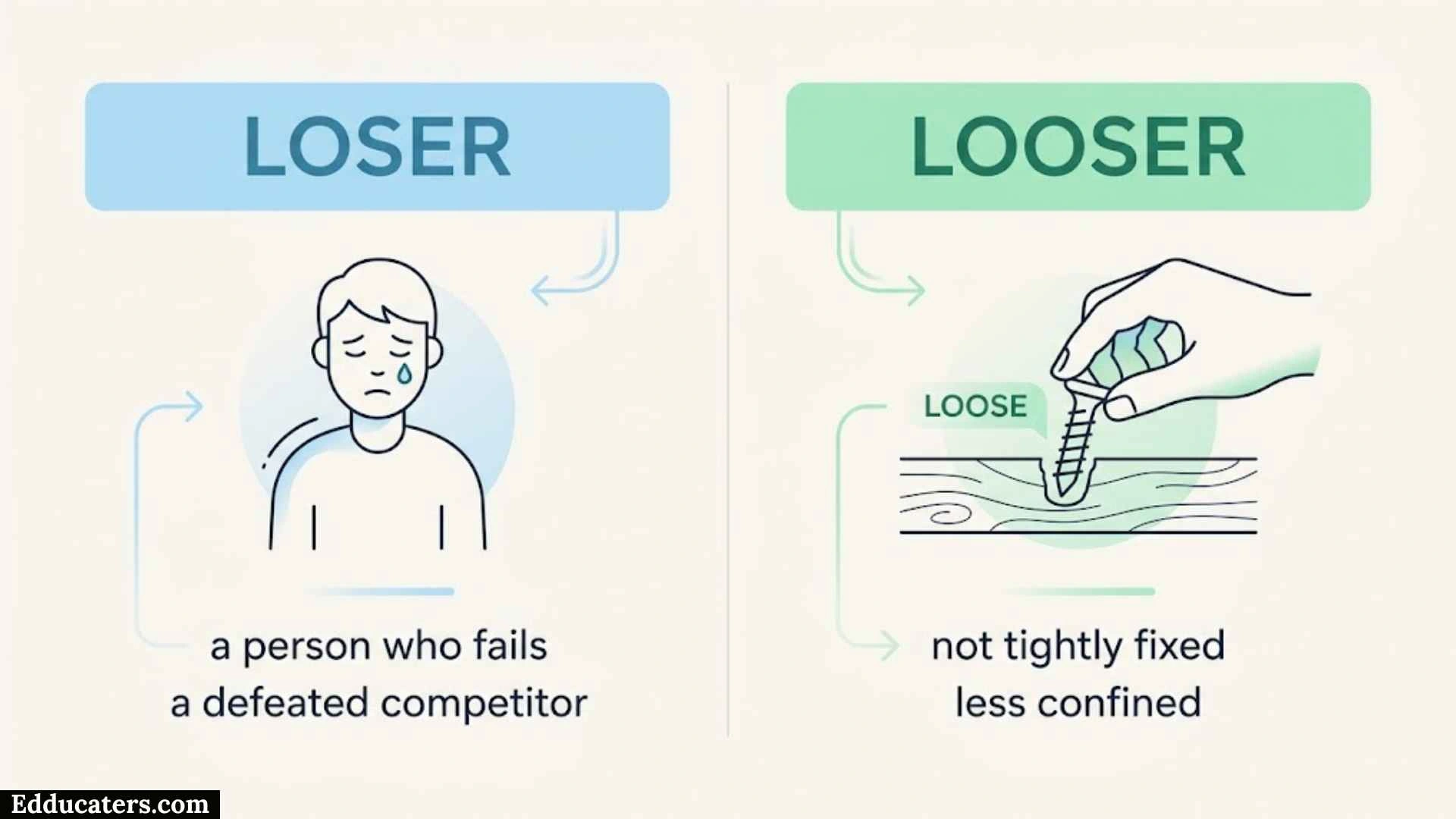
If you are unsure whether to write loser or looser, the correct spelling depends on what you mean. Loser is a noun related to the verb lose, while looser is the comparative form of the adjective loose.
For example:
- He was the loser of the final match.
- This shirt is looser than the one I tried yesterday.
These words look and sound similar, but they have different meanings and grammatical roles. The easiest way to choose the right one is to look at the word you are trying to describe: if you mean someone who loses, use loser; if you mean something that is less tight or less firmly held, use looser.
Loser and Looser at a Glance
| Word | Meaning | Word Form | Example |
| loser | A person or team that does not win | Noun | The loser of the game shook hands with the winner. |
| looser | Less tight, less firmly held, or less restrictive | Comparative adjective | These pants are looser around the waist. |
| lose | To fail to win, misplace, or no longer have something | Verb | We might lose the game. |
| loose | Not tight, not firmly attached, or not closely controlled | Adjective | The handle is loose. |
A useful rule is simple: loser comes from lose, while looser comes from loose.
What Does Loser Mean?
Loser is a noun formed from lose. It can refer to a person or team that does not win a game, competition, contest, or other situation.
Cambridge Dictionary defines loser as someone who does not win a game or competition. It also records broader informal uses for someone who is unsuccessful.
Loser as Someone Who Does Not Win
The most straightforward use of loser is connected with competition.
Examples:
- The loser of the match was eliminated from the tournament.
- Every competition has a winner and a loser.
- The losing team accepted the result.
- The loser of the final received a silver medal.
Here, loser identifies the person or team that did not win.
Notice that the word is connected to the verb lose:
lose → loser
For example:
The team may lose the game.
If it does, the team is the loser of the game.
This relationship makes the spelling easier to remember.
Loser as an Informal Insult
Loser can also be used informally to describe someone considered unsuccessful or someone the speaker does not respect. Cambridge identifies this use as informal and, in some contexts, offensive.
For example:
- He called his opponent a loser.
- Calling someone a loser can sound insulting.
- The word is acceptable when discussing the result of a competition, but it can be offensive when directed at a person as an insult.
This distinction matters because loser is not automatically an insult. In a sentence such as “The loser of the race finished second,” it simply describes the competition result.
What Does Looser Mean?
Looser is the comparative form of loose.
The adjective loose describes something that is not firmly held, fastened, attached, or fitted. Cambridge gives examples involving loose wires, loose hair, and things that are not held together.
When something becomes less tight than another thing, the comparative form is looser.
Examples:
- This jacket is looser than my old one.
- The knot became looser after several minutes.
- These shoes feel looser than the pair I wore yesterday.
- The new rules are looser than the previous rules.
The spelling follows this pattern:
loose → looser
The extra o belongs to the base word loose.
Looser Means “Less Tight”
The most common meaning of looser is “less tight.”
Compare these sentences:
My belt is loose.
This means the belt is not tight.
My new belt is looser than my old belt.
This means the new belt is less tight than the old one.
The comparative ending -er changes loose into looser.
Other examples include:
- The sweater has a looser fit.
- Make the knot looser.
- Her ponytail became looser during the workout.
- The screws are looser than they were before.
The Main Difference Between Loser and Looser
The biggest difference is their base words.
Loser comes from lose, while looser comes from loose.
That gives you two separate word families:
Lose → lost → loser → loss
Loose → loosen → looser → loosely
Merriam-Webster specifically points out the connection between lose, lost, loser, and loss, and notes that the spelling of lose can cause confusion because its pronunciation does not follow what some readers might expect from its spelling.
Use Loser for Losing
Choose loser when the sentence is about losing, defeat, or failure.
Examples:
- The loser left the field quietly.
- Nobody wants to be the loser.
- The tournament’s loser was eliminated.
- The losing player congratulated the winner.
A quick substitution test can help. If you can replace the word with person who loses, you probably need loser.
For example:
The loser of the match received a trophy.
You can think of it as:
The person who lost the match received a trophy.
Use Looser for Something Less Tight
Choose looser when the sentence compares the tightness, fit, attachment, or restriction of two things.
Examples:
- This shirt is looser than that one.
- The rope became looser.
- I prefer a looser fit.
- The lid is looser than before.
A useful substitution test is to replace looser with less tight.
For example:
These jeans are looser than my old jeans.
The meaning is:
These jeans are less tight than my old jeans.
If less tight makes sense, looser is likely the correct word.
Why Do People Confuse Loser and Looser?
The confusion happens mainly because loser and looser look almost identical.
They both begin with los-, and both end with -er. The important difference is the number of o’s:
- loser = one o after the l
- looser = two o’s after the l
The words also belong to different word families.
Lose means to no longer have something, fail to win, or be defeated.
Loose means not tight or not firmly attached.
Merriam-Webster’s discussion of commonly confused words specifically identifies lose and loose as a frequent spelling problem and connects loser with the lose family.
The Extra O Changes the Meaning
Consider these examples:
He is the loser of the game.
The sentence is about competition.
His shirt is looser than mine.
The sentence is about fit.
Changing the spelling changes the entire meaning.
This is why simply choosing the spelling that “looks right” can lead to an incorrect sentence.
Loser, Looser, Lose, and Loose Compared
These four words are especially useful to learn together because they are closely connected to the spelling mistake.
| Word | Part of Speech | Basic Meaning | Example |
| lose | Verb | Fail to win or no longer have something | Don’t lose your keys. |
| loser | Noun | Someone who loses | The loser left the competition. |
| loose | Adjective | Not tight or firmly attached | The wheel is loose. |
| looser | Comparative adjective | Less tight | This wheel is looser than the other one. |
Learning the four words as a group is often more effective than memorizing loser and looser separately.
Lose and Loser Belong Together
If the sentence involves losing, think about lose.
Examples:
- I don’t want to lose the game.
- They lost the game.
- They were the losers of the game.
The spelling stays with the single-o family.
Loose and Looser Belong Together
If the sentence involves something being not tight, think about loose.
Examples:
- The screw is loose.
- The screw became looser.
- The mechanic tightened the screw.
These words belong to the double-o family.
Pronunciation of Loser and Looser
Pronunciation can also contribute to the confusion.
In American English, Cambridge gives loser as approximately /ˈluːzɚ/ and loose as /luːs/. The final sound is important: loser ends with a voiced z sound, while loose ends with an unvoiced s sound.
In ordinary speech, loser and looser can sound very similar, especially when spoken quickly.
The safest way to distinguish them is therefore not to rely only on pronunciation. Look at the meaning and the grammatical role.
A Simple Pronunciation Memory Tip
Think of the final sound:
- loser → sounds like LOO-zər
- looser → sounds like LOO-sər
The first refers to someone who loses.
The second refers to something that is less tight.
Regional accents can affect the exact sound, so spelling and meaning are more reliable clues than pronunciation alone.
Common Mistakes With Loser and Looser
Several mistakes appear repeatedly when these words are used in writing.
Mistake 1: Writing “looser” for Someone Who Lost
Incorrect:
He was the looser of the competition.
Correct:
He was the loser of the competition.
The sentence refers to someone who lost, so loser is required.
Mistake 2: Writing “loser” for Something Less Tight
Incorrect:
This shirt is loser than the other one.
Correct:
This shirt is looser than the other one.
The sentence compares the fit of two shirts, so looser is correct.
Mistake 3: Confusing Lose and Loose
Incorrect:
I don’t want to loose this game.
Correct:
I don’t want to lose this game.
Lose is the verb used for failing to win.
Another example:
Incorrect:
The door handle is lose.
Correct:
The door handle is loose.
Here, the meaning is that the handle is not firmly attached.
How to Remember Loser and Looser
A simple memory trick is to connect each word with its base word.
Remember Loser With Lose
Think:
lose → loser
If someone loses, that person can be called the loser of a competition.
Examples:
- lose a game
- lose a race
- lose a contest
- loser of the game
- loser of the race
- loser of the contest
Remember Looser With Loose
Think:
loose → looser
If something is already loose, making it less tight gives you looser.
Examples:
- loose shirt → looser shirt
- loose knot → looser knot
- loose fit → looser fit
- loose rules → looser rules
The extra o in looser can remind you of the extra space or looseness involved.
When Should You Use Loser in a Sentence?
Use loser when the word functions as a noun for someone or something that loses, does not win, or is disadvantaged in a particular situation.
Examples include:
- The loser of the match will be eliminated.
- The loser admitted that the other player was better on the day.
- The final loser received no points.
- Every contest has winners and losers.
- The team was the loser after a close game.
In business or other contexts, loser can also describe a person, group, company, or other party that ends up at a disadvantage. Cambridge records this broader business usage as well.
When Should You Use Looser in a Sentence?
Use looser when comparing two things and saying that one is less tight, less firmly held, or less restrictive.
Examples:
- I need a looser shirt.
- This knot is looser than the first one.
- The new jacket has a looser fit.
- The rope became looser after the tension was released.
- The company introduced looser restrictions.
Not every use of looser has to describe clothing. The word can describe physical objects, connections, rules, restrictions, or other things where loose has a comparative meaning.
A Quick Decision Guide
When you are unsure between loser and looser, ask yourself one question:
Am I talking about someone who loses, or something that is less tight?
If you mean someone who loses, choose:
loser
If you mean less tight, choose:
looser
You can also use these two substitution tests:
- Replace the word with person who loses.
- If it works, use loser.
- Replace the word with less tight.
- If it works, use looser.
For example:
The ___ of the race received a medal.
“Person who loses” makes sense, so the answer is loser.
This sweater is ___ than the other one.
“Less tight” makes sense, so the answer is looser.
Is Looser a Correct Word?
Yes. Looser is a correctly spelled English word.
It is the comparative form of loose.
For example:
- loose
- looser
- loosest
You use looser when comparing two things:
This jacket is looser than that jacket.
You use loosest when comparing three or more things or referring to the greatest degree:
This is the loosest jacket in the collection.
Cambridge lists loose as an adjective meaning not firmly held or fastened and also records its verb uses.
Is Loser a Correct Word?
Yes. Loser is also a correctly spelled English word.
It is a noun related to the verb lose.
Examples:
- The loser left the field.
- The winner congratulated the loser.
- The loser of the final match received a silver medal.
Cambridge lists loser as a noun for someone who does not win and also records other informal and business-related meanings.
The important point is that loser and looser are both real words. The mistake is using one when you mean the other.
Frequently Asked Questions
Is it loser or looser?
Both are correct words, but they have different meanings. Loser means someone who loses or does not win. Looser means less tight or less restrictive.
Is “looser” a spelling mistake?
No. Looser is a legitimate English word. It is the comparative form of loose.
Is “loser” related to “lose”?
Yes. Loser is formed from lose and refers to someone or something that loses or is at a disadvantage in a particular context.
Which is correct: “the loser” or “the looser”?
Use the loser when talking about a person or team that did not win.
Example:
The loser of the match left the stadium.
Use the looser only when you are describing something that is less tight or less restrictive and the noun has been omitted or is understood from context.
Example:
Of the two knots, this is the looser.
What is the difference between lose and loose?
Lose is usually a verb meaning to fail to win, misplace something, or no longer have something.
Loose is commonly an adjective meaning not tight or not firmly attached.
Examples:
Don’t lose your phone.
The phone case is loose.
What is the difference between loose and looser?
Loose describes something that is not tight.
Looser is the comparative form, meaning less tight than something else.
Example:
This shirt is loose.
This shirt is looser than my other shirt.
How do you pronounce loser?
In American English, loser is pronounced approximately LOO-zər, represented by Cambridge as /ˈluːzɚ/.
How do you pronounce looser?
Looser is pronounced approximately LOO-sər, with the final sound corresponding to the s in loose.
Why do loser and looser sound similar?
They share much of the same sound, particularly at the beginning. Their different meanings and spellings come from different base words: lose and loose.
Is “looser” the opposite of “tighter”?
Yes, in many contexts. Looser can mean less tight, while tighter means more tight.
For example:
Make the knot looser.
Make the knot tighter.
Can loser be used as an insult?
Yes. Loser has an informal use as an insult or negative description of someone considered unsuccessful. Because of this, it can sound offensive when directed at a person. Cambridge specifically identifies this usage as informal and offensive in some contexts.
Can looser describe rules?
Yes. Looser can describe rules, restrictions, controls, or requirements that are less strict.
For example:
The organization introduced looser regulations.
Here, looser does not mean someone who loses. It means less restrictive.
Conclusion
The difference between loser and looser becomes much easier when you remember their base words.
Loser comes from lose and refers to someone who loses, does not win, or is disadvantaged in a particular situation.
Looser comes from loose and means less tight, less firmly attached, or less restrictive.
The simplest memory rule is:
Lose → loser
Loose → looser
So, if you are writing about the person who did not win a competition, use loser. If you are comparing the tightness or restrictiveness of two things, use looser.
References
- Cambridge Dictionary. “Loser.”
- Cambridge Dictionary. “Loose.”
- Cambridge Dictionary. “Loosing.”
- Merriam-Webster. “Lose/Loose,” from its commonly confused words guidance.
- Merriam-Webster Dictionary. Related entries and usage guidance for lose, loose, and loser.

I’m Julian Mercer, an English language writer dedicated to helping people master grammar through practical examples and clear explanations. I enjoy teaching grammar in a way that is both engaging and easy to remember.
My work focuses on grammar rules, punctuation, word usage, and writing techniques that readers can apply in everyday life. I believe learning English should be simple, enjoyable, and useful.
Books
English Grammar in Practice
Writing with Precision
 Claire Holloway