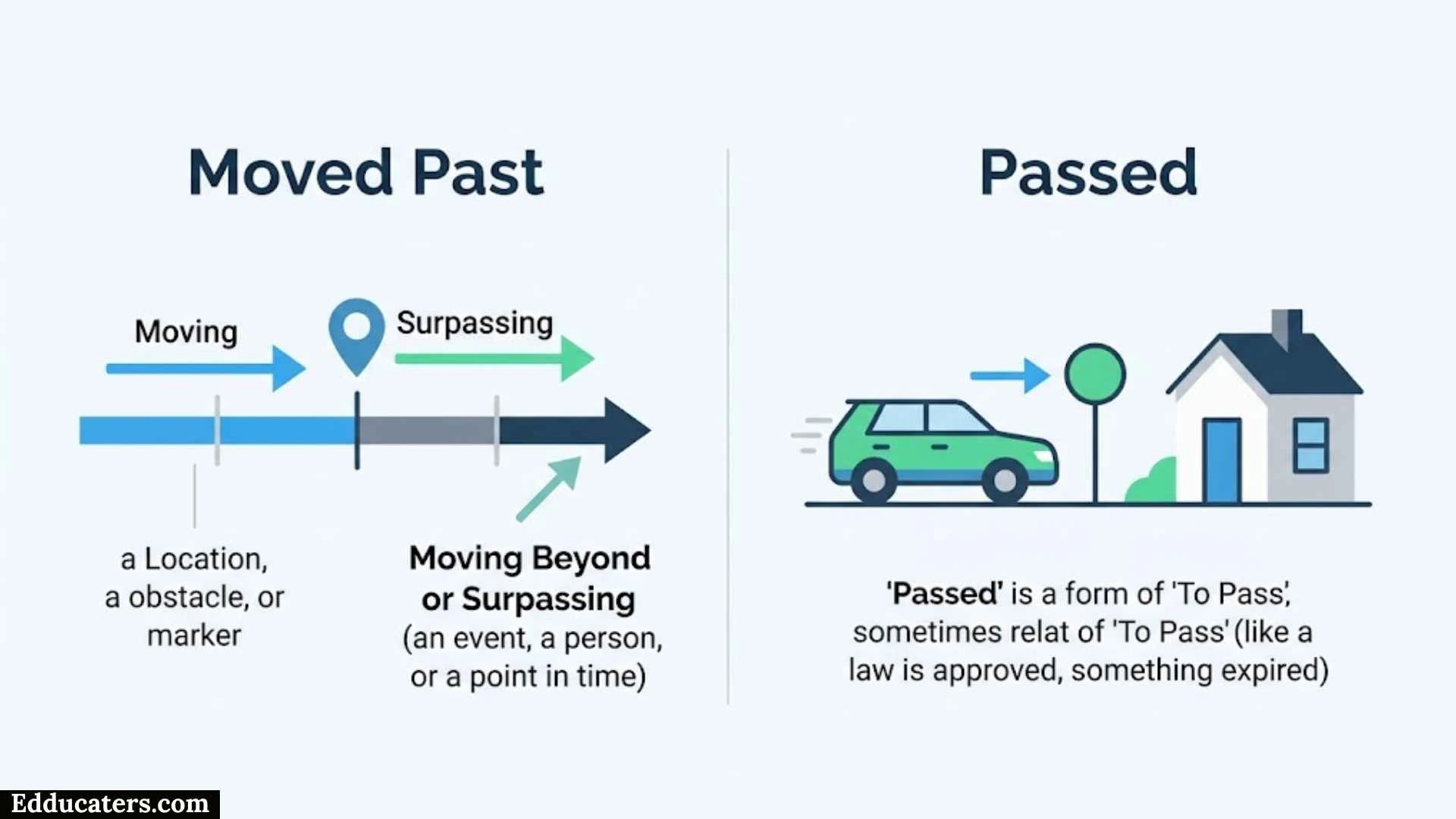
If you are wondering whether “moved past” or “moved passed” is correct, the answer is “moved past.” Use past when you mean moving beyond a person, place, point, stage, problem, or experience. Passed is the past-tense and past-participle form of the verb pass, so it normally cannot replace past in the phrase “moved past.” Cambridge Dictionary identifies passed as the past simple and past participle of pass, while Merriam-Webster defines past as a preposition meaning “beyond” or describing movement by and beyond something.
For example:
She moved past the difficult experience and focused on the future.
Here, past means “beyond.” The sentence could also be expressed as:
She moved beyond the difficult experience and focused on the future.
By contrast, passed is correct when it is the verb:
She passed the exam.
The two words sound similar, which explains why they are often confused in writing. However, they have different grammatical functions and meanings.
This guide explains the difference between moved past and moved passed, shows when to use each word, provides real-world examples, and gives you a simple decision method you can use whenever you encounter this grammar question.
Quick Answer: Is It “Moved Past” or “Moved Passed”?
The correct expression is “moved past” when you mean moved beyond something or someone.
| Expression | Correct? | Meaning |
| moved past | Yes | Moved beyond something |
| moved passed | No, when used to mean “moved beyond” | Incorrect word choice |
| passed | Yes | Past form of the verb “pass” |
| moved beyond | Yes | Similar meaning to “moved past” |
Examples:
- The car moved past the building.
- She moved past her fears.
- The team moved past its early problems.
- We moved past the halfway point.
The basic rule is easy:
Past = beyond
Passed = the past form of the verb “pass.”
Merriam-Webster lists past as a preposition meaning “beyond” and also uses it for movement in a direction that goes close to and then beyond something.
Why “Moved Past” Is Correct
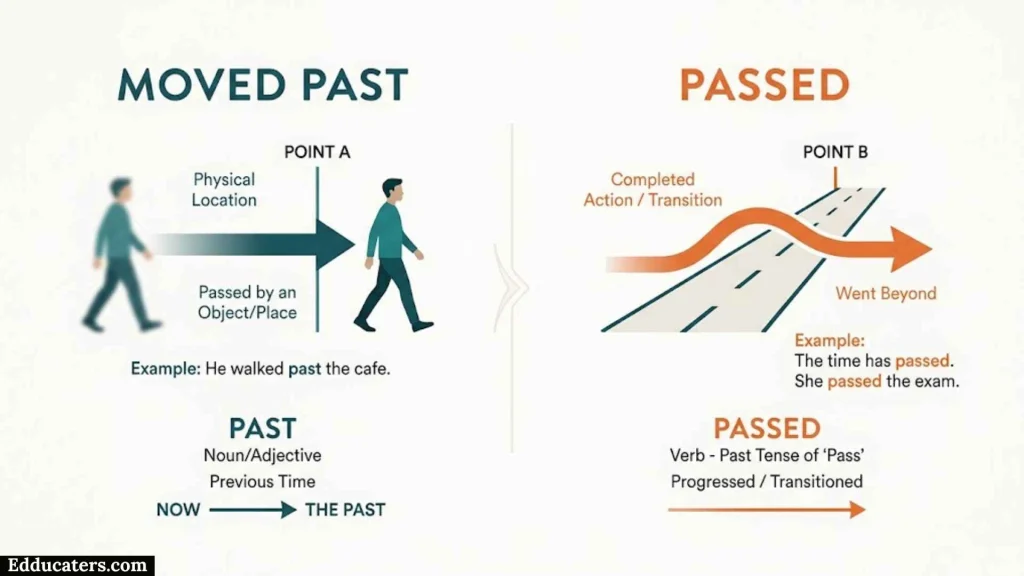
The grammar becomes clearer when you look at the role each word plays.
In the sentence:
The car moved past the school.
The main verb is moved. The word past tells us where the car moved: it went by and beyond the school.
This is why past fits naturally after moved.
The same pattern appears in:
- She moved past the crowd.
- He moved past the doorway.
- We moved past the old building.
- The runner moved past the finish-line marker.
- The conversation moved past the original topic.
In each example, past describes something that lies beyond the point of movement.
Cambridge Dictionary explains that pass can itself mean going past something or someone, which helps explain why past and passed can appear interchangeable at first glance. They are not interchangeable grammatically, though.
The grammar behind “moved past”
Moved is the past form of the regular verb move. Cambridge Grammar explains that regular verbs generally form their past simple by adding -ed, giving move → moved.
In moved past, there are therefore two different grammatical elements:
- moved = the verb
- past = the word expressing movement beyond something
That distinction is the key to the entire question.
Why “moved passed” changes the grammar
Passed is not simply another spelling of past. It is a verb form.
For example:
She passed the store.
Here, passed is the main verb.
But:
She moved past the store.
Here, moved is the main verb and past describes the movement.
These sentences can describe a similar physical event, but their grammatical structures are different.
What Does “Moved Past” Mean?
The expression moved past has several useful meanings. It can describe physical movement, progress through a stage, or emotional and personal growth.
“Moved past” for physical movement
The most literal meaning is to move beyond a person, object, or location.
Examples:
- The bus moved past the station.
- She moved past the security desk.
- I moved past the other customers.
- The truck moved past the intersection.
- The cyclist moved past the parked cars.
In each case, something physically travels beyond another point.
For example:
The driver moved past the entrance and had to turn around.
The entrance is the reference point. The driver went beyond it.
Merriam-Webster similarly defines past as describing movement close to and then beyond something.
“Moved past” for emotional or personal progress
The phrase is also widely used figuratively.
Someone can move past:
- a mistake
- a disagreement
- disappointment
- fear
- grief
- an embarrassing experience
- a difficult period
- an old habit
- a previous failure
For example:
After several months, she moved past the disappointment.
This does not mean that she physically walked beyond the disappointment. It means she emotionally progressed beyond it and stopped allowing the experience to control her present.
Other examples include:
- He has moved past his fear of public speaking.
- They finally moved past their disagreement.
- She is trying to move past what happened.
- The employee moved past the mistake and improved her performance.
This figurative use is especially common in conversations about relationships, personal development, work, and difficult life experiences.
“Moved past” for progress or development
The phrase can also describe progress from one stage to another.
For example:
The company has moved past its early startup phase.
This means the company is no longer in that earlier stage.
Similarly:
The project has moved past the planning stage.
Here, the project has progressed beyond planning and entered another phase.
This use is common in business, education, technology, project management, and professional communication.
Past and Passed: What Is the Difference?
The most important distinction is grammatical.
What does “past” mean?
Past can have several functions. It can refer to an earlier period of time, but it can also function as a preposition or adverb associated with movement beyond something. Merriam-Webster lists meanings including “beyond” and movement by and beyond a location.
Examples:
- Walk past the pharmacy.
- The car drove past the house.
- We are past the halfway point.
- That happened in the past.
- She wants to move past the problem.
So past is not only about time. It can also describe location, movement, position, and progress.
What does “passed” mean?
Passed is the past simple and past participle of pass. Cambridge Dictionary explicitly identifies it as such.
Examples:
- She passed the exam.
- He passed the ball.
- The car passed the truck.
- We passed the entrance.
- Several months passed before they met again.
In these sentences, passed is connected to the verb pass.
Cambridge’s grammar guidance also explains that English verbs have different forms, including the base form, past form, and past participle.
Moved Past and Passed in Side-by-Side Examples
Comparing similar sentences is one of the fastest ways to understand the distinction.
| Sentence | Why it is correct |
| She moved past me. | “Past” means beyond me. |
| She passed me. | “Passed” is the verb meaning went by me. |
| The car moved past the house. | “Past” describes the car’s movement beyond the house. |
| The car passed the house. | “Passed” is the main verb. |
| He moved past his mistake. | He progressed beyond the mistake emotionally or practically. |
| He passed the test. | He successfully completed the test. |
| We moved past the difficult stage. | We progressed beyond that stage. |
| Time passed quickly. | “Passed” is the verb. |
The important lesson is that moved past and passed can sometimes communicate similar ideas, but they build the sentence differently.
A Simple Decision Guide for Choosing Past or Passed
When you are unsure, use this quick test.
Step 1: Ask what you mean
Do you mean beyond?
If yes, choose past.
She moved past the door.
If you mean the action of passing, consider passed.
She passed the door.
Step 2: Identify the main verb
Look at the sentence and ask:
What is the main action?
If the main action is moved, then past can describe what the person or object moved beyond.
The child moved past the teacher.
If the main action is pass, its past form is passed.
The child passed the teacher.
Step 3: Try replacing “past” with “beyond”
This is an especially useful test.
The runner moved past the other competitors.
Try:
The runner moved beyond the other competitors.
The meaning still works, so past is appropriate.
Now try:
She passed the exam.
Replacing it with “beyond” does not work:
She beyond the exam.
That tells you that passed is being used as a verb.
The fastest rule
If you need one rule to remember, use this:
If “past” means “beyond,” spell it P-A-S-T.
That rule will correctly solve most past and passed questions.
Common Mistakes With Moved Past and Passed
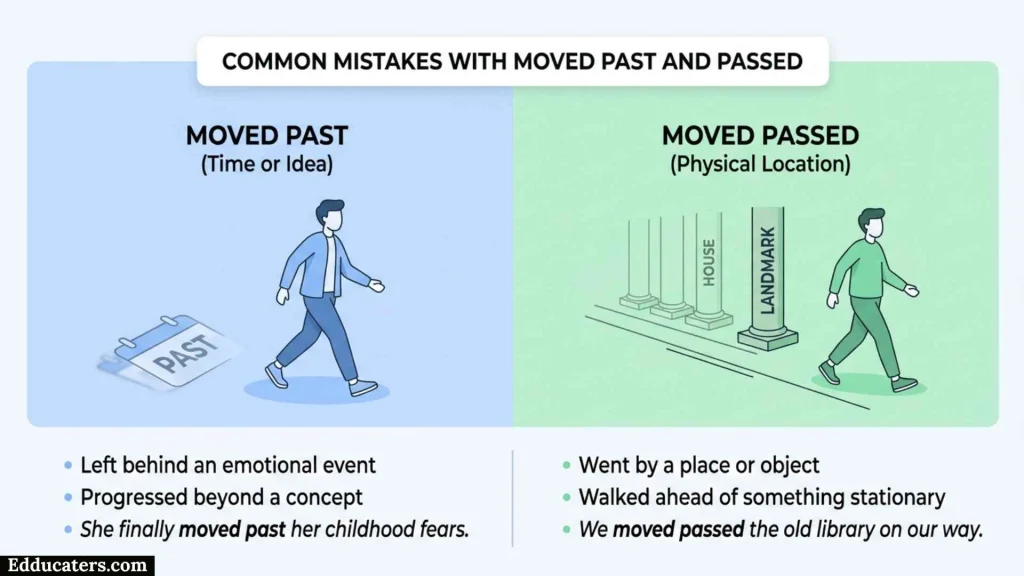
The similarity in pronunciation creates several predictable errors.
Mistake: “She moved passed the car”
Incorrect:
She moved passed the car.
Correct:
She moved past the car.
The sentence describes movement beyond the car, so past is the correct choice.
Mistake: “He moved passed his mistakes”
Incorrect:
He moved passed his mistakes.
Correct:
He moved past his mistakes.
The meaning is figurative: he progressed beyond his previous mistakes.
Mistake: “We moved passed the first stage”
Incorrect:
We moved passed the first stage.
Correct:
We moved past the first stage.
The word past means beyond that stage.
Mistake: assuming “passed” is always about physical movement
This is another common misconception.
Passed can describe physical movement:
The truck passed the building.
But it can also have other meanings:
She passed the exam.
He passed the message to his manager.
Time passed quickly.
The word remains a form of the verb pass. Cambridge lists several uses of pass, including moving past something, going beyond a point in time, and other meanings.
When “Passed” Is the Correct Choice
There are many sentences where passed is exactly right.
Passing a person or vehicle
The runner passed the cyclist.
Here, passed is the verb.
Passing an exam or test
She passed her final exam.
Here, passed means successfully completed the examination.
Passing something to another person
He passed the documents to his manager.
Again, passed is the past form of pass.
Time passing
Several years passed before they met again.
This is another normal use of the verb pass.
The important point is not to treat passed as an incorrect word. It is a perfectly correct word; it is simply not the correct replacement for “past” in “moved past.”
Can “Moved” and “Passed” Appear Together?
Yes, but not normally as the phrase “moved passed” meaning “moved beyond.”
For example:
She moved to a new city after she passed her exam.
Here, moved and passed are separate verbs in different parts of the sentence.
You might also write:
He moved, passed the old building, and continued toward the station.
The words are grammatically separate.
This distinction matters because seeing moved and passed next to each other in a sentence does not automatically make the combination wrong. The problem occurs when someone uses passed where the sentence needs past to mean beyond.
Moved Past in Different Real-Life Contexts
Understanding context makes the rule easier to apply naturally.
Everyday conversation
I need to move past this mistake.
The speaker means they want to stop dwelling on the mistake.
Workplace communication
The project has moved past the initial planning stage.
This means the project has progressed to a later stage.
Academic writing
The discussion moved past the original research question and considered broader implications.
Here, the discussion progressed beyond its original focus.
Relationships
They decided to move past the disagreement and work on their relationship.
The phrase refers to emotional progress rather than physical movement.
Sports
The runner moved past two competitors near the final turn.
This describes physical movement beyond other competitors.
These examples demonstrate why moved past is a flexible expression. Its core meaning remains the same: progressing beyond a reference point, whether that point is physical, emotional, professional, or conceptual.
“Moved Past” and “Moved Beyond”: Are They the Same?
Often, yes.
She moved past her fear.
and:
She moved beyond her fear.
Both can mean that she overcame or progressed beyond her fear.
However, moved past often sounds more natural in everyday American English, while moved beyond may sound slightly more formal depending on the context.
Other alternatives include:
- got past
- went beyond
- progressed beyond
- overcame
- left behind
- advanced beyond
The best choice depends on the context and desired tone.
Why These Words Are So Easy to Confuse
The main reason is pronunciation.
In many varieties of English, past and passed sound the same or extremely similar. This makes the distinction difficult to detect in conversation.
Writing removes that ambiguity because the spellings are different.
There is also a meaning overlap: pass can mean to go past something. Cambridge Dictionary specifically defines one use of pass as going past or moving in relation to someone or something.
That overlap explains why learners often think past and passed are simply alternative spellings.
They are not.
One is commonly a preposition, adverb, adjective, or noun depending on context; the other is a verb form.
Key Takeaways
Before finishing your sentence, remember these points:
- Moved past is correct when you mean moved beyond.
- Moved passed is incorrect when passed is being used as a replacement for past.
- Passed is the past form and past participle of pass.
- Past can describe movement beyond a person, object, place, or point.
- Past can also refer to earlier time or previous events.
- Passed can describe passing a person, passing an exam, passing an object, or the passage of time.
- If past can be replaced by beyond, it is usually the correct word.
- Moved past works for both literal movement and figurative progress.
Frequently Asked Questions About Moved Past or Passed
Is “moved past” grammatically correct?
Yes. Moved past is grammatically correct when past means beyond a person, place, object, stage, problem, or experience.
For example:
The car moved past the intersection.
Is “moved passed” correct?
Not when you mean moved beyond. In that situation, the correct expression is moved past.
Incorrect: She moved passed the crowd.
Correct: She moved past the crowd.
What is the difference between “moved past” and “passed”?
Moved past uses moved as the main verb and past to indicate movement beyond something.
Passed is itself a verb form of pass.
Compare:
The car moved past the house.
The car passed the house.
Both can describe the car going beyond the house, but the grammar is different.
Is “past” a verb?
Usually, no. Past commonly functions as a preposition, adverb, adjective, or noun depending on the sentence. Merriam-Webster lists several of these uses, including past as a preposition meaning “beyond.”
Is “passed” always a verb?
Passed is the past simple and past participle form of the verb pass. In some contexts, participles can also function adjectivally, but for the past and passed distinction, remembering it as the verb form of pass is the most useful rule.
Can I say “moved beyond” instead of “moved past”?
Yes. Moved beyond is grammatically correct and often has nearly the same meaning as moved past.
For example:
She moved beyond her previous limitations.
You could also say:
She moved past her previous limitations.
Which is correct: “moved past the point” or “moved passed the point”?
The correct phrase is:
Moved past the point
For example:
The discussion moved past the point where a simple solution was possible.
Here, the past means beyond.
Is “passed” related to “pass”?
Yes. Passed is the past simple and past participle of pass.
Examples:
pass → passed
I pass the building every morning.
I passed the building yesterday.
How can I remember past and passed easily?
Use the beyond test.
If you can replace the word with beyond, use past.
She moved past the store.
She moved beyond the store.
If replacing it with beyond destroys the sentence, you may need passed or another form of the verb pass.
Editorial Note on Usage
The distinction between past and passed is a standard English grammar and vocabulary issue, not a matter of personal writing style. The most reliable approach is to identify the grammatical role of the word in the sentence rather than relying on pronunciation.
For learners, editors, students, and professional writers, the “past = beyond” test is a practical shortcut, while checking whether passed is functioning as a form of pass provides a more complete grammatical explanation. Cambridge Dictionary and Merriam-Webster both support the underlying distinction used in this guide.
References
- Cambridge Dictionary — “Passed”: Defines passed as the past simple and past participle of pass and explains the verb’s meaning of going past or moving in relation to something.
- Cambridge Grammar — “Verbs: basic forms”: Explains English verb forms and shows how regular verbs such as move form their past tense as moved.
- Cambridge Grammar — “Past simple”: Explains how regular verbs form the past simple and how the tense is used.
- Merriam-Webster — “Past”: Defines past in its different grammatical roles, including its use as a preposition meaning beyond.
- Merriam-Webster — “Pass”: Provides the lexical and historical information for the verb pass and its forms.
Conclusion
When choosing between moved past and moved passed, use moved past when your meaning is moved beyond.
She moved past her fears.
The car moved past the entrance.
The project moved past the planning stage.
In each example, past identifies something that has been moved beyond.
Use passed when you need a form of the verb pass:
She passed the exam.
The driver passed the truck.
Several years passed quickly.
The easiest rule to keep in mind is simple: past means beyond; passed is a form of pass. Once you identify the role of the word in the sentence, the choice becomes much easier.
For the specific keyword “moved past or passed,” the answer is therefore clear: “moved past” is the correct expression when you mean moving beyond something.

Hi, I’m Nathan Whitmore, and I enjoy making English grammar easy for learners of all ages. I believe grammar should be practical, not confusing. I write simple, well-researched guides that help readers improve their writing, speaking, and overall communication skills.
I spend a lot of time studying grammar patterns, sentence construction, punctuation, and modern English usage. My goal is to create lessons that anyone can understand, whether they are students, teachers, or professionals.
Books
Clear English Grammar
The Smart Writer’s Grammar Handbook
 Julian Mercer
 Claire Holloway