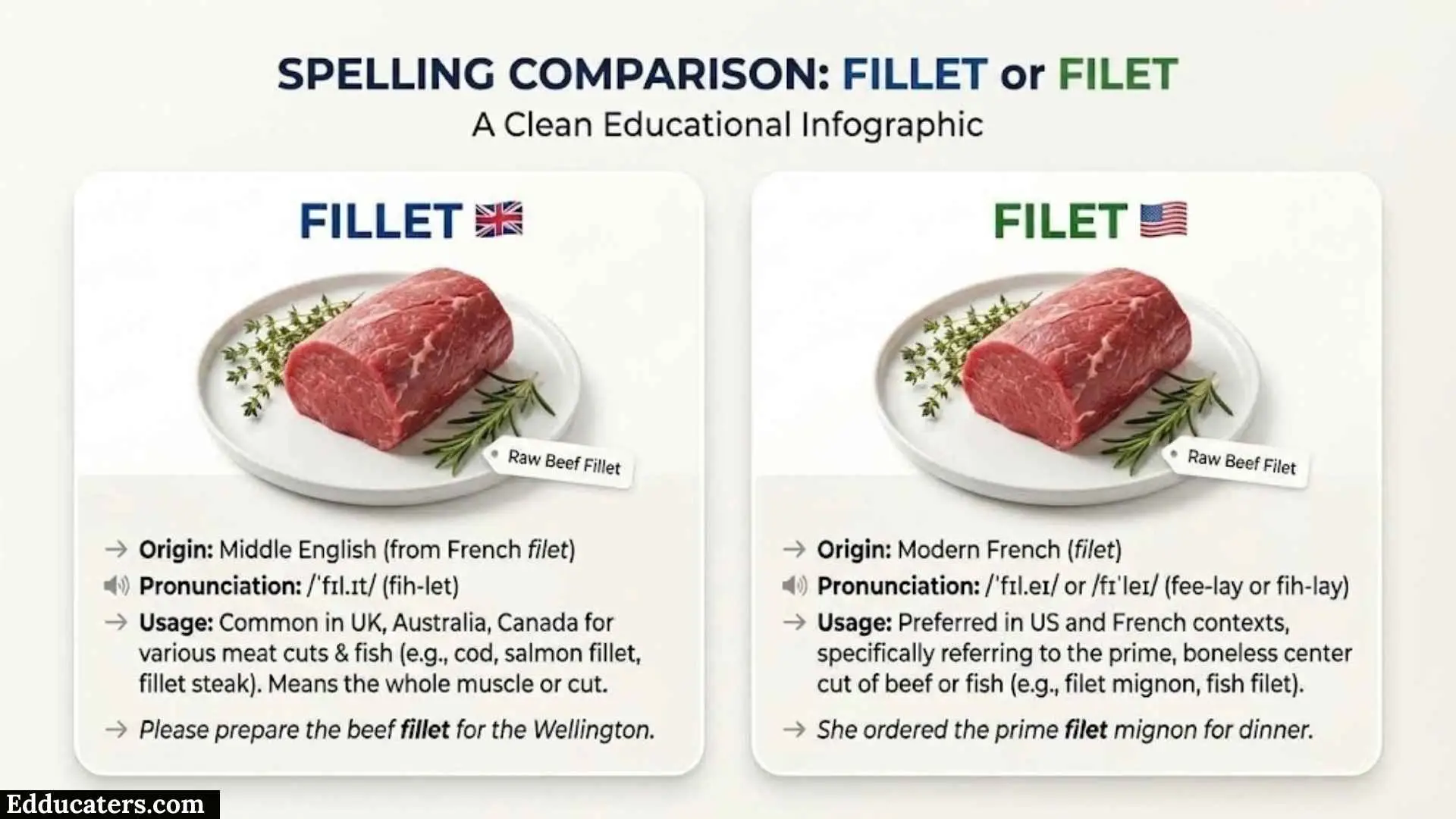
Fillet or filet? Both spellings are correct, but the form you choose depends mainly on regional English and context.
Fillet is the standard British form and is also used in North American English. Filet is especially common in North American English. Both words can mean a piece of meat or fish with the bones removed, and both can be used as verbs meaning to cut meat or fish away from the bones.
The choice can become more specific in culinary expressions. For example, filet mignon is the established spelling of the well-known beef term, while fillet steak is standard British terminology.
If you are deciding which spelling to use in a recipe, menu, article, or everyday sentence, this guide explains the difference, pronunciation, history, regional usage, common mistakes, and the simplest way to choose.
Fillet or Filet: Quick Answer
Fillet or filet are both correct spellings.
As a general guide:
- Fillet is the usual British English spelling.
- Filet is especially common in North American English.
- Fillet is also used in North American English, so it is not exclusively British.
- Both can describe a boneless piece of meat or fish.
- Both can be used as verbs for removing meat or fish from the bones.
- Filet mignon is the established spelling of the culinary expression.
- Fillet steak is a standard British expression.
- Your target audience and the established expression should guide your choice.
Oxford lists filet as a form used especially in North American English, while Cambridge labels filet as the US form of fillet.
Fillet or Filet at a Glance
| Point | Fillet | Filet |
| Basic meaning | Boneless meat or fish | Boneless meat or fish |
| British English | Standard/common | Less common |
| North American English | Also used | Especially common |
| Fish | Common | Also used |
| Beef | Common | Common in North American usage |
| Verb | Yes | Yes |
| Established expression | fillet steak | filet mignon |
| Main distinction | Regional preference | Regional preference |
The important point is that this is a spelling and usage difference, not a simple correct-versus-incorrect distinction.
What Does Fillet Mean?
Fillet is a noun meaning a piece of meat or fish that has no bones in it.
For example:
We bought two salmon fillets for dinner.
Here, fillets are portions of salmon from which the bones have been removed.
Oxford gives examples including plaice fillets, a fillet of cod, fillet steak, and fillet of beef. Cambridge likewise defines fillet as a piece of meat or fish without bones.
Fillet as a Noun
You can use fillet for many types of meat and fish:
- fish fillet
- salmon fillet
- cod fillet
- trout fillet
- chicken fillet
- beef fillet
- fillet steak
- fillet of beef
For example:
The restaurant serves grilled salmon fillet with vegetables.
She bought four chicken fillets from the supermarket.
The recipe calls for a fresh cod fillet.
The exact terminology can vary by country, but the basic meaning remains the same.
Fillet as a Verb
Fillet is also a verb.
To fillet meat or fish means to remove the bones or cut the flesh into fillets.
For example:
The chef filleted the fish before cooking it.
He learned how to fillet a trout.
Oxford defines the verb as removing the bones from meat or fish or cutting it into fillets.
The verb therefore describes an action, while the noun describes the resulting piece of meat or fish.
What Does Filet Mean?
Filet is a variant spelling of fillet, especially associated with North American English.
It has the same basic culinary meaning: a piece of meat or fish without bones.
For example:
The recipe calls for two chicken filets.
The restaurant serves a grilled beef filet.
Cambridge labels filet as US and fillet as UK, while Oxford describes filet as especially North American English and gives fillet as the corresponding form.
Filet as a Verb
Filet can also be used as a verb in North American English.
For example:
The chef fileted the fish.
He knows how to filet a trout.
Cambridge lists filet as both a noun and a verb and defines the verb as cutting a piece of meat or fish from the bones.
So the difference is not limited to the noun. The spelling variation also appears in the verb.
Fillet or Filet: What Is the Difference?
The most useful way to understand fillet or filet is to think about regional spelling and established culinary expressions.
The basic meaning is substantially the same.
Both can refer to:
- a boneless piece of meat;
- a boneless piece of fish;
- the process of removing flesh from bones.
The main difference is which spelling is preferred in a particular variety of English.
British English
British English generally uses fillet.
Examples include:
fish fillet
fillet of cod
beef fillet
fillet steak
fillet the fish
Cambridge gives fillet steak as a British culinary term and defines it as a good-quality cut of beef.
North American English
North American English commonly uses filet, especially in culinary contexts.
Examples include:
beef filet
fish filet
filet mignon
However, it would be misleading to say that Americans never use fillet. Cambridge’s American dictionary entry explicitly gives fillet as a noun and verb and notes filet as the alternative.
That is why the simple rule “British = fillet, American = filet” is useful but not absolute.
Is Fillet or Filet More Common in British English?
If you are writing in British English, fillet is the natural choice in general culinary writing.
For example:
The recipe uses two salmon fillets.
We ordered fillet steak.
Remove the skin and fillet the fish.
The chef prepared a fillet of cod.
Oxford lists fillet as the main entry and identifies filet as especially North American.
Therefore, if your website or publication follows British English, using fillet consistently is the safest editorial choice.
Is Fillet or Filet More Common in American English?
American English uses both fillet or filet, but filet has a particularly strong presence in culinary terminology.
For example:
We ordered filet mignon.
The recipe uses a beef filet.
Season each fish filet before grilling.
At the same time, American publications also use fillet, particularly when discussing fish. Cambridge’s American entry provides examples of fillet in American English and explicitly lists filet as an alternative.
So an American writer does not need to replace every occurrence of fillet with filet.
Why Is It “Filet Mignon”?
One of the biggest reasons people search for fillet or filet is the expression filet mignon.
Filet mignon is the established spelling of the culinary term. Cambridge defines it as a very high-quality piece of meat and provides separate UK and US pronunciation information.
For example:
We ordered filet mignon with roasted vegetables.
It would be unusual to change this established expression simply because you are otherwise using the spelling fillet.
Filet Mignon or Fillet Steak
These expressions are associated with different regional culinary conventions.
British English:
fillet steak
American English:
filet mignon
Cambridge lists fillet steak as a UK term and filet mignon as an established culinary expression.
They are related to high-quality beef cuts, but the expressions should not be treated as interchangeable names in every culinary context.
Fillet or Filet for Fish?
Both spellings can be used for fish.
Fish fillet is particularly familiar in British English:
The recipe uses two cod fillets.
Place the salmon fillets in the oven.
North American English can also use fish filet:
Season the fish filets with salt and pepper.
Cambridge’s US entry specifically gives examples such as chicken/cod filets and filet of beef, while its general fillet entry also documents American usage.
Which Should You Use for Fish?
If you are writing British English, use:
fish fillet
If you are writing North American English, either form may be appropriate depending on your publication’s style and the expression being used.
The important thing is consistency.
Fillet or Filet for Beef?
Beef terminology is where the difference often becomes most noticeable.
British English commonly uses:
beef fillet
fillet steak
North American English commonly uses:
beef filet
filet mignon
Cambridge defines fillet steak as a good-quality cut of beef taken from the middle part of a cow’s back.
Meanwhile, Cambridge defines filet mignon as a very high-quality piece of beef or meat.
Example Sentences
British-style:
The restaurant serves fillet steak with roasted potatoes.
North American-style:
The restaurant serves filet mignon with roasted potatoes.
Both sentences are natural within their respective contexts.
How Do You Pronounce Fillet?
Pronunciation is another important difference.
Oxford gives fillet two pronunciations, reflecting regional English:
- British: approximately FILL-it
- North American: approximately fi-LAY
Cambridge likewise gives the British pronunciation as /ˈfɪl.ɪt/ and the US pronunciation as /fɪˈleɪ/.
This means that the spelling difference can be accompanied by a pronunciation difference.
How Do You Pronounce Filet?
Filet is commonly pronounced approximately fi-LAY in North American English.
Cambridge gives the US pronunciation as /fɪˈleɪ/.
For English learners, it is useful to remember that fillet can have different pronunciations depending on the variety of English, while filet is strongly associated with the fi-LAY pronunciation in US usage.
Why Are There Two Spellings?
The two spellings have a shared history.
Oxford traces fillet through Middle English to Old French filet, meaning “thread,” which is ultimately connected with Latin filum, meaning “thread.”
The word originally had meanings connected with a narrow band or strip. Its culinary meaning developed later.
The spelling filet remains closer to the French form, while fillet became established in English, particularly in British usage.
Over time, both forms became accepted in English, with filet developing a particularly strong association with North American culinary vocabulary.
This history explains why the two spellings are closely related rather than being completely separate words.
Fillet or Filet as Nouns and Verbs
One useful detail that is sometimes missed is that the spelling variation applies to both the noun and verb.
Noun
Fillet:
I bought a salmon fillet.
Filet:
I bought a salmon filet.
Both refer to a boneless portion of fish.
Verb
Fillet:
The chef will fillet the fish.
Filet:
The chef will filet the fish.
Both describe cutting the flesh away from the bones, with the preferred form depending largely on regional usage. Cambridge explicitly lists filet as the US counterpart of fillet for both noun and verb uses.
Common Mistakes With Fillet or Filet
Understanding the difference also means knowing what not to assume.
Mistake 1: Calling “Filet” a Spelling Error
Filet is not simply a misspelling of fillet.
It is a recognized dictionary form, particularly in North American English.
Mistake 2: Saying “Fillet” Is Only British
That is too broad.
Cambridge documents fillet in American English and gives filet as an alternative.
Mistake 3: Changing Every “Fillet” to “Filet” for an American Audience
This is unnecessary.
American English uses both forms, and the appropriate choice can depend on the particular culinary context.
Mistake 4: Changing “Filet Mignon” to “Fillet Mignon”
When you mean the established culinary expression, filet mignon is the conventional spelling.
Mistake 5: Assuming the Two Words Have Completely Different Meanings
In the food-related sense, they have essentially the same core meaning.
The distinction is mainly about regional usage and established terminology.
Fillet or Filet: A Simple Decision Guide
When you are editing or writing, use this quick decision process.
Are You Writing British English?
Yes → Prefer “fillet.”
Examples:
- salmon fillet
- cod fillet
- beef fillet
- fillet steak
- fillet the fish
Are You Writing North American English?
Yes → Check the expression and your style guide.
Use filet where it is the established or preferred form, such as:
- filet mignon
- beef filet
- fish filet
But remember that fillet is also used in North American English.
Is It a Fixed Culinary Expression?
Yes → Keep the conventional spelling.
For example:
filet mignon
Do not change an established expression simply to make all spellings look identical.
Are You Writing for an International Audience?
Choose one main English variety and use it consistently.
If your site primarily follows British English, fillet will usually be the better general form.
If your site primarily follows American English, follow American culinary usage while preserving established expressions.
How Writers Should Choose Between Fillet or Filet
For editors, bloggers, recipe writers, and website owners, the best approach is not to treat the two spellings as interchangeable decoration.
Match Your Target Audience
If your readers are primarily in the UK, use British terminology.
If your readers are primarily in the US or Canada, North American usage may make filet more natural in certain contexts.
Preserve Established Terms
Do not alter familiar culinary expressions unnecessarily.
For example:
filet mignon
is better treated as an established term than as an opportunity to switch spelling.
Maintain Editorial Consistency
If a recipe website uses British English, it should normally use:
fillet
throughout its general food terminology.
If it uses American English, it should follow its chosen American style consistently.
Consistency is particularly important when the same word appears in:
- recipe titles;
- headings;
- ingredients;
- instructions;
- image captions;
- menus;
- product descriptions.
Real-World Examples
The following examples show how the choice works in practice.
Example 1: British Recipe
Place the salmon fillets on a baking tray and season with salt and pepper.
Fillets fits British English.
Example 2: American Steak Menu
Our filet mignon is served with roasted vegetables.
Filet mignon is the established culinary expression.
Example 3: Fish Preparation
The chef carefully filleted the trout before cooking it.
Here, filleted is the verb form.
Example 4: North American Recipe
Season each fish filet before placing it on the grill.
Filet is possible in North American usage.
Example 5: British Restaurant Description
The restaurant is known for its tender beef fillet and seasonal vegetables.
Fillet fits the British style.
Fillet or Filet: Key Takeaways
If you only need the essential information, remember these points:
- Fillet or filet are both correct.
- Fillet is the usual British spelling.
- Filet is especially common in North American English.
- Fillet is also used in North American English.
- Both can describe a boneless piece of meat or fish.
- Both can be used as verbs for removing meat or fish from bones.
- Filet mignon is the established spelling of the culinary term.
- Fillet steak is standard British terminology.
- The two forms have a shared history connected to French filet.
- The best choice depends on your audience, context, and established terminology.
Frequently Asked Questions
Is fillet or filet correct?
Both fillet or filet are correct. Fillet is the standard British form, while filet is especially common in North American English.
Is filet American or British?
Filet is especially associated with North American English. Cambridge labels it as the US form corresponding to British fillet.
Is fillet British or American?
Fillet is strongly associated with British English, but it is also used in American English. American dictionaries recognize both fillet or filet.
Why is it called filet mignon?
Filet mignon is the established culinary expression for a high-quality piece of beef. Cambridge lists the term as filet mignon and provides its English pronunciations.
Is fish fillet or fish filet correct?
Both forms can be correct. Fish fillet is particularly common in British English, while fish filet occurs in North American usage.
Is beef fillet or beef filet correct?
Both can be correct. Beef fillet is common in British English, while beef filet is common in North American usage.
Can fillet be used as a verb?
Yes. Fillet can mean to remove bones from meat or fish or to cut it into fillets.
Can filet be used as a verb?
Yes. Filet can also be used as a verb in North American English, with the meaning of cutting meat or fish from the bones.
Are fillet or filet pronounced the same?
Not always. British fillet is commonly pronounced approximately FILL-it, while North American fillet or filet are commonly pronounced closer to fi-LAY.
Which spelling should I use in British English?
Use fillet in general British English culinary writing, including expressions such as fish fillet, beef fillet, or fillet steak.
Which spelling should I use in American English?
Use the form that fits the specific expression and your publication’s style. Filet is especially common in expressions such as filet mignon, but fillet is also used in American English.
Is filet a misspelling of fillet?
No. Filet is a recognized English word, particularly in North American usage.
Should I use one spelling consistently?
Yes, when you are writing general content for a particular regional audience. However, established expressions should retain their conventional spelling.
Conclusion
Fillet or filet? Both are correct.
The main difference is regional usage and culinary convention. British English generally prefers fillet, while filet is especially common in North American English. However, American English also uses fillet, so the distinction is not an absolute British-versus-American rule.
For fish, you may see fish fillet or fish filet. For beef, British English commonly uses beef fillet and fillet steak, while North American English commonly uses beef filet and the established expression filet mignon.
The words also share the same historical background, with Oxford tracing fillet through Middle English and Old French filet.
So when choosing between fillet or filet, do not ask only which spelling is “correct.” Ask which form fits your audience, your variety of English, and the particular expression you are using. That approach will give you natural, accurate, and consistent writing.
References
- Oxford Advanced Learner’s Dictionary — “fillet”: definition, regional variant, pronunciation, examples, and word origin.
- Oxford Advanced Learner’s Dictionary — “filet”: North American usage, definition, and pronunciation.
- Oxford Advanced Learner’s Dictionary — “fillet” (verb): verb meaning, forms, pronunciation, and etymology.
- Cambridge English Dictionary — “fillet”: UK and US definitions, pronunciation, noun and verb usage.
- Cambridge English Dictionary — “filet”: US usage, definition, pronunciation, and verb usage.
- Cambridge English Dictionary — “filet mignon”: definition and UK/US pronunciation.
- Cambridge English Dictionary — “fillet steak”: British culinary terminology and definition.

I’m Julian Mercer, an English language writer dedicated to helping people master grammar through practical examples and clear explanations. I enjoy teaching grammar in a way that is both engaging and easy to remember.
My work focuses on grammar rules, punctuation, word usage, and writing techniques that readers can apply in everyday life. I believe learning English should be simple, enjoyable, and useful.
Books
English Grammar in Practice
Writing with Precision
 Nathan Whitmore
 Claire Holloway