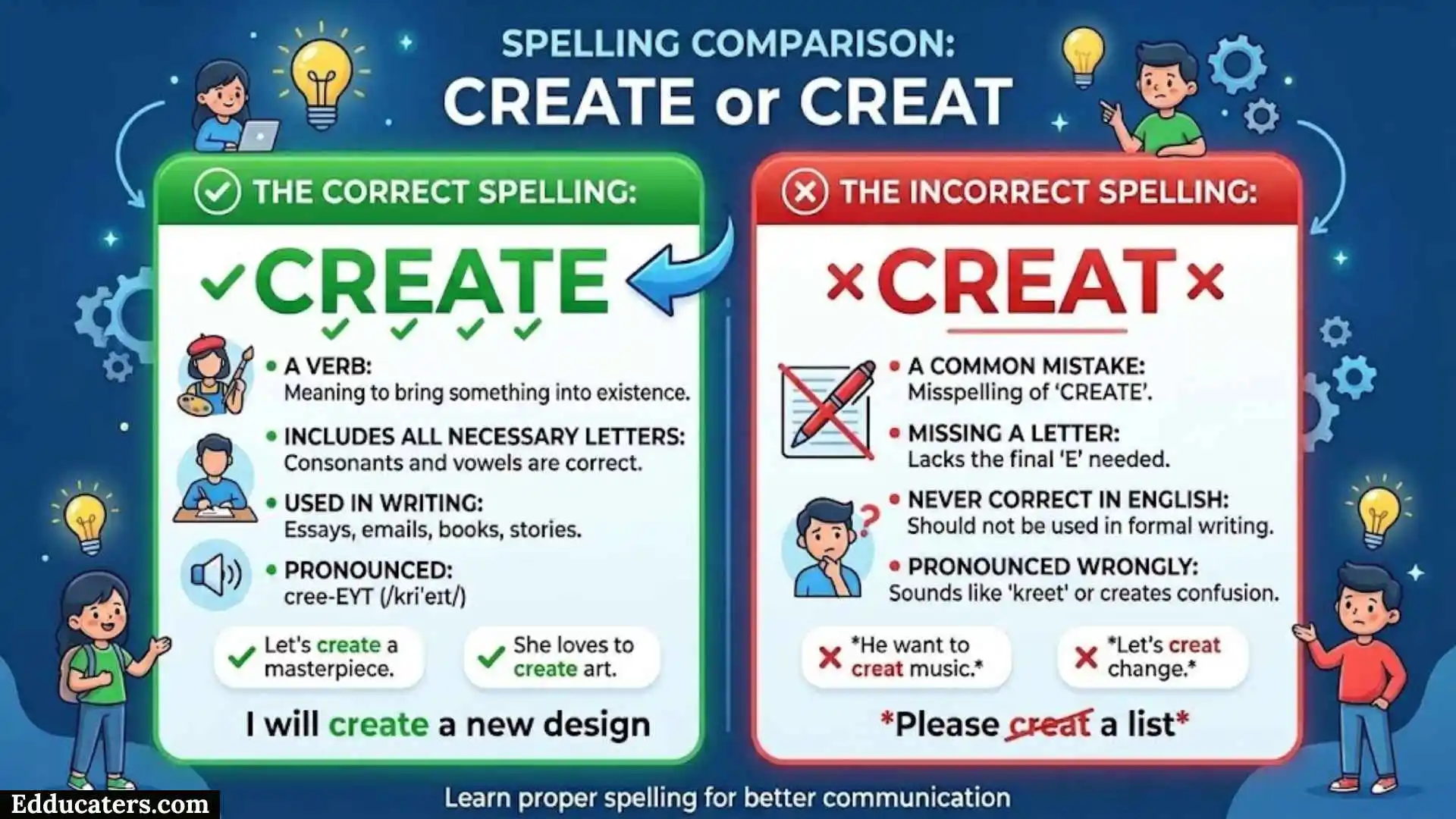
If you are unsure whether the correct spelling is create or creat, the answer is simple: create is the standard English spelling when you mean “to make,” “produce,” “develop,” or “cause something to exist.” Creat is generally a misspelling of create in this context.
The confusion usually comes from the fact that the two forms look almost identical. When typing quickly, it is easy to leave off the final e, especially because that letter does not appear as a separate sound at the end of the word. However, the final e is part of the standard spelling.
This guide explains the difference between create or creat, including their meaning, pronunciation, grammar, verb forms, common mistakes, related words, examples, and situations where you might encounter the shorter spelling.
Quick Answer: Create or Creat?
Create is correct.
Creat is generally incorrect when you are trying to write the English verb meaning “to make or cause something to exist.”
| Word | Standard English spelling? | Meaning |
| create | Yes | To make, produce, develop, or cause something to exist |
| creat | No, when intended as the verb “create” | Usually a spelling mistake |
For example:
- Correct: I want to create a new document.
- Incorrect: I want to creat a new document.
Another example:
- Correct: She wants to create a successful business.
- Incorrect: She wants to creat a successful business.
The easiest rule is:
If you mean “make” or “produce,” spell it CREATE.
Key Takeaways
- Create is the standard spelling.
- Creat is normally a misspelling when used to mean “create.”
- Create is a verb.
- It means to make something exist, make something new, or cause something to happen.
- It is pronounced /kriˈeɪt/ in both standard UK and US dictionary pronunciation.
- Its common forms include creates, created, and creating.
- Related words include creation, creative, creator, and creativity.
What Does Create Mean?
Create is a verb meaning to make something new, cause something to exist, or bring about a particular result.
Cambridge defines create as making something exist or making something new or imaginative. Oxford similarly explains that it can mean making something happen or exist, particularly something new.
The word can be used for physical objects, ideas, situations, opportunities, businesses, artistic works, and many other things.
For example:
The designer created a new logo for the company.
Here, created means the designer made the logo.
You can also use the word for something less physical:
The announcement created confusion.
In this sentence, created means caused confusion.
Create Can Mean More Than Simply Make
Although create and make are sometimes interchangeable, they are not always used in exactly the same way.
Make is a very broad word. You can make a cake, make a table, make a dress, or make a cup of coffee.
Create often emphasizes bringing something new into existence or producing something through imagination, design, planning, or development. Oxford specifically notes that make is more general, while create is particularly associated with something new that did not exist before.
Compare:
She made a cake.
This is a normal description of preparing food.
She created a new cake recipe.
Here, created emphasizes that the recipe is new or original.
This distinction is useful when deciding whether create is the most natural word in a sentence.
Why Is Creat Incorrect?
When someone writes creat, they are usually leaving off the final e from create.
The standard spelling is:
C-R-E-A-T-E
Not:
C-R-E-A-T
This can happen because of fast typing, spelling uncertainty, or pronunciation.
The final e in create is not pronounced as a separate final vowel. The word is pronounced approximately kree-ATE, which can make the spelling less obvious to someone learning English. Cambridge gives the UK and US pronunciation as /kriˈeɪt/.
The Final E Is Part of the Spelling
Think of the word as:
CREAT + E = CREATE
The final e is necessary in the base form.
For example:
Please create an account.
Not:
Please creat an account.
Similarly:
We need to create a new plan.
Not:
We need to creat a new plan.
A simple proofreading trick is to look specifically at the end of the word. If you have written creat, ask yourself whether you intended the verb create. In most ordinary English contexts, the answer will be yes.
Create Pronunciation and Spelling
Create is pronounced:
/kriˈeɪt/
A simple pronunciation guide is:
kree-ATE
Cambridge lists this pronunciation for both UK and US English.
The word has two syllables:
cre-ate
The stress falls on the second syllable:
cre-ATE
This pronunciation can explain why some writers accidentally omit the final e. The spelling contains an e at the end, but the pronunciation does not sound like a separate “ee” syllable.
Create or Creat Sound Similar
There is another reason this spelling question occurs: create or creat would look and sound extremely similar if someone simply removed the written final e.
However, English spelling is not based entirely on pronunciation. A word can contain letters that are not pronounced as separate sounds.
Therefore, do not use the absence of a final sound as a reason to remove the final e.
When the intended word is the verb meaning “to make,” use:
create
Create Verb Forms
Learning the different grammatical forms of create makes it easier to recognize the correct spelling in real sentences.
Oxford lists the principal forms as create, creates, created, and creating.
Create
Use create as the base form of the verb.
I want to create a new website.
They plan to create a new product.
We need to create a better system.
Creates
Use creates with he, she, it, or another singular third-person subject in the present tense.
She creates digital artwork.
The software creates a report automatically.
This process creates additional opportunities.
Created
Use created for the simple past and past participle.
She created the design last year.
The company created a new position.
A new account was created yesterday.
Creating
Use creating as the -ing form.
They are creating a new application.
He enjoys creating digital art.
We are creating a detailed plan.
Understanding these forms also helps prevent another common mistake: using create when the grammar requires created or creating.
Create or Creat in Different Situations
The word create is used across everyday, academic, professional, artistic, and technological contexts.
Everyday English
In ordinary conversation and writing, you might use create when talking about plans, objects, experiences, or situations.
Examples:
I want to create a shopping list.
Let’s create a schedule for the weekend.
She created a beautiful birthday card.
We can create a comfortable space for guests.
These examples all involve making or producing something.
Business English
Create is also common in professional writing.
Cambridge’s Business English definition includes uses such as creating jobs, opportunities, wealth, responsibilities, and companies.
Examples include:
The company plans to create new jobs.
The team wants to create a stronger customer experience.
The founders created a new business.
The campaign could create new opportunities.
In business writing, the word can refer to both tangible things and abstract results.
Academic English
In academic writing, create can describe developing theories, models, conditions, opportunities, or research materials.
For example:
Researchers created a new model for analyzing the data.
The experiment created conditions for further study.
The project aims to create a framework for future research.
The exact choice depends on what is being produced and how it is produced, but create remains the standard spelling.
Technology and Digital Contexts
Technology is one of the areas where create appears especially often.
You may see:
- Create an account
- Create a password
- Create a document
- Create a folder
- Create a profile
- Create a file
- Create a project
- Create a post
- Create a new page
For example:
Click the button to create a new account.
Here, create means to establish something new within a digital system.
Writing creat an account would simply be a spelling error.
Create vs. Make: Are They the Same?
Create and make can have similar meanings, but they are not perfect substitutes in every situation.
Oxford explains that make is more general and is often used for physical things, while create is commonly used for something new that did not previously exist.
| Word | Typical emphasis | Example |
| make | General production or preparation | She made a cake. |
| create | Bringing something new into existence | She created a new recipe. |
| develop | Building or improving something over time | They developed new software. |
| produce | Making goods or results, often systematically | The factory produces cars. |
| generate | Producing something such as energy, income, or ideas | The panels generate electricity. |
| form | Making something take a particular shape or structure | The pieces formed a pattern. |
These words overlap, but choosing the right one can make your writing more precise.
Create, Develop, Produce, and Generate
People sometimes assume these words are interchangeable because they can all describe bringing something about. There are, however, useful differences.
Create
Use create when the focus is on bringing something new into existence.
The artist created a new collection.
Develop
Develop often suggests a process of designing, improving, or advancing something.
The company developed new software.
Produce
Produce commonly refers to making something, especially goods or something produced through a process.
The factory produces electronic components.
Generate
Generate is frequently used for things such as electricity, income, ideas, data, or results.
The solar panels generate electricity.
Oxford identifies these distinctions among related verbs for making or bringing something into existence.
This vocabulary distinction is useful because create is not simply a universal replacement for every verb meaning “make.”
Common Mistakes With Create
Knowing the correct spelling is only the first step. Several other mistakes can occur with this word.
Mistake 1: Dropping the Final E
Incorrect:
We need to creat a new account.
Correct:
We need to create a new account.
This is the main spelling issue addressed by the phrase “create or creat.”
Mistake 2: Using Create for the Past
Incorrect:
She create the document yesterday.
Correct:
She created the document yesterday.
The word needs its past-tense form because the action happened in the past.
Mistake 3: Using Create Instead of Creating
Incorrect:
They are create a new design.
Correct:
They are creating a new design.
After are in this progressive construction, the -ing form is required.
Mistake 4: Confusing Creation With Create
Incorrect:
The team will creation a new product.
Correct:
The team will create a new product.
Creation is a noun, while create is a verb.
Cambridge defines creation as the act of creating something or the thing that has been created.
Create, Creation, Creative, and Creator
These words belong to the same word family but have different grammatical roles.
| Word | Part of speech | Meaning | Example |
| create | Verb | Make or cause something to exist | They create new designs. |
| creation | Noun | The act or result of creating | The creation took months. |
| creative | Adjective | Showing imagination or originality | She has a creative idea. |
| creator | Noun | A person or entity that creates something | The creator designed the program. |
| creativity | Noun | The ability to produce original ideas | Creativity is important in design. |
Learning the whole word family can make the spelling easier to remember.
Oxford traces create to Latin creare, meaning “to produce,” and identifies creation as deriving through Old French from Latin creatio.
Is Creat Ever Used?
For ordinary English writing, creat should not be used as the spelling of the verb create.
However, you may encounter the sequence creat inside other words or in specialized contexts. For example, creativity, creator, and created begin with the letters creat, but that does not make creat a standard standalone replacement for create.
This distinction matters when proofreading. Seeing creat at the beginning of a longer word is completely normal:
creator
creative
created
But when you need the standalone verb meaning “make,” write:
create
A Simple Decision Guide: Create or Creat?
Use this quick decision process when you are unsure.
Are you trying to say “make,” “produce,” “develop,” or “cause something to exist”?
↓
Yes
↓
Use create.
Example:
We need to create a new plan.
If you have written creat, check whether the intended word is create.
↓
Yes
↓
Add the final e.
Correct form: CREATE
This works for most ordinary spelling questions involving these two forms.
How to Remember the Correct Spelling
A simple memory technique is to remember that create has the complete ending:
CREAT + E
You can also connect it with related words:
create → created → creating → creation → creative → creator
When you see the word family together, the spelling pattern becomes easier to recognize.
Another useful trick is to associate create with common phrases:
- create an account
- create a document
- create a plan
- create an opportunity
- create a design
- create a business
- create a solution
If you regularly write these phrases, the correct spelling will become familiar through repetition.
Real-Life Sentence Examples
Here are examples showing how create works in different contexts.
Personal Example
I want to create a daily schedule that is easier to follow.
Workplace Example
The manager asked the team to create a report before Friday.
School Example
Students were asked to create a presentation about climate change.
Creative Example
The artist used recycled materials to create a sculpture.
Technology Example
You can create a new profile using your email address.
Business Example
The new project could create additional employment opportunities.
Cause-and-Effect Example
The sudden change created confusion among customers.
Ongoing Action
The designers are creating a new product.
These examples show why understanding the grammar around the word is just as useful as remembering its spelling.
Frequently Asked Questions
Is create or creat the correct spelling?
Create is the correct standard spelling when you mean to make, produce, develop, or cause something to exist. Creat is generally a misspelling in this context.
How do you spell create?
The correct spelling is C-R-E-A-T-E.
The final e should be included.
What does create mean?
Create means to make something new, cause something to exist, or cause something to happen. It can describe physical objects, ideas, opportunities, businesses, artistic works, and situations.
How do you pronounce create?
Create is pronounced /kriˈeɪt/ in both UK and US English according to Cambridge. A simple pronunciation guide is kree-ATE.
Is creat a correct English word?
Creat is not the standard spelling of the common verb create. If you mean “to make” or “to cause something to exist,” use create.
What is the past tense of create?
The past tense is created.
She created a new design last week.
Oxford lists created as both the past simple and past participle form.
What is the present participle of create?
The present participle is creating.
They are creating a new website.
Cambridge identifies creating as the present participle of create.
What is the noun form of create?
The common noun form is creation.
It can refer to the act of creating or to something that has been created.
Is create the same as make?
Not always. Make is a broader and more general verb, while create often emphasizes bringing something new into existence. Oxford notes that make is commonly used for physical things, while create is especially useful for new things, jobs, wealth, opportunities, ideas, and similar results.
Why do people write creat instead of create?
The error can result from fast typing, forgetting the final e, or trying to spell the word from its pronunciation. Because the final e is not pronounced as a separate sound, learners may be tempted to leave it out.
Which is correct: “create a new account” or “creat a new account”?
The correct phrase is:
Create a new account.
The spelling creat is incorrect when it is intended to mean create.
Can create be used for ideas?
Yes. Create can describe producing ideas, plans, opportunities, impressions, and other abstract things.
For example:
The workshop helped participants create new ideas.
Oxford and Cambridge both provide examples showing that create can be used for abstract results as well as physical or creative things.
What words are related to create?
Common related words include created, creates, creating, creation, creative, creator, and creativity. Their grammatical roles differ, so they should not be substituted for one another.
Conclusion
When choosing between create or creat, the correct standard spelling is create when you mean “to make,” “produce,” “develop,” or “cause something to exist.”
The spelling is:
C-R-E-A-T-E
The word is pronounced /kriˈeɪt/ and can be used in everyday conversation, business writing, academic work, technology, creative writing, and many other contexts.
Remember that create is the base verb, while creates, created, and creating are its common grammatical forms. Related nouns and adjectives include creation, creator, creative, and creativity.
If you type creat when you mean the common English verb, simply add the final e:
Creat ❌ → Create ✅

I’m Julian Mercer, an English language writer dedicated to helping people master grammar through practical examples and clear explanations. I enjoy teaching grammar in a way that is both engaging and easy to remember.
My work focuses on grammar rules, punctuation, word usage, and writing techniques that readers can apply in everyday life. I believe learning English should be simple, enjoyable, and useful.
Books
English Grammar in Practice
Writing with Precision
 Nathan Whitmore
 Claire Holloway