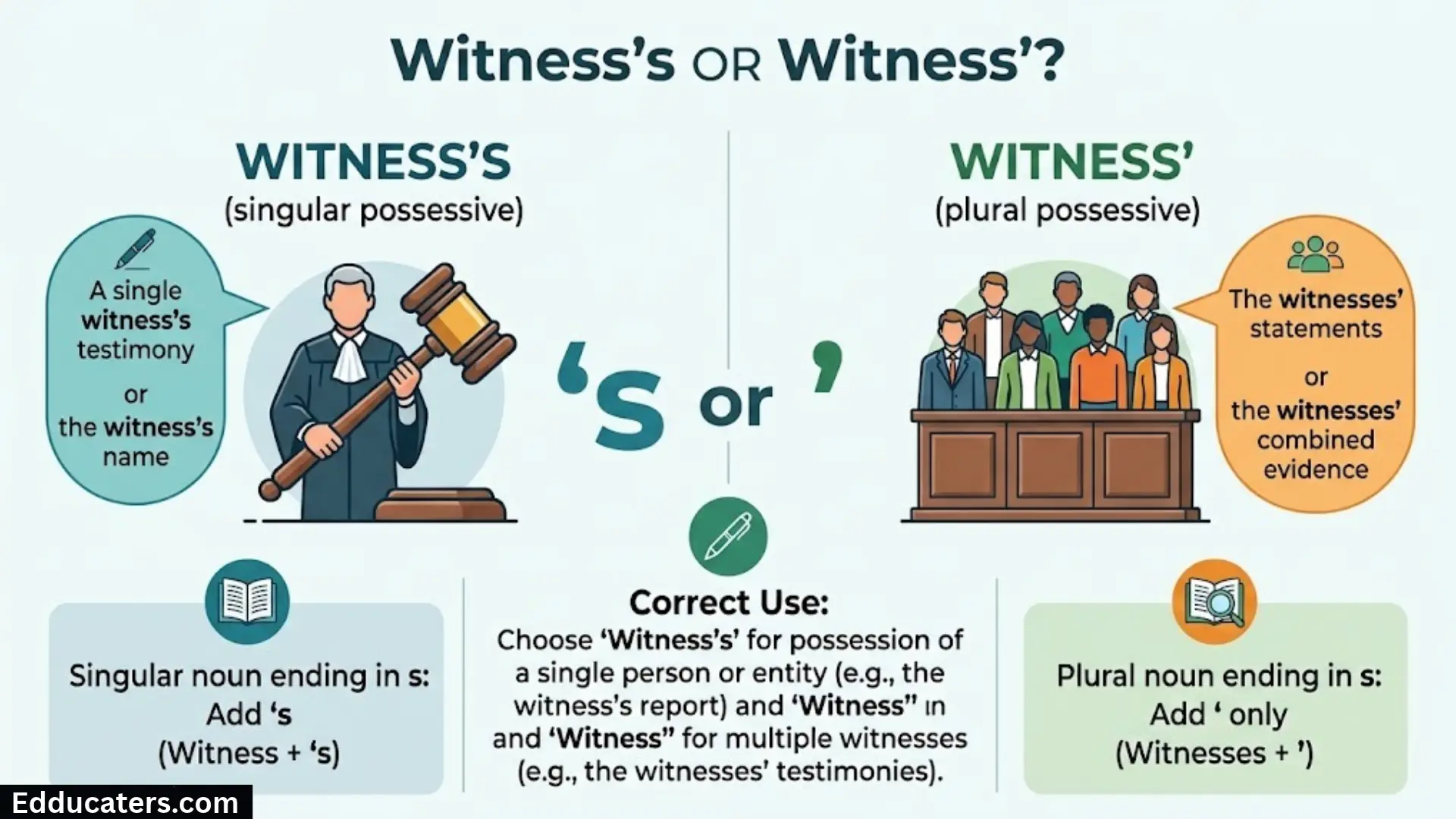
Have you ever paused while writing a sentence because you weren’t sure whether to write witness’s or witness’? You’re not alone. Apostrophes can be tricky, especially when a noun already ends in the letter s.
The good news is that the rule is easier than it looks. In standard American English, witness’s is the usual singular possessive form. Witness’ is an accepted alternative in some style conventions. When you’re talking about something belonging to multiple witnesses, the correct form is witnesses’.
However, these forms aren’t interchangeable in every sentence. The right choice depends on whether you’re referring to one person or several people and whether the sentence expresses possession.
For example:
- The witness’s statement helped the police understand what happened. (One witness.)
- The witnesses’ statements helped investigators reconstruct the incident. (Multiple witnesses.)
- The witnesses arrived before the hearing began. (Multiple people, with no possession.)
Understanding this distinction will help you write more clearly in emails, essays, reports, legal documents, and everyday conversations.
Witness’s or Witness’: What’s the Difference?
Both witness’s or witness’ can express possession by one witness. The difference comes down to the apostrophe rules followed by a particular style guide.
In standard American English, adding an apostrophe and s to a singular noun is the usual approach. Since witness is singular, its standard possessive form is witness’s.
Some editorial conventions allow writers to add only an apostrophe to certain singular nouns ending in s. Under those conventions, witness’ can also be correct.
Consider these examples:
- The witness’s testimony clarified the timeline.
- The witness’ testimony clarified the timeline.
Both sentences can communicate the same meaning. The important point is to follow the applicable style conventions and remain consistent throughout your document.
The plural possessive works differently. When two or more witnesses share or are associated with something, write witnesses’.
| Word form | Grammatical function | Example |
| Witness | Singular noun | The witness arrived early. |
| Witnesses | Plural noun or verb | The witnesses arrived early. |
| Witness’s | Standard singular possessive | The witness’s statement was detailed. |
| Witness’ | Alternative singular possessive | The witness’ statement was detailed. |
| Witnesses’ | Plural possessive | The witnesses’ statements differed. |
Remember: Witness’s or witness’ can refer to one witness’s possession. Witnesses’ refers to possession or association involving multiple witnesses. Witnesses without an apostrophe is simply the plural noun when used in that sense.
What Does Witness Mean?
The word witness has several related uses in the English language. As a noun, it commonly refers to someone who sees an event, observes something happening, or has relevant information about an incident.
A witness might see a traffic collision, attend a wedding, observe a workplace accident, or provide information during a court hearing. In legal settings, a witness may give testimony about what they know.
For example:
- A witness saw the car run a red light.
- The lawyer questioned the witness during the hearing.
- A witness signed the document.
- Several witnesses described the incident to investigators.
As a verb, witness means to see, observe, or experience an event.
For example, “She witnesses the ceremony every year” describes an action rather than ownership.
Understanding the word’s grammatical role helps you choose the correct form. A noun can become plural or possessive, while a verb follows different grammar rules.
Witness as a Singular Noun
A singular noun identifies one person, place, thing, or idea. In this case, witness refers to one person who observes an event or possesses relevant knowledge.
Examples include:
- A witness gave a statement.
- The witness remembered the vehicle’s color.
- One witness remained at the scene.
- Every witness answered the investigator’s questions.
When you want to express possession by this person, the standard American English form is witness’s.
For example, “The witness’s account helped explain the sequence of events” refers to the account of one witness.
The possessive relationship doesn’t always mean physical ownership. It can also identify a statement, responsibility, identity, experience, or other association with that person.
Witnesses as a Plural Noun
The plural of witness is witnesses. Because the singular noun ends in s, English adds -es to form the plural.
The spelling follows this pattern:
witness + es = witnesses
Examples:
- Two witnesses saw the accident.
- The witnesses answered questions separately.
- Several witnesses attended the hearing.
- Investigators interviewed three witnesses.
Notice that witnesses doesn’t contain an apostrophe. That’s because the word simply indicates more than one person.
To express possession by those people, add an apostrophe after the final s: witnesses’.
Compare these sentences:
- The witnesses arrived early.
- The witnesses’ statements arrived early.
The first sentence tells you who arrived. The second identifies statements associated with multiple witnesses.
Witnesses as a Verb
The word witnesses can also function as a third-person singular verb. In this case, it describes an action performed by a singular subject.
Examples:
- She witnesses the signing every year.
- He witnesses the ceremony on behalf of the organization.
- The reporter witnesses the event firsthand.
In each sentence, witnesses means sees, observes, or experiences.
This use doesn’t express possession, so an apostrophe isn’t necessary. The subject performs an action rather than owning something.
Compare:
- The witness’s account describes what happened. (Possessive noun.)
- The witness witnesses the event. (Noun followed by a verb.)
The surrounding sentence tells you which grammatical function the word performs.
What Is the Singular Possessive of Witness?
The standard singular possessive of witness is witness’s.
To form it, start with the singular noun witness and add an apostrophe followed by s. This follows the common American English pattern for singular nouns, including those that already end in s.
The formation looks like this:
| Step | Form | Explanation |
| Singular noun | Witness | Refers to one person. |
| Add apostrophe and s | Witness’s | Marks a possessive relationship. |
| Add the related noun | Witness’s statement | Identifies a statement associated with that person. |
For example, “The witness’s phone was missing” means the phone belonged to or was associated with one witness.
Possessive nouns can express several kinds of relationships:
- Ownership: The witness’s car was parked outside.
- Personal information: The witness’s address appeared on the form.
- Evidence or testimony: The witness’s testimony supported the timeline.
- Responsibility: The witness’s role was to confirm the signature.
- Experience: The witness’s account described the incident.
In each case, the apostrophe helps connect one person to something related to them.
Examples of Witness’s in Sentences
The following sentence examples show how the singular possessive works in different situations.
Everyday situations
- The witness’s coat was hanging near the entrance.
- The witness’s phone rang during the interview.
- The witness’s neighbor reported hearing a loud noise.
- The witness’s answer surprised everyone in the room.
Legal and professional writing
- The witness’s statement was added to the case file.
- The lawyer reviewed the witness’s testimony before the hearing.
- The witness’s signature appeared at the bottom of the declaration.
- The witness’s account helped investigators establish a timeline.
- The report included the witness’s name and contact information.
Formal documentation
- The witness’s identity remained confidential.
- The witness’s arrival was recorded in the official report.
- The investigator checked the witness’s declaration for accuracy.
- The witness’s responsibility was limited to confirming the signature.
These examples show that witness’s can appear before many kinds of nouns. The word following the possessive doesn’t have to be a physical object.
Is Witness’s Grammatically Correct?
Yes. Witness’s is grammatically correct and serves as the standard singular possessive in American English.
You can use it in:
- Everyday writing and personal correspondence
- Academic assignments and essays
- Workplace reports and business documents
- News articles and general nonfiction
- Legal writing when the applicable style requirements permit it
For example, “The witness’s statement contained three important details” is a standard construction.
Some publications follow different rules for singular nouns ending in s. If a required style guide specifies witness’, follow that instruction. Otherwise, witness’s is a clear and widely accepted default.
It’s also important to distinguish correct spelling from a publication’s preferred spelling. A style guide may prefer one accepted form without making every alternative universally incorrect.
Is Witness’ Correct or Should You Write Witness’s?
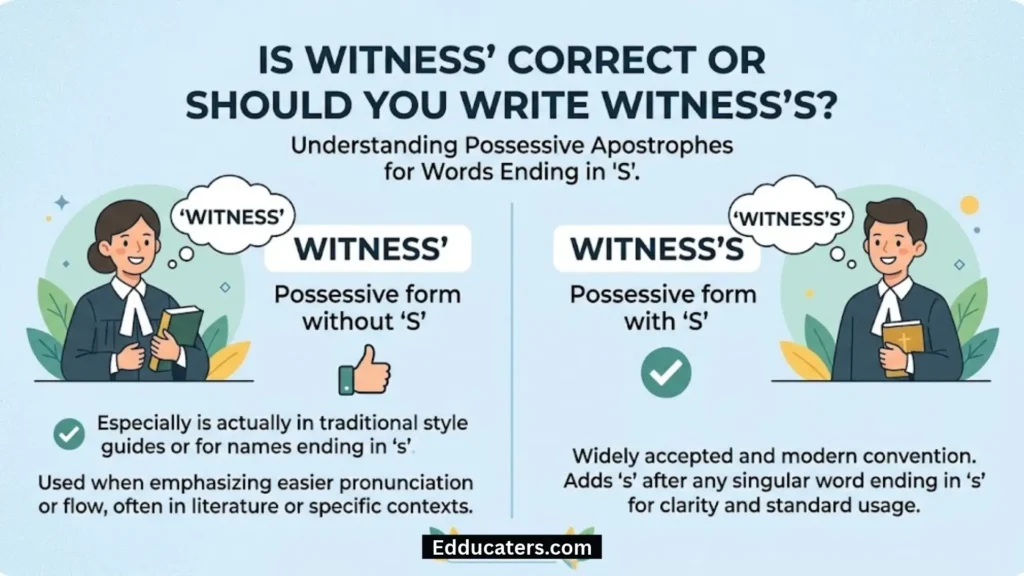
The form witness’ can be correct when a style convention permits an apostrophe-only singular possessive. However, witness’s is the usual recommendation for general American English writing.
The difference is visible in the spelling:
- Witness’s statement
- Witness’ statement
Both can express the idea of a statement associated with one witness. Neither form indicates multiple witnesses by itself.
The main distinction is editorial preference rather than a difference in meaning. When writing for a particular publication, school, employer, or legal organization, follow its instructions.
When no specific rules apply, choose witness’s because it follows the standard American English pattern and makes the possessive relationship clear.
When Can You Use Witness’?
You can use witness’ when your chosen style guide allows an apostrophe alone for a singular noun ending in s.
Some editorial traditions simplify these possessives by placing the apostrophe after the final letter. Others generally add ’s to singular nouns, even when the noun already ends in s.
For example:
- The witness’s account was accurate.
- The witness’ account was accurate.
A publication may accept only one of these spellings. If you’re preparing a school paper, check your instructor’s requirements. If you’re writing for a newspaper or organization, check its editorial guidelines.
Avoid switching randomly between the two forms in the same document. Consistent editorial standards make writing look polished and help readers follow the intended meaning.
Why Does Witness’s Have Two S Letters?
The spelling can look unusual because witness already ends in s. However, each letter has a clear purpose.
The first s belongs to the original noun. The second s appears in the standard singular possessive ending.
The formation is:
- Original noun: witness
- Possessive ending: ’s
- Complete form: witness’s
For example, the witness’s statement contains the singular noun witness and the standard possessive marker ’s.
This pattern also appears in words such as boss’s and actress’s under the standard American English approach.
The plural possessive follows a different pattern because the plural already ends in s. That’s why you write witnesses’, not witnesses’s.
What Is the Plural Possessive of Witness?
The plural possessive of witness is witnesses’.
Use this form when something belongs to, comes from, or is associated with two or more witnesses. First, make the noun plural by adding -es. Then place an apostrophe after the final s.
The formation looks like this:
Witness → witnesses → witnesses’
For example, “The witnesses’ statements differed” means that multiple witnesses gave statements that differed.
The apostrophe doesn’t mean that the noun needs another s. The word witnesses is already plural, so the apostrophe alone marks the possessive relationship.
Examples of Witnesses’ in Sentences
Here are practical examples showing how the plural possessive works.
Everyday examples
- The witnesses’ coats were hanging in the hallway.
- The witnesses’ phones were placed on the table.
- The witnesses’ neighbors described the noise.
- The witnesses’ answers helped resolve the confusion.
Legal and professional examples
- The witnesses’ statements contained different details.
- The witnesses’ signatures appeared on the final page.
- Investigators compared the witnesses’ accounts of the accident.
- The lawyer reviewed the witnesses’ testimony before the hearing.
- The report listed the witnesses’ names and contact details.
Each sentence connects something to multiple witnesses. The apostrophe comes after the s because witnesses is already plural.
When Should You Use Witnesses’?
Use witnesses’ when you mean that something belongs to or is associated with more than one witness.
Compare these examples:
- The witness’s statement was detailed.
- The witnesses’ statements were detailed.
The first sentence refers to one witness. The second refers to multiple witnesses.
However, the noun after a possessive doesn’t always need to be plural. For example, “The witnesses’ testimony was consistent” can refer to testimony given by multiple people. In this sentence, testimony is a mass noun, so it doesn’t require a plural ending.
The key is to identify how many witnesses the possessive refers to. Don’t rely only on whether the following noun ends in s.
Witnesses or Witness’s or Witnesses’: How to Choose the Correct Form
Choosing the right form becomes straightforward when you identify the grammatical function of the word.
Ask yourself two questions:
- Am I talking about one witness or more than one?
- Am I simply identifying people or expressing possession?
Use the answers to select the correct spelling.
Use Witnesses for More Than One Person
Write witnesses when referring to two or more people without expressing possession.
Examples:
- The witnesses arrived before the hearing.
- Investigators interviewed several witnesses.
- Three witnesses saw the collision.
- The witnesses answered the questions separately.
No apostrophe is needed because the noun is plural, not possessive.
Use Witness’s for One Person’s Possession
Write witness’s when one witness owns or is associated with something.
Examples:
- The witness’s car was parked near the scene.
- The witness’s statement included the time of the accident.
- The witness’s signature appeared on the form.
The apostrophe plus s identifies a possessive relationship involving one person.
Use Witnesses’ for Multiple People’s Possession
Write witnesses’ when the possessive relationship involves multiple witnesses.
Examples:
- The witnesses’ cars were parked outside.
- The witnesses’ statements were reviewed by the lawyer.
- The witnesses’ signatures appeared on separate forms.
The apostrophe follows the final s because the noun is already plural.
Use Witness’ When Your Style Guide Allows It
Write witness’ when you follow an editorial convention that permits the alternative singular possessive.
For example, “The witness’ account was included in the report” can be acceptable under such a convention.
Don’t use this spelling simply because the noun ends in s. Check the applicable rules first. When no specific style requirements exist, witness’s is the safer default for American English.
Witness’s or Witness’ or Witnesses’: Key Differences
The easiest way to remember these forms is to compare their number and grammatical function.
| Form | Refers to | Possessive? | Example |
| Witness | One person | No | The witness spoke. |
| Witnesses | Multiple people | No | The witnesses spoke. |
| Witness’s | One person | Yes | The witness’s account was clear. |
| Witness’ | One person | Yes, under applicable styles | The witness’ account was clear. |
| Witnesses’ | Multiple people | Yes | The witnesses’ accounts were clear. |
Notice the distinction between witness’s or witnesses’. The former refers to one witness, while the latter refers to multiple witnesses.
The two singular possessive spellings differ in style, not necessarily in meaning. By contrast, the plural possessive changes the number of people involved.
Witnesses or Witness’s: Common Confusion Explained
These forms look similar, but they serve different purposes.
Witnesses simply identifies more than one person. Witness’s identifies something associated with one person.
Compare the following sentences:
- The witnesses gave their statements.
- The witness’s statement was detailed.
- The witnesses’ statements were detailed.
The first sentence refers to multiple people who gave statements. The second refers to one person’s statement. The third refers to statements associated with multiple people.
A common mistake is to add an apostrophe to witnesses whenever the word appears before another noun. However, possession depends on the meaning of the sentence, not simply on the position of the word.
For example, “The witnesses answered questions” doesn’t require an apostrophe. The witnesses are performing an action; they aren’t possessing the questions.
On the other hand, “The witnesses’ answers were accurate” requires an apostrophe because the answers are associated with the witnesses.
Apostrophe Rules for Witness and Other Nouns Ending in S
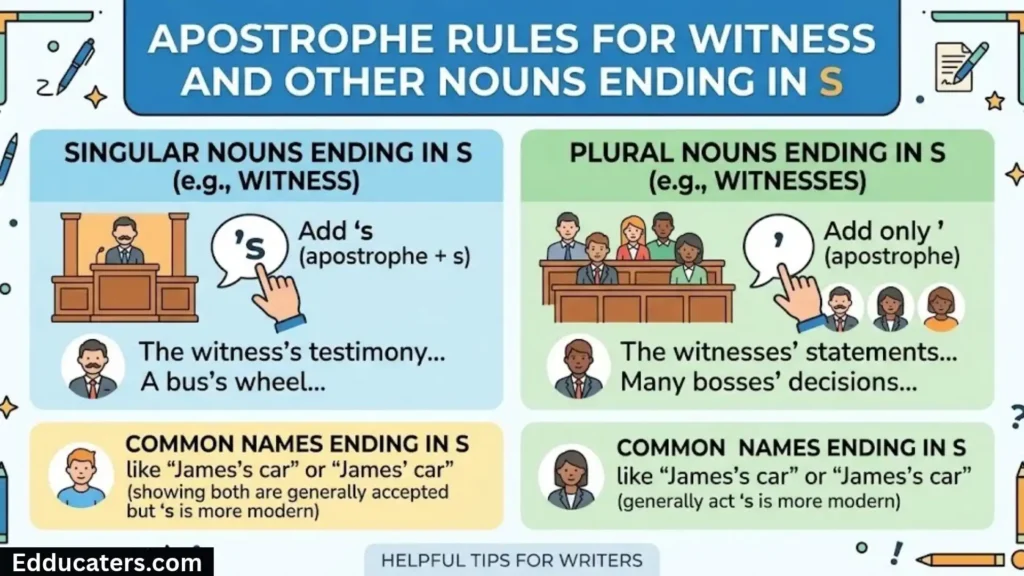
Understanding the broader apostrophe rules helps you avoid mistakes with many English nouns.
The standard American English approach generally follows two patterns:
- Singular noun: add ’s to form the possessive.
- Regular plural noun ending in s: add an apostrophe after the final s.
These patterns explain why witness’s or witnesses’ are spelled differently.
Singular Nouns Ending in S
For most singular nouns, including those ending in s, standard American English generally adds ’s.
Examples:
| Singular noun | Singular possessive | Example |
| Witness | Witness’s | The witness’s account was clear. |
| Boss | Boss’s | The boss’s office was closed. |
| Actress | Actress’s | The actress’s interview appeared online. |
| Class | Class’s | The class’s schedule changed. |
| Business | Business’s | The business’s records were reviewed. |
Some style guides use different conventions for certain singular nouns ending in s. Therefore, don’t assume that every publication will prefer the same form.
Regular Plural Nouns Ending in S
Regular plural nouns that end in s generally form their possessives by adding an apostrophe after the final letter.
Examples:
| Plural noun | Plural possessive | Example |
| Witnesses | Witnesses’ | The witnesses’ statements were reviewed. |
| Classes | Classes’ | The classes’ schedules overlapped. |
| Businesses | Businesses’ | The businesses’ records were audited. |
| Addresses | Addresses’ | The addresses’ locations were verified. |
The pattern remains consistent: form the plural first, then add the apostrophe.
Common Apostrophe Mistakes
Writers often make predictable errors when dealing with singular and plural possessives.
Mistake: Using witness’s for multiple witnesses
Incorrect for the intended plural meaning: “The witness’s statements differed.”
Correct: “The witnesses’ statements differed.”
The corrected sentence makes clear that multiple witnesses provided the statements.
Mistake: Using witnesses without an apostrophe for possession
Incorrect for the intended possessive meaning: “The witnesses statements differed.”
Correct: “The witnesses’ statements differed.”
The apostrophe marks the relationship between the witnesses and their statements.
Mistake: Writing witnesses’s
Incorrect: “The witnesses’s accounts were reviewed.”
Correct: “The witnesses’ accounts were reviewed.”
The plural already ends in s, so another s isn’t needed.
Mistake: Adding an apostrophe to an ordinary plural
Incorrect: “Three witness’s arrived early.”
Correct: “Three witnesses arrived early.”
The sentence needs a plural noun, not a possessive.
Mistake: Switching between witness’s or witness’ without a reason
Choose one convention and apply it consistently. If your organization follows a particular style guide, use that guide throughout the document.
Witness’s or Witnesses’ in Legal and Professional Writing
Possessive accuracy matters in legal documents, workplace reports, and formal records because small spelling differences can affect how readers interpret a sentence.
For example, a report may refer to one witness’s account or the accounts of several witnesses. The apostrophe helps identify that relationship.
However, grammar alone doesn’t determine the legal validity of a document. Writers should also follow the relevant court rules, institutional instructions, and professional requirements.
Witness’s Statement or Witnesses’ Statements
Use witness’s statement when referring to a statement from one witness.
Use witnesses’ statements when referring to statements associated with multiple witnesses.
Examples:
- The witness’s statement described the vehicle’s direction.
- The witnesses’ statements provided different descriptions of the incident.
These phrases are especially useful in police reports, investigation summaries, and courtroom documents.
Witness’s Testimony or Witnesses’ Testimony
Use witness’s testimony when referring to testimony from one witness.
Use witnesses’ testimony when discussing testimony associated with multiple witnesses.
For example:
- The witness’s testimony clarified the timeline.
- The witnesses’ testimony helped investigators understand the sequence of events.
The word testimony is often uncountable when referring to evidence given in a legal setting. Therefore, it can remain singular even when multiple witnesses provide it.
Witness’s Signature or Witnesses’ Signatures
The same distinction applies to signatures.
- The witness’s signature was missing from the form.
- The witnesses’ signatures appeared on the final page.
The first sentence refers to one witness’s signature. The second refers to signatures associated with multiple witnesses.
When preparing official documentation, identify the intended number of witnesses before choosing the possessive form.
Which Style Guides Prefer Witness’s or Witness’?
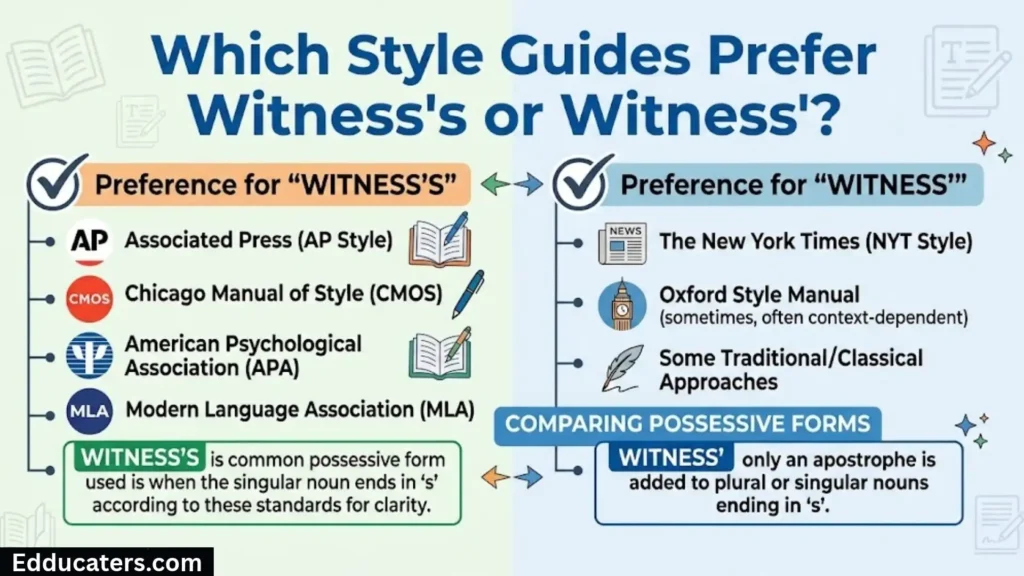
Different editorial authorities may use different rules for singular nouns ending in s. Writers should follow the current guidance that applies to their document rather than treating one publication’s preference as a universal grammar rule.
For general American English writing, witness’s is a practical default. If a required style guide specifies a different form, follow its instructions.
Chicago Manual of Style
The Chicago Manual of Style generally follows the approach of adding ’s to singular nouns to form possessives, including many nouns that end in s. Under this approach, witness’s is the expected form.
Associated Press Stylebook
The Associated Press Stylebook has its own guidance for possessives of singular nouns ending in s. Its conventions may differ from Chicago’s in particular cases.
Writers preparing news content should check the current AP entry rather than assuming that the two style guides use identical rules.
APA and MLA Style
Academic writers should consult the current edition of the required manual and any additional institutional instructions.
The APA Style website and the Modern Language Association website provide official guidance and writing resources.
When working on an academic assignment, follow your instructor’s specified style. Consistency matters, but the required standard takes priority over personal preference.
Quick Tips to Remember Witness’s vs. Witnesses’
If you need to choose the right form quickly, use these practical rules.
- One witness, no possession: Use witness.
- Multiple witnesses, no possession: Use witnesses.
- One witness, possession: Use witness’s in standard American English.
- One witness, alternative style: Use witness’ when the applicable convention permits it.
- Multiple witnesses, possession: Use witnesses’.
You can also use a simple memory trick:
One witness: add ’s. Multiple witnesses: add an apostrophe after the plural s.
This shortcut works for the standard singular and regular plural possessive patterns discussed in this guide.
Another useful technique is to replace the possessive phrase with a longer explanation.
For example:
- The witness’s phone → the phone associated with one witness.
- The witnesses’ phones → the phones associated with multiple witnesses.
If the rewritten phrase matches your intended meaning, you’ve probably chosen the correct form.
Finally, read the whole sentence rather than judging the word in isolation. The surrounding words often reveal whether you need a plural noun or a possessive.
Frequently Asked Questions
Is witness’s grammatically correct?
Yes. Witness’s is the standard singular possessive form in American English. Use it to show that something belongs to or is associated with one witness, as in “The witness’s statement was clear.”
Is witness’ correct or should I write witness’s?
Both forms can express singular possession under different editorial conventions. Witness’s is the standard American English default, while witness’ is accepted by some style guides. Follow the required style guide when one applies.
What is the plural possessive of witness?
The plural possessive is witnesses’. First form the plural witnesses, then place the apostrophe after the final s. For example, “The witnesses’ statements differed.”
What is the difference between witnesses or witness’s?
Witnesses is the plural noun referring to two or more people. Witness’s is the singular possessive referring to something associated with one person. For example, “The witnesses arrived” differs from “The witness’s car arrived.”
When should I use witnesses’?
Use witnesses’ when something belongs to or is associated with multiple witnesses. For example, “The witnesses’ signatures appeared on the document” refers to signatures associated with more than one witness.
Is witnesses’ the same as witnesses?
No. Witnesses is the plural noun, while witnesses’ is the plural possessive. Compare “The witnesses spoke” with “The witnesses’ accounts differed.”
How do you make witness possessive?
In standard American English, add an apostrophe and s to the singular noun: witness’s. For multiple witnesses, use the plural witnesses followed by an apostrophe: witnesses’.
Why does witness’s have two s letters?
The original word witness already ends in s. The standard possessive ending adds another s after the apostrophe, producing witness’s. This spelling follows a common American English rule for singular possessives.
Can I use witness’ in formal writing?
Yes, if the relevant style guide or publication convention permits it. However, witness’s is the usual default in standard American English. Check the required style guide before submitting formal or academic work.
How can I remember the difference between witness’s or witnesses’?
Remember that witness’s refers to one witness, while witnesses’ refers to multiple witnesses. The plural already ends in s, so its possessive apostrophe goes after that letter.
Conclusion: Witness’s or Witness’?
Choosing between witness’s or witness’ becomes much easier when you identify whether you’re referring to one witness or several.
Use witness’s as the standard singular possessive in American English. Use witness’ when your style convention allows the alternative. Use witnesses for the ordinary plural and witnesses’ for the plural possessive.
The most important distinction is simple: the number of witnesses determines the possessive form, while the applicable style guide determines whether the singular possessive takes an additional s.
Before finalizing your writing, check the sentence’s meaning, place the apostrophe carefully, and keep your spelling consistent throughout the document.

Hi, I’m Nathan Whitmore, and I enjoy making English grammar easy for learners of all ages. I believe grammar should be practical, not confusing. I write simple, well-researched guides that help readers improve their writing, speaking, and overall communication skills.
I spend a lot of time studying grammar patterns, sentence construction, punctuation, and modern English usage. My goal is to create lessons that anyone can understand, whether they are students, teachers, or professionals.
Books
Clear English Grammar
The Smart Writer’s Grammar Handbook
 Julian Mercer