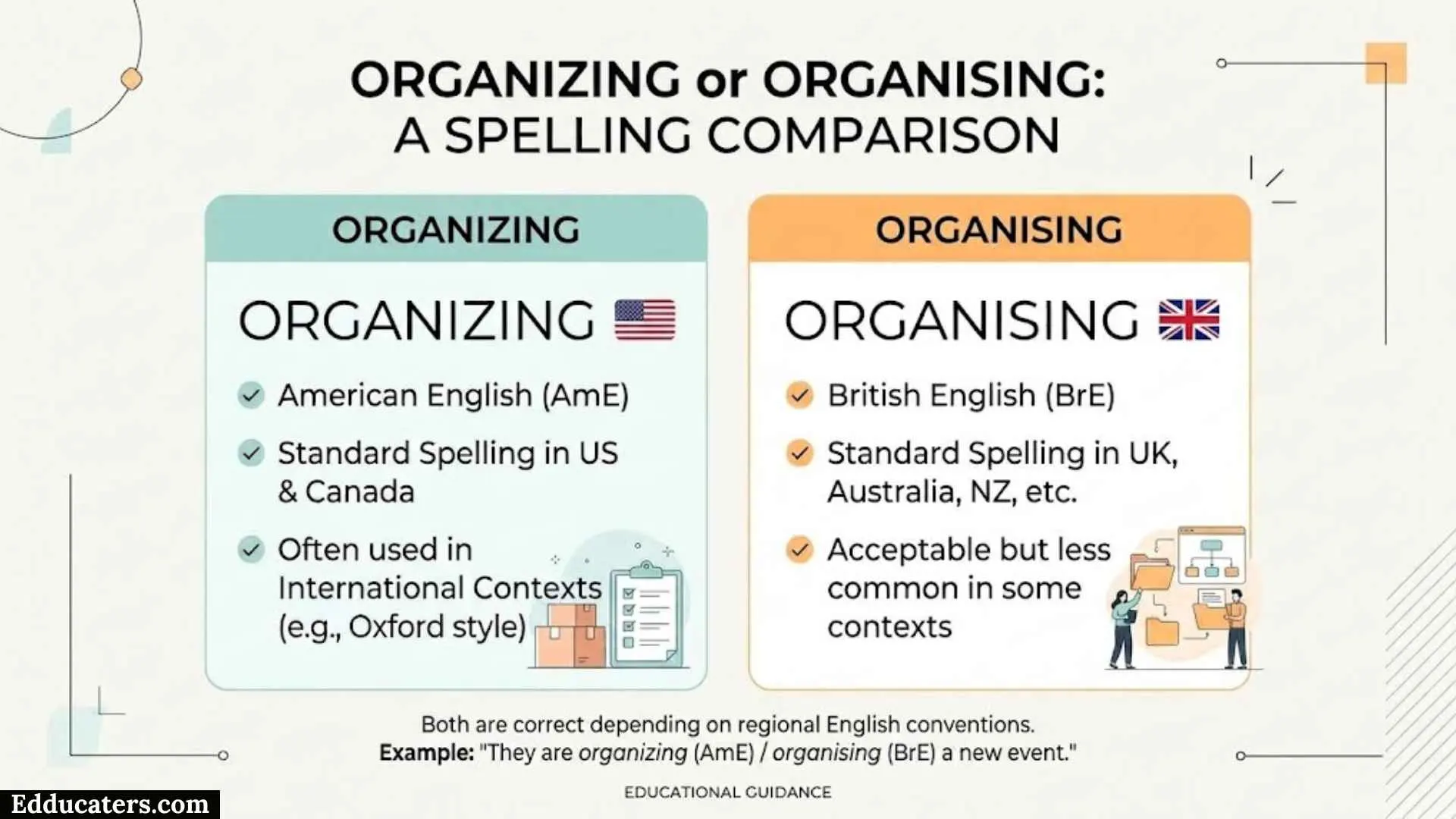
If you are deciding between organizing or organising, the good news is that both spellings are correct. The difference is mainly based on the variety of English you are using.
Organizing is the standard spelling associated with American English, while organising is the usual British English spelling. The two forms have the same meaning and pronunciation; the difference is the letter z or s in the spelling. Cambridge lists organizing as the present participle of organize and notes that British English usually uses organise. Oxford likewise lists organizing as the -ing form of organize and gives organise as the British English form.
The choice matters when you want your writing to match a particular audience, school, employer, publication, or style guide. A writer using American English will normally choose organizing, while a writer following British English conventions will normally choose organising.
This article explains the difference, meaning, pronunciation, grammar, related word forms, regional usage, common mistakes, and practical examples so you can choose the right spelling confidently.
Organizing or Organising: The Quick Answer
The simplest rule is:
Organizing = American English
Organising = British English
Both forms mean the same thing.
| Spelling | Common English variety | Example |
| organizing | American English | We are organizing a conference. |
| organising | British English | We are organising a conference. |
The difference is not about tense, meaning, or pronunciation. It is a spelling difference connected to the forms organize or organise.
If you are writing in American English, use organizing.
If you are writing in British English, use organising.
If you are writing for an international audience, choose the spelling system that fits your publication or established style and use it consistently.
What Do Organizing or Organising Mean?
Organizing or organising are the present participle forms of organize or organise.
The verb can have several related meanings. It can describe planning an event, arranging information, creating a system, coordinating activities, or helping a group work toward a common purpose. Cambridge gives meanings that include making arrangements for something to happen and arranging things according to a particular system. Its Business English entry also includes a workplace sense involving forming or helping people join a trade union.
For example:
- She is organizing a meeting.
- She is organising a meeting.
- He is organizing his files.
- He is organising his files.
- They are organizing a charity event.
- They are organising a charity event.
The meaning does not change when z becomes s.
Organizing an Event
One common use of the word is planning or arranging an event.
You might organize:
- a meeting
- a conference
- a wedding
- a workshop
- a seminar
- a fundraiser
- a school event
- a community activity
- a competition
For example:
The students are organizing a fundraising event.
British spelling:
The students are organising a fundraising event.
In both sentences, the students are making the arrangements needed for the event to take place.
Oxford gives similar examples involving conferences, meetings, protests, rallies, workshops, and seminars.
Organizing Information and Things
The word can also describe putting things into a useful or logical order.
For example:
I am organizing my documents by date.
Or:
I am organising my documents by date.
You can organize:
- documents
- books
- files
- photographs
- notes
- data
- schedules
- tasks
- ideas
- research materials
This meaning is especially common in academic, office, and digital settings.
For example:
The researcher spent the morning organizing the survey responses into categories.
Here, organizing means arranging information according to a system.
Organizing People or Activities
Organizing can also involve coordinating people or activities.
For example:
The manager is organizing the staff schedule.
The manager is not simply putting documents into order. They are coordinating work and deciding how activities should be arranged.
Another example is:
Volunteers are organising a community clean-up.
Here, organising involves planning, coordinating people, and arranging practical details.
Organizing in Workplace and Union Contexts
There is also a specific workplace meaning that readers may encounter.
Cambridge Business English includes organize in the sense of forming, joining, or helping someone join a trade union.
For example:
Workers were organizing to improve workplace conditions.
In this context, organizing does not simply mean tidying or planning an event. It refers to collective workplace activity.
The British spelling would be:
Workers were organising to improve workplace conditions.
The underlying meaning remains the same.
Why Are There Two Spellings?
The difference comes from established regional spelling conventions in English.
American English commonly uses -ize in this word:
organize
British English commonly uses -ise:
organise
When the -ing ending is added, the base spelling remains visible:
organize → organizing
organise → organising
This produces the familiar z/s difference.
The same pattern appears in several related words.
| American English | British English |
| organize | organise |
| organizing | organising |
| organized | organised |
| organization | organisation |
| organizational | organisational |
| organizer | organiser |
Cambridge identifies organization as the American form and notes organisation as the usual British form. Oxford similarly lists organization with organisation as the British English form.
The Difference Is About Spelling, Not Grammar
A common misconception is that organizing or organising represent different grammatical forms.
They do not.
Consider:
She is organizing the meeting.
and:
She is organising the meeting.
Both use the present participle after is. The grammatical structure is identical.
The only difference is the spelling convention.
This is similar to other regional differences such as:
- color / colour
- center / centre
- favor / favour
- realize / realise
The correct choice depends on the English variety being followed.
Organizing in American English
Organizing is the form normally expected in American English.
Examples include:
We are organizing a business conference.
She is organizing her schedule for next week.
The school is organizing a sports event.
He is organizing the files on his computer.
They are organizing a community fundraiser.
The same American spelling continues through the related word family:
- organize
- organizes
- organized
- organizing
- organization
- organizational
- organizer
If you are writing an American English article, using organizing alongside forms such as organization or organized creates a consistent spelling system.
Organising in British English
Organising is the usual British English spelling.
Examples include:
We are organising a business conference.
She is organising her schedule for next week.
The school is organising a sports event.
He is organising the files on his computer.
They are organising a community fundraiser.
British English commonly extends the s spelling through the related forms:
- organise
- organises
- organised
- organising
- organisation
- organisational
- organiser
Oxford identifies organiser as the British English form of organizer and identifies organisational as the British English form of organizational.
Organizing or Organising in Different Writing Contexts
The spelling you choose should fit the context rather than being selected randomly.
Academic Writing
Students and researchers should normally follow the spelling convention required by their institution, instructor, journal, or publication.
American English:
The researchers are organizing the findings into four categories.
British English:
The researchers are organising the findings into four categories.
The important issue is consistency. If an academic institution requires British English, changing to American spellings halfway through a paper can make the document look poorly edited.
Business Writing
Business documents should follow the company’s established style or the language variety expected by the audience.
For an American company:
We are organizing the annual meeting.
For a British company:
We are organising the annual meeting.
This applies to reports, emails, presentations, proposals, website copy, and internal documents.
Website Content
Website writers should consider their primary audience.
If the site consistently uses American English, organizing will normally fit that style.
If it follows British English, organising will normally fit better.
The most important practical rule is to avoid switching spelling systems without a reason.
Professional and Formal Writing
In professional writing, consistency often matters more than personal preference.
For example, an American-style document might use:
organizing
organization
organized
organizational
A British-style document might use:
organising
organisation
organised
organisational
Keeping the word family consistent makes the document easier to edit and gives it a more controlled style.
Common Mistakes With Organizing or Organising
The spelling difference is simple once you understand it, but several mistakes occur frequently.
Mistake 1: Thinking Organising Is Always Wrong
Some writers see the s and assume it is a spelling error.
That is incorrect.
Organising is the usual British English spelling.
For example:
The committee is organising a conference.
This is standard British English.
Mistake 2: Thinking Organizing Is Always Wrong
The opposite assumption is also incorrect.
Organizing is the standard American English spelling.
For example:
The committee is organizing a conference.
This is standard American English.
Mistake 3: Mixing the Word Family
A writer may choose one spelling for organizing but another spelling for a related word.
For example:
The organisation is organizing the event.
This mixes the British organisation with the American organizing.
A consistently American version would be:
The organization is organizing the event.
A consistently British version would be:
The organisation is organising the event.
Mixing regional spellings does not usually make a sentence impossible to understand, but it can make formal writing look inconsistent.
Mistake 4: Assuming the Spelling Changes the Meaning
It does not.
These sentences have the same meaning:
The team is organizing the event.
The team is organising the event.
The choice of z or s tells the reader about the spelling convention, not a different action.
Pronunciation of Organizing or Organising
The spelling difference normally does not create a meaningful pronunciation difference.
Both forms are pronounced essentially the same way.
The word can be represented approximately as:
OR-guh-nize-ing
Cambridge gives the pronunciation of organize in both British and American English and lists organizing as its present participle. Oxford gives the -ing form as organizing and shows corresponding pronunciation information.
This means that a speaker does not normally need to change pronunciation simply because a writer uses organising instead of organizing.
The distinction is primarily visible in written English.
Organizing, Organized, or Organization: The Complete Word Family
Looking at the entire word family is useful because the spelling difference appears in more than one form.
The American Pattern
American English commonly uses:
organize
organizes
organized
organizing
organization
organizational
organizer
For example:
The organization is organizing a training program.
The British Pattern
British English commonly uses:
organise
organises
organised
organising
organisation
organisational
organiser
For example:
The organisation is organising a training programme.
There may be other regional spelling differences in the same sentence, such as program/programme, depending on the variety and context. The important lesson is that a writer should consider the broader spelling system rather than changing only one word.
How to Choose Between Organizing or Organising
When you are unsure, you do not need to memorize a long list of rules.
Use this practical process.
Step 1: Identify the English Variety
Ask:
Am I writing American English?
If yes, choose:
organizing
Am I writing British English?
If yes, choose:
organising
Step 2: Check Your Audience
Consider who will read the content.
An American school, company, publication, or website may expect American spelling.
A British institution or publication may expect British spelling.
Other English-speaking regions may follow British-style spelling conventions or have their own established preferences.
Step 3: Check the Existing Style Guide
If you are writing professionally, follow the organization’s style guide when one exists.
This is especially useful for:
- academic papers
- company documents
- newspapers
- books
- government publications
- websites
- technical documentation
A style guide can settle questions that dictionaries alone do not answer.
Step 4: Check the Related Words
If you have already chosen organization, it is usually sensible to keep the same regional spelling in related words:
organization → organizing
If you have chosen organisation, use:
organisation → organising
This provides a quick consistency check.
A Simple Decision Tree
Use this guide whenever you see the two spellings.
Which English spelling system are you following?
↓
American English
→ Use organizing
↓
British English
→ Use organising
↓
Specific school, employer, publisher, or style guide?
→ Follow its required spelling.
↓
No fixed requirement?
→ Choose the variety that best matches your intended audience and use it consistently.
This is usually all you need.
Practical Examples in Real Sentences
Seeing the two forms side by side can make the distinction easier to remember.
Everyday Situation
American:
I am organizing my room before the weekend.
British:
I am organising my room before the weekend.
Office Situation
American:
Maria is organizing the files for the new project.
British:
Maria is organising the files for the new project.
Event Planning
American:
The students are organizing a charity dinner.
British:
The students are organising a charity dinner.
Academic Situation
American:
The researcher is organizing the data into several categories.
British:
The researcher is organising the data into several categories.
Community Activity
American:
Local residents are organizing a neighborhood cleanup.
British:
Local residents are organising a neighbourhood cleanup.
Notice that the last British example also changes neighborhood to neighbourhood. This illustrates an important point: regional English varieties can involve several spelling differences at once.
Frequently Asked Questions
Is organizing or organising correct?
Both are correct. Organizing is the standard American English spelling, while organising is the usual British English spelling.
Is organizing American or British English?
Organizing is normally associated with American English. British English usually uses organising.
Is organising British English?
Yes. Organising is the usual British English spelling of the present participle of organise.
Does organizing mean the same as organising?
Yes. They have the same meaning. The difference is a regional spelling convention.
Which spelling should I use in American English?
Use organizing.
For consistency, related forms normally include organized, organization, or organizational.
Which spelling should I use in British English?
Use organising.
Related forms normally include organised, organisation, or organisational.
Is organizing spelled with a Z or an S?
In organizing, the letter is z.
In organising, the letter is s.
The first is the American spelling, while the second is the usual British spelling.
Is organize or organise correct?
Both are correct. Organize is the standard American form, while organise is the usual British form. Cambridge explicitly labels organise as the usual UK form.
What is the past tense of organizing?
The corresponding past form is organized in American English and organised in British English.
For example:
American: We organized the meeting yesterday.
British: We organised the meeting yesterday.
What is the noun form of organizing?
The main related noun is organization in American English and organisation in British English.
For example:
The organization is planning a conference.
The organisation is planning a conference.
What is the adjective form?
Common forms are organizational in American English and organisational in British English. Oxford lists organisational as the British English form of organizational.
Can organizing or organising be used in the same article?
They can be understood without difficulty, but formal writing is generally clearer when one spelling system is used consistently.
If the article follows American English, use organizing.
If it follows British English, use organising.
Does Google consider one spelling better than the other?
There is no general grammatical rule that makes one spelling universally superior. They are established regional forms of English.
For online writing, the more useful approach is to match the spelling to the intended audience and maintain consistency throughout the page.
How do I remember the difference?
Remember the base verbs:
organize → organizing
organise → organising
So:
Z = organize = organizing
S = organise = organising
Once you know which English variety you are using, the choice becomes straightforward.
Conclusion
Organizing or organising are both correct spellings of the same word. The difference comes from regional English conventions rather than a difference in meaning or grammar.
Use organizing when following American English.
Use organising when following British English.
The same distinction appears across the wider word family:
- organize / organise
- organized / organised
- organizing / organising
- organization / organisation
- organizational / organisational
- organizer / organiser
The best way to choose is to identify your English variety, consider your audience, check any applicable style guide, and then keep your spelling consistent.
For most writers, the rule is simple: American English uses organizing; British English uses organising.
References
- Cambridge Dictionary — Organizing
- Cambridge Dictionary — Organize
- Cambridge Business English Dictionary — Organize
- Cambridge Dictionary — Organization
- Oxford Advanced Learner’s Dictionary — Organize
- Oxford Advanced Learner’s Dictionary — Organization
- Oxford Advanced Learner’s Dictionary — Organizational
- Oxford Advanced Learner’s Dictionary — Organizer

I’m Julian Mercer, an English language writer dedicated to helping people master grammar through practical examples and clear explanations. I enjoy teaching grammar in a way that is both engaging and easy to remember.
My work focuses on grammar rules, punctuation, word usage, and writing techniques that readers can apply in everyday life. I believe learning English should be simple, enjoyable, and useful.
Books
English Grammar in Practice
Writing with Precision
 Nathan Whitmore
 Claire Holloway