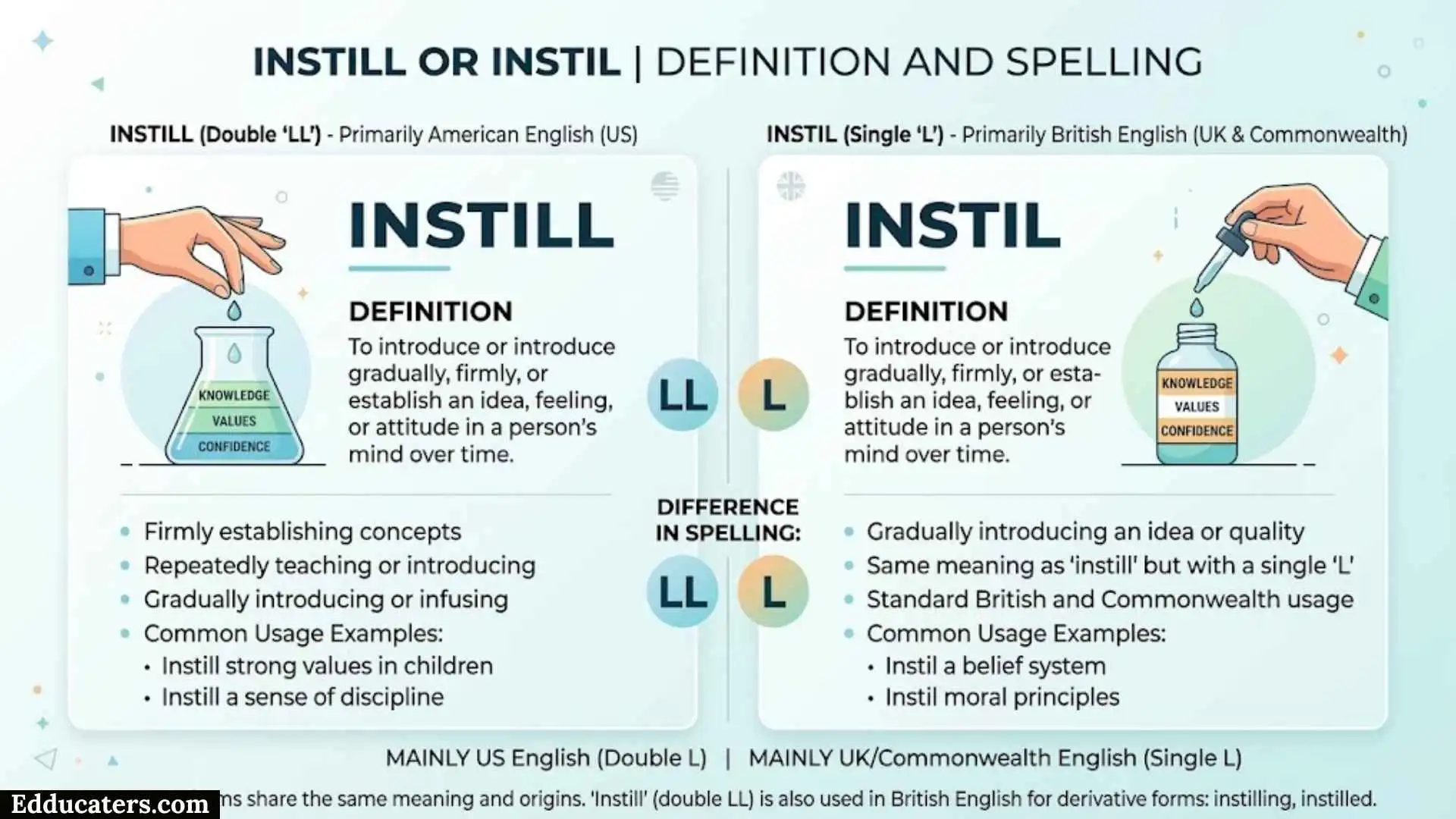
If you are unsure whether to write instill or instil, you are not dealing with two different words. Both spellings are standard, and both have the same meaning and pronunciation. The main difference is regional spelling: instill is the standard spelling in American English, while instil is the traditional British English spelling.
Both forms mean to gradually introduce an idea, feeling, quality, or influence into someone’s mind or character. The word can also mean to introduce a liquid slowly, such as putting eye drops into the eye.
So, the choice depends mainly on the variety of English you are writing:
- Instill is preferred in American English.
- Instil is preferred in British English and is also used in other varieties that generally follow British spelling conventions.
- Both forms are pronounced the same way.
- Both forms have the same meanings and grammatical functions.
- The past tense and participle are instilled in both varieties.
Instill or Instil Have the Same Meaning
The most important point is that instill or instil do not represent different meanings. They are spelling variants of the same verb.
To instill or instil something means to introduce it gradually, usually through repeated teaching, influence, experience, or encouragement. The word is especially common when talking about qualities, attitudes, values, beliefs, habits, confidence, or feelings.
For example:
Parents try to instill good manners in their children.
In British English, the same sentence would normally be written:
Parents try to instil good manners in their children.
The meaning does not change. The only difference is the spelling.
The word often suggests that something develops gradually rather than appearing suddenly. If a teacher instills confidence in a student, for example, the teacher is helping that confidence grow through encouragement and support.
Common meanings of instill or instil
The verb is frequently used in contexts involving personal qualities and ideas. Common examples include:
- instill confidence
- instill discipline
- instill respect
- instill fear
- instill trust
- instill hope
- instill a sense of responsibility
- instill good habits
- instill values
- instill an appreciation of something
The word can also be used for introducing a liquid slowly, particularly in medical or technical contexts.
For example:
The nurse was instructed to instill two drops into the patient’s eye.
Again, British English commonly uses instil:
The nurse was instructed to instil two drops into the patient’s eye.
When Should You Use Instill?
Use instill when you are writing in American English.
American English generally uses the spelling with a double l at the end: instill.
Examples include:
The coach wanted to instill confidence in the young players.
Good teachers can instill a love of learning.
Parents often try to instill a sense of responsibility in their children.
The experience instilled a strong appreciation for nature.
The program is designed to instill healthy habits.
In American English, instill is the spelling readers will normally expect in newspapers, books, educational materials, business writing, websites, and everyday communication.
Instill in American English
The spelling pattern is similar to several other American English verbs that end in -ll when certain suffixes are added.
For example:
- instill
- instilled
- instilling
The final l is retained in these forms.
Notice that the past tense is instilled, not instiled, in standard American usage.
For example:
The teacher instilled confidence in her students.
The present participle is:
The training is instilling good habits in the new employees.
When Should You Use Instil?
Use instil when you are writing in British English.
British English traditionally uses the spelling with a single l at the end:
instil
Examples include:
The teacher hoped to instil confidence in her students.
Parents play an important role in instilling good values.
The school aims to instil a sense of responsibility in its pupils.
The experience instilled a lasting respect for the environment.
Although the base form is spelled instil, the forms instilled or instilling use a double l in standard British English as well.
So you should not assume that the single-l spelling continues into every form.
Instil in British English
The common British forms are:
- instil — base form
- instils — third-person singular present
- instilled — past tense and past participle
- instilling — present participle and gerund
For example:
She instils confidence in everyone around her.
The teacher instilled a strong work ethic in the students.
The program is instilling good habits from an early age.
This distinction is useful because writers sometimes incorrectly assume that instiled or instiling must be the British forms. In standard usage, instilled and instilling are the normal spellings.
Instill or Instil in American and British English
The difference can be summarized simply:
| Feature | American English | British English |
| Standard spelling | instill | instil |
| Meaning | Same | Same |
| Pronunciation | Same | Same |
| Part of speech | Verb | Verb |
| Past tense | instilled | instilled |
| Present participle | instilling | instilling |
| Common use | Gradually introduce an idea, feeling, quality, or liquid | Same |
Neither spelling is inherently more correct than the other. The appropriate choice depends on the variety of English you are using.
If your website, school, employer, publication, or audience follows American English, choose instill. If it follows British English, choose instil.
The most important thing is to remain consistent with the spelling system used throughout your writing.
How to Pronounce Instill or Instil
Instill or instil are pronounced the same way.
A simple pronunciation guide is:
in-STIL
The stress falls on the second syllable.
The pronunciation can be represented approximately as:
/ɪnˈstɪl/
The final sound is similar to the word still, while the beginning sounds like in.
For example:
instill → in-STIL
instil → in-STIL
There is no pronunciation difference created by the extra l in the American spelling. The additional letter is simply a spelling difference.
This makes instill or instil different from word pairs in which spelling differences also produce different pronunciations. Here, readers generally pronounce both forms in the same way.
How to Use Instill or Instil in a Sentence
The verb is commonly followed by a noun representing the idea, feeling, quality, or attitude being introduced.
A common structure is:
instill/instil + something + in + someone
For example:
The teacher instilled confidence in the student.
Parents should instill good habits in their children.
The experience instilled a sense of responsibility in him.
In British English, you can replace the base spelling without changing the sentence structure:
The teacher instilled confidence in the student.
Parents should instil good habits in their children.
Another useful structure is:
instill/instil + something
when the person receiving the quality or feeling is already understood from the context.
For example:
The training is designed to instill discipline.
Or:
The experience helped instil a greater appreciation for teamwork.
Common collocations with instill or instil
Some combinations occur particularly often in natural English.
Instill confidence
This is one of the most common expressions.
Her encouragement helped instill confidence in the new employee.
It means helping someone develop confidence gradually.
Instill fear
This means causing fear or helping fear develop in someone.
The frightening story was intended to instill fear.
Instill discipline
This refers to developing disciplined behavior or habits.
The coach worked hard to instill discipline in the team.
Instill values
This refers to teaching or developing moral, social, or personal values.
Parents often try to instill strong values in their children.
Instill good habits
This means helping someone develop desirable habits.
Regular practice can instill good study habits.
These expressions can all use instil instead when following British spelling conventions.
Instilled or Instilling: Why Do Both Use Two Ls?
One of the most common points of confusion is what happens when instill or instil takes an ending.
The base forms differ:
- American English: instill
- British English: instil
However, both varieties normally spell the past tense and present participle with ll:
- instilled
- instilling
For example:
The teacher instilled confidence in the class.
The training is instilling a stronger sense of responsibility.
This means that instilled is not exclusively American, even though the base form instill is the usual American spelling.
Likewise, instilling is standard in both varieties.
A useful way to remember the pattern is:
American: instill → instilled → instilling
British: instil → instilled → instilling
The difference is mainly visible in the base form and the third-person singular form, such as instils.
Is Instil a British Spelling of Instill?
Yes. Instil is the standard British spelling corresponding to American instill.
This is similar to other British and American spelling differences in which one variety uses a different spelling without changing the meaning.
For example:
- British fulfil and American fulfill
- British enrol and American enroll
- British labelled and American labeled
- British travelling and American traveling
The exact spelling patterns vary from word to word, so they should not be treated as one universal rule.
With instil or instill, however, the regional distinction is straightforward: instill is the usual American form, while instil is the usual British form.
Is Instill or Instil More Common?
The answer depends on the English variety being considered.
In American English, instill is the normal spelling. A writer using American spelling would generally choose it in standard formal and informal writing.
In British English, instil is the traditional standard spelling and is widely used in formal and general writing.
Because English is used internationally, you may encounter both spellings regardless of where you live. A British reader may see instill in an American publication, while an American reader may encounter instil in a British book or article.
Seeing one form in an English-language publication does not necessarily mean the other form is incorrect.
Common Mistakes With Instill or Instil
The most common mistake is treating the two spellings as if they have different meanings.
They do not.
For example, these sentences communicate the same basic idea:
The teacher tried to instill confidence in the student.
The teacher tried to instil confidence in the student.
The difference is regional spelling.
Another mistake is using instiled simply because the base British spelling is instil. The standard past form is instilled.
Incorrect:
The experience instiled confidence in her.
Standard:
The experience instilled confidence in her.
The same applies to the present participle.
Incorrect:
The program is instiling discipline.
Standard:
The program is instilling discipline.
Another common confusion: install
Instill is sometimes confused with install because the two words look similar.
They have completely different meanings.
Instill or instil means to introduce something gradually, such as an idea, feeling, quality, or influence.
Install means to put equipment, software, or something else into position so that it can be used.
For example:
The teacher tried to instill confidence in the student.
But:
We need to install the new software.
You would not normally use install when you mean gradually developing a quality or feeling.
Instill or Instil for Ideas, Feelings, and Qualities
The word is particularly useful when something is gradually developed in a person’s mind or character.
For example:
The mentor instilled a strong sense of responsibility in the young employee.
The sentence suggests that responsibility developed through the mentor’s influence, guidance, or example.
Similarly:
Her parents instilled a love of reading in her.
This means that her parents helped develop that love of reading over time.
The gradual nature of the action is an important part of the word’s meaning. It often describes an influence that becomes established rather than something that happens instantly.
This is why instill confidence, instill trust, instill discipline, or instill values are such common combinations.
Instill or Instil for Liquids
Although the word is frequently associated with ideas and qualities, it can also describe putting a liquid into something slowly or in small amounts.
This use is especially common in medical contexts.
For example:
Instill the prescribed drops into the affected eye.
In British English:
Instil the prescribed drops into the affected eye.
The meaning here is literal rather than psychological. The liquid is introduced gradually or drop by drop.
This usage is less common in everyday conversation than the figurative use involving qualities, feelings, and ideas, but it is a legitimate meaning of the verb.
Word Forms and Related Vocabulary
The main forms of the verb are useful to know because the spelling changes slightly between the American and British base forms.
| Form | American English | British English |
| Base form | instill | instil |
| Third-person singular | instills | instils |
| Past tense | instilled | instilled |
| Past participle | instilled | instilled |
| Present participle | instilling | instilling |
Related words include instillation or instiller, although these forms are much less common in everyday writing than the verb itself.
The noun instillation can refer to the act of instilling something gradually, including the introduction of a liquid drop by drop.
For example:
The instillation of the medication was performed carefully.
In ordinary writing, however, the verb is often the more natural choice.
A Simple Way to Remember the Difference
If you regularly switch between American and British English, remember the base forms this way:
American English = instill
British English = instil
Think of the American spelling as having the extra l:
instiLL
The British form has one l:
instiL
However, remember that both varieties use instilled or instilling.
This distinction is more useful than trying to memorize the two spellings as completely separate words because they are simply regional forms of the same verb.
Frequently Asked Questions About Instill or Instil
Is instill or instil correct?
Both instill or instil are correct standard spellings. Instill is the usual American English spelling, while instil is the usual British English spelling.
Does instill mean the same as instil?
Yes. They have the same meaning and pronunciation. Both mean to introduce something gradually, such as an idea, feeling, quality, or influence. The verb can also refer to introducing a liquid slowly.
Is instil British or American?
Instil is the standard British English spelling. American English normally uses instill.
Is instill American or British?
Instill is the standard American English spelling. British English normally uses instil.
Is instilled British English?
Yes. Instilled is standard in both British and American English. The regional difference appears in the base forms instil or instill, not in the normal spelling of instilled.
Is instilling spelled with one or two Ls?
The standard spelling is instilling, with two ls. This form is used in both American and British English.
How do you pronounce instill or instil?
Both are pronounced the same way, approximately in-STIL, with the main stress on the second syllable.
What is the difference between instill or install?
Instill means to introduce an idea, feeling, quality, or influence gradually. Install means to put equipment, software, or something else into position for use. They are different words with different meanings.
Can instill be used for feelings?
Yes. It is commonly used with feelings and attitudes such as confidence, fear, trust, hope, and respect.
For example:
The teacher’s encouragement instilled confidence in the student.
Can instill be used for habits?
Yes. Instill good habits is a common expression.
For example:
Parents can help instill healthy habits in their children.
In British English, the same phrase is normally written instil good habits.
Final Answer: Instill or Instil?
Instill or instil are both correct. They are regional spellings of the same English verb, not two words with different meanings.
Use instill when following American English spelling conventions. Use instil when following British English spelling conventions. Both mean to gradually introduce an idea, feeling, quality, habit, or influence, and both can also describe introducing a liquid slowly.
The pronunciation is the same, and both varieties normally use instilled or instilling.
The easiest rule is:
American English: instill
British English: instil
So, if you are writing for an American audience, choose instill. If your writing follows British English, choose instil. Neither spelling is a mistake simply because it belongs to a different regional variety of English.
Tighten repeated explanationsAdd a quick answer box
Tighten repeated explanations
Add a quick answer box
Standardize example spelling

I’m Julian Mercer, an English language writer dedicated to helping people master grammar through practical examples and clear explanations. I enjoy teaching grammar in a way that is both engaging and easy to remember.
My work focuses on grammar rules, punctuation, word usage, and writing techniques that readers can apply in everyday life. I believe learning English should be simple, enjoyable, and useful.
Books
English Grammar in Practice
Writing with Precision
 Nathan Whitmore
 Claire Holloway