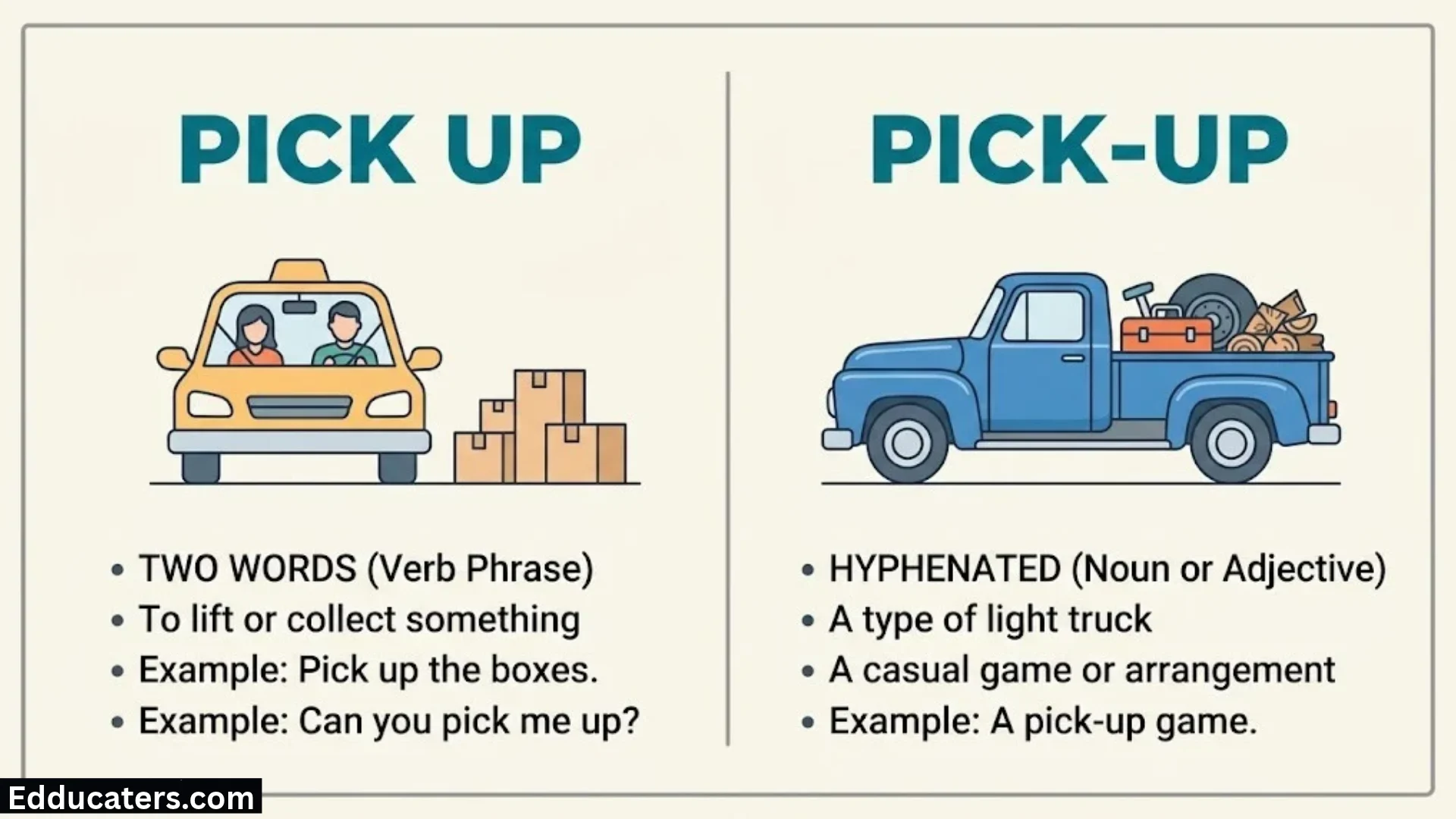
Have you ever wondered whether to write pickup, pick up, or pick-up? These three forms look similar, but their correct use depends on grammar and context.
The good news is that the difference is simple once you understand how each form works. In American English, pickup is generally a noun or adjective, while pick up is a verb phrase. The hyphenated form, pick-up, also appears in some dictionaries and writing styles.
Consider these examples:
- Pickup: The grocery pickup is scheduled for noon.
- Pick up: I need to pick up my groceries before noon.
- Pick-up: Please check the pick-up instructions before arriving.
Although these examples relate to collecting groceries, each spelling serves a different purpose or follows a particular spelling convention.
In this guide, you’ll learn the difference between pickup or pick up, understand when to use the hyphenated form, and explore practical examples that make the correct spelling easier to remember.
Pickup or Pick Up: What Is the Difference?
The main difference between pickup or pick up comes down to grammatical function. Pickup is commonly a noun or adjective, whereas pick up is a verb phrase that describes an action.
Here’s a quick comparison:
| Spelling | Part of speech | Meaning | Example |
| Pickup | Noun | An act or arrangement for collecting something | The pickup is scheduled for noon. |
| Pickup | Noun | A type of vehicle | She drives a pickup. |
| Pickup | Noun | An increase in activity | We noticed a pickup in sales. |
| Pickup | Adjective | Describing a type of game or service | We joined a pickup basketball game. |
| Pick up | Verb phrase | To collect something | I’ll pick up the package. |
| Pick up | Verb phrase | To lift something | Please pick up the box. |
| Pick up | Verb phrase | To learn or detect something | She picked up a few Spanish phrases. |
| Pick-up | Hyphenated variant | An alternative spelling used in some contexts | Check the pick-up instructions. |
The easiest way to remember the difference is to consider what the sentence describes.
If you’re naming an object, service, or event, pickup is usually appropriate. If you’re describing an action, use pick up.
For example, you might arrange a pickup for an online order, but you still need to pick up that order from the store.
The hyphenated form requires a little more judgment. Some dictionaries and editorial styles accept pick-up in certain noun or adjective uses. However, contemporary American English generally favors pickup as a noun or adjective.
What Does Pickup Mean?
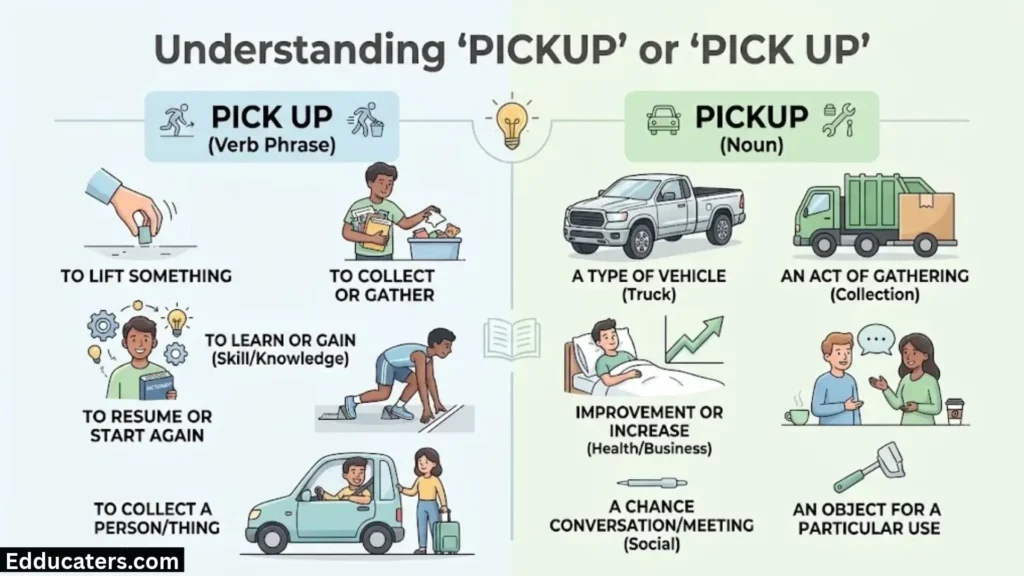
The word pickup has several meanings in everyday English. It can refer to collecting something, a type of truck, a musical device, an informal sports game, or an increase in activity.
The intended meaning depends on the context. A pickup truck has little in common with a pickup in sales, yet both use the same spelling.
Pickup as a Noun
A pickup noun names an object, event, service, or result rather than describing an action.
Here are the main meanings you’ll encounter.
Collection or retrieval: A pickup can refer to an arrangement for collecting a person, package, or order.
- The package pickup is scheduled for Friday.
- Our grocery pickup is ready.
- School pickup begins at 3 p.m.
- The customer arrived early for the order pickup.
In each sentence, pickup names an event or arrangement. It doesn’t function as an action verb.
A type of truck: In American English, a pickup is a vehicle with a passenger cab and an open cargo bed. People commonly use pickup trucks to transport tools, equipment, and other goods.
- My neighbor drives a red pickup.
- The contractor loaded his tools into the pickup.
- We rented a pickup for the weekend.
An increase or improvement: The word can also describe a rise in activity, speed, or performance.
- The store noticed a pickup in holiday sales.
- There has been a pickup in customer demand.
- The car has good pickup when accelerating.
A musical or electronic device: A guitar pickup converts string vibrations into electrical signals that can be amplified or processed. Record players also use pickup mechanisms to read information from record grooves.
- The guitarist replaced a faulty pickup.
- This electric guitar has two pickups.
- The technician adjusted the record player’s pickup.
These meanings share one important feature: pickup identifies something, whether it’s an object, an event, a service, or an increase.
Pickup as an Adjective
A pickup adjective describes the type or purpose of the noun that follows it. In this role, pickup often appears in expressions related to informal sports or collection services.
Consider these examples:
- Pickup game: An informal game arranged without a formal league structure.
- Pickup basketball: A casual basketball game among available players.
- Pickup service: A service that lets customers collect orders.
- Pickup truck: A truck designed with an open cargo area.
For example, a group of friends might organize a pickup soccer game at a local park. They don’t need a formal tournament or league schedule. They simply gather enough players and start playing.
Likewise, a retailer might offer pickup service for customers who order products online. Customers collect their purchases instead of having them delivered.
Notice that pickup doesn’t describe an action in these expressions. It modifies another noun to tell readers what kind of game, service, or vehicle you’re discussing.
Pickup Examples in Sentences
These examples show how the same spelling works across different contexts.
| Sentence | Meaning of pickup | Grammatical role |
| The pickup is waiting outside. | A collection arrangement | Noun |
| He bought a used pickup. | A truck | Noun |
| Sales showed a pickup in December. | An increase | Noun |
| We played a pickup game after school. | An informal game | Adjective |
| The store offers curbside pickup. | A collection service | Noun |
| The guitarist adjusted her pickup. | An electronic musical component | Noun |
Remember: The word’s meaning changes with the context, but its spelling can remain the same.
What Does Pick Up Mean?
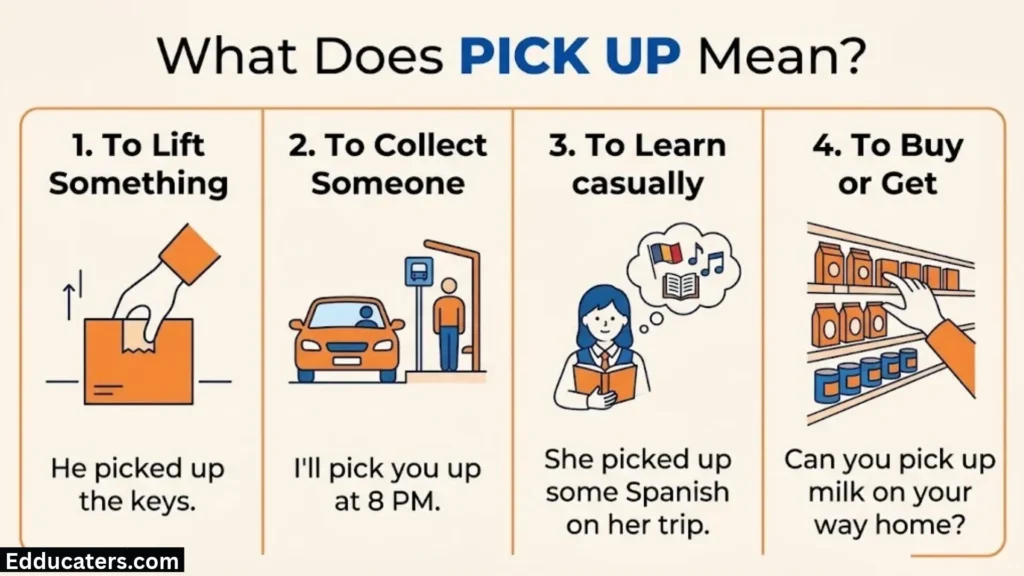
Pick up is a phrasal verb formed from the verb pick and the particle up. Together, these words express several related and figurative meanings.
The phrase can describe lifting an object, collecting a passenger, learning a skill, answering a phone, detecting a signal, or improving an activity. The exact meaning depends on the sentence.
Pick Up Meaning to Collect or Retrieve
One of the most common meanings of pick up is to go somewhere and collect a person or thing.
You might pick up groceries after work, collect a package from a delivery center, or pick up a friend from the airport.
Examples:
- I’ll pick up the groceries on my way home.
- Can you pick up the package before the store closes?
- She picks up her children after school.
- We need to pick up our tickets at the box office.
In these sentences, pick up describes an action. That’s why you write the words separately.
Compare these examples:
- Noun: The grocery pickup is at 5 p.m.
- Verb phrase: I’ll pick up the groceries at 5 p.m.
The first sentence names an arrangement. The second describes what someone will do.
Pick Up Meaning to Lift or Raise
The phrase can also mean to lift something from a surface or raise it from a lower position.
Examples:
- Please pick up your backpack.
- He picked up the fallen keys.
- The child tried to pick up a heavy rock.
- She picked up the phone from the desk.
This meaning describes a physical action. You use your hands to lift or grasp something.
However, pick up doesn’t always require physical contact. The phrase also has several figurative meanings related to receiving information or gaining a skill.
Pick Up Meaning to Learn or Acquire
Have you ever learned a few expressions from a foreign-language movie without taking a class? You can describe that experience by saying you picked up some words or phrases.
In this context, pick up means to learn or acquire something through exposure, practice, or experience.
Examples:
- He picked up some Spanish while traveling.
- She picked up useful cooking skills from her grandmother.
- Children often pick up new expressions from their friends.
- I picked up a few computer shortcuts at work.
The phrase suggests that learning happened informally or gradually. It doesn’t necessarily mean the person studied the subject in a structured course.
Pick Up Meaning to Detect or Receive
Another common meaning involves receiving or noticing something that might otherwise go unnoticed.
For example, a radio can pick up a broadcast signal. A microphone can pick up a quiet voice. A person might pick up a hint of irritation in someone’s tone.
Examples:
- This radio can pick up distant stations.
- The microphone picked up every word.
- She picked up a strange sound from the engine.
- The instrument picked up a faint signal.
In scientific writing, pick up can describe receiving or detecting a signal. The technical details depend on the instrument and the type of signal involved.
The everyday grammar remains straightforward: when the phrase describes the act of receiving or detecting something, write pick up as two words.
Pick Up Meaning to Improve or Increase
The phrase can describe something that becomes stronger, faster, busier, or more active.
Examples:
- Business usually picks up before the holidays.
- The wind began to pick up in the afternoon.
- Sales picked up after the company introduced a discount.
- His pace picked up during the final mile.
- Her mood picked up after the good news.
In these sentences, the phrase doesn’t mean lifting or collecting an object. It describes a change in condition or intensity.
This use is common in conversations about business, weather, sports, and everyday life.
Pick Up Meaning to Answer the Phone or Resume an Activity
There are a few other useful meanings worth knowing.
Answering a phone: In American English, pick up often means answering an incoming call.
- I called twice, but nobody picked up.
- Please pick up the phone when your manager calls.
Continuing after an interruption: The phrase can also mean resuming something from an earlier point.
- Let’s pick up where we left off yesterday.
- The speaker picked up the discussion after lunch.
Tidying a space: In American English, pick up can mean putting things away or making a room neat.
- Please pick up your room before dinner.
- I need to pick up the living room before our guests arrive.
These examples demonstrate the flexibility of this phrasal verb. Its spelling stays the same even when its meaning changes.
Pick Up Examples in Sentences
Here are more examples to help you recognize the phrase in everyday writing.
- Please pick up your coat before leaving.
- I’ll pick up dinner on my way home.
- She picked up the basics of photography quickly.
- The radio couldn’t pick up the station clearly.
- Sales tend to pick up during the summer.
- He didn’t pick up when I called.
- Let’s pick up the conversation tomorrow.
Each sentence describes an action, process, or change. That’s the defining clue that you need the two-word form.
When Should You Use Pickup, Pick Up, or Pick-Up?
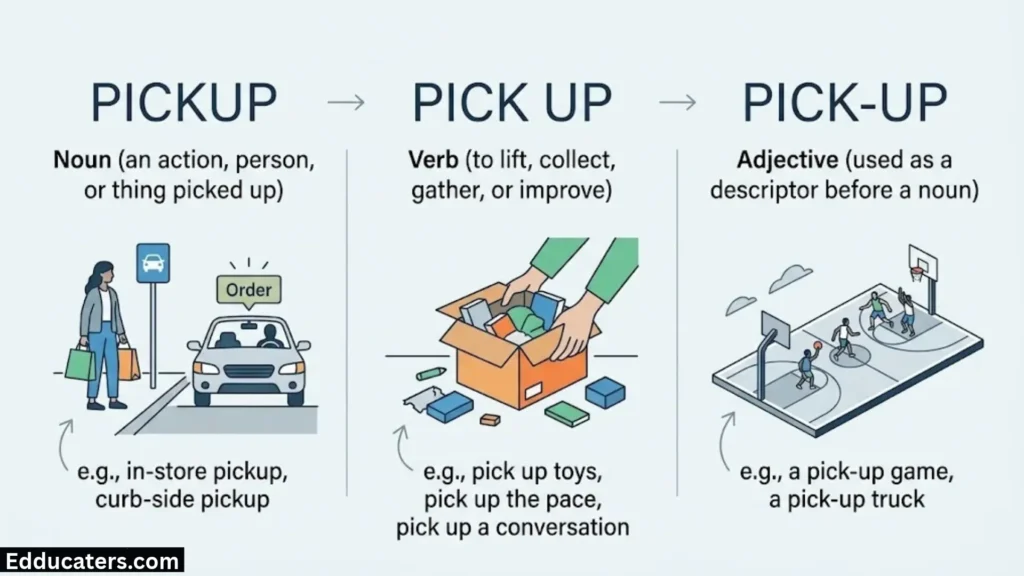
Choosing among these spellings becomes easier when you identify the word’s function before writing it.
When to Use Pickup
Use pickup when you need a noun or an adjective in standard American English.
As a noun, it can name a collection, vehicle, device, or increase. As an adjective, it can describe a type of game or service.
Correct examples:
- The pickup is scheduled for 10 a.m.
- She drives a pickup to the construction site.
- The store offers pickup for online orders.
- We organized a pickup soccer game.
- The company reported a pickup in demand.
A helpful test is to ask yourself whether the word names something or describes a category. If it does, pickup is often the right choice.
When to Use Pick Up
Use pick up when you need the verb phrase.
The phrase can appear in different verb tenses without changing its two-word structure.
| Verb tense | Example |
| Present | I pick up my mail every morning. |
| Third-person singular | She picks up her mail every morning. |
| Present continuous | He is picking up the groceries. |
| Simple past | They picked up the package yesterday. |
| Present perfect | We have picked up the tickets. |
| Future | I’ll pick up the order tomorrow. |
The verb pick changes form when the tense or subject requires it. The particle up remains separate.
One more useful detail: when a noun or pronoun object appears in the phrase, the placement rules matter.
Both of these sentences are correct:
- Pick up the bag.
- Pick the bag up.
However, when the object is a pronoun, it normally goes between the verb and particle.
- Correct: Pick it up.
- Incorrect: Pick up it.
This object-placement rule is especially helpful when you’re learning how phrasal verbs work.
When to Use Pick-Up
Use pick-up when a dictionary or the style guide you’re following supports that hyphenated form.
The hyphenated spelling appears in some dictionaries and editorial conventions. You may encounter it in expressions such as:
- Pick-up instructions
- Pick-up time
- Pick-up football
These forms aren’t automatically wrong. However, they aren’t necessary in every sentence.
For ordinary American English writing, pickup is usually the simplest choice for the noun and adjective, while pick up remains the verb phrase. Follow your publication’s style guide if it specifies a different convention.
Is It Pickup Truck or Pick-Up Truck?
In standard American English, pickup truck is the preferred spelling. The word pickup functions as a noun modifier that identifies the type of truck.
A pickup truck has a passenger cab and an open cargo bed. People use these vehicles for personal transportation, work, and hauling supplies.
Examples:
- My brother bought a used pickup truck.
- The farmer loaded equipment into his pickup truck.
- We rented a pickup truck to move furniture.
- Her pickup truck has enough space for tools and camping gear.
You may also see pick-up truck in older texts or publications that follow a different spelling convention. That variant is recognizable, but contemporary American writing generally uses the closed form.
The spelling pick up truck is generally incorrect when you mean the vehicle. In that phrase, pick up looks like a verb rather than the established name of the vehicle.
Compare the difference:
- Correct: He parked his pickup truck outside.
- Correct: He will pick up the truck tomorrow.
- Incorrect for the vehicle’s name: He bought a pick up truck.
The last sentence incorrectly separates the established compound noun.
Common Expressions That Use Pickup or Pick Up
Some expressions become easier to remember when you see how they work in everyday situations.
Pickup Game
A pickup game is an informal sports game that people arrange without the structure of an organized league or scheduled competition.
For example:
- We played a pickup basketball game after work.
- The neighborhood hosts pickup soccer games on weekends.
- She joined a pickup baseball game at the park.
In these expressions, pickup describes the type of game. It doesn’t mean someone is physically collecting the players.
Grocery Pickup and Curbside Pickup
Retailers commonly use grocery pickup and curbside pickup to describe services that let customers collect orders instead of receiving home delivery.
Examples:
- Our grocery pickup is scheduled for 4 p.m.
- The store offers free curbside pickup.
- I need to pick up my online order before closing.
Notice the difference between the service and the action. Grocery pickup names the service, while pick up my online order describes what the customer will do.
Guitar Pickup
A guitar pickup is an electronic component that converts string vibrations into an electrical signal. That signal can then pass through an amplifier or other audio equipment.
Examples:
- The guitarist installed a new pickup.
- This guitar has two pickups.
- The technician repaired the damaged pickup.
The word is a noun in each sentence, so the one-word spelling is appropriate.
Pick Up the Phone
The expression pick up the phone means to answer or take an incoming call.
Examples:
- Please pick up the phone if the office calls.
- He didn’t pick up when I called yesterday.
- She picked up the phone and greeted the caller.
Use two words because the phrase expresses an action.
Pick Up After Yourself
In American English, pick up after yourself means to clean up your belongings or return items to their proper places.
Examples:
- Please pick up after yourself in the kitchen.
- The children need to pick up their toys.
- He picked up the living room before the guests arrived.
Here, pick up describes the act of tidying. You wouldn’t write pickup after yourself in this sentence.
Pickup or Pick Up: Common Grammar Mistakes
Even experienced writers sometimes confuse these forms because their meanings overlap. Fortunately, a few simple checks can prevent most errors.
| Incorrect or less suitable | Preferred form | Explanation |
| Please pickup the package. | Please pick up the package. | The sentence needs a verb phrase. |
| Your pick up is ready. | Your pickup is ready. | The word names a collection or service. |
| We played a pick up game. | We played a pickup game. | The standard American spelling is generally closed. |
| I will pickup my order. | I will pick up my order. | The phrase describes an action. |
| He bought a pick up truck. | He bought a pickup truck. | The vehicle’s name is conventionally one word before truck. |
| The pickup the box. | Pick up the box. | The sentence needs a correctly formed verb phrase. |
The hyphenated form deserves a separate note. Pick-up isn’t automatically incorrect because some dictionaries and style guides accept it as a variant. The important thing is to choose a form that fits your grammatical context and follow a consistent spelling convention.
Mistake: Treating Every Form as Interchangeable
The biggest mistake is assuming that pickup, pick up, or pick-up are simply three interchangeable spellings.
Consider these examples:
- The pickup is waiting outside.
- Please pick up the package.
- Check the pick-up instructions.
Each spelling has a different grammatical role or follows a particular editorial convention. Replacing one with another without checking the sentence can produce an awkward or incorrect result.
Mistake: Ignoring the Verb’s Object
The phrasal verb pick up allows its object to appear in different positions when the object is a noun.
Both of these sentences are correct:
- Pick up the package.
- Pick the package up.
However, pronouns normally go between the verb and particle:
- Correct: Pick it up.
- Incorrect: Pick up it.
This rule applies to the grammatical structure of the verb phrase, not to the noun pickup.
Pickup or Pick Up: Easy Ways to Remember the Difference
You don’t need to memorize a long list of grammar rules to distinguish these spellings. A simple memory trick will handle most everyday situations.
Use pickup to name something. Use pick up to describe an action.
Think of these examples:
- Pickup: The pickup is scheduled for noon.
- Pick up: I’ll pick up the order at noon.
In the first sentence, pickup names a collection arrangement. In the second, pick up tells you what the speaker plans to do.
You can apply a similar pattern to other English word pairs.
| Noun or adjective | Verb phrase | Example |
| Setup | Set up | The setup is ready. / Set up the equipment. |
| Makeup | Make up | Her makeup looks natural. / They made up after the argument. |
| Kickoff | Kick off | The kickoff is at noon. / Let’s kick off the meeting. |
| Pickup | Pick up | The pickup is ready. / Pick up the package. |
These pairs follow a common word-formation pattern, but English spelling isn’t perfectly uniform. Check a dictionary whenever you’re unsure about a particular compound.
Pickup or Pick Up: Frequently Asked Questions
Is pickup one word or two?
Pickup is one word when used as a noun or adjective in standard American English. Pick up is two words when used as a verb phrase.
For example, The pickup is ready uses the noun, while Please pick up the package uses the verb phrase.
Is it pickup or pick up?
Both spellings are correct, but they serve different grammatical purposes. Use pickup for a noun or adjective and pick up for an action.
The sentence determines which form you need.
What is the difference between pickup or pick up?
The main difference is grammatical function. Pickup names something, such as a vehicle, collection service, or informal game. Pick up describes an action, such as lifting an object, collecting a person, or learning a skill.
Is pickup a noun or a verb?
Pickup is commonly used as a noun and can also function as an adjective. The standard verb phrase is pick up, written as two separate words.
For example, The pickup is outside uses a noun, while I’ll pick up the groceries uses a verb phrase.
Is pickup an adjective?
Yes. Pickup functions as an adjective in expressions such as pickup truck, pickup game, and pickup service.
In each expression, it describes the type or purpose of the following noun.
Can pickup be used as a verb?
In standard American English, write the verb as pick up, not pickup.
For example, write I need to pick up my order, rather than I need to pickup my order.
Can pick up be used as a noun?
The standard noun form is pickup. The hyphenated spelling pick-up is also accepted in some dictionaries and editorial conventions.
For example, The pickup is scheduled for noon uses the noun correctly.
Is it pickup truck or pick-up truck?
Pickup truck is the preferred spelling in contemporary American English. You may encounter pick-up truck in some publications, but the closed form is the usual choice.
Avoid pick up truck when referring to the vehicle.
What does pickup mean in English?
Pickup has several meanings. It can refer to collecting something, a pickup truck, an electronic musical component, an informal sports game, or an increase in activity.
The intended meaning depends on the surrounding words.
What does pick up mean in a sentence?
Pick up is a phrasal verb that can mean to collect, lift, learn, detect, answer, or improve.
For example, I need to pick up my package means that you need to collect it.
How can you remember the difference between pickup or pick up?
Remember this simple rule: pickup names something, while pick up describes an action.
- The pickup is ready. — noun.
- Pick up the package. — verb phrase.
The hyphenated pick-up is a recognized variant in certain contexts, so follow your chosen dictionary or style guide when deciding whether to use it.
Conclusion: Pickup or Pick Up?
The difference between pickup or pick up becomes clear when you identify the word’s grammatical role.
Use pickup as a noun or adjective in standard American English. Write pick up as two words when describing actions such as collecting, lifting, learning, or detecting something. Use pick-up when your chosen dictionary or style guide supports that variant.
Remember the central distinction: a pickup is something you name, but to pick up is something you do. Once you recognize that difference, choosing the correct spelling becomes much easier.

Hello, I’m Claire Holloway. I have always been passionate about the English language and enjoy turning complex grammar rules into simple, easy-to-follow lessons. I believe that every learner can become a confident English writer with the right guidance.
I create educational content focused on grammar, vocabulary, sentence structure, and writing improvement. Every article I publish is designed to help readers learn with confidence and accuracy.
Books
Grammar Without Confusion
Modern English Usage Guide
 Nathan Whitmore
 Julian Mercer