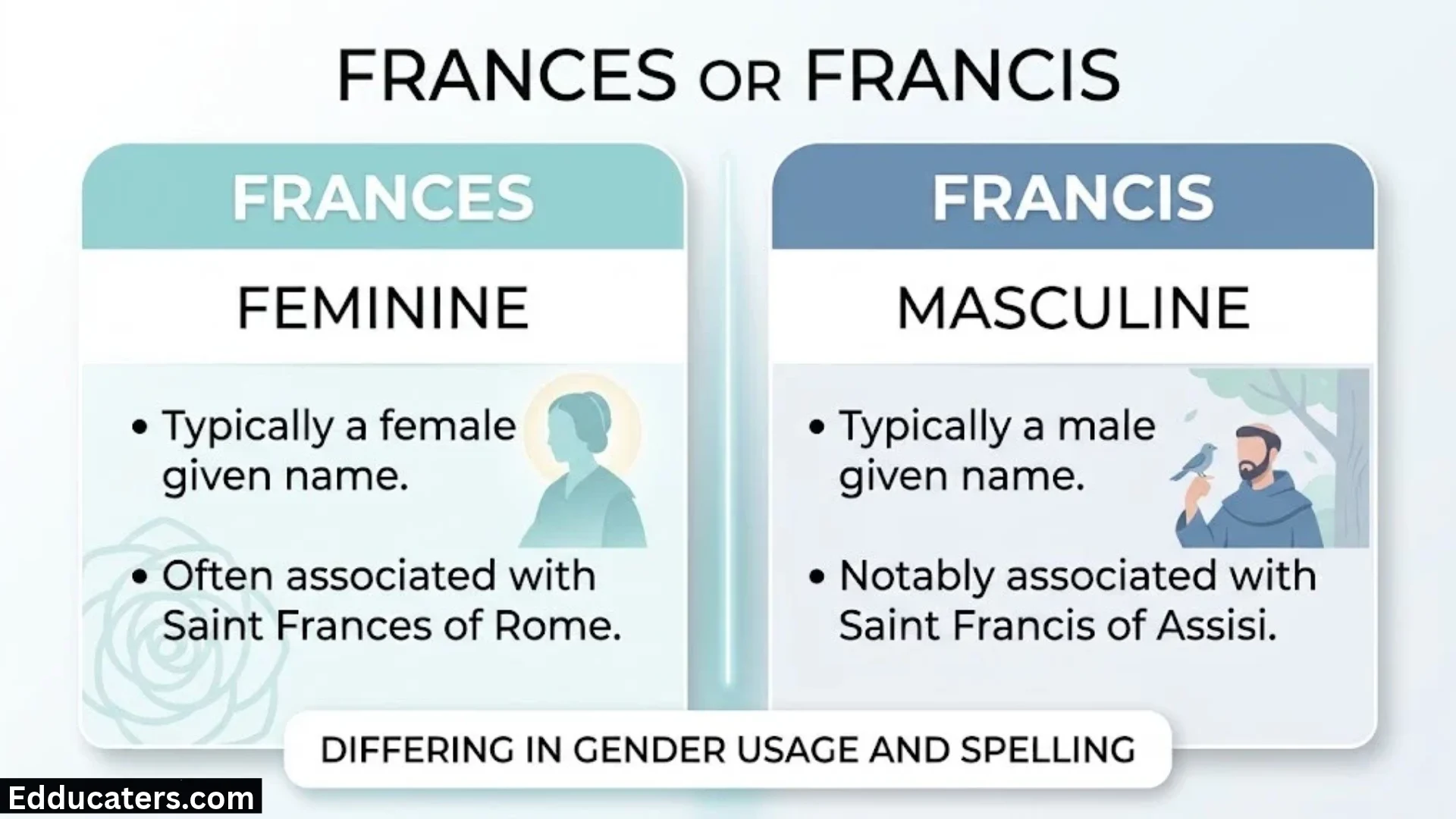
Have you ever wondered whether the correct spelling is Frances or Francis? These two names look almost identical and usually sound the same when spoken aloud. However, they have traditionally served different naming roles in English.
Francis is traditionally a masculine given name, while Frances is traditionally a feminine given name. Both spellings are correct, and neither is a British or American spelling variant of the other. The right choice depends on the person’s actual name.
The distinction becomes easier to understand when you look at their spelling, meaning, history, and everyday use. Both names share a historical origin connected to the Latin name Franciscus and the word Frenchman. Their traditional gender associations developed over time rather than following an unchanging rule.
If you’re checking a name for an email, writing about a historical figure, researching your family tree, or choosing a name for a baby, understanding the difference will help you avoid common mistakes.
Frances or Francis: Which Spelling Is Correct?
Both Francis or Frances are correct spellings of personal names. The difference lies in their traditional usage and the person you’re referring to.
Use Francis when that is the individual’s name. Traditionally, English speakers have used it as a masculine first name. Use Frances when that is the individual’s name. English speakers have traditionally used this spelling as a feminine first name.
Here’s a quick comparison:
| Feature | Francis | Frances |
| Traditional gender association | Masculine | Feminine |
| Common use | First name and surname | First name; also found as a surname |
| Spelling ending | -is | -es |
| Common English pronunciation | FRAN-sis | FRAN-sis |
| Historical origin | Latin Franciscus | Same historical name family |
| British or American variant? | No | No |
The most important point is that neither name is inherently a misspelling of the other. They are established names with different conventional spellings.
For example, if your colleague’s name is Francis, changing it to Frances would be incorrect when addressing that person. The same applies if someone named Frances receives a message addressed to Francis.
A person’s actual name matters more than a general naming convention. Traditional gender associations can help you understand the distinction, but they cannot tell you how every individual spells their name.
What Is the Difference Between Frances or Francis?
The main Francis or Frances difference involves spelling and traditional gender association. Their pronunciation and historical background are closely related.
Although the names look like simple variations of one another, English speakers generally recognize them as separate personal names.
Francis: The Traditional Masculine Name
Francis is traditionally a masculine given name in English. It has a long history in European naming traditions and became especially familiar through Christian history.
One of its best-known historical bearers was Saint Francis of Assisi, a medieval religious figure associated with humility, poverty, and care for the poor. His influence helped spread the name across Europe.
Other well-known bearers include philosopher Francis Bacon and explorer Francis Drake. Their names illustrate the spelling’s long-standing use for men in English-speaking societies.
Common nicknames and related short forms include:
- Frank: A traditional short form associated with Francis.
- Frankie: An informal, familiar form.
- Fran: A short form that can be used for different names.
- Franklin: A separate given name, not simply another spelling of Francis.
These forms don’t replace the full name in every setting. For example, someone whose legal name is Francis may use Frank with friends but prefer Francis in professional correspondence.
Frances: The Traditional Feminine Name
Frances is traditionally the feminine form of Francis in English. It shares the same broad historical background but uses a different final spelling.
The name has appeared throughout English-language history and remains recognizable as a classic feminine given name. Saint Frances Xavier Cabrini, a Catholic missionary and social worker, is one notable historical bearer.
Common nicknames for Frances include:
- Fran: A familiar shortened form.
- Frannie: An informal and affectionate form.
- Franny: Another familiar nickname.
- Frankie: A nickname that can be used for Frances as well as Francis.
A nickname doesn’t always reveal a person’s full name. Someone called Frankie might be named Frances, Francis, or something else entirely.
Can Francis or Frances Be Used for Any Gender?
Traditionally, Francis has been masculine and Frances feminine. However, naming conventions don’t function as absolute rules for every individual.
Some families choose traditional names regardless of gender. Others use names in new ways or select a spelling for personal, cultural, or family reasons.
It is therefore possible to encounter a woman named Francis or a man named Frances. Such cases don’t make the names invalid. They reflect individual naming choices rather than the most common traditional pattern.
When discussing names, it’s useful to distinguish between traditional usage and individual identity. The first describes a historical convention. The second tells you what name a particular person actually uses.
For ordinary writing, don’t change a person’s spelling simply because it doesn’t match your expectations. Check the person’s own spelling whenever possible.
What Does the Name Francis Mean?
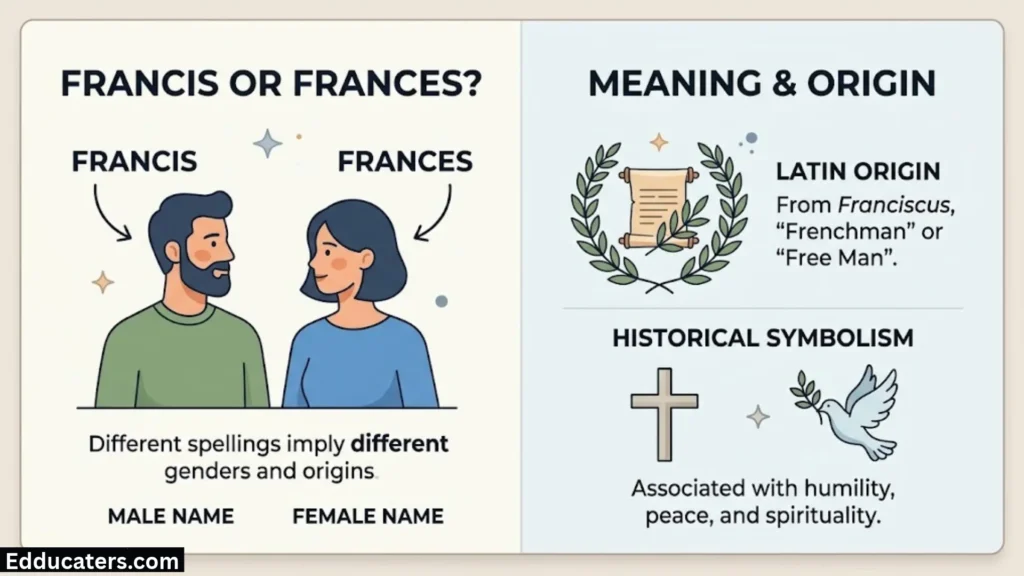
The name Francis comes from the Late Latin name Franciscus, commonly explained as meaning “Frenchman.” Its history connects it to the Franks, a Germanic people whose name became associated with the region and people of France.
The name passed through French forms before becoming established in English. Its history is therefore tied to language, geography, and European naming traditions rather than to a simple modern English definition.
According to Behind the Name’s Francis entry, Francis developed from Franciscus, a name associated with the meaning “Frenchman.”
The Meaning Behind Francis
The historical meaning of Francis is best understood through its connection to the Franks and the term for a French person.
You may also see the name described as meaning “free man” or “free person.” This interpretation is associated with the historical development of words connected to Frank and frank. However, “Frenchman” is the more direct explanation commonly given for the name’s Latin source.
These meanings should not be treated as perfectly interchangeable. A name’s original linguistic meaning can differ from the symbolic meaning people attach to it today.
For example, a family might choose Francis because it honors a relative, reflects a religious tradition, or carries a sense of heritage. Those personal associations can be meaningful even when they go beyond the name’s etymology.
Why Is Francis Historically Significant?
Francis became particularly influential through Saint Francis of Assisi, who lived from approximately 1181 or 1182 until 1226.
Born Giovanni in Assisi, Italy, he became known as Francesco. Accounts connect that nickname with his father’s association with France and the French language.
Francis later renounced a wealthy lifestyle and devoted himself to religious life and service to the poor. His example inspired the Franciscan religious movement, and his reputation helped the name spread throughout medieval Europe.
The name also became familiar through other religious figures, writers, explorers, and public figures. Its long history explains why Francis remains recognizable across many English-speaking communities.
In short, Francis has a historical meaning connected to France and the Franks, while its modern significance often comes from family, cultural, or religious associations.
What Does the Name Frances Mean?
Frances is the traditional feminine form of Francis in English. Because both names belong to the same historical name family, they share a closely related origin and meaning.
The feminine spelling developed from related French forms. Etymonline traces Frances to Old French Franceise, the feminine form associated with Franceis. You can read its explanation in the Frances etymology entry.
As with Francis, the name’s historical meaning connects to the French and Frankish name tradition.
The Meaning Behind Frances
The name Frances is commonly associated with the meaning “Frenchwoman” through its feminine relationship to Francis and the historical French forms.
You may also encounter interpretations such as “free woman.” That meaning reflects the broader association between Frank, frank, and ideas of freedom. However, the most direct historical explanation comes from the name’s connection to Franciscus and the French name tradition.
When explaining Frances, it’s helpful to separate three ideas:
- Etymological meaning: The historical linguistic origin of the name.
- Traditional usage: Its established role as a feminine given name in English.
- Personal meaning: The associations a family or individual gives the name.
For instance, a parent might choose Frances to honor a grandmother. Another family might prefer it because it sounds classic and familiar. Neither choice depends on the literal historical meaning.
Is Frances Simply the Female Version of Francis?
In traditional English naming conventions, yes. Frances is widely recognized as the feminine form of Francis.
However, the distinction between the two spellings did not always operate as consistently as it does today. Historical naming practices were less standardized, and spellings could vary across records and periods.
The distinction between Francis as a masculine name and Frances as a feminine name became established over time, with the seventeenth century often cited as an important point in that development.
This history explains why the names are closely related yet retain different spellings. It also cautions against assuming that every historical record followed today’s conventions.
Are Francis or Frances Pronounced the Same?
In most English-speaking contexts, Francis or Frances are pronounced the same or nearly the same. Both commonly have two syllables, with stress on the first.
The usual pronunciation is represented as /ˈfræn.sɪs/ in many English pronunciation references. The first syllable sounds like “Fran,” and the second has a short unstressed vowel.
| Name | Common pronunciation | Syllables |
| Francis | FRAN-sis | 2 |
| Frances | FRAN-sis | 2 |
Because the names are homophones for many English speakers, hearing one usually won’t tell you how the person spells it.
Accent can affect the exact vowel sounds. For example, some British English speakers pronounce the first vowel differently from many American English speakers. That variation generally reflects accent rather than a reliable distinction between Francis or Frances.
Why Pronunciation Can Cause Confusion
Imagine someone introduces a friend at a gathering and says, “This is Frances.”
If you have never seen the name written down, you might spell it Francis because that spelling is familiar to you. Someone else might choose Frances based on their experience with the name.
Neither listener can reliably determine the spelling from sound alone.
To avoid mistakes:
- Ask how the person’s name is spelled.
- Check an email signature or official profile.
- Copy the spelling from a reliable source when writing about a public figure.
- Avoid guessing based on the person’s perceived gender.
The simplest rule is this: pronunciation helps you say the name, but spelling confirms which name it is.
What Is the Origin and History of Francis or Frances?
Francis or Frances share a historical background that connects Latin, French, and English. Their story stretches across centuries of language change and evolving naming customs.
Understanding this origin helps explain why the names look so similar while following different spelling conventions.
From Latin Franciscus to English Francis
The name Francis developed from Late Latin Franciscus. The Latin form was associated with the Franks and later acquired the meaning “Frenchman.”
The Franks were a Germanic people whose history shaped parts of Western Europe. Their name became closely linked to the region that developed into France, and related words passed between languages over time.
Old French used forms such as Franceis. The name then developed into French François and English Francis, among other related forms.
This progression illustrates an important point about name origin: a name can travel between languages while changing its spelling and pronunciation. Those changes don’t necessarily create entirely unrelated names.
How Saint Francis of Assisi Influenced the Name
Saint Francis of Assisi played a major role in making Francis widely known in Christian Europe.
He was born in Assisi, in present-day Italy, and originally received the name Giovanni. He later became known as Francesco. His religious life and the movement associated with him gave the name lasting prominence.
His influence extended beyond Italy. Religious communities, families, and later generations adopted the name, helping it become established in multiple languages.
Francis also became familiar through Saint Francis Xavier and other historical figures. Over time, it developed into a traditional given name as well as a surname.
How Frances Developed as a Feminine Name
Frances followed a related path through feminine forms in French and English.
Old French Franceise contributed to the development of Frances, while the related masculine form developed into Francis. English gradually established a clearer distinction between the two spellings.
According to Behind the Name’s Frances entry, the convention distinguishing Francis as masculine and Frances as feminine did not arise until the seventeenth century.
That distinction reflects changing naming practices rather than an original rule that applied identically in every period.
French Equivalents: François and Françoise
Francis or Frances belong to a broader family of names found in several languages. French provides two useful examples:
- François: A traditional French masculine name related to Francis.
- Françoise: A traditional French feminine name related to Frances.
Other related forms include Francesco in Italian, Francisco in Spanish and Portuguese, and Franz in German.
These names share historical roots, but they are not interchangeable spellings. Each belongs to its own language and naming tradition.
If you’re writing in English, use Francis or Frances when that is the person’s established English name. If a person uses François or Françoise, preserve the accents and spelling where possible.
Is Francis or Frances Different in American and British English?
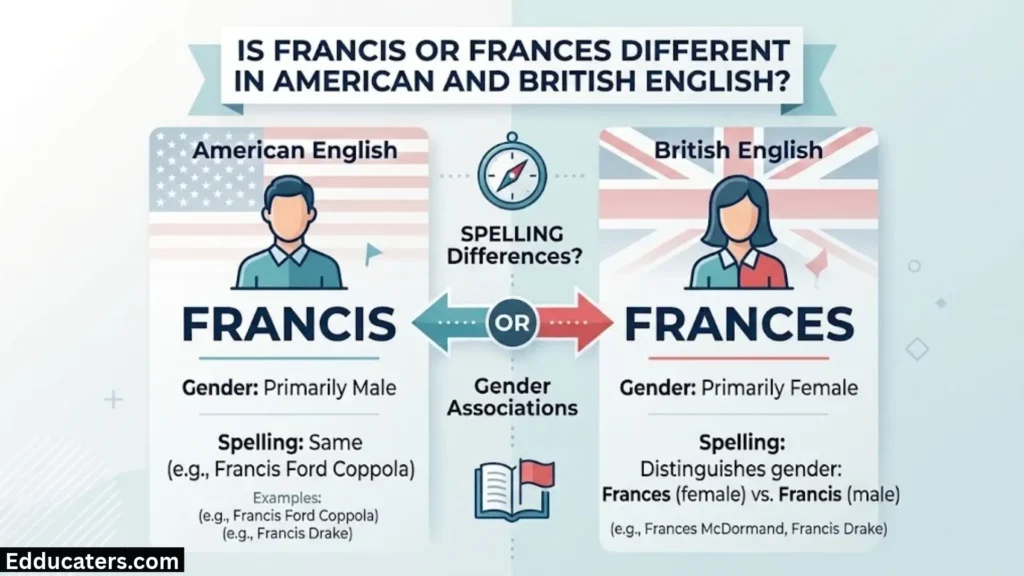
No major American-versus-British spelling distinction separates Francis from Frances. Both are established personal names in American and British English.
This is different from word pairs such as color and colour, where regional spelling conventions often explain the difference. Francis or Frances instead reflect traditional name usage.
| English variety | Francis | Frances |
| American English | Established name | Established name |
| British English | Established name | Established name |
| Canadian English | Established name | Established name |
| Australian English | Established name | Established name |
The table describes general recognition, not the frequency of either name in each country. Naming trends can vary across communities and generations, but nationality alone does not determine which spelling is correct.
Does American English Prefer Francis?
Francis is a familiar traditional masculine name in American English, while Frances is the conventional feminine form.
However, it would be inaccurate to claim that Americans universally prefer one spelling over the other. The correct spelling depends on the individual, and the frequency of names can change over time.
The same principle applies in British English and other English-speaking regions.
Should You Change the Spelling for an International Audience?
No. You generally shouldn’t alter a person’s name to suit an audience’s national spelling conventions.
For example, if you’re preparing a presentation for readers in the United States, use Frances if that is the person’s name. If you’re writing for a British audience about someone named Francis, retain Francis.
Personal names should follow the individual’s established spelling, not regional spelling preferences for ordinary vocabulary.
How to Use Francis or Frances in a Sentence
Francis or Frances function like other English proper nouns. They can serve as subjects, objects, or possessive names without changing the basic rules of sentence structure.
The main challenge isn’t grammar. It’s selecting the correct spelling.
Examples Using Francis
Here are practical examples showing how to use Francis in everyday writing:
- Introduction: “Francis will join us for dinner tonight.”
- Workplace: “I sent Francis the meeting agenda.”
- Family conversation: “My grandfather Francis loved gardening.”
- Invitation: “Please confirm whether Francis can attend the ceremony.”
- Possessive: “Francis’s birthday is next week.”
- News writing: “Francis delivered a speech at the event.”
Each example uses Francis as a name. The surrounding sentence doesn’t change because the name ends in -is.
Examples Using Frances
Frances works in the same grammatical positions:
- Introduction: “Frances is joining us for lunch.”
- Workplace: “I spoke with Frances about the project.”
- Family conversation: “My aunt Frances lives nearby.”
- Invitation: “Frances is invited to the celebration.”
- Possessive: “Frances’s birthday is next week.”
- News writing: “Frances shared her views during the interview.”
These examples illustrate the traditional feminine use, but the grammatical rules apply regardless of the person’s gender.
Francis or Frances in Emails and Formal Writing
When writing a professional email, invitation, report, or letter, confirm the spelling before sending the document.
For example:
Correct when the recipient’s name is Francis:
Dear Francis,
Thank you for confirming your attendance at the meeting.
Correct when the recipient’s name is Frances:
Dear Frances,
Thank you for confirming your attendance at the meeting.
Both greetings are grammatically correct. The difference is whether the name matches the intended recipient.
This matters because a name is part of a person’s identity. Even a one-letter mistake can make a message seem careless, especially in formal correspondence.
How Do You Write the Possessive Form?
To show ownership or association, add an apostrophe and s to most singular personal names.
Examples include:
- Francis’s book
- Frances’s invitation
- Francis’s appointment
- Frances’s family
Some editorial styles handle names ending in s differently, particularly when they follow particular pronunciation or style conventions. Follow your publication’s style guide when one applies, and use a consistent approach.
The spelling difference between Francis or Frances doesn’t otherwise change how possessives work.
Common Francis or Frances Spelling Mistakes
People often confuse these names because they differ by only one letter and generally sound alike. A quick check can prevent the most common errors.
Confusing -Is With -Es
The most obvious difference is the final letter sequence:
- Francis ends in -is.
- Frances ends in -es.
A useful memory aid is to associate Francis with the traditional masculine form and Frances with the traditional feminine form.
However, remember that this is a conventional distinction rather than an inflexible rule for every individual.
Writing Francess or Françis
Forms such as Francess or Françis are not the standard English spellings of these names in ordinary use.
- Francess adds an extra s to Frances.
- Françis adds a cedilla that does not belong in the standard English spelling Francis.
These forms may appear as individual or family-specific spellings, but you shouldn’t assume they are standard alternatives.
If you encounter an unusual spelling in a historical document or family record, preserve it when transcribing the record. Don’t automatically correct a genuine name to match modern convention.
Relying on Gender to Guess the Spelling
Another common mistake is assuming that a person’s name must follow traditional gender associations.
For example, you might expect a woman to be named Frances and a man to be named Francis. That expectation reflects common convention, but it cannot confirm an individual’s actual spelling.
The safest approach is to check the spelling directly. An email signature, official profile, published biography, or the person’s own confirmation can settle the question.
Letting Autocorrect Change the Name
Spell-checkers sometimes replace unfamiliar names with more familiar words or names. This can happen when the software doesn’t recognize a person’s spelling.
Before sending an important email or publishing an article, review names separately from ordinary spelling errors.
A name that looks unusual to a spell-checker may still be correct. Personal names deserve the same careful proofreading as dates, addresses, and other important details.
Are Francis or Frances First Names or Surnames?
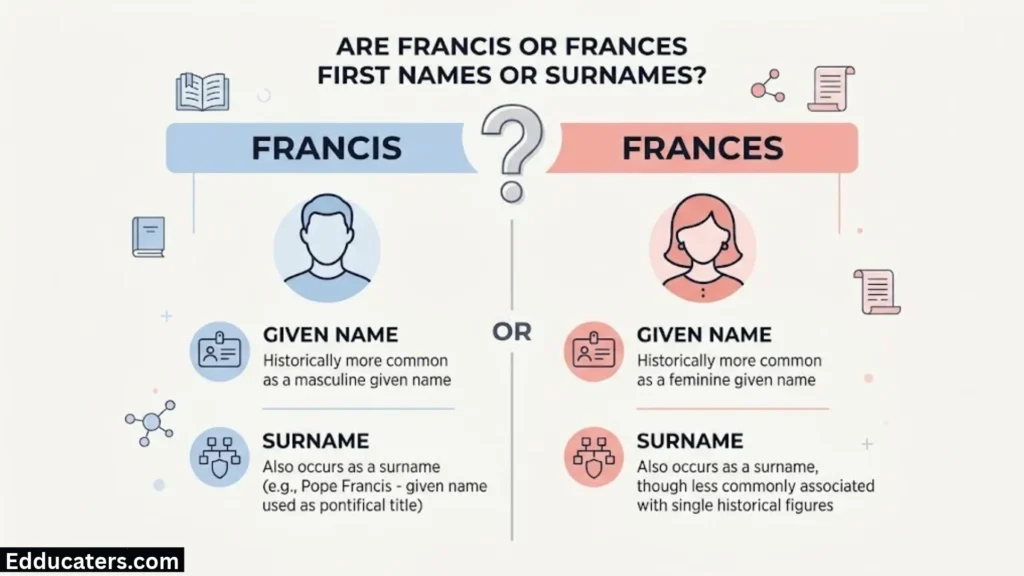
Both Francis or Frances can appear as given names, and both are also found as surnames. Their traditional gender associations apply most clearly to their use as first names.
A given name is the name assigned to a person as an individual identifier. A surname, also called a family name or last name, is a name used as part of a family or inherited naming system.
Francis as a First Name or Surname
Francis has a long history as a given name in English. It is also an established surname, often derived from the personal name or related historical forms.
For example:
- “Francis arrived early” uses Francis as a given name.
- “Ms. Francis chaired the meeting” may use Francis as a surname.
- “The Francis family moved to a new home” uses Francis as a family name.
The surrounding context helps identify how the name functions.
Frances as a First Name or Surname
Frances is most familiar as a feminine given name in English, but it can also appear as a surname.
For example:
- “Frances wrote the letter” uses Frances as a given name.
- “Mr. Frances signed the form” could use Frances as a surname.
- “The Frances family organized the reunion” uses Frances as a family name.
These examples show why you shouldn’t assume a name’s gender association tells you everything about the person carrying it.
Why Surnames Need Special Care
Family names don’t necessarily follow the gender conventions associated with given names. A surname remains the family’s name regardless of whether the person carrying it is male, female, or nonbinary.
If Francis or Frances appears in a family tree, census record, or historical document, identify whether it functions as a given name or surname before interpreting it.
Genealogical research also requires attention to spelling changes. Older records may contain inconsistent spellings because clerks wrote names as they heard them or followed local conventions.
When documenting family history, record the spelling used in the source and note any verified alternatives rather than silently replacing one with another.
How to Remember the Difference Between Frances or Francis
If you often mix up these names, focus on their final two letters.
Francis ends in -is, while Frances ends in -es.
The traditional naming convention provides another memory aid:
- Francis: Traditionally masculine.
- Frances: Traditionally feminine.
You can use these associations to remember the usual distinction, but don’t rely on them to guess someone’s name.
For a real person, the most reliable method is simple: check the spelling. If you’re writing a formal email, preparing an invitation, or citing a public figure, verify the name before you publish or send your work.
One letter can make the difference between two established names. A quick check is usually all it takes.
Frequently Asked Questions
Is Francis or Frances the Correct Spelling?
Both are correct. Francis is traditionally masculine, while Frances is traditionally feminine in English. Use the spelling that belongs to the person you’re referring to.
Is Francis a Male or Female Name?
Francis is traditionally a masculine name in English. However, some people use it outside that convention, so the spelling alone doesn’t establish someone’s gender.
Is Frances a Male or Female Name?
Frances is traditionally a feminine name in English. It has a long history as the feminine form of Francis, although individual naming choices can differ from traditional patterns.
Is Frances the Feminine Form of Francis?
Yes. Frances is the established feminine form of Francis in English. The distinction between their traditional gender associations became clearer over time, particularly from the seventeenth century onward.
Can Frances Be a Man’s Name?
Yes. Although Frances is traditionally feminine, an individual may use it regardless of gender. When referring to a particular person, follow their actual name rather than assuming a spelling based on traditional convention.
Can Francis Be a Woman’s Name?
Yes. Francis is traditionally masculine, but it is occasionally used for women. Frances remains the conventional feminine form in English, but traditional naming patterns don’t dictate every individual’s name.
Are Francis or Frances Pronounced the Same?
Generally, yes. Both are commonly pronounced FRAN-sis in English, with two syllables and stress on the first. Regional accents may affect the exact vowel sounds, but pronunciation usually doesn’t reveal the spelling.
Do Francis or Frances Have the Same Meaning?
They share a historical origin and closely related meanings. Both are connected to the Latin name Franciscus and its association with the Franks and a French person. Frances is the traditional feminine form of Francis in English.
Is Frances or Francis the British English Spelling?
Neither spelling belongs exclusively to British English. Both are established names in British and American English. The distinction primarily reflects traditional name usage rather than a regional spelling rule.
How Do You Spell Francis or Frances Correctly?
Francis ends in -is, while Frances ends in -es. Remembering the traditional masculine and feminine associations can help, but checking the person’s own spelling is the most reliable method.
Conclusion: Frances or Francis
The difference between Frances or Francis comes down to spelling and traditional name usage. Francis is conventionally masculine, while Frances is conventionally feminine. Both names share a historical origin connected to Latin Franciscus and the name traditions of France and the Franks.
They also generally sound the same in English, which explains why people sometimes confuse them. Neither spelling is exclusively American or British, and both can appear as given names or surnames.
When writing about a specific person, don’t rely on pronunciation or traditional gender associations alone. Check the person’s actual spelling and use it consistently. That’s the simplest way to choose correctly every time.

Hi, I’m Nathan Whitmore, and I enjoy making English grammar easy for learners of all ages. I believe grammar should be practical, not confusing. I write simple, well-researched guides that help readers improve their writing, speaking, and overall communication skills.
I spend a lot of time studying grammar patterns, sentence construction, punctuation, and modern English usage. My goal is to create lessons that anyone can understand, whether they are students, teachers, or professionals.
Books
Clear English Grammar
The Smart Writer’s Grammar Handbook
 Julian Mercer