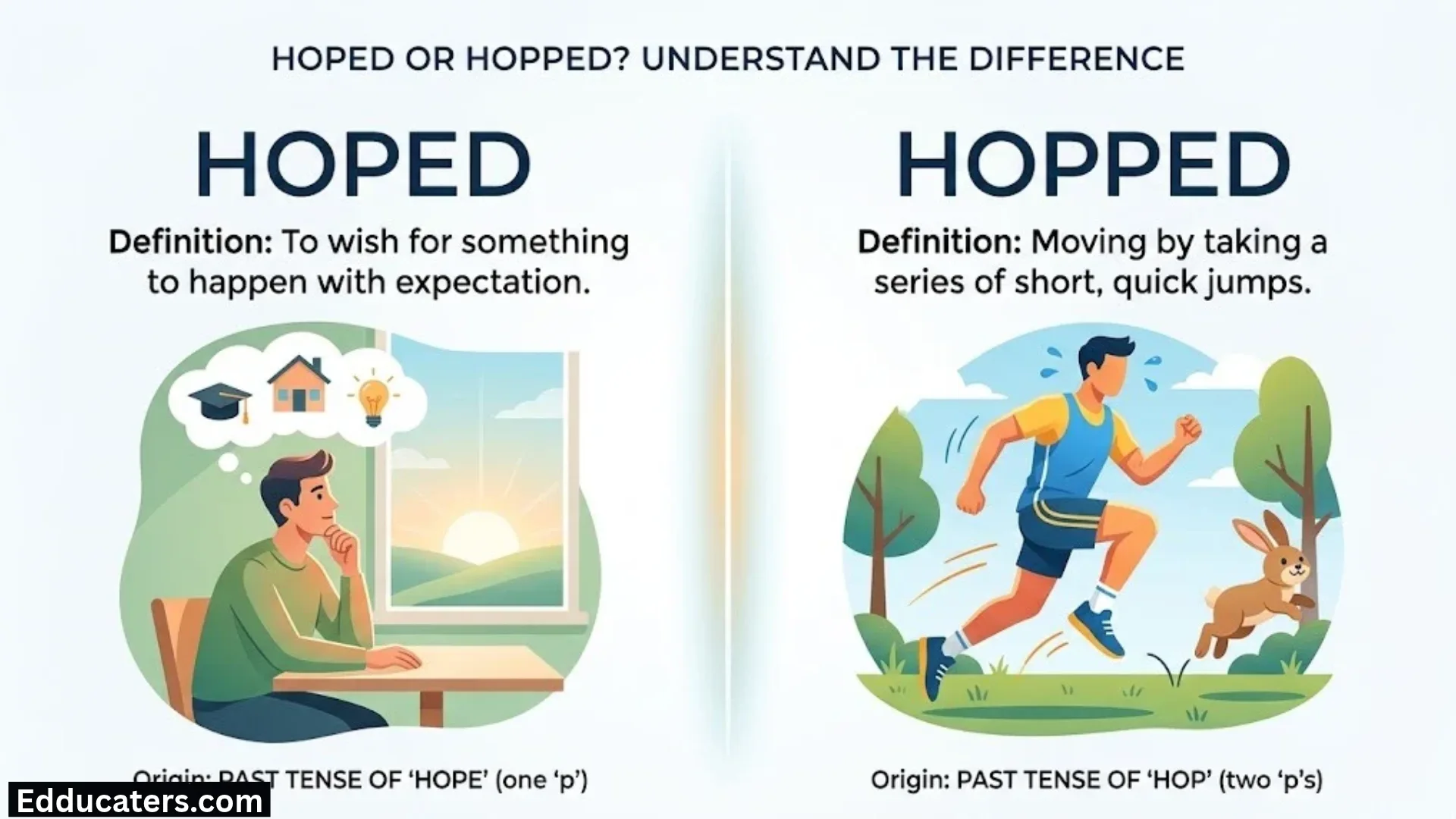
Have you ever wondered whether to write hopped or hoped? These two words look almost identical, but they describe completely different things. One refers to jumping or moving with a short bounce. The other expresses a wish or expectation.
Both spellings are correct in standard English. However, choosing the right one depends on your intended meaning and your understanding of English spelling rules.
Hopped is the past tense and past participle of hop. For example, “The rabbit hopped over the fence.” Hoped is the past tense and past participle of hope. For example, “She hoped to win the competition.”
The difference also explains why one word has two Ps while the other has only one. The verb hop doubles its final consonant before adding -ed, whereas hope drops its silent e.
In this guide, you’ll learn the difference between hopped and hoped, how to spell each word correctly, how to pronounce them, and how to use them naturally in everyday English.
What Is the Difference Between Hopped or Hoped?
The main difference between hopped or hoped is their meaning. Hopped describes a physical movement or a quick change between places. Hoped describes a wish, desire, or expectation about something.
Although the words share most of their letters, they come from different base verbs. Their spelling, pronunciation, and grammatical forms follow different patterns.
| Feature | Hopped | Hoped |
| Base verb | Hop | Hope |
| Meaning | Jumped or moved with a short bounce | Wished for or expected something |
| Simple past tense | Hopped | Hoped |
| Past participle | Hopped | Hoped |
| Present participle | Hopping | Hoping |
| Spelling rule | Double the final P | Drop the silent E |
| Vowel sound | Short O | Long O |
| Example | The frog hopped into the pond. | I hoped for good news. |
Hopped Meaning
Hopped is the simple past tense and past participle of hop. It usually describes a short jump or bouncing movement made by a person or animal.
For example, a rabbit hops across a lawn, a frog hops toward a pond, and a child might hop on one foot during a game.
The word can also describe a quick movement from one place or activity to another. This extended meaning appears frequently in everyday conversation.
Consider these examples:
- The rabbit hopped across the garden.
- She hopped over a puddle on her way home.
- The puppy hopped onto the sofa.
- We hopped between several shops during our afternoon outing.
- He hopped off the bus near the school.
In each sentence, hopped describes movement. The subject physically jumps or moves from one location to another.
Hoped Meaning
Hoped is the simple past tense and past participle of hope. It expresses a wish, desire, or expectation about a possible outcome.
Unlike hopped, this word describes a mental state rather than a physical action. You can hope for better weather, hope to get a job, or hope that someone feels better.
For example:
- I hoped for good news.
- She hoped to pass her final exam.
- They hoped the weather would improve.
- We hoped to finish the project before Friday.
- He hoped everything would work out.
Notice that none of these sentences describes jumping. Each one communicates something a person wanted or expected to happen.
The desired outcome doesn’t have to occur. You can say, “I hoped to win the race, but I finished second.” The word describes your earlier wish, not the final result.
Hopped or Hoped: Which One Should You Use?
Choosing between these words becomes easy when you focus on the sentence’s meaning.
Use hopped when you describe jumping, bouncing, or moving quickly between locations. Use hoped when you describe a wish or expectation.
Compare these sentences:
- The boy hopped across the stones. — He physically jumped from stone to stone.
- The boy hoped to cross the river. — He wanted or expected to cross it.
The surrounding words can also provide helpful context clues. Expressions such as over the fence, onto the sofa, and off the bus often indicate physical movement. Phrases such as hoped to win, hoped for success, and hoped everything would be fine express wishes or expectations.
Remember this simple distinction: hopped means jumped; hoped means wished or expected.
Why Is Hopped Spelled With Two Ps?
The spelling hopped follows a common English spelling pattern called the double consonant rule. When a short, one-syllable verb ends in a single consonant preceded by a single vowel, you usually double that final consonant before adding a suffix that begins with a vowel.
The base verb hop contains three letters: H, O, and P. The O represents a short vowel sound, and P is the single final consonant. When you add -ed, you double the P to form hopped.
The same rule applies when you add -ing.
- Hop → hopped
- Hop → hopping
- Stop → stopped
- Plan → planned
- Slip → slipped
- Grab → grabbed
This pattern helps distinguish words with short vowel sounds from words with silent E endings. Compare hop with hope. Their final letters change the way you pronounce the O.
The Double P Rule Explained
The final consonant doubling pattern generally applies to short, one-syllable verbs that end in a consonant after a single short vowel. When you add a vowel suffix such as -ed or -ing, you usually double the final consonant.
| Base verb | Add -ed | Add -ing |
| Hop | Hopped | Hopping |
| Stop | Stopped | Stopping |
| Plan | Planned | Planning |
| Slip | Slipped | Slipping |
| Grab | Grabbed | Grabbing |
The pattern doesn’t apply to every verb that ends in a consonant. For example, jump becomes jumped and jumping, not jumpped or jumpping. That’s because the base verb ends in two consonants, M and P, rather than one.
Likewise, help becomes helped and helping. The final P doesn’t need doubling because the word already has two consonants after its vowel.
Why Does Hopped Keep the Short O Sound?
Doubling the P helps preserve the short vowel sound in hop. Compare these two word families:
- Hop: hop, hopped, hopping
- Hope: hope, hoped, hoping
In hopped, the doubled P separates the O from the ending in a way that keeps the short vowel sound. In hoped, the silent E disappears before -ed is added, but the long O sound remains.
This difference is useful when you’re learning English spelling. A single letter can change both a word’s pronunciation and its meaning.
Why Is Hoped Spelled With One P?
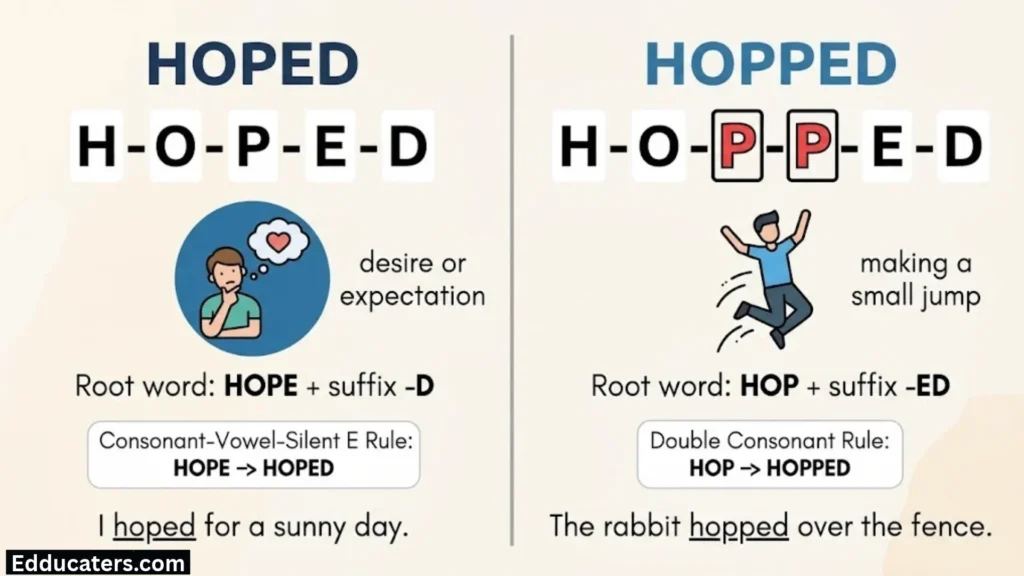
The spelling hoped follows a different pattern because the base verb hope ends in a silent E. English spelling usually drops this final E before adding a suffix that begins with a vowel.
The result is hoped, not hopeed.
For example:
- Hope → hoped
- Hope → hoping
- Smile → smiled
- Smile → smiling
- Dance → danced
- Dance → dancing
- Bake → baked
- Bake → baking
The silent E doesn’t produce its own sound. However, it often affects the pronunciation of the preceding vowel. In hope, it signals the long O sound.
The Silent E Spelling Rule
The silent E rule helps explain why hope changes differently from hop.
When you add -ed to hope, you remove the final E and attach the suffix. The P stays single because the original verb doesn’t follow the same short-vowel doubling pattern as hop.
Here is the difference:
| Base verb | Correct past tense | Reason |
| Hop | Hopped | Doubles the final P |
| Hope | Hoped | Drops the silent E |
| Stop | Stopped | Doubles the final P |
| Smile | Smiled | Drops the silent E |
| Plan | Planned | Doubles the final N |
| Dance | Danced | Drops the silent E |
Why Hoped Doesn’t Become Hopped
The key is that hop and hope are two separate verbs. They have different meanings and different spelling patterns.
Writing hopped when you mean hoped changes the meaning of the sentence. Likewise, writing hoped when you mean hopped can make the sentence confusing or incorrect.
Compare:
- Correct: I hoped to get the job.
- Incorrect for the intended meaning: I hopped to get the job.
- Correct: The child hopped across the room.
- Incorrect for the intended meaning: The child hoped across the room.
The incorrect versions aren’t necessarily impossible strings of words in every imaginable context, but they don’t communicate the intended meanings in these examples.
Hopped or Hoped Pronunciation: What’s the Difference?
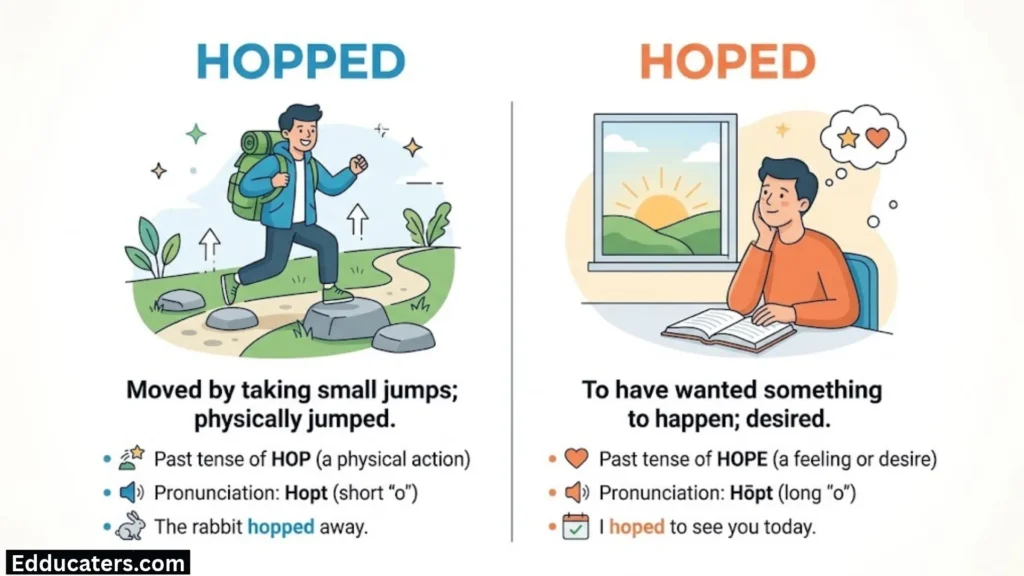
The words hopped or hoped sound different because their vowel sounds differ. In standard American English, hopped has a short vowel sound, while hoped has the long O sound found in words such as rope and hope.
Their final -ed endings sound the same. In both words, the ending is pronounced as a /t/ sound rather than as a separate syllable.
How to Pronounce Hopped
In American English, hopped typically sounds like /hɑpt/. The vowel resembles the sound in hot for many American speakers, although exact vowel quality varies by accent.
The word has one syllable. You don’t add an extra syllable for the -ed ending.
Examples of words with a similar ending include:
- Stopped
- Topped
- Dropped
- Mopped
Practice these sentences aloud:
- The rabbit hopped across the lawn.
- He hopped over the puddle.
- The ball hopped off the pavement.
Focus on the short vowel and the crisp ending.
How to Pronounce Hoped
In American English, hoped typically sounds like /hoʊpt/. Its vowel matches the long O sound in hope, rope, and doped.
Like hopped, the word has one syllable. The final -ed doesn’t create an extra syllable.
Words with a similar ending include:
- Roped
- Doped
- Cope (similar vowel, but a different ending)
- Hope (the base verb)
Practice these sentences aloud:
- She hoped for good news.
- I hoped to see you.
- They hoped the weather would improve.
Hopped or Hoped Pronunciation Comparison
| Word | American English IPA | Vowel sound | Rhyming example |
| Hopped | /hɑpt/ | Short O-type vowel | Stopped |
| Hoped | /hoʊpt/ | Long O | Roped |
The IPA symbols represent typical American pronunciations. Some speakers pronounce the vowel in hopped differently because regional accents vary.
One useful exercise is to read both sentences aloud:
- The boy hopped over the rock.
- The boy hoped to reach the rock.
Listen to the vowel in each word. The final consonant pattern stays similar, but the vowel sound changes.
What Are the Verb Forms of Hop or Hope?
Both hop and hope are regular verbs. They form their simple past tense and past participle with -ed, but they use different spelling changes.
Understanding their complete verb forms can help you avoid confusion when writing in the present, past, or continuous tense.
| Verb form | Hop | Hope |
| Base form | Hop | Hope |
| Third-person singular | Hops | Hopes |
| Simple past tense | Hopped | Hoped |
| Past participle | Hopped | Hoped |
| Present participle | Hopping | Hoping |
Hop, Hopped, or Hopping
The verb hop describes jumping or making a short bouncing movement.
Use hop for the base form, hopped for completed past actions, and hopping for ongoing actions or actions described by a participle.
Examples:
- Present: The bird hops along the path.
- Past: The bird hopped along the path.
- Continuous: The bird is hopping along the path.
- Perfect: The bird has hopped onto the fence.
Notice the spelling changes. The past-tense form doubles the P, and the present participle does the same before adding -ing.
Hope, Hoped, or Hoping
The verb hope describes a wish or positive expectation.
Use hope for the base form, hoped for past wishes, and hoping for ongoing wishes or expectations.
Examples:
- Present: I hope you feel better soon.
- Past: I hoped you would feel better.
- Continuous: I am hoping for good news.
- Perfect: I have hoped for this opportunity for years.
The final E disappears in both hoped or hoping. The P remains single because the word follows the silent E pattern.
Hopping or Hoping: What’s the Difference?
Hopping describes an action involving short jumps or bounces. Hoping describes a wish or expectation.
Compare these sentences:
- The puppy is hopping around the yard.
- The puppy’s owner is hoping it will behave.
- We were hopping from one shop to another.
- We were hoping to find a good deal.
The first and third sentences describe movement. The second and fourth describe what someone wants to happen.
The difference between hopping or hoping follows the same spelling and meaning rules as hopped or hoped.
Common Mistakes When Using Hopped or Hoped
Even experienced writers can confuse hopped or hoped when typing quickly. The words differ by only one letter, so it’s easy to choose the wrong form if you don’t check the meaning.
Here are the most common errors and how to correct them.
Using Hopped When You Mean Hoped
Use hoped when you describe a wish or expectation. The word doesn’t refer to a physical jump in this context.
Incorrect: I hopped to get the job.
Correct: I hoped to get the job.
The corrected sentence means that you wanted to get the job. It doesn’t mean you physically jumped toward it.
More examples:
- Incorrect: She hopped that her friends would arrive on time.
- Correct: She hoped that her friends would arrive on time.
- Incorrect: We hopped for better weather.
- Correct: We hoped for better weather.
Using Hoped When You Mean Hopped
Use hopped when you describe a jump, bounce, or quick movement.
Incorrect: The frog hoped into the pond.
Correct: The frog hopped into the pond.
The frog physically jumped into the water. It didn’t express a wish.
More examples:
- Incorrect: The child hoped over the puddle.
- Correct: The child hopped over the puddle.
- Incorrect: The rabbit hoped onto a rock.
- Correct: The rabbit hopped onto a rock.
Confusing the Spelling Rules
Another common mistake is applying the wrong spelling pattern when changing the base verb.
Remember these forms:
- Hop → hopped → hopping
- Hope → hoped → hoping
Avoid writing hoped when you mean the past tense of hop. Likewise, don’t write hopped when you mean the past tense of hope.
The same distinction applies to the present participles. Hopping describes movement, while hoping expresses a wish or expectation.
How to Remember the Difference Between Hopped or Hoped
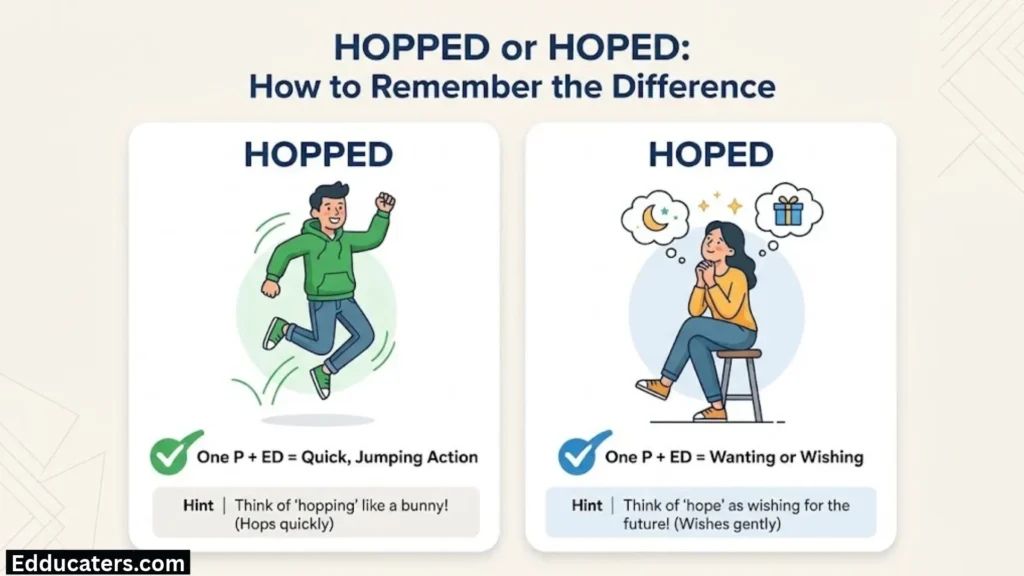
A simple memory trick can help you choose the correct word without memorizing a long list of spelling rules.
Remember the Extra P in Hopped
Think of the extra P as a reminder of the short, sharp movement involved in hopping.
The spelling follows the pattern hop + -ed = hopped. The final consonant doubles because the base verb has a short vowel followed by a single consonant.
For example: “The puppy hopped over the toy.”
Remember the Silent E in Hoped
The word hope already contains the silent E that signals its long O sound.
When you add -ed, remove that E to form hoped. The word keeps its meaning of wishing for or expecting something.
For example: “She hoped for a better result.”
Use the Meaning Test
If you’re still unsure, ask yourself one question: Am I describing a jump or a wish?
- If the sentence describes physical movement, choose hopped.
- If the sentence expresses a desire or expectation, choose hoped.
For example, consider the sentence “I ___ to finish early.”
You want to finish early. You’re not jumping anywhere. Therefore, hoped is the correct choice when referring to a past wish.
Hopped or Hoped Practice Quiz
Test your understanding with these five sentences. Choose the correct word for each blank before checking the answers.
- The rabbit _____ over the fence.
- I _____ that you would visit us.
- The children _____ on one foot during the game.
- She _____ to receive good news.
- We _____ from one café to another.
Answers and Explanations
| Question | Answer | Explanation |
| 1 | Hopped | The rabbit jumped over the fence. |
| 2 | Hoped | The speaker wanted the person to visit. |
| 3 | Hopped | The children made physical jumping movements. |
| 4 | Hoped | She wanted or expected good news. |
| 5 | Hopped | The sentence describes moving between cafés. |
If you answered all five correctly, you’ve understood the central distinction. When a sentence expresses a wish, use hoped. When it describes a jump or short movement, use hopped.
Frequently Asked Questions About Hopped or Hoped
Is Hopped a Correct Word?
Yes. Hopped is the correct simple past tense and past participle of hop. It describes jumping, bouncing, or moving quickly between places.
Example: The frog hopped into the pond.
Is Hoped a Correct Word?
Yes. Hoped is the correct simple past tense and past participle of hope. It expresses a wish, desire, or expectation.
Example: I hoped everything would go well.
What Is the Past Tense of Hop?
The past tense of hop is hopped. English doubles the final P before adding -ed because hop ends in a short vowel followed by a single consonant.
Example: The child hopped across the room.
What Is the Past Tense of Hope?
The past tense of hope is hoped. The final silent E disappears before the -ed suffix is added.
Example: She hoped to see her family.
Can Hopped or Hoped Be Used Interchangeably?
No. The words have different meanings and come from different base verbs. Hopped describes movement, while hoped expresses a wish or expectation.
Replacing one with the other can change the sentence’s meaning or make it incorrect in context.
Why Does Hopped Have Two Ps but Hoped Has One?
Hopped follows the final consonant doubling rule. Hoped follows the silent E deletion rule.
The base verb hop doubles its P before -ed, while hope drops its final E and keeps one P.
Do Hopped or Hoped Sound the Same?
No. In typical American English pronunciation, hopped has a short O-type vowel, while hoped has a long O sound. Both words have one syllable and end with a /t/ sound.
What Is the Difference Between Hopping or Hoping?
Hopping means jumping or moving with short bounces. Hoping means wishing for or expecting something.
Examples:
- The bird is hopping along the path.
- I’m hoping for good news.
Is Hopped the Past Participle of Hop?
Yes. Hopped serves as both the simple past tense and the past participle of hop.
Examples:
- Simple past: The rabbit hopped away.
- Present perfect: The rabbit has hopped away.
Is Hoped the Past Participle of Hope?
Yes. Hoped serves as both the simple past tense and the past participle of hope.
Examples:
- Simple past: I hoped for a positive result.
- Present perfect: I have hoped for this opportunity for years.
Conclusion: Hopped or Hoped?
The difference between hopped or hoped comes down to meaning, pronunciation, and spelling.
Use hopped when describing a jump, bounce, or quick movement. Use hoped when expressing a wish, desire, or expectation about something.
The spelling rules are straightforward once you understand the base verbs. Hop doubles its final P before adding -ed, while hope drops its silent E to form hoped.
Keep these examples in mind:
- The rabbit hopped over the fence.
- She hoped to win the competition.
When you’re unsure which word to use, focus on the meaning first. A quick check can help you choose the correct spelling every time.

I’m Julian Mercer, an English language writer dedicated to helping people master grammar through practical examples and clear explanations. I enjoy teaching grammar in a way that is both engaging and easy to remember.
My work focuses on grammar rules, punctuation, word usage, and writing techniques that readers can apply in everyday life. I believe learning English should be simple, enjoyable, and useful.
Books
English Grammar in Practice
Writing with Precision
 Nathan Whitmore