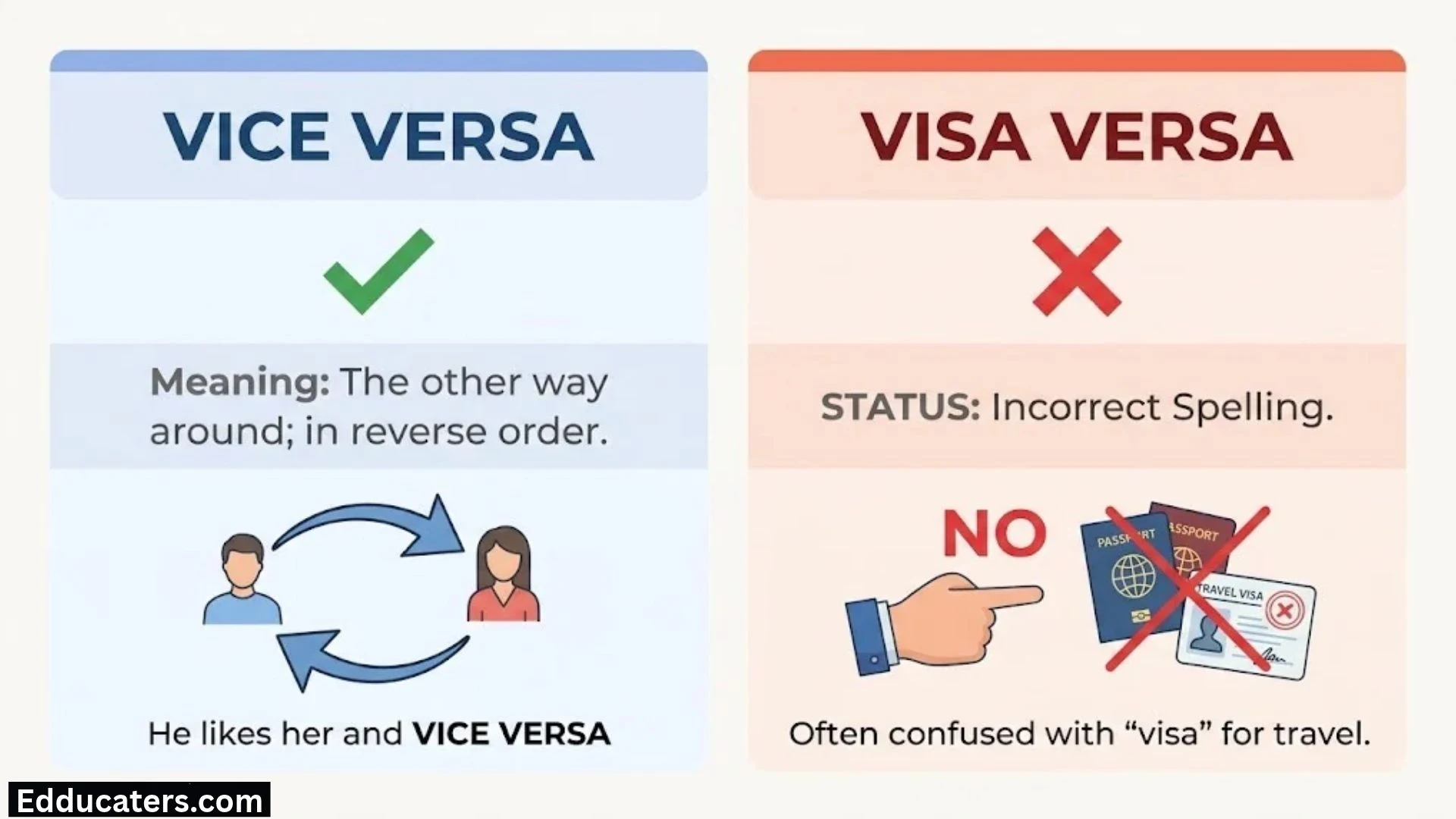
Have you ever written visa versa when you actually meant vice versa? You’re not alone. These two expressions look and sound remarkably similar, which makes them easy to confuse. However, only one is correct when you want to express a reversed relationship or situation.
The correct spelling is vice versa, not visa versa. It’s a Latin expression that means “the other way around” or “with the opposite order or relationship.” You can use it when the reverse of a statement also applies.
For example:
- Correct: Sarah helps her brother with homework and vice versa.
- Incorrect: Sarah helps her brother with homework and visa versa.
The first sentence means Sarah helps her brother and her brother helps her, too. The second sentence contains a common spelling mistake.
Although visa versa frequently appears in online conversations, informal messages, and everyday writing, that doesn’t make it an accepted alternative. The confusion mainly comes from pronunciation and the familiar English word visa.
In this guide, you’ll learn the correct spelling of vice versa, its meaning, Latin origin, pronunciation, grammatical function, and proper usage. You’ll also discover practical examples, common mistakes, and alternative expressions that can make your writing clearer.
Vice Versa or Visa Versa: Which One Is Correct?
When choosing between vice versa or visa versa, remember that vice versa is the only standard spelling of the English expression.
The word visa has its own meaning. It refers to an official document or authorization that allows someone to enter, leave, or remain in a country. It has nothing to do with reversing a statement or relationship.
Consider these examples:
| Sentence | Correct or incorrect? | Explanation |
| I support my friends, and vice versa. | Correct | The support goes both ways. |
| I support my friends, and visa versa. | Incorrect | Visa doesn’t express a reversed relationship. |
| You can travel from Lahore to Islamabad or vice versa. | Correct | The reverse journey is also possible. |
| You can travel from Lahore to Islamabad or visa versa. | Incorrect | The expression has the wrong spelling. |
Why Is Vice Versa Correct?
The expression has a long history in English and comes directly from Latin. Its established spelling has remained vice versa rather than changing to match the familiar English word visa.
English often preserves the spelling of expressions borrowed from other languages. Pronunciation may shift over time, but that doesn’t automatically change the conventional written form.
For example, people sometimes spell words according to how they hear them. That’s understandable, especially when two sounds seem almost identical. However, standard spelling follows established language conventions rather than individual guesses.
Remember: Write vice versa whenever you mean “the other way around.” Never substitute visa versa for this expression.
What Does Vice Versa Mean?
Vice versa is an English expression that means “the other way around,” “in the opposite order,” or “with the relationship reversed.”
You use it when the reverse of something you’ve just mentioned is also true. Instead of repeating an entire statement, you can add these two words to communicate the reversed meaning.
For example:
Emma trusts Daniel, and vice versa.
This sentence means Emma trusts Daniel and Daniel trusts Emma. The expression replaces the longer statement, “Daniel trusts Emma, too.”
According to the Cambridge Dictionary, vice versa is an adverb used to indicate that what you’ve just said also applies in the opposite order.
English meaning – Cambridge Dictionary+1
Vice Versa Meaning in Simple English
The easiest way to understand vice versa meaning is to think of two things changing places.
Imagine that you and your friend exchange gifts. You give your friend a book, and your friend gives you a notebook.
You could describe the exchange like this:
– I gave my friend a book, and vice versa.
The expression suggests that the same action happens in the opposite direction. However, the example needs context if the two gifts aren’t identical. A clearer version would be:
– I gave my friend a book, and my friend gave me a notebook.
Here’s another example:
Without vice versa:
– Teachers learn from students, and students learn from teachers.
With vice versa:
– Teachers learn from students, and vice versa.
The second version is shorter because the expression carries the reversed relationship.
In simple terms, remember these meanings:
- The other way around.
- In the opposite direction.
- With the order reversed.
- The reverse is also true.
What Does Vice Versa Mean in a Sentence?
The meaning depends on the statement that comes before it. Readers use that earlier information to understand what needs reversing.
Consider this example:
Sentence: My parents care about my happiness, and vice versa.
Meaning: My parents care about my happiness, and I care about theirs.
The expression reverses the relationship between the people involved.
Now consider another example:
Sentence: We can travel from Islamabad to Lahore or vice versa.
Meaning: We can travel from Islamabad to Lahore or from Lahore to Islamabad.
Here, the expression reverses the direction of travel rather than the relationship between two people.
You can use vice versa in several situations:
- Relationships: I respect my colleagues, and vice versa.
- Travel: We can fly from New York to Chicago or vice versa.
- Communication: Employees can contact managers, and vice versa.
- Education: Students learn from teachers, and vice versa.
- Technology: You can convert a PDF into another format and vice versa, provided the software supports both conversions.
The central idea remains the same: something mentioned earlier also works when you reverse its order or direction.
Does Vice Versa Mean the Opposite Is Also True?
Yes, but there’s an important distinction.
Vice versa indicates that a statement also applies when you reverse the relationship or order. It doesn’t mean that every opposite statement is automatically true.
For example:
– John respects Mary, and vice versa.
This means Mary respects John, too. The relationship works in both directions.
However, consider this statement:
– All roses are flowers, but not vice versa.
This means all roses belong to the category of flowers, but not all flowers are roses.
The expression works here because it reverses the relationship between the two categories. It doesn’t claim that every flower is a rose.
Here’s another example:
– All squares are rectangles, but not vice versa.
Every square qualifies as a rectangle, but some rectangles aren’t squares. The reverse statement isn’t universally true.
This distinction matters in academic writing, mathematics, scientific explanations, and logical arguments. Using vice versa without checking the reversed statement can change your intended meaning or introduce an inaccurate claim.
Why Is Vice Versa the Correct Spelling?
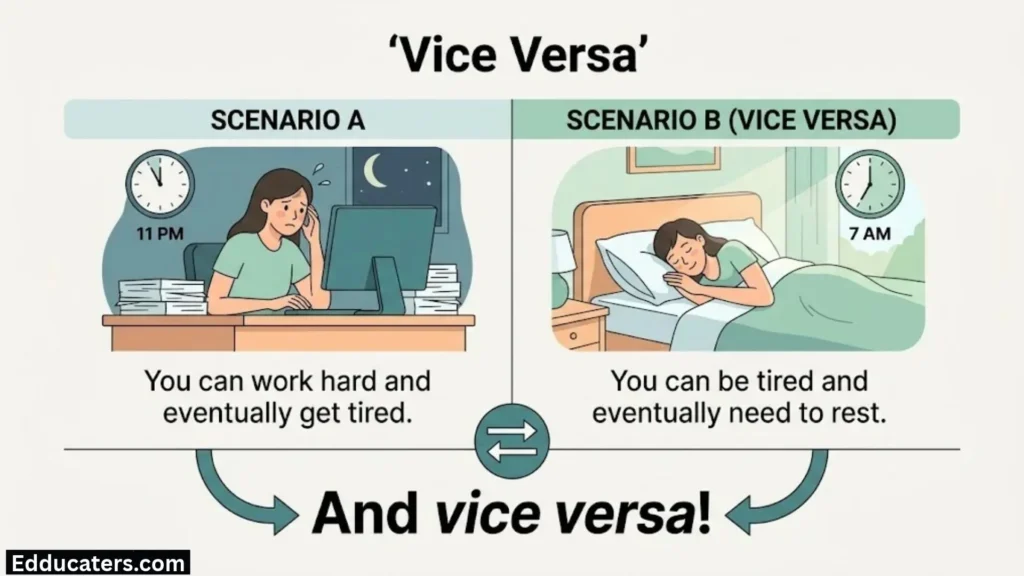
The spelling vice versa comes from its Latin origin. English borrowed the expression centuries ago and retained its traditional written form.
The word visa doesn’t appear in the original expression. Instead, vice and versa are both connected to Latin words associated with changing, turning, and reversing something.
This explains why visa versa is a common spelling mistake rather than a legitimate alternative.
The Latin Origin of Vice Versa
The expression comes from the Latin phrase vice versā. Its components are connected to the ideas of change, arrangement, and turning.
Here’s a simplified breakdown:
| Latin component | Meaning or grammatical connection |
| Vice | From vicis, associated with change, exchange, or arrangement |
| Versa | A feminine form of the past participle of vertere, meaning turned or reversed |
| Vertere | The Latin verb meaning to turn or change direction |
Together, the expression conveys the idea of an arrangement being turned around or reversed.
The phrase entered English around the beginning of the 17th century. Historical dictionaries commonly place its first recorded English use around 1600, although exact dates can vary according to the historical evidence and dictionary methodology.
Over time, English speakers adopted vice versa as an ordinary expression. It no longer belongs exclusively to scholarly or Latin writing.
You can now find it in:
- Everyday conversations.
- Academic essays.
- Business reports.
- Newspaper articles.
- Scientific explanations.
- Professional correspondence.
- Books and educational materials.
An interesting fact: Although vice versa has Latin roots, you don’t need to italicize it in ordinary modern English. It’s an established expression that English has fully adopted.
Why Do People Write Visa Versa?
The confusion usually starts with pronunciation.
Some English speakers pronounce vice versa with a reduced vowel sound between the first and second parts. That sound can resemble the beginning of the familiar word visa.
When people write what they hear rather than what they’ve learned, they may produce the incorrect spelling visa versa.
Several factors contribute to this pronunciation confusion:
- Similar sounds: The unstressed vowel in some pronunciations makes the expression sound different from its written form.
- Familiar vocabulary: People recognize visa as an English word, so the incorrect spelling may look natural.
- Phonetic spelling: Writers sometimes assume that English expressions should be spelled exactly as they sound.
- Online repetition: Seeing the same misspelling on websites or social media can make it appear acceptable.
- Limited proofreading: Quick messages and informal writing often contain spelling errors that writers overlook.
However, frequent use doesn’t establish correctness. The standard English expression remains vice versa.
Vice Versa Pronunciation: Why Does It Sound Like Visa Versa?
Pronunciation plays a major role in the confusion between vice versa and visa versa.
In American English, the expression commonly has a pronunciation that makes the first part sound like either one or two syllables, depending on the speaker.
The Cambridge Dictionary gives two American pronunciation patterns:
- A pronunciation with a one-syllable first part.
- A pronunciation with a reduced vowel sound that makes the first part sound closer to two syllables.
Both preserve the same written spelling: vice versa.
How to Pronounce Vice Versa in American English
Pronunciation
1×PlayStop
vice versa
/ˌvaɪ.sə ˈvɝː.sə/
Practice in VoiceAdd to flashcards
Give feedback
The American English IPA transcription above represents one common pronunciation.
Here’s a breakdown:
| Part | Sound | Explanation |
| Vice | /vaɪ/ | Begins with the sound in “very” followed by the vowel sound in “eye” |
| Reduced vowel | /ə/ | An unstressed vowel, sometimes heard in American pronunciation |
| Versa | /ˈvɝːsə/ | The main stress falls on the first syllable of this part |
Some speakers pronounce the first part with a single syllable. Others use a reduced vowel, creating an additional syllable.
Neither pronunciation changes the correct spelling.
Vice Versa or Visa Versa: Is There a Difference in Pronunciation?
The distinction isn’t always obvious when you hear someone speak.
The pronunciation of vice versa can vary between accents and individual speakers. In particular, the first part may sound like a single syllable or contain a reduced vowel.
That reduced vowel can make the expression resemble visa versa to someone unfamiliar with its spelling.
However, pronunciation and spelling serve different purposes.
For example:
- Vice versa is the correct written expression.
- Visa versa is a common phonetic spelling mistake.
- Visa is a separate word with an unrelated meaning.
You shouldn’t change the spelling simply because a speaker uses a different pronunciation.
A useful reminder: Learn the expression as a complete unit rather than trying to spell each sound independently.
Is Vice Versa One Word or Two?
Vice versa is written as two separate words. The standard spelling includes a space between vice and versa.
Although the expression functions as a single unit of meaning, it doesn’t become one written word.
Correct:
- I enjoy reading novels, and vice versa.
- We can travel by train or vice versa.
- Good communication benefits employers and employees, and vice versa.
Incorrect:
- I enjoy reading novels, and viceversa.
- We can travel by train or viceversa.
The difference is simple:
| Spelling | Status |
| Vice versa | Correct |
| Viceversa | Nonstandard |
| Visa versa | Incorrect |
| Vice-versa | Not the preferred standard form |
Why does this matter?
English contains many expressions made up of multiple words that work together to express one idea. Their grammatical function doesn’t determine whether writers should combine them.
For example, in fact, of course, and vice versa each contain separate words. You should preserve their established spelling.
When proofreading, check both the letters and the spacing. A correct expression can still become a spelling error when you join its components.
Does Vice Versa Need a Hyphen?
No. Standard modern English generally writes the expression as vice versa, without a hyphen.
The hyphenated form vice-versa appears in some older or nonstandard writing. However, the unhyphenated form is the established choice in contemporary English dictionaries and general editorial practice.
Consider these examples:
- Correct: My brother enjoys cooking, and vice versa.
- Avoid: My brother enjoys cooking, and vice-versa.
The same rule applies whether you’re writing a casual message, academic essay, business email, or professional report.
You don’t need to add a hyphen to connect the two words. Their established expression already communicates a complete meaning.
When in doubt, remember this simple spelling pattern:
Vice + space + versa = vice versa.
How to Use Vice Versa Correctly in a Sentence
Knowing the definition is only half the battle. You also need to understand how to place the expression naturally within a sentence.
Vice versa functions as an adverb. It modifies a statement by showing that the same relationship or action applies in reverse.
It commonly appears near the end of a sentence or clause. Writers often place and or or immediately before it.
For example:
- I help my sister with her studies, and vice versa.
- You can exchange dollars for euros or vice versa.
- Parents teach their children, and vice versa.
- We can travel by bus or train and vice versa, depending on the available routes.
The expression works best when readers can easily identify the original statement and understand how to reverse it.
Vice Versa Examples in Everyday Conversation
People use vice versa in everyday English when discussing relationships, activities, responsibilities, and shared experiences.
Here are some natural examples:
| Example sentence | Meaning |
| I call my best friend when I need advice, and vice versa. | My friend also calls me for advice. |
| My parents support me, and vice versa. | I support my parents, too. |
| Children learn from their parents, and vice versa. | Parents also learn from their children. |
| I share my problems with Sara, and vice versa. | Sara shares her problems with me. |
| Dogs depend on their owners, and vice versa. | Owners also depend on their dogs in certain ways. |
| We help each other whenever necessary, and vice versa. | The help goes in both directions. |
| My brother enjoys football, and vice versa. | This example is unclear without additional context about what is being reversed. |
A small but important point: the expression needs a logical relationship. It doesn’t automatically make an incomplete or unrelated statement meaningful.
For instance, “My brother enjoys football, and vice versa” doesn’t clearly identify what should be reversed. You need to mention the other person or activity.
A better version would be:
– My brother enjoys playing football, and I do, too.
Alternatively:
– My brother enjoys watching football, and vice versa when we have free time.
The second example still needs a clear context identifying the two people involved.
Vice Versa Examples in Academic Writing
Academic writing often explores relationships between theories, ideas, concepts, and research findings.
Vice versa can help you explain these relationships without repeating lengthy statements.
Consider these examples:
- Learning and teaching: Teachers influence students’ learning, and vice versa.
- Research and theory: Research can shape theoretical explanations, and vice versa.
- Language and culture: Language influences culture, and vice versa.
- Practice and knowledge: Practical experience improves theoretical understanding, and vice versa.
- Reading and vocabulary: Reading can expand vocabulary, and vice versa, as a larger vocabulary can make reading easier.
These examples show how the expression can describe mutual influence or a two-way relationship.
However, academic writers should be careful when discussing cause and effect. Two things may influence each other, but that doesn’t mean their effects are identical.
For example:
– Economic conditions influence consumer behavior, and vice versa.
This sentence suggests that economic conditions affect consumer behavior and consumer behavior also affects economic conditions.
It doesn’t claim that both influences happen in precisely the same way or to the same degree.
Vice Versa Examples in Professional Writing
The expression also works in business communication. It can shorten sentences involving employees, clients, departments, and organizations.
Here are some examples:
| Sentence | Intended meaning |
| Our marketing team supports the sales department, and vice versa. | Both departments support each other. |
| Managers provide feedback to employees, and vice versa. | Employees can provide feedback to managers, too. |
| We communicate with our clients regularly, and vice versa. | Clients also communicate with us. |
| The design department works closely with marketing, and vice versa. | Both departments collaborate. |
| Employers expect professionalism from employees, and vice versa. | Employees also expect professional behavior from employers. |
You can use the expression in:
- Business emails.
- Workplace reports.
- Team presentations.
- Professional documents.
- Client communications.
- Company policies and explanations.
For example, consider this business email sentence:
“Please contact our support department for assistance. You can also reach the technical team directly and vice versa.”
Although grammatically possible, the final expression may create confusion because the sentence doesn’t clearly establish which action should be reversed.
A clearer version would be:
“You can contact the support department for technical assistance, and the technical team can contact support whenever necessary.”
The lesson is simple: use vice versa when it makes your sentence shorter without sacrificing clarity.
Vice Versa Examples Showing Direction or Reversed Order
One of the most common uses of vice versa involves reversing directions, routes, or arrangements.
These examples make the expression especially easy to understand.
Travel and transportation
- You can travel from Lahore to Islamabad or vice versa.
- Flights operate from New York to London and vice versa.
- We can drive from the airport to the hotel or vice versa.
Exchanging information
- Customers can send messages to businesses, and vice versa.
- The system transfers information from the server to the device and vice versa.
- You can convert the document from PDF to Word and vice versa.
Everyday activities
- You can read the instructions before assembling the product or vice versa.
- We can have dinner before the movie or vice versa.
- You can send the invitation before making the phone call or vice versa.
Notice how the expression avoids repeating the entire reversed arrangement.
Correct and Incorrect Vice Versa Sentence Examples
The following table highlights common spelling and usage mistakes.
| Incorrect sentence | Correct sentence |
| I respect my teachers, and visa versa. | I respect my teachers, and vice versa. |
| You can travel from Lahore to Islamabad or visa versa. | You can travel from Lahore to Islamabad or vice versa. |
| My parents support me, and viceversa. | My parents support me, and vice versa. |
| We help our colleagues and vice-versa. | We help our colleagues and vice versa. |
| I enjoy helping others, and vice versa. | I enjoy helping others, and they enjoy helping me. |
The last example demonstrates an important usage issue. The original sentence doesn’t clearly identify what the expression reverses.
Before using vice versa, ask yourself:
- What statement am I reversing?
- Can the reversed statement actually be true?
- Will readers understand the relationship without additional explanation?
If you can answer all three questions, you’re more likely to use the expression correctly.
Common Vice Versa Spelling and Usage Mistakes
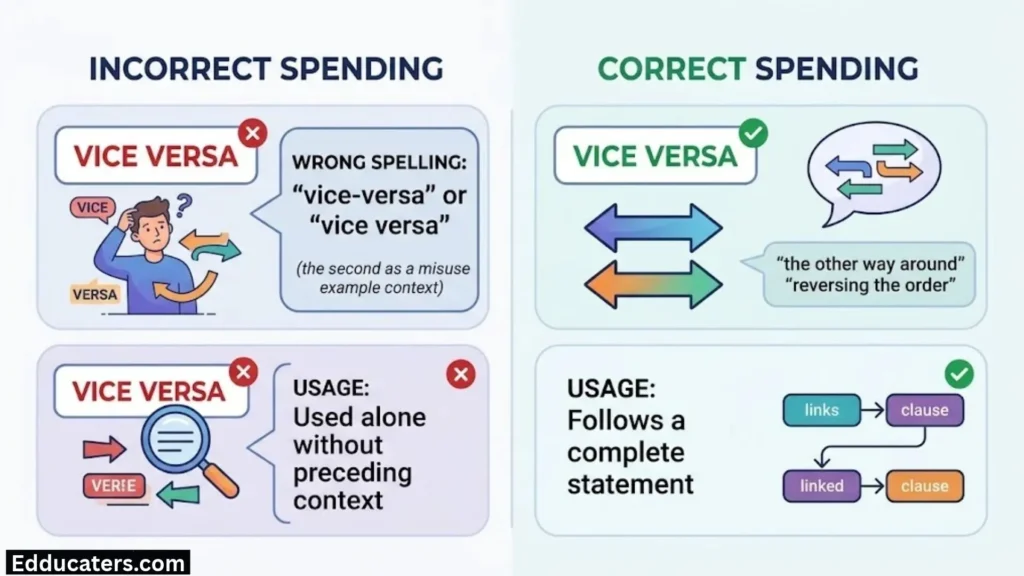
Even experienced English writers sometimes make mistakes with familiar expressions. Because vice versa looks simple, people often overlook small spelling and grammatical details.
Here are the most common errors to watch for.
Writing Visa Versa Instead of Vice Versa
This is the most recognizable visa versa spelling mistake.
People often write visa versa because the pronunciation of vice versa can sound similar to that incorrect form.
However, the two expressions don’t have the same meaning.
- Vice versa: Indicates a reversed relationship or arrangement.
- Visa: Refers to official permission to enter or stay in a country.
- Visa versa: An incorrect spelling when someone intends to use the Latin expression.
For example:
Incorrect: I respect my parents, and visa versa.
Correct: I respect my parents, and vice versa.
Always remember that the correct expression begins with vice, not visa.
Writing Viceversa as One Word
Another common mistake involves removing the space between the two words.
Some writers assume that because the expression communicates one complete idea, they should combine its components.
That’s not how its standard English spelling works.
For example:
- Incorrect: The students help their teachers and viceversa.
- Correct: The students help their teachers and vice versa.
The space is part of the established spelling. Don’t remove it.
Using Vice-Versa With a Hyphen
The hyphenated spelling vice-versa is another form you may encounter.
Although older publications and occasional informal writing contain this variation, vice versa without a hyphen is the preferred modern English spelling.
Use the standard two-word form in:
- School assignments.
- Academic essays.
- Business emails.
- Professional reports.
- Online articles.
- Everyday communication.
Consistency also matters. Avoid switching between vice versa and vice-versa within the same document.
Using Vice Versa Without a Clear Reverse Relationship
A sentence can contain the correct spelling but still use the expression incorrectly.
This usually happens when writers don’t establish a clear relationship before adding vice versa.
For example:
Unclear: Sarah likes reading books, and vice versa.
What does the expression reverse? Does another person like reading? Does someone enjoy books that Sarah dislikes?
The sentence doesn’t provide enough information.
Clearer: Sarah enjoys reading books written by Daniel, and Daniel enjoys reading books written by Sarah.
You could shorten this when the context already identifies both people:
“Sarah enjoys reading Daniel’s books, and vice versa.”
However, the shorter version only works when readers can understand the intended relationship.
Using Vice Versa When the Relationship Is Not Mutual
Not every relationship works in both directions.
Consider this example:
– All dogs are animals, but not vice versa.
The sentence is correct because all dogs belong to the animal category, but not all animals are dogs.
Now consider:
– All students are people, and vice versa.
This statement is incorrect because not all people are students.
The reverse relationship must be logically accurate.
This matters particularly in scientific writing, mathematics, academic arguments, and professional explanations.
Don’t use vice versa simply because two ideas appear related. Make sure the reverse statement actually holds.
Vice Versa Synonyms and Alternative Expressions
Sometimes repeating vice versa makes your writing sound unnecessary or overly formal. Fortunately, English offers several alternatives.
However, these expressions aren’t interchangeable in every situation. Some describe a reversed order, while others indicate contrast or an inverse relationship.
Here’s a comparison of useful vice versa synonyms:
| Alternative | Meaning | Example |
| The other way around | Reversing a situation or relationship | I thought she was helping him, but it was the other way around. |
| Conversely | Introducing an opposing or contrasting point | Some students prefer reading; conversely, others prefer listening. |
| In reverse | Changing the original direction or order | Read the instructions in reverse. |
| The reverse is also true | Confirming that a statement applies in the opposite direction | Employees need respect, and the reverse is also true. |
| Reciprocally | Describing a mutual relationship | The two organizations cooperate reciprocally. |
| Inversely | Describing an inverse relationship | As speed increases, travel time decreases under fixed-distance conditions. |
| Contrariwise | Expressing an opposing or contrary idea | He expected failure; contrariwise, the project succeeded. |
When to Use the Other Way Around Instead of Vice Versa
The other way around is probably the simplest alternative.
It sounds natural in everyday conversations and works well when you want to explain a reversed situation without using a Latin expression.
Compare these examples:
- I thought Ahmed was helping Bilal, but it was the other way around.
- I thought Ahmed was helping Bilal, but vice versa.
The first sentence sounds more natural because the speaker is correcting an earlier assumption.
Another example:
- We can travel from Islamabad to Lahore or the other way around.
- We can travel from Islamabad to Lahore or vice versa.
Both sentences communicate the same basic idea.
Choose the other way around when you want a conversational tone. Choose vice versa when you prefer a shorter, established expression.
Vice Versa or Conversely: What’s the Difference?
Although conversely and vice versa sometimes appear in similar contexts, they perform different functions.
Vice versa indicates that a statement also applies when the order or relationship is reversed.
Conversely introduces a contrasting or opposite point.
Consider these examples:
Vice versa:
– I support my brother, and vice versa.
Meaning: My brother supports me, too.
Conversely:
– Some people prefer working independently. Conversely, others enjoy working in teams.
Meaning: The second statement presents a contrasting preference.
Here’s a quick comparison:
| Vice versa | Conversely |
| Reverses a previously mentioned relationship | Introduces a contrasting idea |
| Often appears near the end of a statement | Often begins a new clause or sentence |
| Commonly expresses mutual or reversed actions | Commonly expresses contrast |
| Example: I trust her, and vice versa. | Example: I prefer tea. Conversely, she prefers coffee. |
Use the expression that accurately communicates your intended relationship.
Vice Versa or Inversely: Which Is More Appropriate?
Inversely usually describes a relationship in which one quantity changes in the opposite direction from another.
It appears frequently in mathematics, science, economics, and technical explanations.
For example:
– When the price increases, demand may decrease inversely, depending on market conditions.
By contrast:
– I can travel from Lahore to Islamabad or vice versa.
The first example discusses an inverse relationship. The second describes a reversed direction.
Remember these distinctions:
- Vice versa: The other way around.
- Inversely: In an inverse or opposite relationship.
- Conversely: In contrast or the opposite case.
- Reciprocally: In a mutual or corresponding way.
Choosing the right alternative makes your writing more precise.
Can You Use Vice Versa in Formal and Informal Writing?
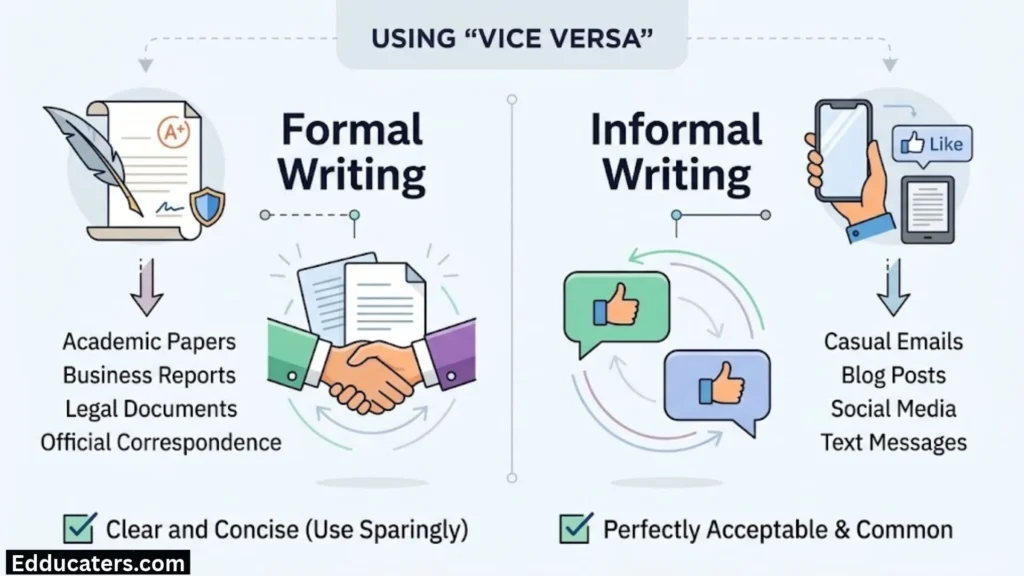
Yes! Vice versa is appropriate in both formal and informal English.
Although the expression comes from Latin, English speakers have used it for centuries. It now appears naturally in ordinary conversations and professional documents.
You don’t need to avoid it simply because you’re writing an academic essay or business email.
However, consider your audience and sentence structure. A simpler alternative may sometimes communicate your point more effectively.
Vice Versa in Academic Essays and Research Papers
Academic writers frequently use vice versa when explaining relationships between ideas, concepts, and research findings.
For example:
- Language influences cultural development, and vice versa.
- Theoretical research can guide practical applications, and vice versa.
- Changes in consumer behavior can influence market conditions, and vice versa.
The expression helps avoid repetition while keeping the sentence concise.
However, academic writing requires precision. Don’t assume that two related variables necessarily influence each other equally.
If you’re discussing a scientific relationship, explain the direction and nature of the influence clearly.
Vice Versa in Business Emails and Workplace Communication
In professional communication, vice versa can make sentences shorter and easier to read.
For example:
“Please share your feedback with the marketing department. The marketing team can also contact your department directly and vice versa.”
However, the sentence may be clearer if you specify the two directions:
“Your department can contact marketing directly, and the marketing team can reach out to your department whenever necessary.”
Both approaches can work. Choose the one that makes your message easiest to understand.
Vice Versa in Everyday English
You don’t need complicated grammar to use vice versa correctly.
The expression works naturally in conversations about friends, family, hobbies, responsibilities, and everyday activities.
For example:
- I help my sister, and vice versa.
- We visit our grandparents, and vice versa.
- My friends support me, and vice versa.
- I share useful information with my colleagues, and vice versa.
It’s a practical expression that can save you from repeating information.
How to Remember the Correct Spelling of Vice Versa
If you frequently confuse vice versa with visa versa, a simple memory trick can help.
Remember the word “vice” in vice versa. The correct expression always starts with V-I-C-E.
You can also use these practical techniques:
1. Associate the expression with its meaning.
Whenever you want to say “the other way around,” think of vice versa.
2. Remember its Latin origin.
The expression comes from Latin rather than the English word visa. This connection helps explain why its spelling doesn’t change according to the familiar English word.
3. Learn the complete expression.
Don’t memorize vice and versa separately. Remember them as one established expression written in two words.
4. Practice with short sentences.
Write a few examples until the spelling becomes familiar.
For instance:
- I trust my friends, and vice versa.
- We can travel in either direction or vice versa.
- Teachers learn from students, and vice versa.
5. Proofread your writing.
Before submitting an assignment or sending a professional email, check whether you’ve accidentally written visa versa.
A simple proofreading habit can prevent this common mistake.
Easy spelling reminder
Vice versa = The other way around.
Visa = Permission to enter or stay in a country.
The two expressions have different meanings. Keeping that distinction in mind makes the correct spelling much easier to remember.
Frequently Asked Questions About Vice Versa or Visa Versa
Is It Vice Versa or Visa Versa?
Vice versa is the correct spelling. It means “the other way around” or indicates that a statement also applies when its relationship or order is reversed. Visa versa is a common spelling mistake.
What Is the Correct Spelling of Vice Versa?
The correct spelling is vice versa. Write it as two separate words without a hyphen. Avoid visa versa, viceversa, and the nonpreferred hyphenated form vice-versa.
Why Is Visa Versa Incorrect?
Visa versa is incorrect because it doesn’t represent the established Latin expression. People often make this mistake because some pronunciations of vice versa sound similar to the incorrect spelling.
What Does Vice Versa Mean in Simple English?
Vice versa means the other way around. It indicates that something remains true when you reverse the order, direction, or relationship mentioned earlier.
For example:
“I help my brother, and vice versa.”
This means your brother helps you, too.
Is Vice Versa a Latin Phrase?
Yes. Vice versa comes from the Latin expression vice versā. Its components relate to change, arrangement, and turning something around. English adopted the expression around the beginning of the 17th century.
Is Vice Versa One Word or Two?
It’s written as two words: vice versa. Always include a space between the two parts. Writing viceversa as one word isn’t the standard English spelling.
Does Vice Versa Need a Hyphen?
No. Standard modern English uses vice versa without a hyphen. The spelling vice-versa is not the preferred form in contemporary English writing.
Is Visa Versa Ever Correct?
Not when you’re trying to express the meaning of vice versa. The word visa is correct in its own context when referring to travel authorization, but visa versa is a misspelling of the Latin expression.
Can I Use Vice Versa in Formal Writing?
Absolutely. You can use vice versa in academic essays, research papers, business emails, reports, and professional documents. Just make sure the reversed relationship is clear and logically accurate.
What Is Another Way to Say Vice Versa?
Common alternatives include:
- The other way around.
- Conversely.
- In reverse.
- The reverse is also true.
- Reciprocally.
- Inversely.
Choose an alternative according to the context. These expressions don’t all have exactly the same meaning.
How Do You Use Vice Versa in a Sentence?
Use vice versa after a statement when you want to indicate that the reverse is also true.
For example:
“Students learn from teachers, and vice versa.”
This means teachers learn from students as well.
Conclusion: Vice Versa or Visa Versa?
The correct spelling is vice versa, not visa versa. The expression comes from Latin and means “the other way around” or “with the relationship reversed.”
Although some English speakers pronounce it in a way that resembles visa versa, the pronunciation doesn’t change its established spelling.
Remember these essential points:
- Vice versa is the correct standard English expression.
- Visa versa is a common spelling mistake.
- Write the expression as two separate words.
- Don’t use a hyphen in standard modern English.
- It functions as an adverb.
- You can use it in formal and informal writing.
- Its meaning depends on a clear and logically reversible relationship.
For example, you can say, “I respect my friends, and vice versa.” This means your friends respect you, too.
So, whenever you’re unsure whether to write vice versa or visa versa, choose vice versa. It’s the correct spelling and the expression you should use in your everyday writing.

I’m Julian Mercer, an English language writer dedicated to helping people master grammar through practical examples and clear explanations. I enjoy teaching grammar in a way that is both engaging and easy to remember.
My work focuses on grammar rules, punctuation, word usage, and writing techniques that readers can apply in everyday life. I believe learning English should be simple, enjoyable, and useful.
Books
English Grammar in Practice
Writing with Precision
 Nathan Whitmore