Have you ever wondered whether the correct expression is free rein or free reign? You’re not alone. These two phrases sound exactly alike, but their spellings have different meanings and origins. Choosing the wrong one can make an otherwise polished sentence look careless.
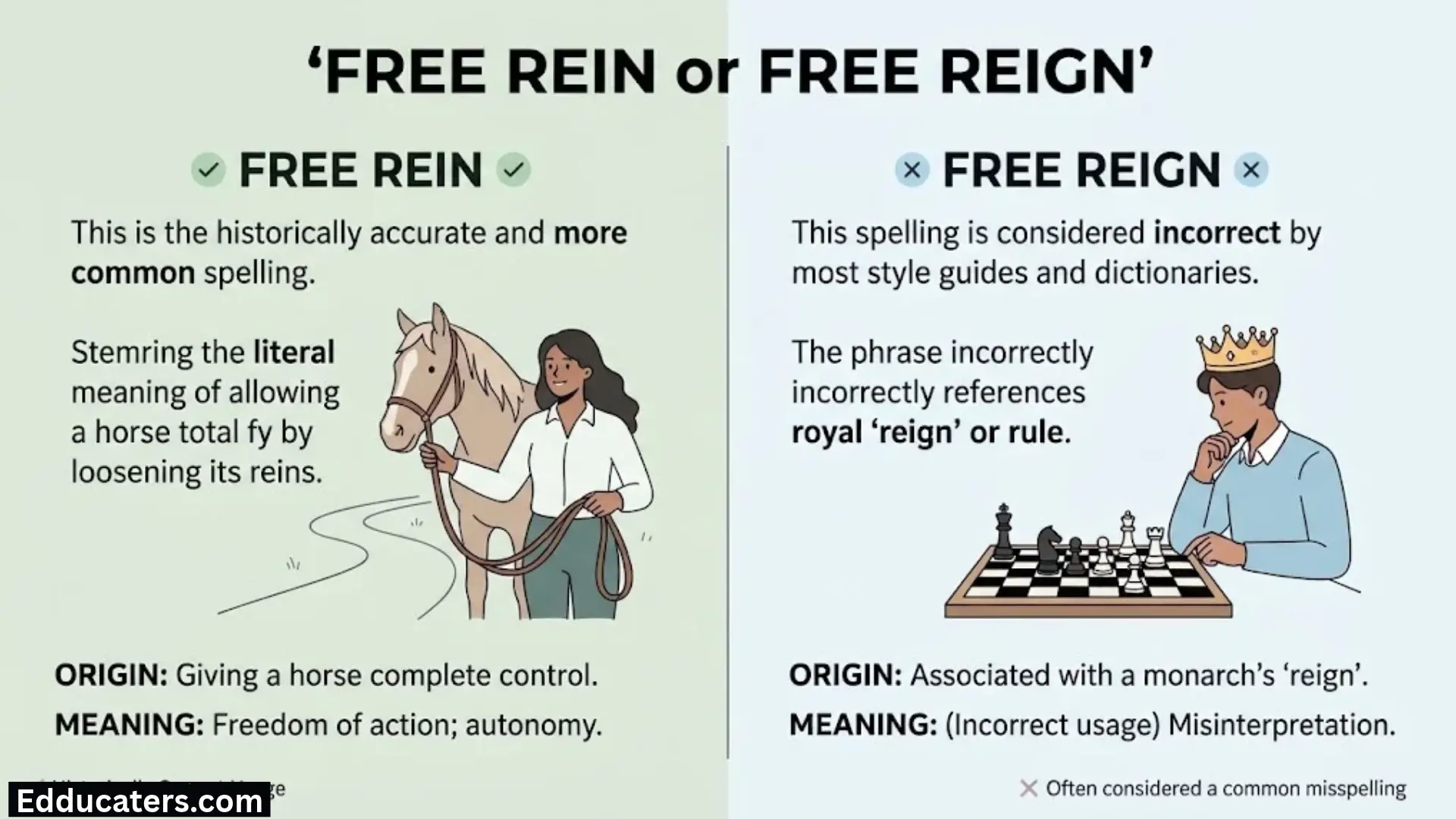
The correct expression is free rein when you mean giving someone the freedom to act, make decisions, or express themselves without unnecessary restrictions. The phrase comes from horseback riding, where a rider loosens the reins to let a horse move more freely.
The confusion comes from the word reign, which refers to a king’s or queen’s rule. Because both words have identical pronunciation, writers sometimes replace rein with reign. Although free reign appears in modern writing, free rein remains the established spelling in standard American English.
For example:
- Correct: The manager gave her employees free rein to develop new ideas.
- Incorrect in the traditional idiom: The manager gave her employees free reign to develop new ideas.
Think of it this way: horses have reins, while kings and queens reign. Once you understand that distinction, remembering the correct expression becomes much easier.
Let’s explore the meanings, origins, differences, examples, and related expressions so you can use both words confidently.
Free Rein or Free Reign: Which One Is Correct?
Free rein is the correct spelling when you want to describe freedom of action, choice, or expression. It means allowing someone to do something with little interference or unnecessary control.
The expression originally referred to loosening a horse’s reins. A rider who holds the reins loosely gives the horse more freedom to move. Over time, English speakers adopted this physical image to describe personal independence and unrestricted decision-making.
On the other hand, free reign is generally considered a misspelling of the traditional expression. People often write it because reign relates to power and authority. That association makes the alternative spelling seem logical, even though it doesn’t reflect the expression’s original meaning.
Consider these examples:
| Sentence | Correct or incorrect? | Explanation |
| The artist received free rein to design the building. | Correct | The artist received creative freedom. |
| The artist received free reign to design the building. | Nonstandard | The traditional expression uses rein. |
| The queen’s reign lasted several decades. | Correct | Reign refers to a period of royal rule. |
| The king continued to reign over his kingdom. | Correct | Reign functions as a verb meaning to rule. |
The important distinction is that free rein is an established idiom. You shouldn’t replace its spelling simply because free reign appears to make sense.
Remember: If you’re talking about freedom, flexibility, or permission to act, choose free rein.
What Does Free Rein Mean?
The expression free rein means having the freedom to act, speak, think, or make decisions without excessive restrictions. It describes a situation in which someone can exercise personal judgment instead of following constant instructions.
Imagine that your manager assigns you a project but doesn’t dictate every detail. You can choose the design, organize your schedule, and decide how to approach the work. Your manager has given you free rein.
The expression can describe several types of independence, depending on the situation.
Free Rein Definition
According to its standard dictionary meaning, free rein refers to freedom of movement, choice, or action.
It often appears when someone gives another person permission to work independently. However, the phrase can also describe the freedom to express emotions, explore ideas, or follow personal interests.
Here are its central meanings:
- Freedom of action: Having the ability to decide what to do without unnecessary interference.
- Freedom of expression: Sharing thoughts, feelings, or opinions openly.
- Creative independence: Developing original ideas without strict instructions.
- Personal autonomy: Making decisions about your own life.
- Professional flexibility: Managing work responsibilities with limited supervision.
- Freedom of movement: Moving more freely without physical restraint.
For example:
- The teacher gave her students free rein to choose their research topics.
- My parents gave me free rein to decorate my bedroom.
- The company gives its designers free rein when developing new products.
- The musician gave free rein to his emotions during the performance.
In each sentence, someone enjoys a considerable degree of freedom.
However, free rein doesn’t always mean having unlimited authority. Someone might have complete creative freedom while still following a project’s budget, deadline, and basic requirements.
Literal Meaning of Free Rein
The literal meaning of free rein comes from horseback riding.
A rein is a strap attached to a horse’s bridle. Riders hold the reins to guide the animal, communicate directions, and control its movement.
When a rider keeps the reins tight, the horse receives more direct guidance. When the rider loosens the reins, the horse can move with greater freedom.
Consider a simple horseback-riding situation.
A rider wants a horse to move comfortably along an open path. Instead of constantly pulling on the reins, the rider relaxes their grip. The horse receives more room to move naturally while remaining under the rider’s general guidance.
This is the basic idea behind giving a horse free rein.
The literal expression helps explain the figurative meaning. Just as a horse moves more freely when its reins loosen, a person enjoys greater independence when someone reduces unnecessary restrictions.
Figurative Meaning of Free Rein
Today, people use free rein far beyond horseback riding. The expression describes freedom in personal, professional, creative, and social situations.
Its figurative meaning depends on what kind of freedom someone receives.
1. Creative freedom
Artists, writers, musicians, and designers often need room to experiment. Giving them free rein allows original ideas to develop without excessive instructions.
Example: The publisher gave the illustrator free rein to create the book’s cover.
2. Personal independence
Parents, teachers, and mentors sometimes allow people to make their own decisions. This freedom helps individuals develop confidence and responsibility.
Example: Her parents gave her free rein when choosing a university.
3. Professional autonomy
Employees often perform better when managers trust them to handle responsibilities independently. Free rein allows workers to use their knowledge and judgment.
Example: The supervisor gave the experienced accountant free rein to organize the department’s financial records.
4. Freedom of expression
People sometimes need space to communicate their feelings without constant criticism or interruption.
Example: The discussion gave everyone free rein to express their opinions.
5. Organizational flexibility
Companies may give teams freedom to choose their methods while still expecting them to meet specific goals.
Example: The company gave its marketing team free rein to develop the campaign.
6. Emotional expression
The phrase can also describe allowing emotions to emerge naturally rather than suppressing them.
Example: The pianist gave free rein to her emotions during the final movement.
The common thread is independence. Whether you’re discussing art, education, business, or personal decisions, free rein describes freedom from unnecessary control.
Free Rein in Everyday English
You’ll encounter this expression in conversations, workplace discussions, books, newspapers, and professional writing.
People generally use it when someone has considerable freedom to decide how something should happen.
Here are some natural examples:
- My parents gave me free rein to explore different career options.
- The coach gave the players free rein to develop their own strategies.
- The new manager allows employees free rein over their daily schedules.
- The director gave the actors free rein to interpret their characters.
- The children had free rein to play in the backyard.
- The author enjoyed free rein when developing the fictional world.
- The organization gave local branches free rein to plan community events.
Notice that the expression doesn’t necessarily mean someone can ignore every rule. It simply suggests that the person has substantial freedom within a particular situation.
What Does Free Reign Mean?
Free reign is a common alternative spelling of free rein. It usually appears when writers confuse the words rein and reign because they sound identical.
Although many editors and traditional usage guides recommend avoiding this spelling, its appearance in real-world English deserves a little explanation.
The word reign has a strong connection with ruling, authority, and power. Since free rein also describes freedom from control, some writers naturally associate the expression with unrestricted power.
However, the original idiom comes from horseback riding, not monarchy.
Free Reign Definition
In everyday writing, free reign generally represents a nonstandard spelling of free rein. It communicates the same intended idea of unrestricted freedom when writers use it in place of the traditional expression.
For example:
- Nonstandard: The designer received free reign over the project.
- Standard: The designer received free rein over the project.
The difference is spelling rather than intended meaning.
There is an important nuance, though. Language changes through actual usage. Linguists sometimes describe free reign as an eggcorn: a familiar expression that people reshape into another meaningful-sounding expression.
In this case, reign replaces rein because the idea of unrestricted authority seems to fit the context.
Some language references document free reign as a common alternative form. That doesn’t mean every editor accepts it or that it has replaced the traditional spelling. For formal writing, standard American English, academic work, and professional communication, free rein remains the safest choice.
Why Do People Write Free Reign?
Several factors explain why this spelling mistake continues to appear.
1. Identical pronunciation
The words rein and reign are homophones. They sound the same in standard American English.
When people hear the expression rather than read it, they might choose either spelling.
2. Familiarity with royal terminology
Most English speakers recognize the word reign from expressions such as:
- The reign of a king.
- The queen’s reign.
- A monarch’s reign.
- Reign over a kingdom.
Because reign relates to authority, writers sometimes connect it with the idea of having freedom or power.
3. Less familiarity with horseback riding
Many people rarely use horses or handle riding equipment. They might understand the word reign more easily than the word rein.
Consequently, the original horse-riding connection isn’t always obvious.
4. Logical reinterpretation
The idea of having unrestricted power seems to fit the expression’s figurative meaning. Someone who receives free rein can make decisions independently.
A writer might therefore assume that free reign refers to having permission to rule or control a situation.
5. Spellcheck limitations
Both rein and reign are correctly spelled English words. Basic spellcheck tools may not identify the wrong choice because neither word contains a spelling error on its own.
This is why understanding word meanings matters just as much as knowing correct spelling.
Is Free Reign Ever Correct?
The answer depends on how someone uses it.
When you mean the traditional expression describing freedom of action or expression, free rein is the standard spelling.
However, free reign isn’t simply meaningless. It appears in published writing and is sometimes used intentionally as wordplay or as a reinterpretation of the idea of unrestricted rule.
For example, a writer discussing an imaginary ruler might deliberately use free reign to suggest unlimited royal power. Such a use relies on a play between the established expression and the word reign.
Nevertheless, this is different from using the conventional idiom.
Consider these situations:
| Intended meaning | Best choice |
| Allowing an employee to make independent decisions | Free rein |
| Giving an artist creative freedom | Free rein |
| Allowing someone to express emotions freely | Free rein |
| Describing a monarch’s period of rule | Reign |
| Describing a champion’s period of dominance | Reign |
| Deliberate wordplay involving unrestricted royal authority | Free reign may be intentional |
For everyday writing, there’s no reason to take the risk. Use free rein whenever you mean freedom without unnecessary restrictions.
Rein vs. Reign: What Is the Difference?
The easiest way to understand rein vs. reign is to remember that one word relates to guiding or controlling a horse, while the other relates to ruling or holding power.
Although both words have the same pronunciation, they aren’t interchangeable. Each has its own spelling, meaning, and grammatical uses.
Let’s examine them separately.
What Does Rein Mean?
The word rein refers primarily to a strap used to guide and control a horse. It can also function as a verb and describe the act of controlling or restraining something.
It appears in both literal and figurative expressions.
Rein as a noun
As a noun, rein refers to a strap attached to a horse’s bridle. Riders hold the reins to guide the horse and communicate directions.
Examples:
- The rider gently pulled the reins to slow the horse.
- She loosened the reins as the horse approached the open field.
- The instructor showed the beginner how to hold the reins properly.
- The experienced rider maintained a light grip on the reins.
The plural form is reins. When discussing the equipment used in horseback riding, people generally refer to a pair of reins.
The word also appears metaphorically when discussing responsibility or control.
Examples:
- The new director took the reins of the company.
- She handed over the reins to her successor.
- The president held the reins of power during a difficult period.
Rein as a verb
As a verb, rein means to guide an animal using reins or to restrain something.
Its common forms include:
| Form | Example |
| Rein | Riders rein their horses carefully. |
| Reins | The rider reins the horse toward the gate. |
| Reined | She reined in her horse. |
| Reining | He was reining in the animal. |
The verb also appears in figurative language.
Examples:
- The government must rein in unnecessary spending.
- She tried to rein in her excitement.
- The manager needed to rein in the team’s unrealistic expectations.
Notice that rein in means to control or limit something. It doesn’t mean to give someone freedom.
What Does Reign Mean?
The word reign relates to ruling, authority, and dominance. It commonly describes the period during which a king, queen, or other sovereign holds power.
However, modern English also uses it to describe periods of dominance outside royal families.
Like rein, reign functions as both a noun and a verb.
Reign as a noun
As a noun, reign refers to the period during which someone rules as a monarch or holds a position of dominance.
Examples:
- Queen Victoria’s reign lasted more than 63 years.
- The king’s reign brought major political changes.
- The champion’s reign ended after a surprising defeat.
- The country experienced several changes during the monarch’s reign.
A reign can describe royal rule or a figurative period of influence.
For example, a sports champion might enjoy a long reign at the top of a competition. A popular musician might dominate the charts during a particular period.
Reign as a verb
As a verb, reign means to rule or exercise sovereign authority. It can also describe something that dominates or becomes widespread.
Examples:
- The queen continued to reign over her kingdom.
- The monarch reigned for several decades.
- Confidence reigned throughout the team.
- Confusion reigned after the unexpected announcement.
The verb doesn’t always involve royalty. In the sentence about confusion, reigned means that confusion prevailed or dominated the situation.
Rein vs. Reign: Quick Comparison
The following table highlights their most important differences.
| Feature | Rein | Reign |
| Pronunciation | /reɪn/ | /reɪn/ |
| Main meaning | A strap used to guide a horse | Rule or authority |
| Part of speech | Noun and verb | Noun and verb |
| Literal association | Horse riding | Royal power |
| Figurative meaning | Control, restraint, or guidance | Dominance or authority |
| Common expression | Free rein | Reign supreme |
| Related expression | Rein in | Reign over |
| Example | Give someone free rein | The queen’s reign |
The distinction becomes easier when you connect each word with its original subject.
- Rein: Horses, riding, guidance, and control.
- Reign: Kings, queens, sovereignty, and periods of rule.
Are Rein and Reign Homophones?
Yes. Rein and reign are homophones because they share the same pronunciation but have different spellings and meanings.
A homophone is a word that sounds like another word but differs in spelling, meaning, or sometimes both.
For example:
| Word | Meaning |
| Rein | A strap used to guide a horse |
| Reign | A period of ruling or exercising authority |
| Rain | Water that falls from clouds |
All three words share the same pronunciation in standard American English.
These words demonstrate why pronunciation alone can’t always tell you which spelling to choose. You need to understand the context.
Consider the following sentences:
- The rider loosened the rein.
- The queen’s reign lasted many years.
- Heavy rain flooded the streets.
Each sentence uses a different word even though the words sound identical.
This is a common source of spelling errors in English. Writers sometimes select a familiar word without considering whether its meaning fits the sentence.
Where Does the Phrase Free Rein Come From?
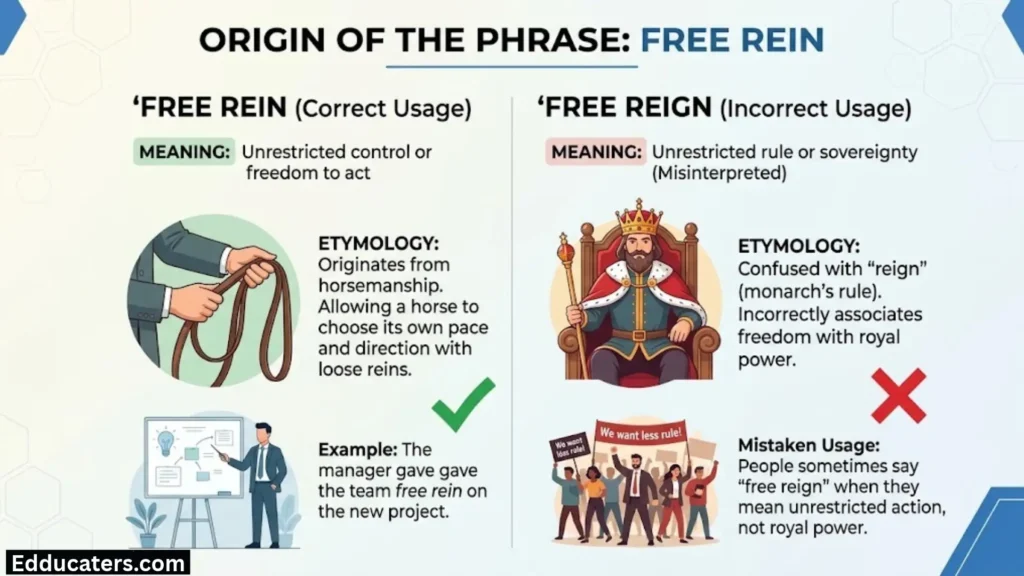
The expression free rein has a long connection with horseback riding. Its original meaning describes a horse moving with greater freedom because the rider holds the reins loosely.
English speakers eventually extended this image to situations involving personal independence, creative expression, and decision-making.
Understanding the historical connection makes the modern meaning much easier to remember.
The Horse-Riding Origin of Free Rein
Before modern transportation became widespread, horses played an important role in travel, farming, transportation, and warfare.
Riders relied on reins to guide their animals. These straps connected to the bridle and allowed riders to communicate directions through controlled movements.
A rider could pull the reins to slow or turn a horse. A lighter grip allowed the animal more freedom.
When a rider gave a horse free rein, the rider relaxed the tension on the reins. This allowed the horse to move more naturally without constant direction.
The expression eventually became a metaphor for giving someone greater independence.
For example, imagine a riding instructor who trusts an experienced student to guide a horse across an open field. The instructor doesn’t need to provide constant instructions because the student understands how to handle the animal.
That physical freedom provides the foundation for the modern expression.
How Free Rein Developed Its Figurative Meaning
Language often develops through comparisons between physical experiences and abstract ideas.
The expression free rein follows this pattern. Its meaning expanded from controlling a horse to describing how people exercise independence.
The transition is straightforward:
| Original horse-riding idea | Modern figurative meaning |
| Loosening a horse’s reins | Reducing restrictions |
| Allowing a horse to move freely | Giving someone independence |
| Avoiding constant control | Allowing independent decisions |
| Giving a horse more movement | Providing creative freedom |
For example, a company that gives designers free rein isn’t literally handing them horse equipment. It’s allowing them to work with fewer restrictions.
Similarly, a parent who gives a teenager free rein over a personal project allows that teenager to make more decisions independently.
The physical image remains the same. Only the situation changes.
The Historical Meaning of Rein
The noun rein entered English through French forms associated with controlling or restraining an animal.
Its deeper linguistic history connects it with ideas of holding back and keeping something under control.
The word’s relationship with restraint also explains several familiar expressions.
Consider:
- Free rein: Freedom from unnecessary control.
- Tight rein: Strict control.
- Rein in: Reduce, restrain, or control something.
- Hold the reins: Maintain control or authority.
These expressions share the same underlying image of guiding or controlling something through reins.
The figurative meaning of free rein developed over centuries. Historical usage references trace the expression back to early modern English, with examples of figurative use appearing in the seventeenth century.
Wiktionary, the free dictionary+2
Why Reign Became a Common Alternative
The confusion between rein and reign isn’t new.
Both words sound alike, and their figurative meanings can overlap around ideas of control and authority.
A person who receives free rein has considerable freedom. Someone who reigns has power or authority. Because both ideas involve control, the alternative spelling can appear reasonable.
Language researchers sometimes call this an eggcorn.
An eggcorn occurs when someone replaces an unfamiliar word or phrase with a familiar expression that sounds similar and seems meaningful.
For example, a writer who doesn’t recognize the horse-riding origin might interpret free reign as having unrestricted authority.
The substitution makes sense to that writer, even though it changes the historical image behind the original idiom.
Interestingly, free reign has appeared in historical writing for a long time. Linguistic discussions have documented examples dating back to the nineteenth century. Its presence shows that the confusion isn’t simply a recent internet spelling trend.
Wiktionary, the free dictionary+1
However, the established expression remains free rein.
How to Use Free Rein in a Sentence
Knowing the definition is only part of the challenge. You also need to understand how the expression fits naturally into a sentence.
The good news is that free rein works with several common sentence patterns. Once you learn these structures, using the phrase becomes straightforward.
Give Someone Free Rein
The construction give someone free rein means allowing another person to act independently or make decisions without excessive interference.
The person receiving freedom usually appears between give and free rein.
Examples:
- The manager gave the new employee free rein to organize the office.
- My parents gave me free rein to choose my summer activities.
- The director gave the actors free rein during rehearsals.
- The coach gave the players free rein to develop their strategies.
- The teacher gave her students free rein to explore different subjects.
You can use this construction in personal, educational, creative, and professional situations.
It emphasizes the decision to allow someone greater independence.
Give Free Rein to Something
Another common construction is give free rein to followed by a noun.
This structure often appears when discussing creativity, emotions, imagination, or personal expression.
Examples:
- The author gave free rein to her imagination.
- The musician gave free rein to his emotions.
- The designer gave free rein to her creativity.
- The filmmaker gave free rein to his artistic vision.
- The children gave free rein to their curiosity.
This construction focuses on the thing receiving freedom rather than the person receiving permission.
For example, in “She gave free rein to her imagination,” imagination is the quality allowed to develop without unnecessary restrictions.
Have Free Rein to Do Something
Use have free rein to when someone already possesses the freedom or permission to perform an action.
This structure often appears in conversations about responsibilities, personal choices, and professional independence.
Examples:
- Employees have free rein to organize their daily schedules.
- You have free rein to choose your preferred design.
- The students have free rein to select their research topics.
- The children had free rein to explore the garden.
- The team has free rein to develop its own working methods.
The phrase doesn’t necessarily mean that someone has unlimited power. It describes freedom within the relevant situation.
For instance, employees might have free rein to organize their schedules while still following company policies.
Enjoy Free Rein
The expression enjoy free rein describes someone who benefits from considerable freedom.
Examples:
- The experienced designer enjoyed free rein over the project.
- The young entrepreneur enjoyed free rein when developing her business.
- The author enjoyed free rein while creating the fictional world.
- The students enjoyed free rein during the creative workshop.
This construction emphasizes the opportunity to act independently.
More Free Rein Sentence Examples
Here are additional examples showing how the expression works in different contexts.
| Context | Example sentence |
| Education | The professor gave students free rein to select their research subjects. |
| Workplace | The manager gives experienced employees free rein over their projects. |
| Creativity | The artist had free rein to experiment with unusual materials. |
| Family | The parents gave their teenager free rein to arrange the bedroom. |
| Business | The company gave its marketing department free rein to develop new campaigns. |
| Government | The agency received free rein to review its internal procedures. |
| Entertainment | The director gave the performers free rein to improvise. |
| Personal development | She had free rein to explore different career paths. |
| Sports | The coach gave the team free rein to adjust its strategy. |
| Writing | The editor gave the novelist free rein to develop the ending. |
These examples demonstrate that free rein works naturally with many subjects. The central idea always involves allowing greater freedom or independence.
Free Rein or Full Rein: Are They the Same?
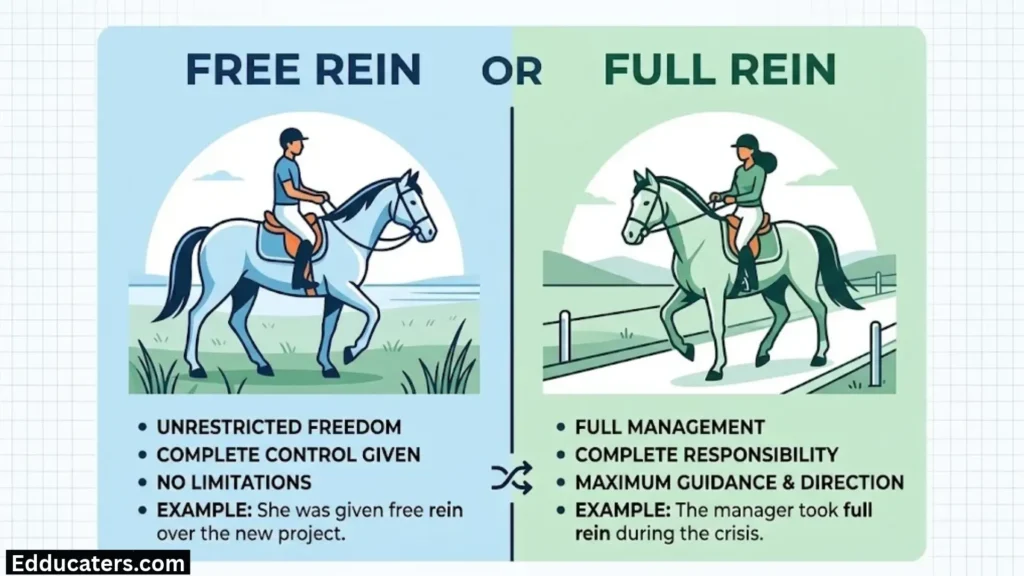
The expressions free rein and full rein are both used to describe freedom of action or expression. Although they share a similar meaning, their wording and frequency differ.
Free rein is the more familiar expression. Full rein is also recognized and can emphasize complete freedom.
Full Rein Meaning
The expression full rein means complete freedom to act, make decisions, or express yourself.
It carries the same basic horse-riding image as free rein. A horse moving with full rein has considerable freedom because the rider isn’t restricting its movement through tight control.
In figurative English, the expression suggests giving someone the widest possible freedom within a particular situation.
Examples:
- The director gave the actors full rein to develop their characters.
- The designer received full rein over the creative direction.
- The organization gave its research team full rein to investigate new possibilities.
- The author enjoyed full rein when developing the story.
The expression can appear in both professional and everyday writing.
Free Rein vs. Full Rein
Although the expressions are similar, you might notice a slight difference in emphasis.
| Expression | Meaning | Typical emphasis |
| Free rein | Freedom to act or make decisions | General independence |
| Full rein | Complete freedom of action | Maximum independence |
For example:
- The manager gave the team free rein to organize the project.
- The manager gave the team full rein to make every creative decision.
Both sentences communicate considerable freedom. The second places slightly more emphasis on the extent of that freedom.
Importantly, full rein doesn’t mean full reign. The same distinction between the two homophones still applies.
Examples of Full Rein
Here are additional examples:
- The playwright received full rein to revise the original script.
- The company gave its designers full rein over the new collection.
- The research team enjoyed full rein when exploring alternative solutions.
- The teacher allowed the students full rein during the creative exercise.
If you’re unsure which expression sounds more natural, choose free rein. It’s the more widely recognized option.
Related Expressions That Use Rein or Reins
The word rein appears in several familiar English expressions. Most of them involve control, responsibility, restraint, or authority.
Understanding these phrases also helps you remember why rein belongs in free rein.
Rein In Meaning
The phrasal verb rein in means to control, restrain, reduce, or limit something.
It comes from the physical action of pulling a horse’s reins to slow or control its movement.
In modern English, people use it when discussing spending, emotions, behavior, expectations, and other things that need greater control.
Examples:
- The government introduced new policies to rein in public spending.
- Parents sometimes need to rein in excessive screen time.
- The manager tried to rein in the team’s unrealistic expectations.
- She struggled to rein in her excitement.
- The company needs to rein in unnecessary expenses.
Notice that rein in expresses the opposite idea of free rein.
| Expression | Meaning |
| Give someone free rein | Allow someone greater freedom |
| Rein in someone or something | Exercise greater control |
This distinction is particularly useful because writers sometimes mistakenly use reign in instead of rein in.
Correct: The company must rein in its operating costs.
Incorrect: The company must reign in its operating costs.
Remember the horse connection whenever you use this expression.
Keep a Tight Rein
The expression keep a tight rein on someone or something means maintaining strict control.
It comes from horseback riding. A rider who holds the reins tightly exercises greater control over the horse’s movement.
In figurative language, the expression describes someone who carefully supervises people, activities, or resources.
Examples:
- The manager keeps a tight rein on the department’s budget.
- Some parents keep a tight rein on their children’s activities.
- The organization keeps a tight rein on its operating expenses.
- The supervisor maintained a tight rein on the project schedule.
The expression often suggests close supervision rather than independence.
Compare:
- The manager gave employees free rein over their projects.
- The manager kept a tight rein on employees’ daily activities.
The first sentence describes freedom. The second describes strict control.
Hand Over the Reins
The expression hand over the reins means transferring responsibility, authority, or control to another person.
The image comes from handing someone the reins of a horse. Once the other person takes control of the reins, that person becomes responsible for guiding the animal.
In modern usage, the phrase often appears in discussions about leadership changes, management, and succession.
Examples:
- The retiring CEO handed over the reins to her successor.
- After ten years, the founder decided to hand over the reins.
- The outgoing principal handed over the reins to the new administrator.
- The coach handed over the reins after the final match.
The expression doesn’t refer exclusively to business leadership. It can describe any situation in which someone transfers responsibility to another person.
Take the Reins
The expression take the reins means assuming control or responsibility for something.
It’s commonly used when someone becomes a leader, takes charge of a project, or manages a situation.
Examples:
- She took the reins after the previous manager resigned.
- The new director took the reins during a difficult period.
- Someone needs to take the reins before the project falls behind.
- The experienced coach took the reins before the championship season.
The difference between hand over the reins and take the reins is simple:
- Hand over the reins: Transfer control to someone else.
- Take the reins: Assume control or responsibility.
Both expressions use the same figurative image of guiding something.
Hold the Reins of Power
The expression hold the reins of power refers to having authority or control over an organization, government, or institution.
It uses the image of holding reins to guide something.
Examples:
- The elected officials hold the reins of power.
- The new administration took control of the reins of government.
- Several political groups competed to hold the reins of power.
- The organization placed its future in the hands of those holding the reins.
This expression is especially common in political and leadership discussions.
Unlike free rein, it focuses on authority rather than freedom from restrictions.
Free Rein Synonyms and Alternative Expressions
Several English expressions communicate ideas similar to free rein. However, their meanings aren’t always identical.
The best alternative depends on whether you’re discussing independence, permission, creative freedom, or unrestricted decision-making.
Common Synonyms for Free Rein
Here are useful alternatives:
| Synonym | Meaning | Example |
| Free hand | Freedom to make decisions | The manager gave her a free hand. |
| Complete freedom | Freedom without significant restrictions | The artist enjoyed complete freedom. |
| Autonomy | Independence in decision-making | Employees value professional autonomy. |
| Independence | Ability to act without relying on others | She wanted greater independence. |
| Liberty | Freedom to act or choose | Everyone deserves personal liberty. |
| Carte blanche | Complete permission or authority | The director received carte blanche. |
| Creative freedom | Freedom to develop original ideas | The designer enjoyed creative freedom. |
| Room to maneuver | Space or flexibility to make decisions | The team needed more room to maneuver. |
These alternatives can help you avoid repetition while preserving the intended meaning.
Alternative Ways to Say Give Someone Free Rein
You can replace give someone free rein with several natural expressions.
For example:
- Give someone complete freedom.
- Allow someone to make their own decisions.
- Give someone a free hand.
- Let someone do as they please.
- Allow someone to act independently.
- Give someone room to experiment.
- Let someone follow their own judgment.
- Allow someone to explore different possibilities.
Consider these examples:
- Original: The manager gave the designer free rein.
- Alternative: The manager gave the designer a free hand.
Both sentences communicate that the designer can make independent decisions.
Another example:
- Original: The teacher gave students free rein to explore their interests.
- Alternative: The teacher allowed students to follow their own interests.
The second sentence expresses the same general idea using simpler language.
When to Use Free Rein Instead of a Synonym
Although several alternatives exist, free rein has a particular advantage. It communicates freedom within an established situation without requiring a lengthy explanation.
For example:
“The editor gave the writer free rein.”
This short sentence tells readers that the writer can make independent creative decisions.
You could write:
“The editor allowed the writer to make independent decisions without unnecessary interference.”
Both sentences communicate the same basic idea, but the idiom is shorter and more natural.
However, choose a synonym when it provides greater precision. For example, autonomy might work better in a formal discussion about workplace independence.
Common Mistakes When Using Free Rein or Free Reign
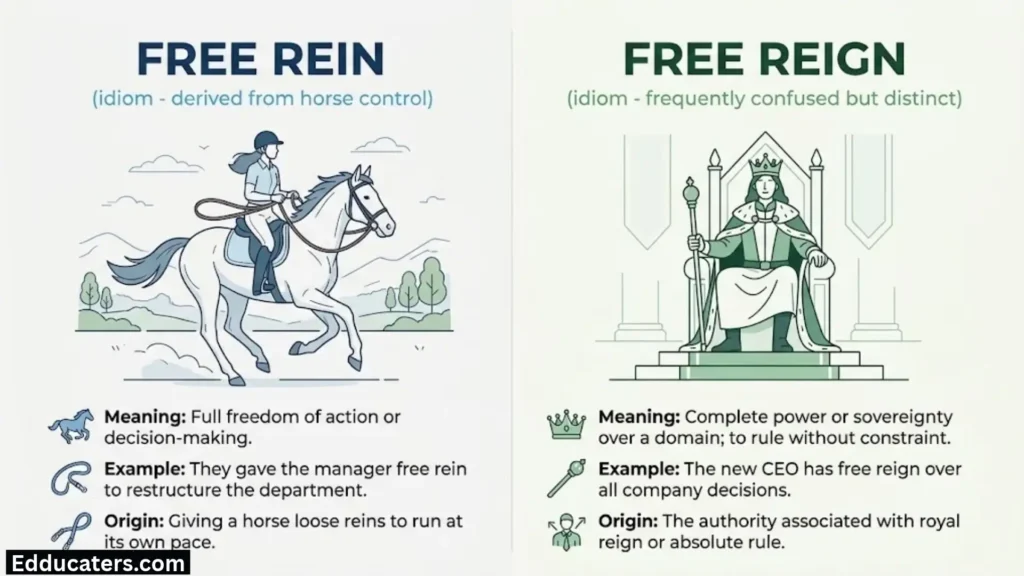
Even experienced writers sometimes confuse these expressions. The identical pronunciation makes the mistake easy to overlook.
Understanding a few common problems can help you avoid them.
Writing Free Reign Instead of Free Rein
This is the most recognizable mistake.
Writers often choose reign because it relates to power and authority. However, the traditional expression comes from horseback riding.
Incorrect:
- The teacher gave students free reign over their assignments.
- The designer received free reign to develop the collection.
- My parents gave me free reign to choose my activities.
Correct:
- The teacher gave students free rein over their assignments.
- The designer received free rein to develop the collection.
- My parents gave me free rein to choose my activities.
Whenever you describe freedom of action, use free rein.
Confusing Rein With Reign
The words have different meanings despite their identical pronunciation.
A useful way to distinguish them is to associate each word with a familiar subject.
| Word | Think about | Example |
| Rein | Horses and riding | The rider held the reins. |
| Reign | Kings and queens | The queen’s reign lasted decades. |
If the sentence involves controlling a horse, guiding something, or restraining an activity, rein may be appropriate.
If it involves ruling, sovereignty, or dominance, choose reign.
Confusing Free Rein With Complete Lack of Control
Another mistake involves misunderstanding the expression itself.
Giving someone free rein doesn’t always mean allowing them to do absolutely anything.
For example, a manager might give an employee free rein to organize a project. The employee can make independent decisions but still needs to follow the company’s budget and deadline.
Similarly, parents might give a teenager free rein to choose a hobby while maintaining reasonable household rules.
The expression describes considerable freedom rather than the complete absence of boundaries.
Using Rein In and Reign In Interchangeably
The correct expression is rein in, not reign in, when you mean controlling or limiting something.
Examples:
- Correct: The company needs to rein in its spending.
- Incorrect: The company needs to reign in its spending.
- Correct: She tried to rein in her emotions.
- Incorrect: She tried to reign in her emotions.
The horse-riding image explains the spelling. A rider pulls the reins to control the horse, so rein in is the appropriate expression.
Confusing Free Rein With Reins of Power
These expressions both contain rein or reins, but their meanings differ.
Free rein describes freedom from unnecessary control.
Reins of power describes authority or control over something.
Examples:
- The designer received free rein over the project.
- The president held the reins of power.
The first sentence emphasizes independence. The second emphasizes leadership and authority.
Easy Ways to Remember Free Rein or Free Reign
If you regularly confuse these words, a simple memory trick can save you from spelling mistakes.
The easiest method is to connect each word with a familiar image.
Remember the Horse Connection
Think about a horse whenever you see the word rein.
A rider holds the reins to guide a horse. When the rider loosens them, the horse gains greater freedom of movement.
This connection explains why the correct expression is free rein.
Remember:
- Horses have reins.
- Riders loosen reins to allow greater freedom.
- Free rein describes freedom of action or expression.
For example, if your manager allows you to make independent decisions, you’ve received free rein.
Associate Reign With Royalty
Think about kings, queens, and royal authority whenever you see reign.
A monarch reigns over a kingdom. The period during which that monarch holds power is called a reign.
Examples:
- The king’s reign lasted 30 years.
- The queen continued to reign over the kingdom.
- The country experienced major changes during his reign.
This association makes the distinction easier to remember.
Use This Simple Memory Trick
Free Rein = Horse + Freedom
Reign = King or Queen + Rule
You can also remember these two sentences:
- Give someone free rein to make decisions.
- A king or queen reigns over a kingdom.
Once you connect each word with its meaning, you’ll rarely confuse them again.
Frequently Asked Questions About Free Rein or Free Reign
Here are straightforward answers to common questions about the correct spelling, definitions, pronunciation, and usage of these expressions.
Is It Free Rein or Free Reign?
Free rein is the correct spelling when you mean allowing someone freedom to act, make decisions, or express themselves.
The expression comes from horseback riding, where loosening the reins allows a horse to move more freely. Free reign is generally a nonstandard spelling of this established idiom.
What Is the Difference Between Free Rein and Free Reign?
Free rein is the standard expression meaning freedom of action or expression. It comes from the practice of loosening a horse’s reins.
Free reign is a common alternative spelling that reflects confusion with the word reign, which refers to royal rule or authority.
Use free rein in standard American English.
What Does Free Rein Mean?
Free rein means having the freedom to act, make decisions, or express yourself without unnecessary restrictions.
For example, when a manager gives an employee free rein, the employee can use personal judgment instead of following constant instructions.
The expression can describe creative freedom, personal independence, professional autonomy, and freedom of expression.
What Does Free Reign Mean?
Free reign usually represents a nonstandard spelling of free rein. People often use it because rein and reign sound identical.
Some writers also use free reign intentionally as wordplay involving unrestricted authority. However, free rein remains the established expression for freedom of action.
Why Is Free Rein the Correct Spelling?
The expression comes from horseback riding.
A rein is a strap that helps a rider guide and control a horse. When the rider loosens the reins, the horse can move more freely.
This physical image developed into the figurative expression free rein, meaning freedom from unnecessary restrictions.
Is Free Reign a Spelling Mistake?
Usually, yes, when someone intends to use the traditional expression meaning freedom of action.
However, free reign appears in actual English usage and can sometimes represent intentional wordplay.
For standard writing, professional communication, and academic work, choose free rein.
Where Does the Phrase Free Rein Come From?
The phrase comes from horseback riding. Riders use reins to guide horses and control their movement.
Giving a horse free rein means loosening the reins and allowing greater freedom of movement.
English speakers later adopted this physical image to describe personal independence, creative freedom, and unrestricted decision-making.
Does Free Rein Come From Horse Riding?
Yes. The original expression has a direct connection with horseback riding.
A rider gives a horse free rein by holding the reins loosely instead of maintaining constant tension. This allows the animal to move more freely.
The modern figurative meaning developed from this practice.
What Does Giving Someone Free Rein Mean?
Giving someone free rein means allowing that person to make decisions or act independently without excessive interference.
For example:
“The director gave the actors free rein to interpret their characters.”
This means the actors could make creative choices about their performances.
What Does Full Rein Mean?
Full rein means complete freedom of action or expression.
It resembles free rein and can emphasize the extent of someone’s independence.
For example:
“The designer received full rein over the creative project.”
Both expressions are recognized, although free rein is more familiar in everyday English.
What Is the Difference Between Rein and Reign?
Rein refers to a strap used to guide a horse. It can also mean control or restraint.
Reign refers to ruling as a monarch or holding a position of dominance.
Examples:
- The rider held the reins tightly.
- The queen’s reign lasted several decades.
Both words are homophones, meaning they sound alike but have different meanings and spellings.
How Do You Use Free Rein in a Sentence?
Use free rein when describing freedom to act, decide, or express yourself.
Here are three examples:
- The manager gave her team free rein to develop new ideas.
- My parents gave me free rein to choose my career.
- The artist had free rein to experiment with different styles.
You can also use the expression in constructions such as give free rein to something and have free rein to do something.
What Does Rein In Mean?
Rein in means to control, restrain, or limit someone or something.
The expression comes from pulling a horse’s reins to control its movement.
Examples:
- The government needs to rein in public spending.
- She tried to rein in her excitement.
- The manager had to rein in the team’s expectations.
Remember that rein in is correct when describing restraint or control.
What Does Keeping a Tight Rein Mean?
Keeping a tight rein means maintaining strict control over someone or something.
For example:
“The manager keeps a tight rein on the department’s expenses.”
This means the manager closely monitors spending and prevents unnecessary costs.
The expression comes from holding a horse’s reins tightly to maintain greater control.
What Does Handing Over the Reins Mean?
Handing over the reins means transferring responsibility, leadership, or authority to another person.
For example:
“After 20 years, the founder handed over the reins to her daughter.”
This means the founder transferred control of the business to her successor.
What Does Reign Mean as a Noun?
As a noun, reign means the period during which a monarch rules or someone holds a position of dominance.
Examples:
- The king’s reign lasted several decades.
- The champion’s reign ended after a surprising defeat.
- The queen’s reign brought significant political changes.
It can describe both literal royal rule and figurative dominance.
What Does Reign Mean as a Verb?
As a verb, reign means to rule as a monarch or hold a position of authority.
It can also describe something that dominates or prevails in a particular situation.
Examples:
- The queen continued to reign over her kingdom.
- The monarch reigned for many years.
- Confusion reigned throughout the meeting.
Is Full Rein Another Way to Say Free Rein?
Yes. Full rein can describe complete freedom of action or expression, much like free rein.
Both expressions use the imagery of loosening a horse’s reins to allow greater movement.
However, free rein is the more common expression in everyday American English.
Conclusion: Free Rein or Free Reign?
When choosing between free rein or free reign, remember that free rein is the standard expression for freedom of action, choice, and expression.
Its origin comes from horseback riding, where a rider loosens the reins to allow a horse greater freedom of movement. The word reign, however, refers to ruling or holding authority.
Both words sound identical, but their meanings and historical backgrounds differ.
Keep this simple distinction in mind:
- Free rein: Freedom to act without unnecessary restrictions.
- Reign: The act or period of ruling or exercising authority.
If you’re writing about creative freedom, workplace independence, or personal decisions, free rein is the spelling to choose.

I’m Julian Mercer, an English language writer dedicated to helping people master grammar through practical examples and clear explanations. I enjoy teaching grammar in a way that is both engaging and easy to remember.
My work focuses on grammar rules, punctuation, word usage, and writing techniques that readers can apply in everyday life. I believe learning English should be simple, enjoyable, and useful.
Books
English Grammar in Practice
Writing with Precision
 Nathan Whitmore