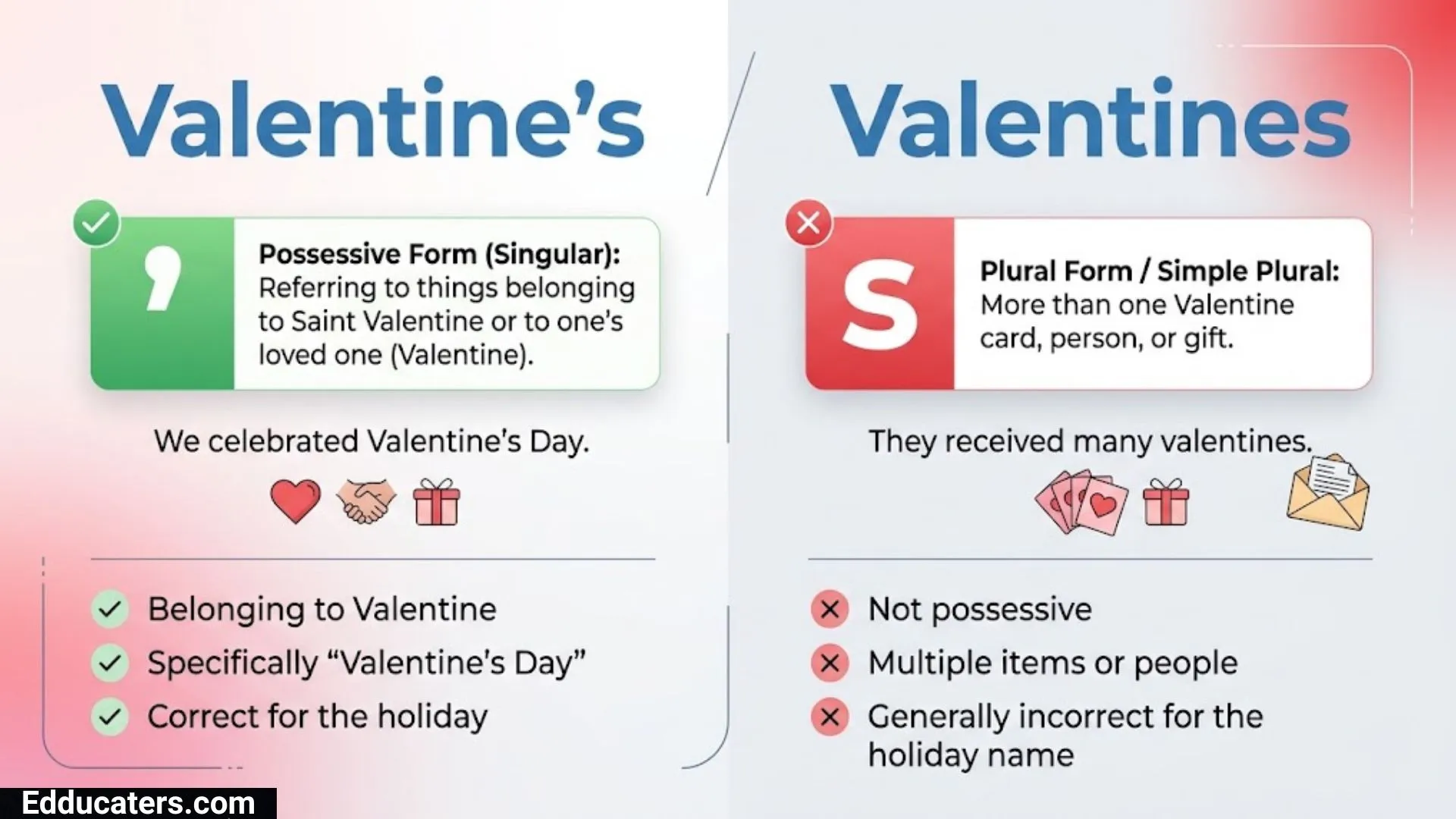
Choosing between Valentine’s and Valentines can be confusing, especially when you’re writing a card, posting a holiday greeting, or referring to February 14. The difference comes down to punctuation and meaning: the apostrophe in Valentine’s usually shows possession or forms part of the established holiday name, while valentines is the plural of valentine.
Valentine’s Day is the standard spelling of the February 14 holiday. If you’re writing a greeting, Happy Valentine’s Day! is the conventional form. However, valentines is also correct when you mean multiple Valentine’s Day cards, gifts, or people who are someone’s valentine.
Understanding when to use the apostrophe makes it easier to write the holiday’s name correctly in everyday messages, invitations, school activities, and social media posts.
Valentine’s or Valentines: What’s the Difference?
Both Valentine’s and valentines are legitimate forms, but they serve different purposes. The apostrophe is not simply a decorative mark; it helps distinguish the holiday’s name from the plural noun.
| Form | Meaning or Use | Example |
| Valentine’s | Possessive form of Valentine or part of the holiday’s name | Valentine’s Day is on February 14. |
| Valentine | A person you love or a card sent on Valentine’s Day | She gave her valentine a handwritten note. |
| Valentines | More than one valentine, card, or romantic partner in the relevant context | The children made valentines for their classmates. |
| Valentines Day | Commonly seen without the apostrophe, but not the standard spelling of the holiday | Write Valentine’s Day instead. |
The key distinction is that Valentine’s Day is the conventional name of the holiday, whereas valentines is a plural noun. In standard English, the holiday’s name includes an apostrophe before the s.
For example:
- Correct: We’re celebrating Valentine’s Day on Friday.
- Correct: I bought several valentines for my friends.
- Nonstandard for the holiday name: We’re celebrating Valentines Day on Friday.
The apostrophe belongs in the holiday’s name even when the sentence doesn’t otherwise express ownership. It is part of the established spelling of the expression.
Is It Valentine’s or Valentines Day?
The correct standard spelling is Valentine’s Day, with an apostrophe between the e and the s.
The expression is traditionally understood as a possessive construction associated with Saint Valentine. Over time, it became the established name of the holiday celebrated on February 14.
Here is how to write it in different situations:
- Holiday name: Valentine’s Day
- Greeting: Happy Valentine’s Day!
- Event invitation: Join us for a Valentine’s Day party.
- School activity: Valentine’s Day crafts for children
- Plural cards: We made valentines for everyone in the class.
Although you may see Valentines Day on informal posts, signs, or handwritten invitations, it is not the standard spelling. Use the apostrophe in polished writing, schoolwork, business communications, and published content.
You may also see Valentine Day without the apostrophe or the final s in Valentine’s. Although people may understand what it means, Valentine’s Day is the established English name and the safest choice.
What Does Valentine’s Mean?
Valentine’s is the possessive form of Valentine. In the holiday name Valentine’s Day, it forms part of the conventional expression for the celebration of love and affection on February 14.
The word valentine can refer to a person you love or admire, particularly on Valentine’s Day. It can also mean a card, note, or small gift sent to express affection.
The meaning depends on the context:
1. Valentine’s as part of a holiday name
“Valentine’s Day is our favorite winter celebration.”
Here, Valentine’s appears in the established name of the holiday.
2. Valentine’s as a possessive form
“That is my valentine’s handwritten card.”
Here, valentine’s indicates that the card belongs to or is associated with the person described as the valentine.
3. Valentine as a noun
“Will you be my valentine?”
Here, valentine refers to the person being asked to share the occasion.
4. Valentines as a plural noun
“The students exchanged valentines after lunch.”
Here, valentines means multiple cards or messages expressing affection.
Remember that Valentine’s and valentines are not interchangeable in every sentence. The apostrophe and the surrounding words help establish the intended meaning.
What Is Valentine’s Day?
Valentine’s Day is an annual celebration of love, affection, and appreciation observed on February 14. People often mark the occasion by exchanging cards, flowers, chocolates, thoughtful gifts, and personal messages.
Although the holiday is commonly associated with romantic relationships, it can also be an opportunity to show appreciation for friends, family members, classmates, and other important people.
The spelling of the name remains the same regardless of how you celebrate it: Valentine’s Day.
Examples:
- My family exchanges small gifts on Valentine’s Day.
- The restaurant is offering a special Valentine’s Day dinner.
- Our school is organizing a Valentine’s Day card-making activity.
- I sent my best friend a message on Valentine’s Day.
In each example, the apostrophe is part of the holiday’s conventional name. You do not remove it simply because the sentence refers to a public celebration rather than something owned by an individual.
How Do You Spell Happy Valentine’s Day?
The standard spelling is Happy Valentine’s Day!
The apostrophe goes after Valentine and before the s. All three words are capitalized in this greeting because it is a conventional holiday expression, although capitalization can vary with sentence position and editorial style.
Here are some correct ways to write the greeting:
- Happy Valentine’s Day!
- Wishing you a wonderful Valentine’s Day.
- Happy Valentine’s Day to my favorite person.
- Have a lovely Valentine’s Day filled with happiness.
- Happy Valentine’s Day to all my friends!
These common alternatives need attention:
- Happy Valentines Day — missing the apostrophe.
- Happy Valentine Day — missing the possessive ‘s in the standard holiday name.
- Happy Valentine’s day — understandable, but the holiday’s name is conventionally capitalized as Valentine’s Day.
If you are writing a card, email, social media caption, or greeting to a loved one, choose Happy Valentine’s Day! It is the clearest and most widely accepted form.
Valentine’s Day or Valentines Day: Common Mistakes
The most frequent mistake is leaving out the apostrophe when writing the holiday’s name. Since the words sound almost identical in ordinary speech, the difference is easy to overlook.
Here are a few examples to help you recognize the correct form.
Mistake: We are having a Valentines Day party.
Correct: We are having a Valentine’s Day party.
The corrected version uses the standard spelling of the holiday.
Mistake: Happy Valentines Day to you!
Correct: Happy Valentine’s Day to you!
The apostrophe belongs in the holiday name even in a short greeting.
Mistake: I bought a Valentine’s for each of my classmates.
Better: I bought a valentine for each of my classmates.
In this sentence, valentine is a singular noun referring to one card or gift. If you mean several cards, write valentines without an apostrophe.
Mistake: The children exchanged Valentine’s.
Correct: The children exchanged valentines.
The plural of valentine is valentines, not Valentine’s. An apostrophe is not normally used to form a plural in English.
The easiest way to avoid these mistakes is to remember the difference between a holiday name and an ordinary plural noun.
How to Spell Valentine’s Day in Spanish
In Spanish, Valentine’s Day is commonly called Día de San Valentín. Another widely used expression is Día de los Enamorados, which means “Day of Lovers.” The exact expression varies by country and regional tradition.
Unlike English, Spanish generally uses lowercase letters for holiday names unless capitalization is required for another reason, such as the beginning of a sentence. The word día also retains its accent mark.
Examples:
- English: Happy Valentine’s Day!
- Spanish: ¡Feliz Día de San Valentín!
- Spanish alternative: ¡Feliz Día de los Enamorados!
In some Spanish-speaking countries, other regional expressions are used for the celebration of love and friendship. For example, Día del Amor y la Amistad means “Day of Love and Friendship.”
If you are translating a greeting, choose the expression that fits your audience. For a general Spanish-language greeting, ¡Feliz Día de San Valentín! is a recognizable option.
What Is the Difference Between Valentine and Galentine?
A valentine is someone you express love or affection for on Valentine’s Day. The term can refer to a romantic partner, a person you admire, or a card sent to communicate affection.
A Galentine is a term associated with celebrating female friendship, particularly among women who gather to appreciate their friends around Valentine’s Day. The word became widely popular through the television comedy Parks and Recreation, which introduced the fictional celebration of Galentine’s Day.
The two words have related cultural contexts but different meanings.
| Term | Meaning | Example |
| Valentine | A loved one or an affectionate card or message | He asked his partner to be his valentine. |
| Galentine | A female friend celebrated in the context of Galentine’s Day | She invited her galentines to brunch. |
| Galentine’s Day | An informal celebration of female friendship, often held around February 13 | We’re having brunch for Galentine’s Day. |
| Valentine’s Day | The February 14 celebration of love and affection | They exchanged gifts on Valentine’s Day. |
A valentine is not necessarily a romantic partner; the word can be used more broadly. Likewise, Galentine’s Day is not a replacement for Valentine’s Day. It offers a separate way to celebrate friendship.
For example, you might spend Valentine’s Day with your partner and organize a Galentine’s Day brunch with your friends. Both expressions are appropriate when used for their intended occasions.
Examples of Valentine’s and Valentines in Sentences
Seeing the words in context makes their different uses easier to remember.
- Valentine’s Day: We’re planning a surprise dinner for Valentine’s Day.
- Valentine’s Day: Happy Valentine’s Day to everyone celebrating!
- Valentine’s: My valentine’s gift arrived yesterday.
- Valentine: She wrote a heartfelt message to her valentine.
- Valentines: The children decorated valentines with colorful hearts.
- Valentines: We handed out valentines to our classmates.
- Valentine: Will you be my valentine this year?
- Valentine’s Day: The shop is selling Valentine’s Day cards and flowers.
- Galentine’s Day: My friends and I are meeting for brunch on Galentine’s Day.
- Spanish greeting: I sent my cousin a message saying, “¡Feliz Día de San Valentín!”
Notice how the apostrophe changes with the grammatical purpose. In Valentine’s Day, it appears in the holiday name. In my valentine’s gift, it marks possession. In valentines, the word is plural and needs no apostrophe.
FAQs
Is it Valentine’s or Valentines?
Both forms are correct in different contexts. Valentine’s is used in the standard holiday name Valentine’s Day, while valentines is the plural of valentine, meaning multiple cards or people associated with the occasion.
Is it Happy Valentine’s or Valentines Day?
The standard greeting is Happy Valentine’s Day! The apostrophe belongs between the e and the s in Valentine’s. Writing Happy Valentines Day leaves out the apostrophe required in the conventional holiday name.
Do you say Valentine’s or Valentines?
Both forms are used in English, but they have different meanings. You say Valentine’s Day when naming the holiday and valentines when referring to multiple cards or affectionate messages. In speech, the apostrophe is not audible, so context usually determines the meaning.
Why does Valentine’s Day have an apostrophe?
The apostrophe marks the possessive form in the traditional name associated with Saint Valentine. The expression became the established name of the February 14 holiday, so the apostrophe remains part of its standard spelling.
Is Valentines Day grammatically incorrect?
Valentines Day without an apostrophe is a common informal spelling, but it is not the standard form of the holiday’s name. Use Valentine’s Day in formal writing, school assignments, professional messages, and edited content.
Is Valentine’s a singular or plural word?
Valentine’s is a possessive form, not the ordinary plural of valentine. The plural is valentines. For example, “my valentine’s card” indicates a card associated with one valentine, while “my valentines” can refer to multiple cards or people.
How do you write Valentine’s Day in a sentence?
Write Valentine’s Day with an apostrophe and capitalize both Valentine’s and Day when using the holiday’s name. For example: “We are celebrating Valentine’s Day with dinner and flowers.”
Is Valentine’s Day the same as Galentine’s Day?
No. Valentine’s Day is observed on February 14 and celebrates love and affection. Galentine’s Day is an informal celebration of female friendship, commonly associated with February 13, although people may celebrate it on other dates.
Conclusion
Valentine’s Day is the correct standard spelling of the February 14 holiday, and Happy Valentine’s Day! is the conventional greeting. The apostrophe is part of the holiday’s established name.
Use valentines when referring to multiple cards, notes, or people who are someone’s valentine. Use Valentine’s when the possessive form is required or when writing the holiday’s name.
The rule is simple: include the apostrophe in Valentine’s Day, but leave it out when forming the plural valentines.

Hi, I’m Nathan Whitmore, and I enjoy making English grammar easy for learners of all ages. I believe grammar should be practical, not confusing. I write simple, well-researched guides that help readers improve their writing, speaking, and overall communication skills.
I spend a lot of time studying grammar patterns, sentence construction, punctuation, and modern English usage. My goal is to create lessons that anyone can understand, whether they are students, teachers, or professionals.
Books
Clear English Grammar
The Smart Writer’s Grammar Handbook
 Claire Holloway
 Julian Mercer