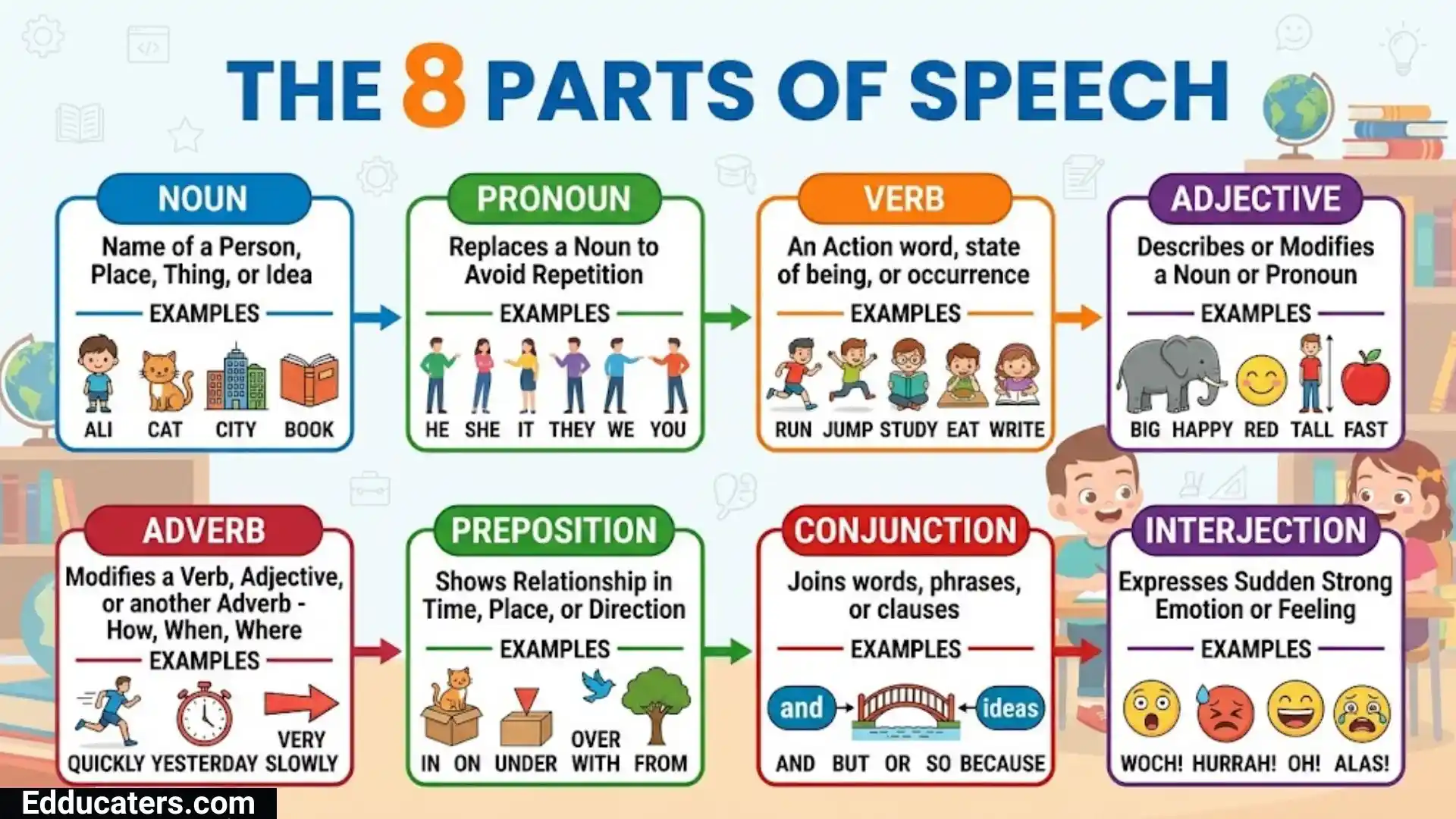
Parts of speech are the basic building blocks of English grammar. Every word in a sentence has a role, such as naming a person, describing something, expressing an action, or connecting ideas. Understanding the parts of speech in English helps you write correct sentences, improve your vocabulary, and communicate more clearly.
English grammar traditionally recognizes eight main parts of speech: nouns, pronouns, verbs, adjectives, adverbs, prepositions, conjunctions, and interjections. Some grammar resources count articles as a ninth category because words such as a, an, and the have an important role in sentences. In modern grammar, however, articles are generally considered a type of determiner.
Parts of Speech in English: Quick Overview
The following table provides a simple overview of the parts of speech, their functions, and examples.
| Part of Speech | Definition | Examples |
| Noun | Names a person, place, thing, or idea | teacher, city, book, happiness |
| Pronoun | Replaces a noun or noun phrase | I, you, he, they, it |
| Verb | Expresses an action, event, or state | run, write, become, is |
| Adjective | Describes or gives information about a noun or pronoun | beautiful, tall, clever, blue |
| Adverb | Modifies a verb, adjective, another adverb, or sometimes a whole sentence | quickly, very, carefully, often |
| Preposition | Shows a relationship involving time, place, direction, or other connections | in, on, under, before |
| Conjunction | Connects words, phrases, or clauses | and, but, because, although |
| Interjection | Expresses a sudden feeling or reaction | Wow!, Ouch!, Hurray!, Oh! |
| Article | Introduces a noun and indicates whether it is specific or nonspecific | a, an, the |
1. Noun
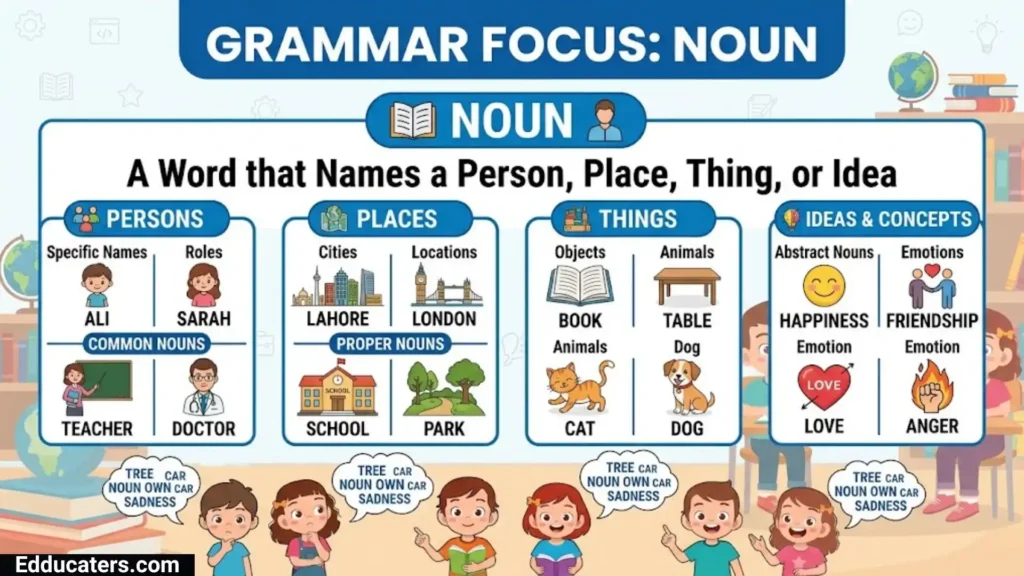
A noun is a word that names a person, place, thing, animal, or idea. Nouns are important because they often identify who or what a sentence is about.
Examples of nouns:
- Person: teacher, doctor, Sarah
- Place: school, London, garden
- Thing: phone, table, computer
- Animal: cat, horse, elephant
- Idea or quality: love, freedom, honesty
Examples in sentences:
- The teacher explained the lesson.
- We visited a beautiful city.
- My dog likes playing outside.
- Honesty is an important quality.
In these examples, the bold words are nouns because they name people, places, animals, or ideas.
Types of Nouns
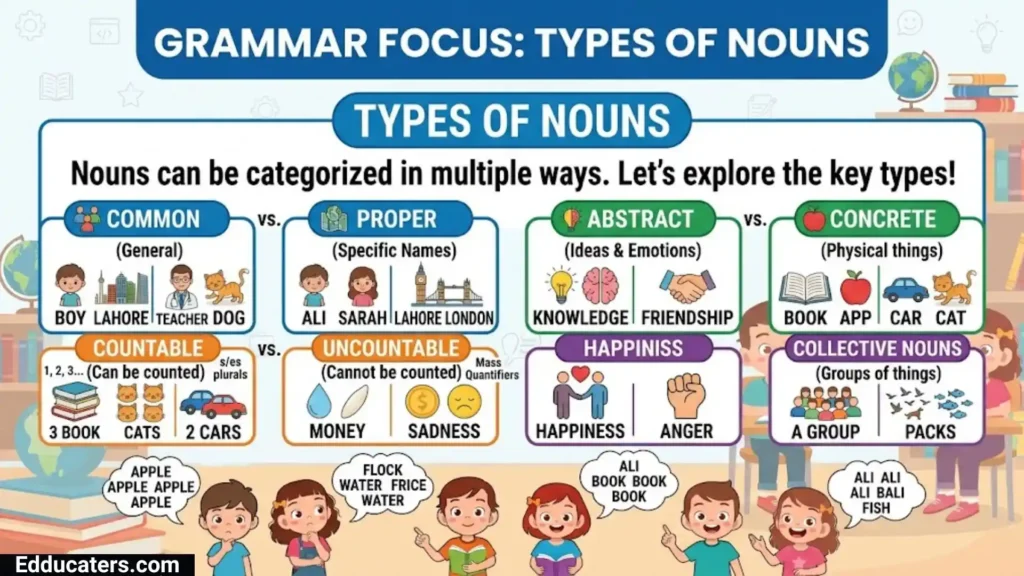
Nouns can be divided into several categories according to what they name.
Common Nouns: These name general people, places, or things.
Examples: boy, country, school, river
Sentence: The boy is reading a book.
Proper Nouns: These name specific people, places, organizations, or other unique entities. They usually begin with capital letters.
Examples: Ali, Pakistan, Monday, Microsoft
Sentence: Pakistan is a beautiful country.
Concrete Nouns: These name things you can experience through your senses.
Examples: apple, chair, flower, music
Sentence: She placed an apple on the table.
Abstract Nouns: These name feelings, qualities, states, or ideas that you cannot physically touch.
Examples: kindness, courage, wisdom, happiness
Sentence: Kindness can make a difference in someone’s life.
Collective Nouns: These refer to a group of people, animals, or things.
Examples: team, family, crowd, flock
Sentence: The team won the match.
Countable and Uncountable Nouns: Countable nouns have singular and plural forms, such as book and books. Uncountable nouns generally refer to things measured by amount rather than counted individually, such as water, advice, and information.
Sentence: I bought three books and some water.
Understanding noun types helps you use articles, plurals, and subject-verb agreement correctly.
2. Pronoun
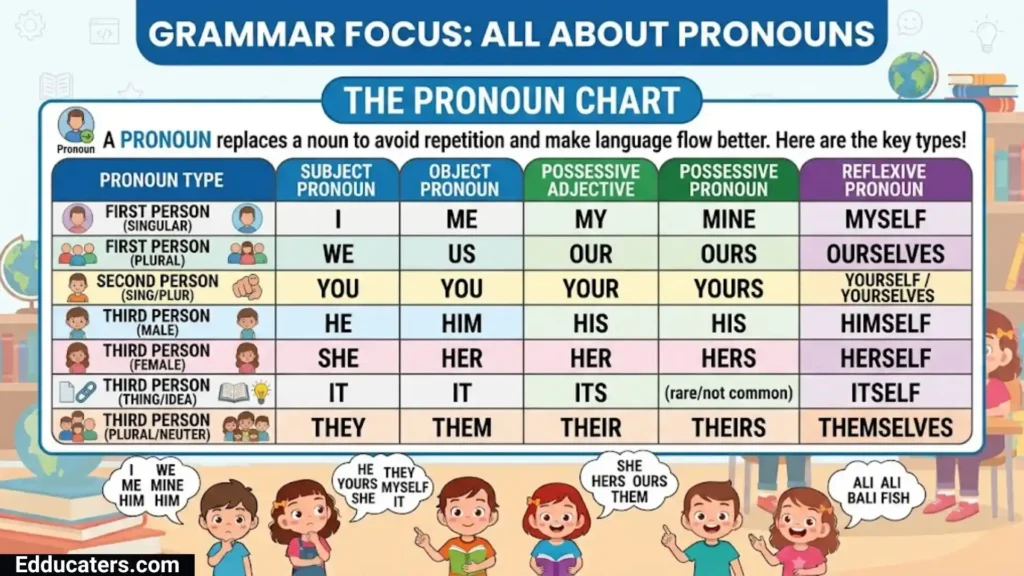
A pronoun is a word used instead of a noun or noun phrase. Pronouns help avoid unnecessary repetition and make sentences smoother.
Examples of pronouns:
I, me, you, he, him, she, her, it, we, us, they, them, who, someone, this, those
Examples in sentences:
- Maria is my friend. She is very helpful.
- Ahmed lost his keys.
- The children said they were tired.
- This book belongs to me.
In the first example, she replaces the name Maria. In the third example, they refers to the children.
Types of Pronouns
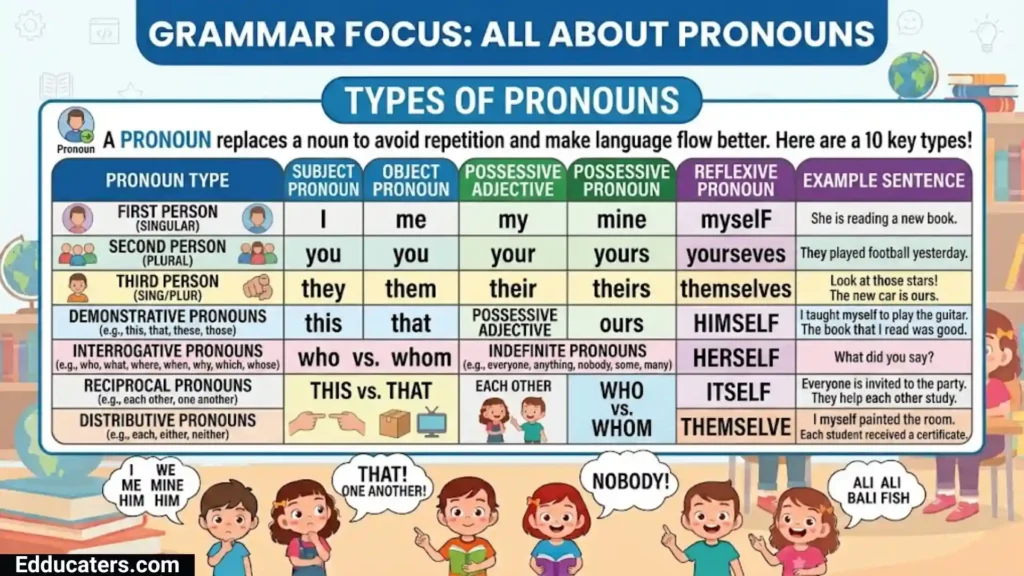
Personal Pronouns: Refer to specific people or things.
Examples: I, you, he, she, it, we, they
Sentence: They are playing football.
Possessive Pronouns: Show ownership without repeating the noun.
Examples: mine, yours, his, hers, ours, theirs
Sentence: This bag is mine.
Reflexive Pronouns: Refer back to the subject of a sentence.
Examples: myself, yourself, himself, herself, itself, ourselves, themselves
Sentence: She taught herself to cook.
Demonstrative Pronouns: Point to particular people or things.
Examples: this, that, these, those
Sentence: Those are my favorite shoes.
Interrogative Pronouns: Help ask questions.
Examples: who, whom, whose, what, which
Sentence: Who called you?
Relative Pronouns: Introduce clauses that provide information about a noun.
Examples: who, whom, whose, which, that
Sentence: The woman who lives next door is a doctor.
Indefinite Pronouns: Refer to people or things without naming them specifically.
Examples: someone, anyone, everyone, nobody, something
Sentence: Someone left a message for you.
Use pronouns carefully so readers can understand exactly which person or thing each pronoun refers to. The noun a pronoun refers to is called its antecedent.
3. Verb
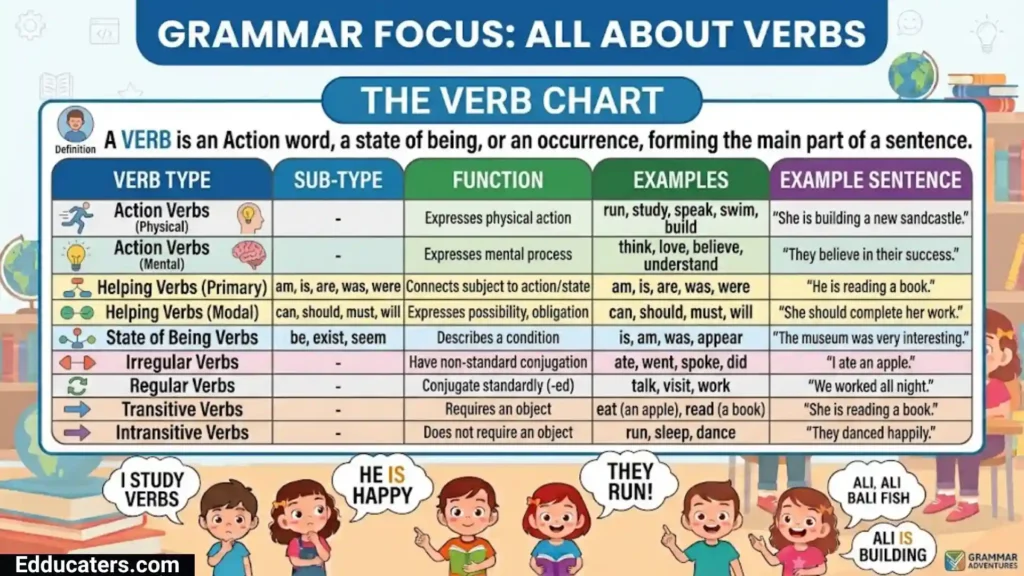
A verb expresses an action, an event, or a state of being. Most complete English sentences need a verb, and verbs are central to sentence structure.
Examples of verbs:
- Action: run, eat, write, jump
- State: know, believe, understand, belong
- Linking: be, seem, become, appear
- Helping: is, have, do, can, will
Examples in sentences:
- The children play outside.
- She writes every morning.
- I understand the question.
- He is tired.
- They have finished their work.
The verb play expresses an action, while is connects the subject to information about its state.
Types of Verbs
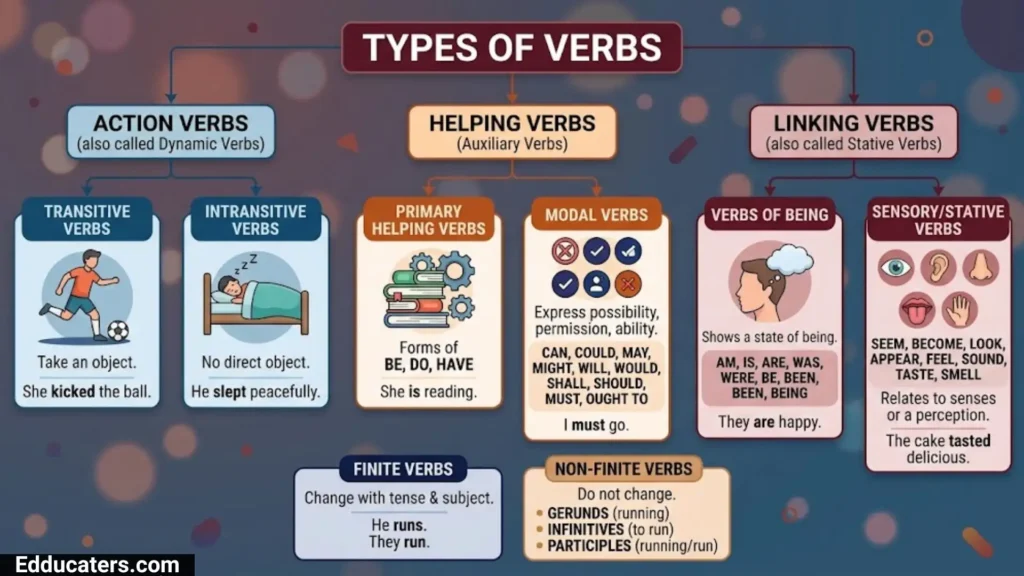
Action Verbs: Describe physical or mental actions.
Examples: walk, swim, think, remember
Sentence: He remembered the answer.
Linking Verbs: Connect the subject to a word or phrase that describes or identifies it.
Examples: be, seem, become, feel, look
Sentence: The soup smells delicious.
Here, smells links the soup to the description delicious.
Helping Verbs: Work with a main verb to express tense, possibility, necessity, or other meanings.
Examples: is, have, do, can, should, will
Sentence: She is reading a novel.
The helping verb is works with the main verb reading.
Transitive Verbs: Take a direct object.
Sentence: She opened the door.
The word door receives the action of the verb opened.
Intransitive Verbs: Do not take a direct object.
Sentence: The baby slept peacefully.
The verb slept does not act directly on an object.
Regular and Irregular Verbs: Regular verbs usually form their past tense by adding -ed, as in walk/walked. Irregular verbs follow different patterns, as in go/went and write/wrote.
Verbs also change according to tense, subject-verb agreement, and sentence structure. For example, we say she works but they work in the simple present tense.
4. Adjective
An adjective describes or gives more information about a noun or pronoun. It can tell you what something is like, which one it is, or how many there are.
Examples of adjectives:
beautiful, tall, small, intelligent, blue, three, several
Examples in sentences:
- She lives in a beautiful house.
- The blue car belongs to my uncle.
- We adopted a small puppy.
- He is an intelligent student.
- I bought three notebooks.
The adjectives add details about the house, car, puppy, student, and notebooks.
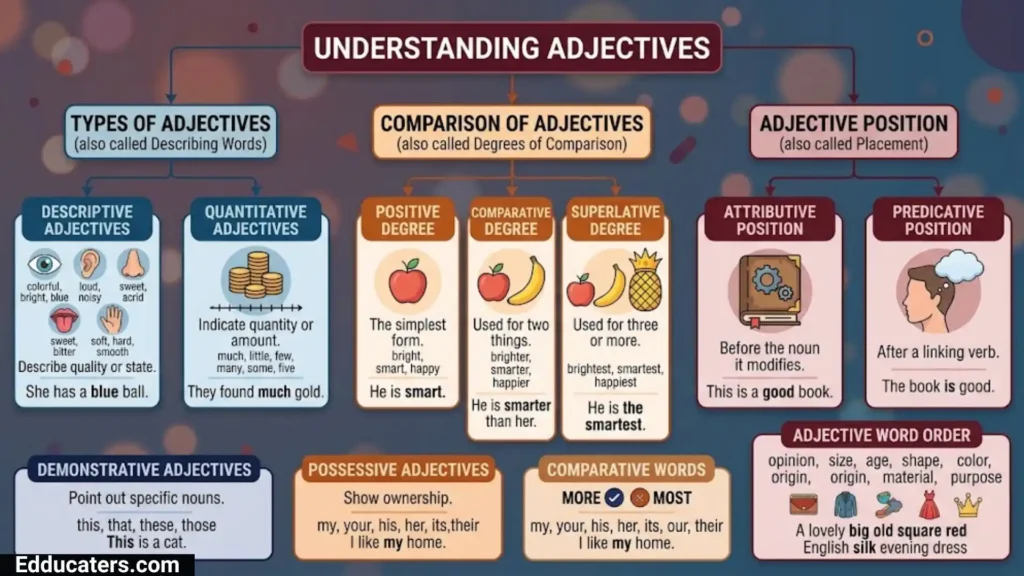
Types of Adjectives
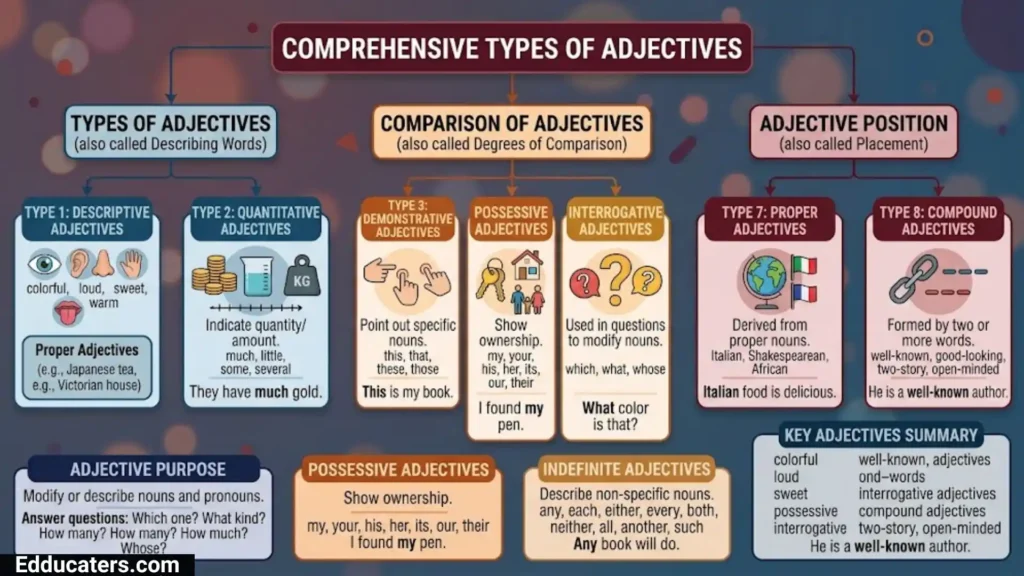
Descriptive Adjectives: Describe qualities or characteristics.
Examples: happy, bright, tall, delicious
Sentence: We ate a delicious meal.
Quantitative Adjectives: Indicate quantity or amount.
Examples: some, much, little, enough
Sentence: There is enough food for everyone.
Numeral Adjectives: Indicate number or order.
Examples: one, five, first, second
Sentence: She won the first prize.
Demonstrative Adjectives: Identify particular nouns when used before them.
Examples: this, that, these, those
Sentence: This book is interesting.
Possessive Adjectives: Show whose item or person is being referred to.
Examples: my, your, his, her, its, our, their
Sentence: Their house is near the park.
Interrogative Adjectives: Help ask questions about nouns.
Examples: which, what, whose
Sentence: Which subject do you prefer?
In modern grammar, words such as my, this, and which are often classified as determiners when they introduce nouns. Traditional school grammar may call them possessive, demonstrative, or interrogative adjectives.
Degrees of Comparison
Adjectives can compare people or things.
- Positive: tall
- Comparative: taller
- Superlative: tallest
Examples:
- Ali is tall.
- Ahmed is taller than Ali.
- Hamza is the tallest boy in the group.
Some adjectives use more and most, as in more beautiful and most beautiful.
5. Adverb
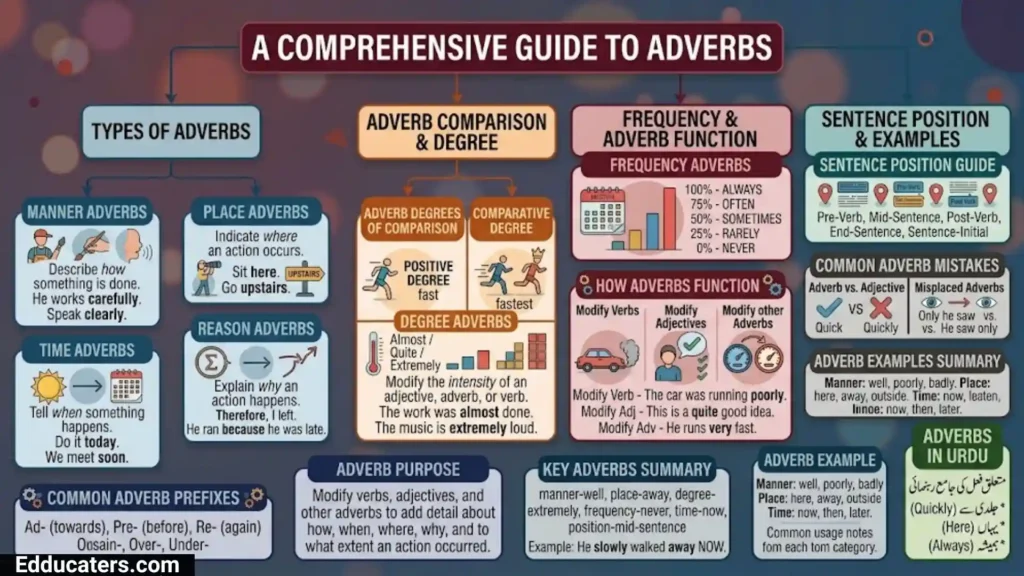
An adverb modifies a verb, an adjective, another adverb, or sometimes an entire sentence. Adverbs often explain how, when, where, or how often something happens. They can also show degree.
Examples of adverbs:
quickly, slowly, yesterday, here, often, very, carefully
Examples in sentences:
- She speaks clearly.
- We arrived yesterday.
- The children played outside.
- He often visits his grandparents.
- The test was very difficult.
- She completed the task quite easily.
In these examples, the adverbs provide information about manner, time, place, frequency, and degree.
Types of Adverbs
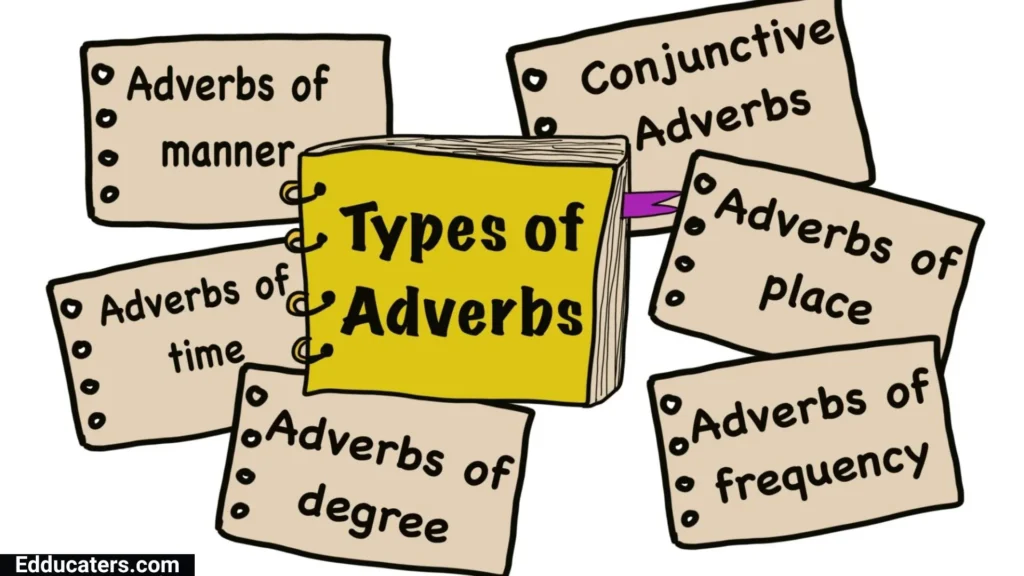
Adverbs of Manner: Explain how an action happens.
Examples: carefully, quickly, politely, quietly
Sentence: The driver moved carefully.
Adverbs of Time: Explain when something happens.
Examples: today, yesterday, soon, later
Sentence: We will leave soon.
Adverbs of Place: Explain where something happens.
Examples: here, there, outside, nearby
Sentence: Please wait outside.
Adverbs of Frequency: Explain how often something happens.
Examples: always, usually, often, sometimes, rarely, never
Sentence: She usually drinks tea in the morning.
Adverbs of Degree: Explain the intensity or extent of something.
Examples: very, too, quite, almost, extremely
Sentence: The room is extremely cold.
Sentence Adverbs: Express a speaker’s attitude toward a whole statement.
Examples: fortunately, honestly, perhaps, surprisingly
Sentence: Fortunately, nobody was injured.
Adjectives or Adverbs?
Adjectives describe nouns or pronouns, while adverbs often modify verbs, adjectives, or other adverbs.
- Adjective: She is a careful driver.
- Adverb: She drives carefully.
However, not all adverbs end in -ly. Words such as often, fast, well, and here can also function as adverbs.
Compare:
- He is a fast runner. (Fast describes the noun runner.)
- He runs fast. (Fast modifies the verb runs.)
6. Preposition
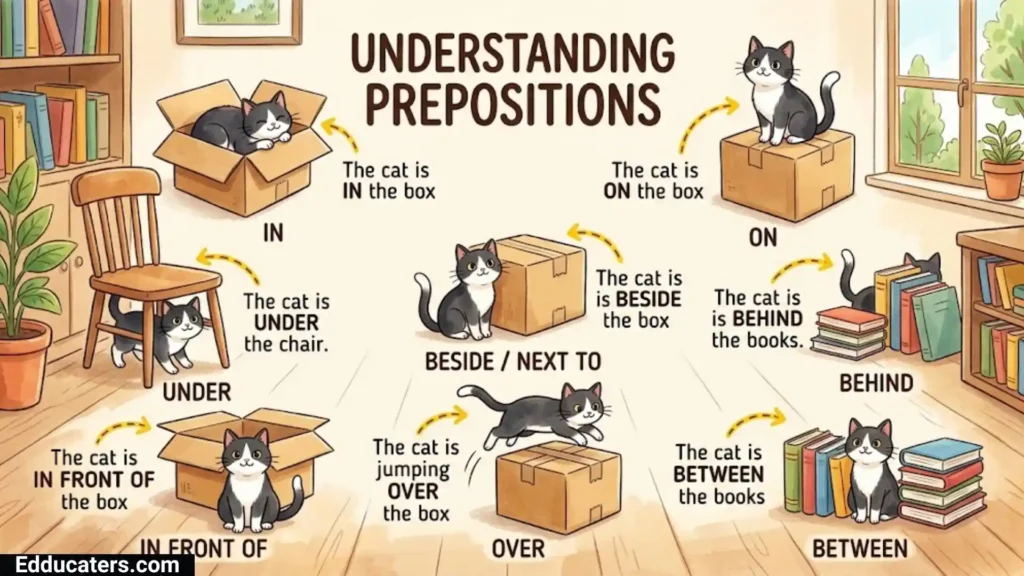
A preposition shows a relationship between a noun or pronoun and another part of a sentence. Prepositions commonly express place, time, direction, position, and other relationships.
Examples of prepositions:
in, on, at, under, over, beside, between, through, during, before, after, with, from, to
Examples in sentences:
- The keys are on the table.
- We arrived at noon.
- The cat is hiding under the bed.
- She walked through the park.
- He traveled with his family.
- They have lived here since 2020.
Each preposition connects the noun or pronoun in its phrase to another part of the sentence.
Types of Prepositions
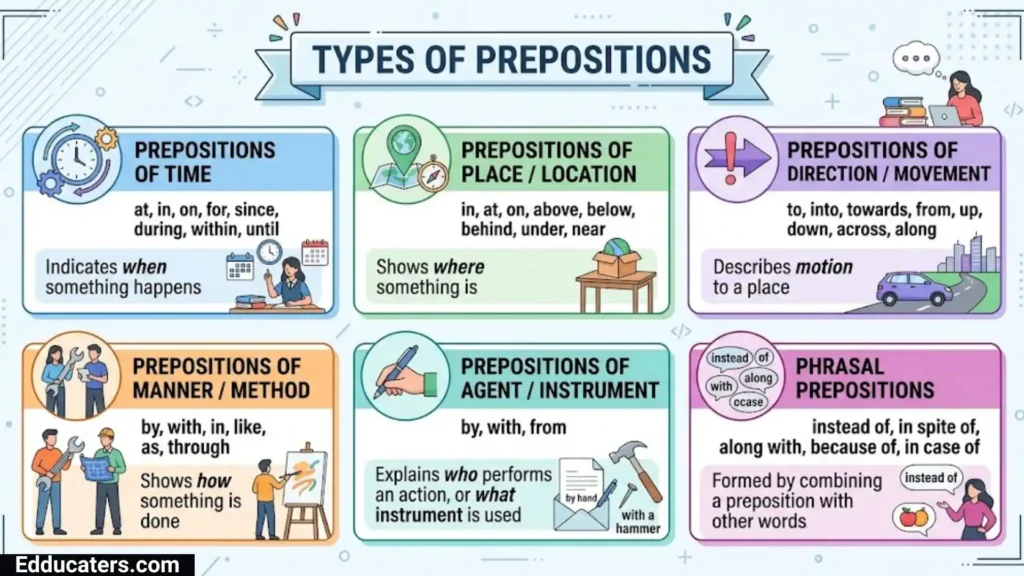
Prepositions of Place: Show where something is located.
Examples: in, on, under, behind, beside
Sentence: The shoes are under the bed.
Prepositions of Time: Show when something happens.
Examples: at, on, in, before, after, during
Sentences:
- The meeting starts at 9 a.m.
- We travel in July.
- Her birthday is on Monday.
Prepositions of Direction or Movement: Show movement toward, away from, or through a place.
Examples: to, into, onto, toward, across, through
Sentence: The boy ran across the field.
Prepositions of Agent or Instrument: Can show who performs an action or what is used to do it.
Examples: by, with
Sentences:
- The novel was written by a famous author.
- She cut the paper with scissors.
A preposition usually begins a prepositional phrase, such as in the garden, after lunch, or under the old bridge. These phrases can provide additional information about nouns or actions.
7. Conjunction
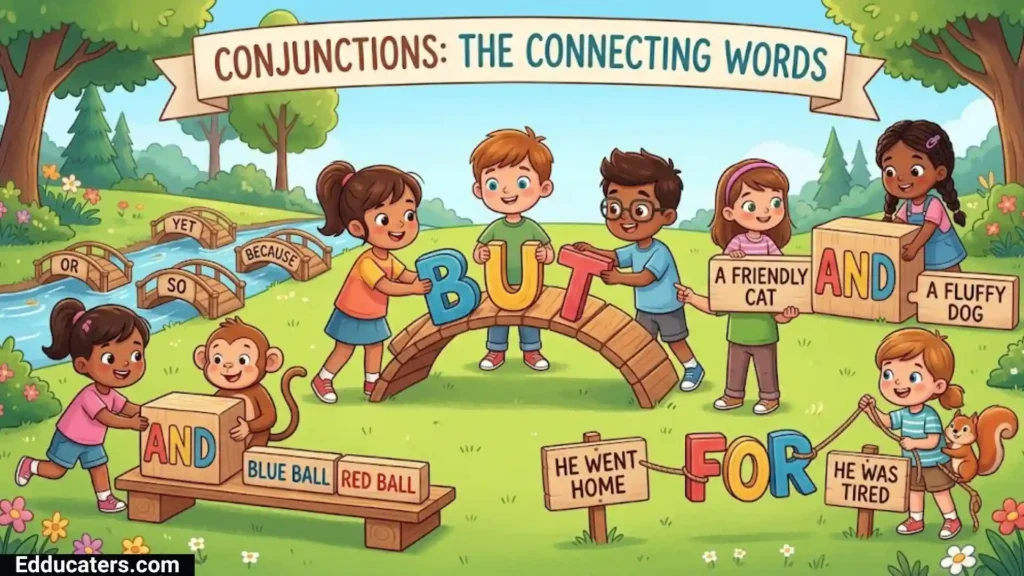
A conjunction connects words, phrases, or clauses. Conjunctions help express relationships between ideas, including addition, contrast, choice, reason, and condition.
Examples of conjunctions:
and, but, or, because, although, if, while, unless
Examples in sentences:
- Sara and Ali are classmates.
- I wanted to go, but I was busy.
- Would you like tea or coffee?
- We stayed inside because it was raining.
- Although he was tired, he continued working.
Types of Conjunctions
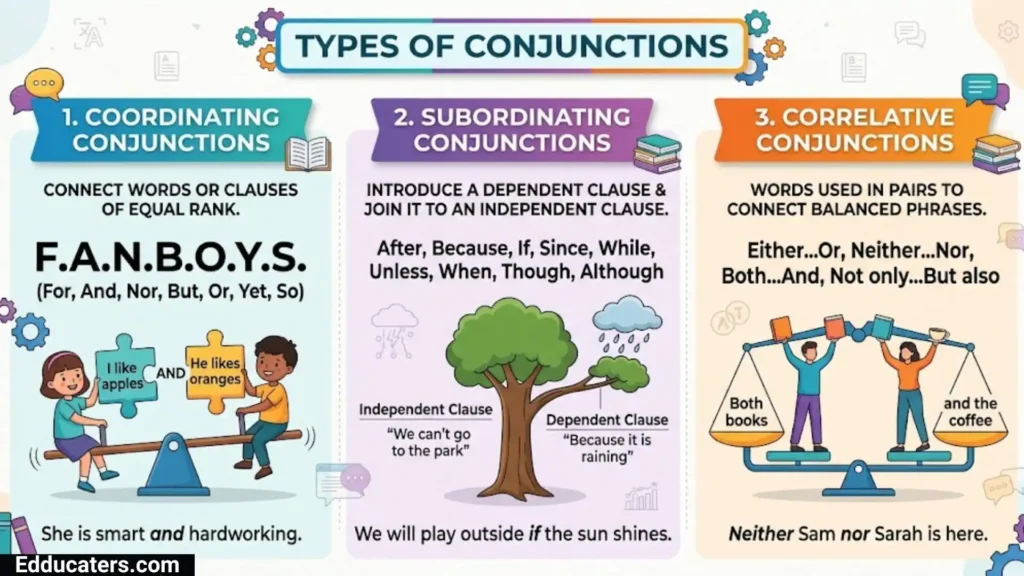
Coordinating Conjunctions: Connect words, phrases, or independent clauses of equal grammatical importance.
The seven common coordinating conjunctions are for, and, nor, but, or, yet, so. They are often remembered using the acronym FANBOYS.
Examples:
- I bought apples and oranges.
- She was tired, but she finished her homework.
- You can walk, or you can take the bus.
When a coordinating conjunction connects two independent clauses, a comma is generally placed before it.
Subordinating Conjunctions: Connect a dependent clause to a main clause. They often express time, reason, contrast, condition, or purpose.
Examples: because, although, if, when, while, since, unless
Sentences:
- I stayed home because I was sick.
- Although it was cold, we went outside.
- Call me when you arrive.
Correlative Conjunctions: Work in pairs to connect balanced grammatical elements.
Examples: either…or, neither…nor, both…and, not only…but also
Sentences:
- You can choose either tea or coffee.
- Both my brother and my sister enjoy reading.
- She is not only talented but also hardworking.
Conjunctions make writing more connected and help readers understand how ideas relate to one another.
8. Interjection
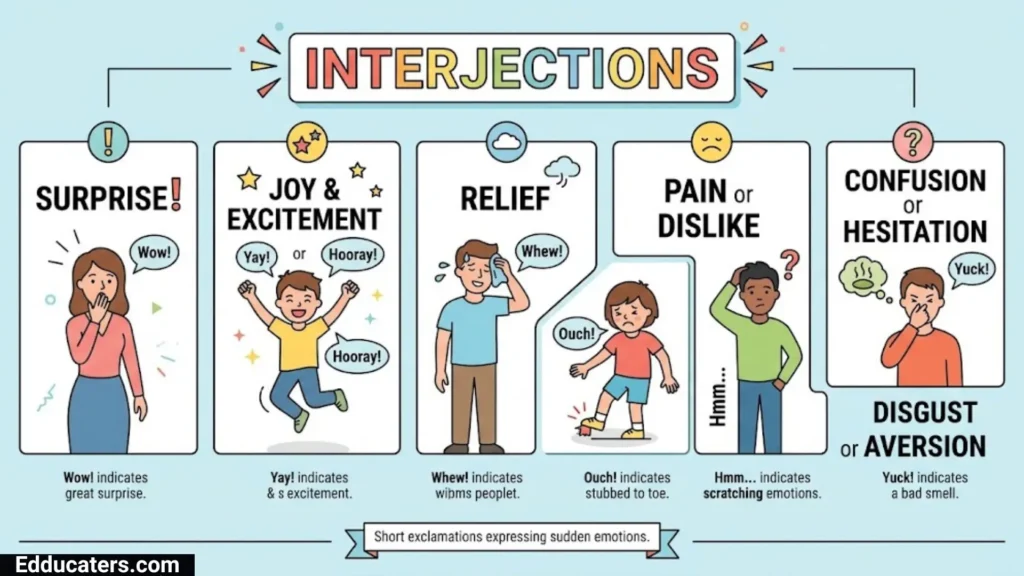
An interjection is a word or short expression that communicates a sudden feeling, reaction, or emotion. Interjections often appear outside the main grammatical structure of a sentence.
Examples of interjections:
Wow!, Oh!, Ouch!, Hurray!, Alas!, Hey!
Examples in sentences:
- Wow! That painting is beautiful.
- Ouch! I hurt my finger.
- Hurray! We won the competition.
- Oh! I forgot my notebook.
- Hey! Wait for me.
Common Types of Interjections
Interjections of Happiness: Express joy or excitement.
Examples: Hurray!, Yay!
Sentence: Yay! We are going on vacation.
Interjections of Surprise: Express astonishment or sudden realization.
Examples: Wow!, Oh!, What!
Sentence: Wow! You finished the project already.
Interjections of Pain: Express physical discomfort.
Examples: Ouch!, Ow!
Sentence: Ouch! That really hurt.
Interjections of Sadness or Regret: Express sorrow or disappointment.
Examples: Alas!, Oh no!
Sentence: Oh no! I missed the bus.
Interjections for Attention: Call someone’s attention.
Examples: Hey!, Look!
Sentence: Hey! You left your bag behind.
Interjections are common in conversations, informal writing, dialogue, and expressive storytelling. In formal writing, use them selectively.
9. Articles
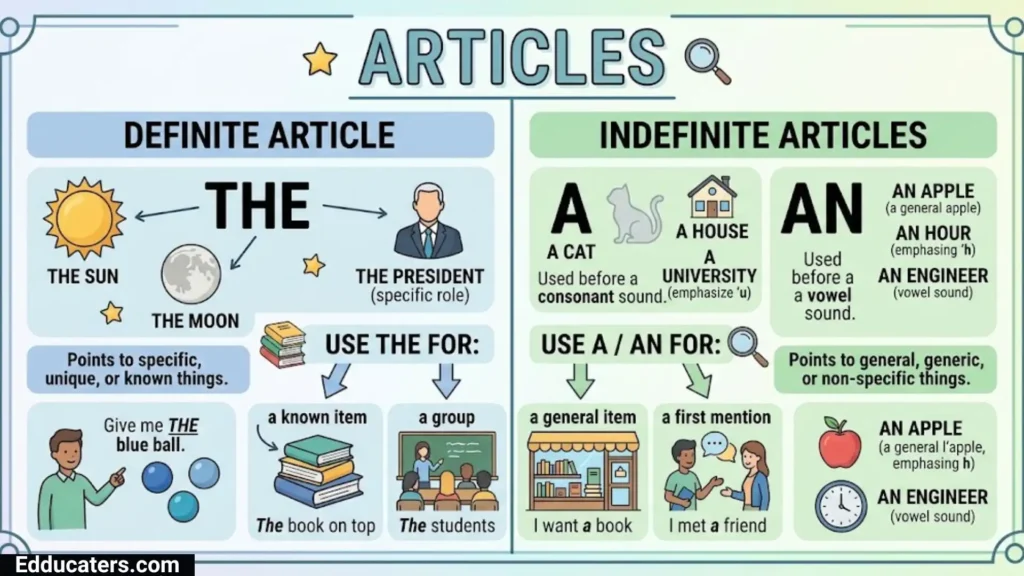
Articles are words used before nouns to indicate whether a noun refers to something specific or nonspecific. English has three articles: a, an, and the.
Many traditional English-learning resources present articles as a ninth part of speech. In modern grammatical analysis, articles are generally classified as determiners, a category that helps specify nouns.
Types of Articles
Indefinite Articles: A and An
Use a or an with a singular countable noun when referring to something nonspecific or mentioning it for the first time.
Use a before a consonant sound.
Examples:
- a book
- a university
- a car
Use an before a vowel sound.
Examples:
- an apple
- an umbrella
- an hour
The choice depends on pronunciation rather than spelling. For example, university begins with a consonant sound, while the h in hour is silent.
Sentences:
- I saw a bird in the garden.
- She ate an orange.
Definite Article: The
Use the when the reader or listener can identify the particular person or thing being discussed.
Examples:
- the sun
- the door
- the book on my desk
Sentences:
- Please close the window.
- I returned the book you lent me.
The first sentence refers to a particular window. The second refers to a specific book already known to both people.
When to Use No Article
English sometimes uses no article before plural or uncountable nouns when speaking generally.
Examples:
- Books can help us learn.
- Water is essential for life.
- Children need enough sleep.
Article use can be challenging because it depends on whether a noun is countable, whether it is singular or plural, and whether the reference is general or specific.
How Parts of Speech Work Together in a Sentence
Parts of speech do not work independently. They combine to create meaningful sentences. Each word’s function helps establish the sentence’s grammatical structure.
Consider this example:
The young girl quickly opened the door because she heard a noise.
| Word or Phrase | Part of Speech | Function |
| The | Article/determiner | Introduces a specific noun |
| young | Adjective | Describes the girl |
| girl | Noun | Names the person |
| quickly | Adverb | Explains how she opened the door |
| opened | Verb | Expresses the action |
| the | Article/determiner | Introduces a specific noun |
| door | Noun | Names the object |
| because | Conjunction | Introduces the reason |
| she | Pronoun | Refers to the girl |
| heard | Verb | Expresses an action |
| a | Article/determiner | Introduces a nonspecific noun |
| noise | Noun | Names what she heard |
This example shows how word classes, sentence structure, and grammatical relationships work together. Nouns identify people and things, verbs express actions, and modifiers add detail. Conjunctions connect clauses to explain the relationship between ideas.
Can One Word Belong to More Than One Part of Speech?
Yes. A word’s part of speech often depends on how it is used in a sentence. You should examine the word’s function rather than classify it based on spelling alone.
Consider the word light:
- The light is bright. — Noun
- This is a light bag. — Adjective
- Please light the candle. — Verb
Now consider fast:
- He drives a fast car. — Adjective
- He drives fast. — Adverb
The word book can also be a noun or a verb:
- I read a book. — Noun
- Please book a table. — Verb
These examples demonstrate why context matters in English grammar. A word’s position and function help determine its grammatical category.
Content Words and Function Words
English words can also be grouped according to their role in conveying meaning.
Content words carry much of a sentence’s main meaning. They include nouns, main verbs, adjectives, and many adverbs.
Examples: teacher, explain, beautiful, carefully
Function words help organize grammatical relationships. They include many pronouns, prepositions, conjunctions, articles, and auxiliary verbs.
Examples: she, in, because, the, have
Consider this sentence:
The teacher explained the lesson clearly.
The words teacher, explained, and lesson carry much of the main meaning. Words such as the help establish grammatical relationships, while clearly explains how the teacher explained the lesson.
Both groups are essential. Content words communicate key information, while function words help that information fit together correctly.
How to Identify Parts of Speech
If you are unsure which part of speech a word belongs to, follow these steps.
- Read the complete sentence. Context helps you understand how the word is being used.
- Ask what the word does. Does it name something, express an action, describe something, or connect ideas?
- Check the words around it. A word before a noun may be an article or determiner. A word modifying a verb may be an adverb.
- Look at the sentence structure. Identify the subject, verb, object, and phrases where possible.
- Consider more than one possibility. Some words can function as different parts of speech in different contexts.
- Use a reliable dictionary. A dictionary can show the possible grammatical categories and example sentences for a word.
For example, in She sings beautifully, the word beautifully modifies the verb sings, so it functions as an adverb. In She has a beautiful voice, the word beautiful describes the noun voice, so it functions as an adjective.
Common Mistakes in Parts of Speech
Learning the parts of speech becomes easier when you recognize frequent mistakes.
1. Confusing Adjectives With Adverbs
Incorrect: She sings beautiful.
Correct: She sings beautifully.
Beautiful describes a noun, while beautifully describes how she sings.
2. Confusing Nouns With Verbs
Incorrect: I need to decision now.
Correct: I need to decide now.
Decision is a noun, while decide is a verb.
3. Using Pronouns Without Clear Antecedents
Unclear: When Sara spoke to Maria, she was upset.
It is unclear whether she refers to Sara or Maria. Rewriting the sentence can make the meaning clearer.
4. Using Articles Incorrectly
Incorrect: He is an university student.
Correct: He is a university student.
The word university begins with a consonant sound, so a is correct.
5. Confusing Prepositions
Incorrect: She is good in mathematics.
More standard: She is good at mathematics.
Some prepositions are determined by conventional word combinations, so learning them in context can help.
6. Misidentifying a Word Without Considering Context
The word fast is an adjective in a fast train and an adverb in the train moves fast. Its role changes with its use.
Parts of Speech Practice Exercises
Test your understanding by identifying the part of speech of each bold word.
- The cat is sleeping.
- They went to the market.
- She writes every day.
- It is a beautiful morning.
- He answered the question correctly.
- The shoes are under the bed.
- I wanted to go, but it was raining.
- Wow! That is amazing.
- She bought an umbrella.
- We stayed home because we were tired.
Answers
- Cat — Noun
- They — Pronoun
- Writes — Verb
- Beautiful — Adjective
- Correctly — Adverb
- Under — Preposition
- But — Conjunction
- Wow — Interjection
- An — Article/determiner
- Because — Subordinating conjunction
Practicing with complete sentences is more useful than memorizing word lists alone. It teaches you to recognize grammatical functions in real contexts.
Frequently Asked Questions
What Are the Parts of Speech in English?
The traditional eight parts of speech are nouns, pronouns, verbs, adjectives, adverbs, prepositions, conjunctions, and interjections. Some learning resources list articles as a ninth category.
Why Are Parts of Speech Important?
Parts of speech help you understand sentence structure, choose the correct words, use grammar accurately, and express ideas clearly in speaking and writing.
What Is the Difference Between a Noun and a Pronoun?
A noun names a person, place, thing, or idea. A pronoun replaces a noun or noun phrase to avoid repetition. For example, Sara is here uses a noun, while She is here uses a pronoun.
What Is the Difference Between an Adjective and an Adverb?
An adjective describes a noun or pronoun, while an adverb often modifies a verb, adjective, or another adverb. For example, a careful driver uses an adjective, while drives carefully uses an adverb.
Is an Article a Part of Speech?
Articles are often taught as a separate category in beginner grammar. In modern grammar, a, an, and the are generally classified as determiners.
Can a Word Have Two Parts of Speech?
Yes. A word can belong to different grammatical categories depending on its use. For example, light is a noun in turn on the light, an adjective in a light bag, and a verb in light a candle.
How Can I Learn Parts of Speech Easily?
Start with the quick-reference table, learn one category at a time, and practice identifying words in complete sentences. Writing your own examples can help you remember each category and its function.
Conclusion
The parts of speech in English explain how words function in sentences. Nouns name people and things, pronouns replace nouns, verbs express actions or states, and adjectives and adverbs add information. Prepositions show relationships, conjunctions connect ideas, interjections express reactions, and articles help specify nouns.
Learning these categories gives you a stronger foundation in English grammar. Instead of memorizing definitions alone, focus on how each word works in a sentence. With regular reading and practice, you’ll find it easier to identify word classes, avoid common mistakes, and write clearer English.

Hello, I’m Claire Holloway. I have always been passionate about the English language and enjoy turning complex grammar rules into simple, easy-to-follow lessons. I believe that every learner can become a confident English writer with the right guidance.
I create educational content focused on grammar, vocabulary, sentence structure, and writing improvement. Every article I publish is designed to help readers learn with confidence and accuracy.
Books
Grammar Without Confusion
Modern English Usage Guide
 Nathan Whitmore
 Julian Mercer