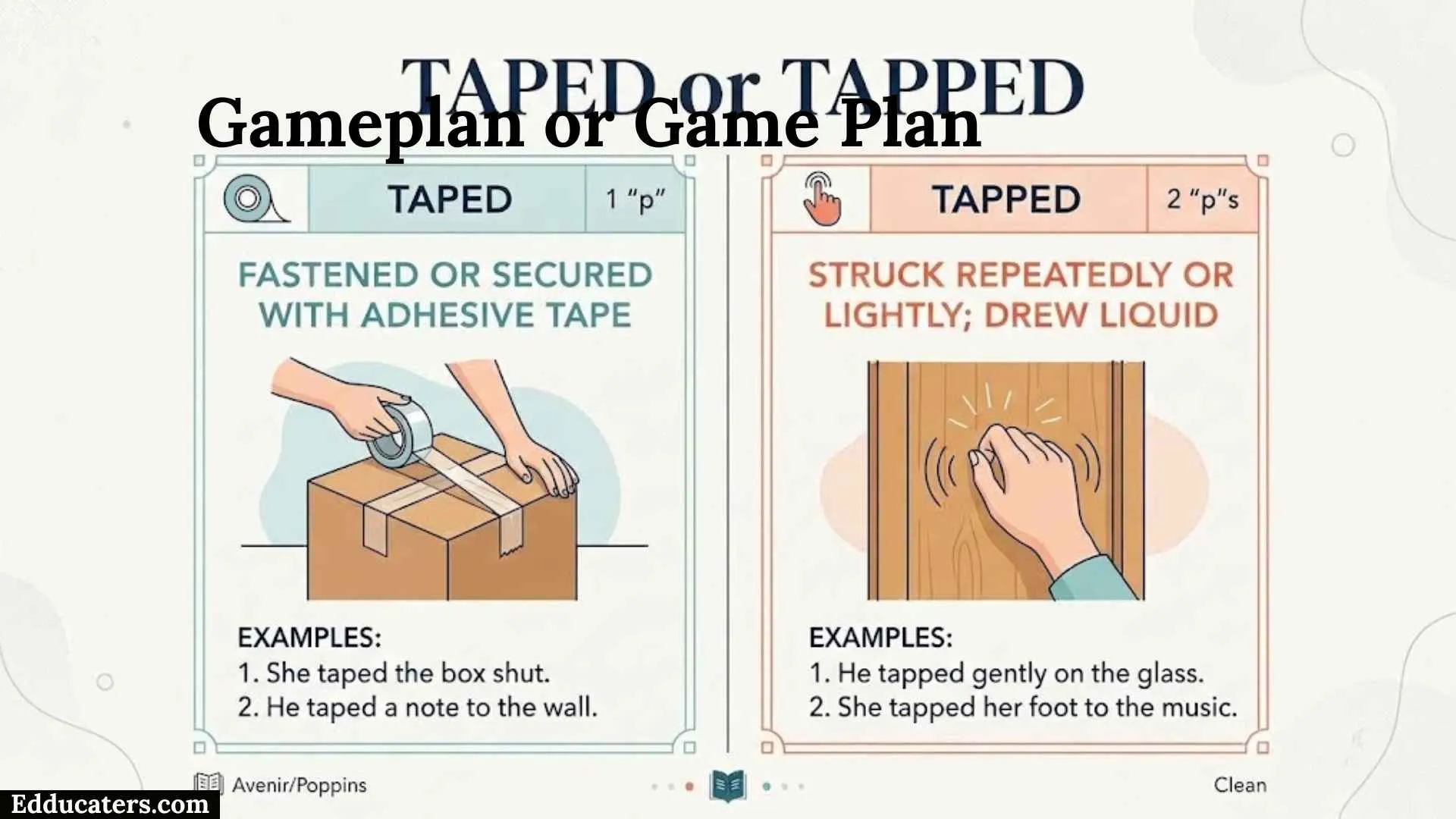
Taped or tapped are both correct English words, but they come from different verbs and have different meanings. If you are unsure which one belongs in a sentence, the key is to identify the action you are describing.
Taped is the past tense and past participle of tape. It can mean that something was attached, fixed, or fastened with tape, or that something was recorded.
Tapped is the past tense and past participle of tap. It can mean that someone or something was touched or hit lightly, that a touchscreen or button was touched, or that a resource was accessed or used.
Compare these sentences:
She taped the note to the door.
He tapped me on the shoulder.
The first sentence involves tape. The second involves a tap, meaning a light touch or strike.
This small spelling difference creates a major difference in meaning. Understanding the verbs tape or tap makes it much easier to choose between taped or tapped.
Quick Answer: Taped or Tapped?
| Word | Base verb | Main meaning | Example |
| taped | tape | Attached with tape or recorded | She taped the box shut. |
| tapped | tap | Touched or hit lightly; accessed something | He tapped the screen. |
The simple rule
Use taped when the action comes from tape:
tape → taped
Use tapped when the action comes from tap:
tap → tapped
So:
- taped the package = used tape on the package
- tapped the package = touched or struck it lightly
- taped the interview = recorded the interview
- tapped the screen = touched the screen
- tapped me on the shoulder = touched my shoulder lightly
- tapped into a resource = accessed or made use of a resource
Both spellings are correct. The correct choice depends on meaning.
What Does Taped Mean?
Taped is the past tense and past participle of the verb tape.
The verb tape has two especially useful meanings in modern English: using tape to attach or secure something, and recording something.
Taped Meaning “Attached With Tape”
When you tape something, you use adhesive or another type of tape to attach, join, cover, or fasten it.
The past form is taped.
For example:
She taped the photograph to the wall.
He taped the package before sending it.
We taped the pages back together.
They taped a notice to the door.
In each sentence, the person uses tape as part of the action.
This meaning is especially common with objects such as:
- boxes
- packages
- posters
- photographs
- papers
- cables
- wires
- signs
- doors
- containers
A useful test is to ask:
Did the person use tape?
If the answer is yes, taped is probably the word you need.
Taped Meaning “Recorded”
Taped can also mean recorded, especially when talking about audio, video, television programs, interviews, or other recordings.
For example:
The interview was taped yesterday.
They taped the television program in front of a live audience.
The performance was taped for later broadcast.
This meaning comes from the historical use of magnetic tape for recording sound and images. Even though many recordings are now digital, taped can still be used to mean recorded.
For example:
I taped the interview.
may simply mean:
I recorded the interview.
The word does not necessarily mean that the recording was made on physical tape.
What Does Tapped Mean?
Tapped is the past tense and past participle of tap.
The verb tap has several meanings. The most familiar involves a light touch or strike, but English also uses tap for touching screens, entering information, accessing resources, and drawing liquid from trees or other sources.
Tapped Meaning “Touched or Hit Lightly”
The most common meaning is to touch or hit something gently, often more than once.
For example:
He tapped me on the shoulder.
She tapped the glass with her finger.
The child tapped on the window.
He tapped his fingers on the desk.
In these examples, the action is light rather than forceful.
If someone gives you a gentle touch on the shoulder to get your attention, they tap you.
That is why the standard expression is:
She tapped me on the shoulder.
Not:
She taped me on the shoulder.
Tapped Meaning “Touched a Screen”
Modern technology has made another meaning of tap extremely common.
To tap a phone, tablet, touchscreen, or button means to touch it briefly to make something happen.
For example:
She tapped the icon on her phone.
I tapped the screen to open the app.
He tapped the button twice.
She tapped her card on the payment reader.
In this context, tapped is the past form of tap.
If you mean that someone touched a screen, button, icon, or payment reader, use tapped, not taped.
Tapped Meaning “Used or Accessed a Resource”
Tap can also mean to obtain, access, or make use of something that is available.
For example:
The company tapped into a new market.
The researchers tapped local knowledge.
The organization tapped its existing resources.
The phrase tap into is particularly useful. It means to access or make use of a source of information, skills, money, energy, talent, or another resource.
So:
The business tapped into a growing market.
means that the business made use of or gained access to that market.
This is completely different from taped.
Why Does Tapped Have Two Ps?
The spelling tapped can look confusing because the final consonant of tap is doubled before -ed.
The basic transformation is:
tap → tapped
This doubling is part of a common English spelling pattern found in certain short verbs.
Other examples include:
- stop → stopped
- plan → planned
- drop → dropped
- clap → clapped
- rub → rubbed
- slip → slipped
The important point is that the base verb is tap, not tape.
By contrast:
tape → taped
The final e remains as part of the spelling of the base word, while the added -d produces taped.
Compare the two forms carefully:
tap → tapped
tape → taped
The extra p is not optional. It helps distinguish the past form of tap from the past form of tape.
Taped or Tapped Pronunciation
The two words are also pronounced differently.
How to Pronounce Taped
Taped is pronounced /teɪpt/.
It has the long a sound found in words such as:
- tape
- late
- name
- game
You can think of the pronunciation as approximately:
taypt
The final e in tape is silent.
How to Pronounce Tapped
Tapped is pronounced /tæpt/.
It has the short a sound found in words such as:
- tap
- cat
- map
- hat
You can think of it as approximately:
tapt
The difference is therefore not only in spelling. The vowel sound changes too:
taped → /teɪpt/
tapped → /tæpt/
This distinction can be helpful when you hear the words in conversation.
Taped or Tapped on the Shoulder?
The correct phrase is:
tapped on the shoulder
For example:
Someone tapped me on the shoulder.
This means someone touched or struck your shoulder lightly.
Use taped only if actual tape is involved.
For example:
She taped a note to my shoulder.
That sentence has a completely different meaning because tape is being used to attach the note.
The easiest way to remember it
If someone touches you lightly:
tapped
If someone attaches something using tape:
taped
This distinction is useful in everyday conversation, storytelling, emails, and professional writing.
Taped or Tapped on the Screen?
If you mean touching a phone, tablet, or computer screen, use tapped.
Correct:
I tapped the screen.
She tapped the notification.
He tapped the icon.
I tapped the button to continue.
Using taped would suggest that someone physically put tape on the screen.
For example:
He taped the screen.
This could mean that he covered or attached something to the screen with tape.
The two sentences therefore describe completely different actions.
Taped or Tapped Into?
The correct expression is:
tapped into
For example:
The company tapped into a new customer base.
The project tapped into local expertise.
The researchers tapped into a valuable source of information.
Here, tap into means to access or make use of something.
Taped into is not the normal spelling when you mean access or use.
This is an especially useful distinction because taped or tapped can look similar when typed quickly.
Taped or Tapped the Glass?
Both forms can be grammatically possible, but they communicate different actions.
Tapped the glass
She tapped the glass with her finger.
This means she touched or struck the glass lightly.
Taped the glass
She taped the glass.
This means she put tape on the glass or used tape as part of the action.
If you mean a light knock, use tapped.
If you mean applying tape, use taped.
The surrounding words usually make the intended meaning clear.
Taped or Tapped a Button?
If someone touches a button on a phone, computer, machine, or other device, use tapped.
She tapped the button.
He tapped the save button.
I tapped the menu button.
If someone physically attaches something to a button with tape, then taped could be appropriate, but that is a much different situation.
This is why the sentence should be interpreted by meaning rather than by sound alone.
Taped or Tapped the Record Button?
This is another useful example because both words can occur naturally in the same situation.
If someone touches the button:
She tapped the record button.
If someone recorded the event:
She taped the interview.
The two verbs describe different actions:
tapped = touched the button
taped = recorded the material
You could even use both in one sentence:
She tapped the record button and taped the interview.
This sentence shows the distinction particularly clearly.
Taped or Tapped in Different Real-World Situations
The correct word becomes easier to identify when you connect it with the situation.
Mailing a Package
He taped the box shut.
Tape is being used to seal the package.
Getting Someone’s Attention
She tapped him on the shoulder.
The person is touching him lightly.
Using a Smartphone
I tapped the screen.
The person touched the touchscreen.
Recording an Interview
The journalist taped the interview.
The interview was recorded.
Using Business Resources
The company tapped into its existing customer base.
The company made use of an available resource.
Collecting Maple Sap
The workers tapped the maple trees.
Here, tap has a specialized meaning involving obtaining sap from a tree.
These examples show why the spelling cannot be chosen simply by looking at the letters. The intended meaning determines the verb.
Taped or Tapped: A Simple Decision Guide
When you are unsure, follow these questions:
Are you using adhesive tape to attach, secure, cover, or join something?
→ Use taped.
Are you talking about recording audio or video?
→ Use taped.
Are you touching or hitting something lightly?
→ Use tapped.
Are you touching a phone or touchscreen?
→ Use tapped.
Are you pressing or entering something on a device?
→ Use tapped.
Are you accessing or making use of a resource?
→ Use tapped.
Are you drawing liquid from a tree or another source?
→ Use tapped.
This decision guide works because it starts with meaning rather than spelling.
Common Mistakes With Taped or Tapped
Mistake 1: Taped Me on the Shoulder
Incorrect when you mean a light touch:
He taped me on the shoulder.
Correct:
He tapped me on the shoulder.
The verb tap is used for a light touch or strike.
Mistake 2: Tapped the Package Shut
If you mean that tape was used to close the package, the correct form is:
She taped the package shut.
Not:
She tapped the package shut.
Mistake 3: Taped the Screen
If you mean that someone touched the screen:
She tapped the screen.
If someone actually put tape on the screen, then:
She taped the screen.
Both are possible in English, but the meanings are different.
Mistake 4: Taped Into a Market
When you mean accessed or made use of a market, use:
tapped into a market
For example:
The company tapped into a growing market.
Mistake 5: Assuming the Words Are Different Spellings of the Same Verb
They are not.
Taped comes from tape.
Tapped comes from tap.
That is the most important fact to remember.
Taped or Tapped in Formal and Informal Writing
Both words are standard English and can appear in formal and informal contexts.
The difference is not about formality. It is about meaning.
You can use taped in professional writing:
The interview was taped with the participant’s permission.
You can also use tapped in professional writing:
The company tapped into new sources of funding.
Likewise, both words are natural in casual conversation:
I taped the box.
He tapped me on the shoulder.
The important consideration is choosing the verb that accurately describes the action.
Related Forms You Should Know
Understanding related forms can prevent additional spelling mistakes.
Forms of Tape
The verb tape produces forms such as:
- tape
- tapes
- taped
- taping
For example:
I tape the package.
She tapes the package.
He taped the package.
They are taping the package.
Notice that taping has only one p.
Forms of Tap
The verb tap produces:
- tap
- taps
- tapped
- tapping
For example:
I tap the screen.
She taps the screen.
He tapped the screen.
They are tapping the screen.
Here, tapped or tapping both show the doubled p.
Knowing the whole word family makes the spelling pattern easier to remember.
Why Taped or Tapped Are Easy to Confuse
These words are easy to mix up for several reasons.
First, they begin with the same three letters:
tap-
Second, they have similar sounds in some forms.
Third, both can describe physical actions.
Fourth, the difference between one p and two p’s is visually small.
But their base verbs are different:
tape = use tape or record
tap = touch or hit lightly, or access something
Once you identify the base verb, the spelling usually becomes obvious.
Frequently Asked Questions About Taped or Tapped
Is it taped or tapped on the shoulder?
It is tapped on the shoulder when you mean a light touch.
She tapped me on the shoulder.
Is it taped or tapped on the screen?
Use tapped when you mean touching a touchscreen.
He tapped the screen.
Use taped only when tape is actually involved.
Is it taped or tapped into?
Use tapped into when you mean accessed or made use of something.
The company tapped into a new market.
Is taped a correct word?
Yes. Taped is the past tense and past participle of tape.
It can describe using tape to attach something or recording something.
Is tapped a correct word?
Yes. Tapped is the past tense and past participle of tap.
It can describe a light touch, a light strike, touching a screen, accessing a resource, and other meanings of tap.
Why does tap become tapped?
The spelling changes from tap to tapped because the final consonant is doubled before the -ed ending in this verb.
tap → tapped
The same pattern occurs in words such as stop → stopped and plan → planned.
Why does tape become taped instead?
The base verb is tape, so its past form is:
tape → taped
The spelling retains the final e and adds d.
Does taped mean recorded?
Yes. Taped can mean recorded, particularly in contexts involving audio or video.
The interview was taped yesterday.
Does tapped mean touched?
Yes. One common meaning of tapped is touched or hit lightly.
He tapped her on the shoulder.
Can taped or tapped be used in the same sentence?
Yes, when the sentence describes two different actions.
She tapped the record button and taped the interview.
Here, tapped describes touching the button, while taped describes recording the interview.
Is “taped into” correct?
Usually not when you mean “accessed” or “made use of.” The normal expression is tapped into.
The business tapped into a new source of customers.
Is “tapped the package” correct?
It can be correct if you mean that someone touched or struck the package lightly.
If you mean that someone used tape to close it, use:
taped the package
What is the difference between taped or tapped?
Taped comes from tape and usually means attached with tape or recorded.
Tapped comes from tap and usually means touched or hit lightly, touched a screen, or accessed something.
Final Takeaway
Taped or tapped are both correct words, but they are not interchangeable.
Use taped when the verb is tape:
She taped the box shut.
They taped the interview.
Use tapped when the verb is tap:
He tapped me on the shoulder.
She tapped the screen.
The company tapped into new resources.
The fastest way to choose correctly is to ask what action you mean.
Tape → taped
Tap → tapped
If something was attached with tape or recorded, choose taped. If something was touched or struck lightly, entered on a device, or accessed as a resource, choose tapped.
References
- Cambridge Dictionary — taped
- Cambridge Dictionary — tape
- Cambridge Dictionary — tapped
- Cambridge Dictionary — tap
- Cambridge Dictionary — tap in and related phrasal-verb usage

Hi, I’m Nathan Whitmore, and I enjoy making English grammar easy for learners of all ages. I believe grammar should be practical, not confusing. I write simple, well-researched guides that help readers improve their writing, speaking, and overall communication skills.
I spend a lot of time studying grammar patterns, sentence construction, punctuation, and modern English usage. My goal is to create lessons that anyone can understand, whether they are students, teachers, or professionals.
Books
Clear English Grammar
The Smart Writer’s Grammar Handbook
 Claire Holloway
 Julian Mercer