
Grammar can feel like a labyrinth, especially when you encounter two words that sound identical but follow different spelling conventions. The confusion between “yours” and “your’s” is a classic example of this struggle. Because we frequently use these words in daily conversation, emails, and professional documents, even seasoned writers sometimes pause before typing them.
If you have ever stared at a sentence, wondering if an apostrophe belongs, you are not alone. This guide breaks down the distinction once and for all, ensuring you always choose the correct form with absolute confidence.
Featured Snippet: The Quick Answer
“Yours” is the correct form; it is a possessive pronoun that never requires an apostrophe. “Your’s” is grammatically incorrect and does not exist in the English language. Use “yours” to indicate ownership when the noun is omitted, such as in “That book is yours.” Apostrophes are for contractions, not possessive pronouns.
Comparison Table: At a Glance
| Feature | Yours | Your’s |
| Correct Word | Yes | No |
| Meaning | Belonging to you | N/A (Error) |
| Part of Speech | Possessive Pronoun | N/A |
| Grammar Rule | No apostrophe needed | N/A |
| Usage | Standard English | Incorrect |
| Memory Tip | It’s a pronoun like ‘mine’ | Never use with pronouns |
Understanding “Yours”
“Yours” is a possessive pronoun. Its primary purpose is to show ownership without needing to repeat the noun that was previously mentioned. Because it is already inherently possessive, it does not require any additional punctuation. Think of it as a finished package; it contains the meaning of possession within its own spelling.
Pronunciation: /jɔːrz/ (rhymes with “tours” or “doors”).
Examples:
- I finished my report; is the blue folder yours?
- These keys are yours to keep while I am away.
- The pleasure is all yours.
The Truth About “Your’s”
To put it simply: “Your’s” does not exist. In English, we use apostrophes for two specific reasons: to show possession with nouns (e.g., “John’s car”) or to create contractions (e.g., “it is” becomes “it’s”).
However, possessive pronouns—such as yours, mine, hers, his, its, and ours—are already possessive by definition. Adding an apostrophe to these words is a common error, much like writing “her’s” or “our’s.” If you find yourself wanting to add an apostrophe, pause and remind yourself that the word is already complete.
Key Differences and Usage
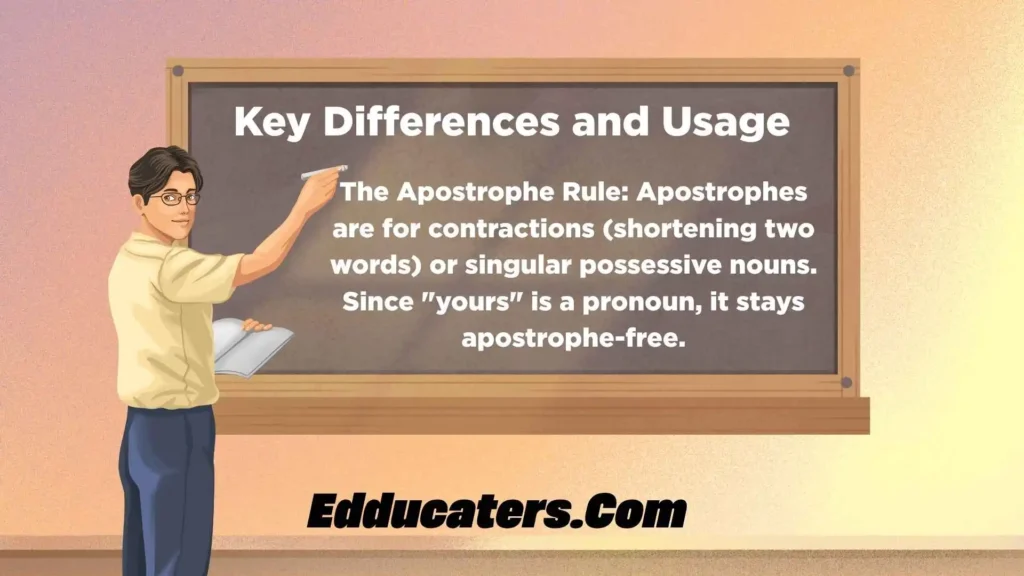
- The Apostrophe Rule: Apostrophes are for contractions (shortening two words) or singular possessive nouns. Since “yours” is a pronoun, it stays apostrophe-free.
- Contextual Flexibility: You use “yours” when the object of possession is understood from context, allowing you to avoid redundancy.
- Universal Application: Whether you are writing an informal text, a high-stakes business proposal, or a formal academic paper, “yours” is the only correct spelling.
Grammar Rules: Why No Apostrophe?
The English language follows a strict rule regarding personal pronouns: they do not take apostrophes to show possession. This group includes:
- Mine (not mine’s)
- Yours (not your’s)
- His (not hi’s)
- Hers (not her’s)
- Ours (not our’s)
- Theirs (not their’s)
- Its (not it’s—it’s is a contraction for “it is” or “it has”)
When you see a word ending in “s” that acts as a pronoun, treat it as a closed unit. The apostrophe has no place here.
When to Use “Yours”
Academic and Professional Writing
In formal reports, research papers, or legal documents, precision is vital. Using “yours” correctly demonstrates a high level of literacy.
Business Correspondence and Emails
You will frequently see this word in closing salutations.
- “Yours sincerely,”
- “Yours faithfully,”
- “Yours truly,”
These are standard professional sign-offs. Note that even in these formal constructions, “yours” never takes an apostrophe.
Daily Conversation
In casual speech, the distinction is auditory, but in writing, the error stands out. Using the correct spelling ensures your digital communication remains professional.
Common Mistakes
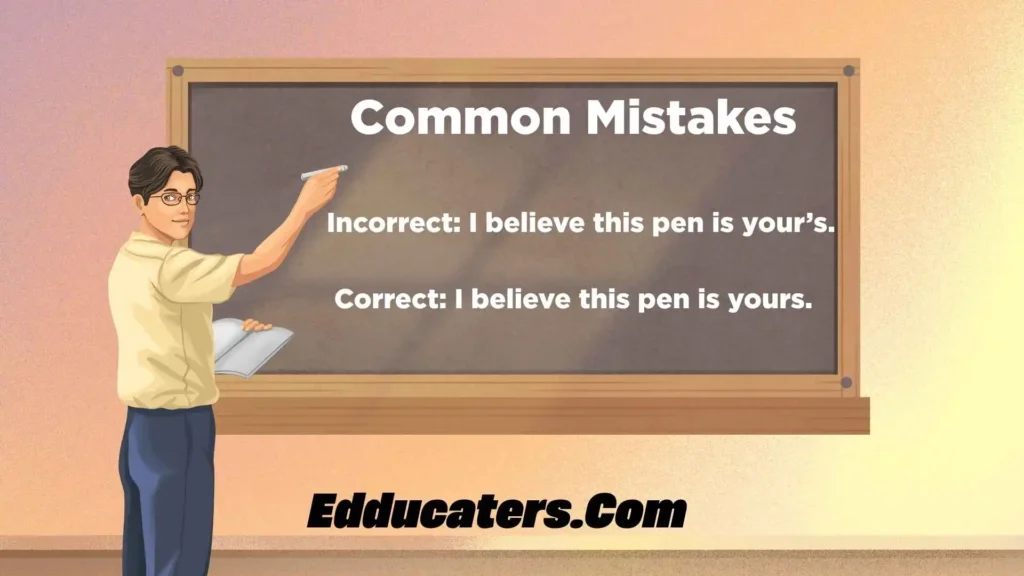
The most frequent mistake is the “Possessive Trap.” Because we are taught that apostrophes show possession for nouns (e.g., “The cat’s toy”), we naturally want to apply that rule to pronouns.
Incorrect: The choice is your’s to make. Correct: The choice is yours to make.
Incorrect: I believe this pen is your’s. Correct: I believe this pen is yours.
Tip to avoid the mistake: If you are unsure, try replacing “yours” with “mine.” You would never write “mine’s.” Since they follow the same grammatical category, if “mine” doesn’t have an apostrophe, “yours” shouldn’t either.
20 Original Examples for Every Situation
- School: If you forgot your notebook, you can borrow yours from the locker.
- School: The teacher said the final grade is yours to influence by studying.
- Workplace: Is the strategy document on the server yours or Sarah’s?
- Workplace: I have reviewed the budget, but the signature must be yours.
- Business: We have received your payment, and the confirmation email is yours.
- Business: Please ensure the feedback provided is truly yours.
- Conversation: I like your outfit; is that hat yours?
- Conversation: If you want to take the lead on this project, the opportunity is yours.
- Books: “The victory was yours from the start,” the captain whispered.
- Books: She looked at the old house and knew it was finally yours to renovate.
- News: The decision rests with the committee, but the ultimate responsibility is yours.
- News: Analysts claim the market share is yours if you launch by Friday.
- Social Media: Great photo! Is that camera yours?
- Social Media: The opinion expressed here is yours to share with your followers.
- Everyday: I found a jacket in the hall; is it yours?
- Everyday: My coffee is black, but I think the one with cream is yours.
- Formal: Yours sincerely, the board of directors.
- Formal: The future of the organization is yours to shape.
- Professional: Please review the contract and add any notes of yours.
- Professional: If you need help, the door is always yours to knock on.
The “Mine” Memory Trick
To remember this forever, simply pair “yours” with “mine.” Ask yourself: “Would I write mine?” You know the answer is no. Since “mine” is a pronoun and “yours” is a pronoun, they share the same rule: No apostrophes allowed.
Mini Quiz
- Which sentence is grammatically correct? A) The choice is your’s. B) The choice is yours. C) The choice is yours’. Answer: B
- Does “yours” ever take an apostrophe? A) Only in formal writing. B) Only in plural cases. C) Never. Answer: C
- What part of speech is “yours”? A) Possessive noun. B) Possessive pronoun. C) Contraction. Answer: B
- How should you sign off a formal email? A) Your’s sincerely, B) Yours sincerely, C) Your sincerely, Answer: B
- If you are unsure, what word can you use to test the grammar? A) Mine B) It’s C) Theirs Answer: A
Frequently Asked Questions (FAQs)
Is your’s a word in the dictionary?
No, “your’s” is not a word in any standard English dictionary. It is considered a common spelling error resulting from the confusion between possessive nouns and possessive pronouns. Always use “yours” instead.
Why do people keep using yours?
Many people mistakenly apply the apostrophe rule for nouns to pronouns. Because apostrophes are used to show possession in phrases like “the dog’s bone,” users incorrectly assume they must add one to “yours” to indicate that something belongs to the person.
Does the plural “yours” require an apostrophe?
No. The word “yours” does not change form for plurality. Whether you are speaking to one person or a group, the spelling remains “yours.” Adding an apostrophe to indicate plurality or possession is grammatically incorrect in all scenarios.
Is “yours” the same in British and American English?
Yes. Both American and British English strictly follow the rule that “yours” is a possessive pronoun that never uses an apostrophe. This is a universal standard across all English-speaking regions.
Can “yours” be a contraction?
No, “yours” cannot be a contraction. A contraction combines two words, such as “you are” (you’re). “Yours” is a single possessive pronoun and does not stand for “you is” or “you are.”
What is the difference between yours and you’re?
“Yours” is a possessive pronoun indicating ownership. “You’re” is a contraction of “you are.” They are often confused due to their similar sound, but they serve entirely different grammatical functions and are not interchangeable in any context.
Key Takeaways
- Yours is the only correct spelling.
- Your’s is always incorrect.
- “Yours” is a possessive pronoun, not a contraction.
- Apostrophes are never used with possessive pronouns.
- Use the “Mine” test: if you don’t use an apostrophe for “mine,” don’t use one for “yours.”
Conclusion
Mastering the distinction between “yours” and the non-existent “your’s” is a simple yet powerful step in refining your writing. By remembering that “yours” is an already complete possessive pronoun, you eliminate the temptation to add unnecessary punctuation. Whether you are crafting a formal business letter or a quick social media update, you can now move forward with the assurance that your grammar is spot-on. Remember, the choice is yours to write with precision.

Hi, I’m Nathan Whitmore, and I enjoy making English grammar easy for learners of all ages. I believe grammar should be practical, not confusing. I write simple, well-researched guides that help readers improve their writing, speaking, and overall communication skills.
I spend a lot of time studying grammar patterns, sentence construction, punctuation, and modern English usage. My goal is to create lessons that anyone can understand, whether they are students, teachers, or professionals.
Books
Clear English Grammar
The Smart Writer’s Grammar Handbook
 Claire Holloway
 Julian Mercer