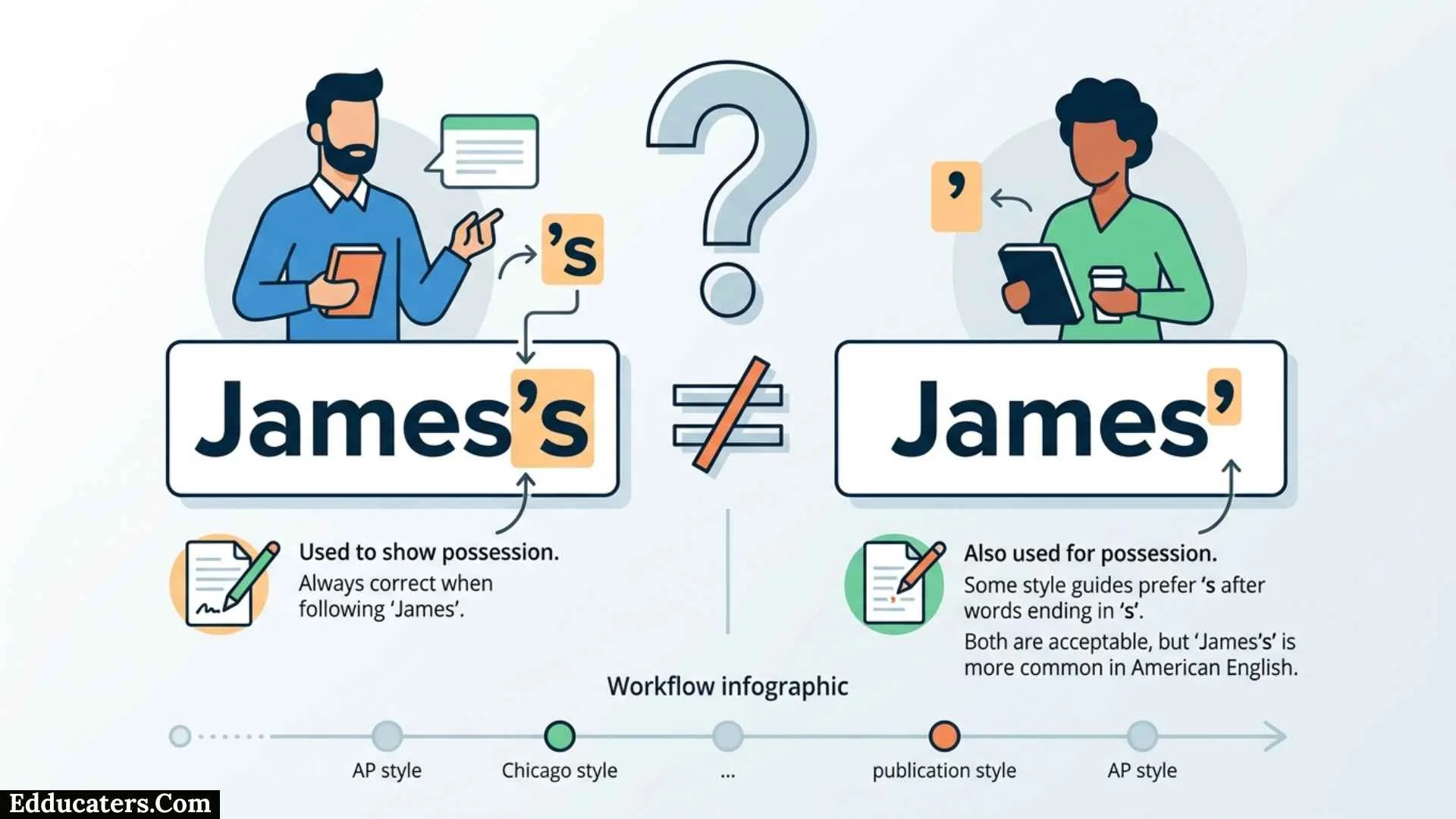
If you are wondering whether James’s or James’ is the correct way to show possession, the short answer is: both forms are used, but James’s is the preferred form in some major style guides, while James’ is also accepted in other English usage traditions.
For example, Chicago style recommends James’s, while Cambridge Grammar notes that when a first or second name ends in -s, writers can use either James’ or James’s. Oxford University also gives James’s teaching methods as an example of the possessive form.
That difference explains why you may see both forms in books, newspapers, academic writing, websites, and everyday communication.
The important thing is to understand what each form means, when to use it, how different style guides treat it, and how it differs from the plural form Jameses.
Quick Answer: James’s or James’?
When James refers to one person and you need to show possession or association, James’s is a strong choice for formal writing, especially when following Chicago or Oxford-style guidance.
Examples:
- James’s car is outside.
- I borrowed James’s book.
- James’s sister is a doctor.
- We visited James’s house.
- James’s opinion was different from mine.
However, James’ is also used:
- James’ car is outside.
- I borrowed James’ book.
- James’ sister is a doctor.
Cambridge Grammar specifically gives James’ car and James’s car as alternatives and notes that both are normally pronounced with the possessive ending.
The simplest rule
If no particular style guide has been given, James’s is a safe choice for formal writing.
If a publication, school, employer, or editor follows a style that prefers James’, use that form consistently.
The difference is primarily a matter of style convention, not a difference in the basic meaning.
What Does James’s Mean?
James’s is the possessive form of the singular name James.
A possessive construction shows ownership, association, relationship, or another close connection.
For example:
- James’s car means the car belonging to James.
- James’s office means the office associated with James.
- James’s mother means James’s mother.
- James’s idea means an idea expressed or proposed by James.
- James’s birthday refers to James’s birthday.
The apostrophe and s together create the possessive form.
This follows the general English pattern in which a singular noun takes ‘s to form a possessive. Cambridge Grammar describes possessive ‘s as a construction used to show that something belongs to someone or something.
Why Does James’s Have Two s Letters?
This is one of the main reasons people hesitate over the spelling.
The name already ends in s:
James
When the possessive ending ‘s is added, the result is:
James’s
The first s belongs to the name. The second s is part of the possessive ending.
The same pattern can appear with other singular names ending in s.
For example:
- Iris → Iris’s
- Charles → Charles’s
- Thomas → Thomas’s
Chicago specifically recommends adding an apostrophe and s to names such as James and Iris.
What Does James’ Mean?
James’ is another form used for the singular possessive of James.
For example:
James’ car is parked outside.
The intended meaning is normally the same as:
James’s car is parked outside.
The shorter form removes the additional s after the apostrophe.
Cambridge Grammar recognizes both forms for first and second names ending in -s, giving James’ car and James’s car as alternatives.
This means it is too simplistic to say that James’ is always wrong.
Instead, the correct choice depends on the style or convention being followed.
Does James’ Change the Meaning?
Usually, no.
Compare:
James’s laptop was stolen.
and:
James’ laptop was stolen.
Both normally mean that the laptop belonged to James.
The difference is mainly the possessive spelling convention being used.
This is an important distinction because writers sometimes assume that the two forms represent different meanings. They generally do not.
James’s vs. James’: A Clear Comparison
| Form | Meaning | Example |
| James | One person named James | James is at work. |
| James’s | Possessive form of one James | James’s car is outside. |
| James’ | Alternative possessive form of one James | James’ car is outside. |
| Jameses | More than one person named James | The Jameses arrived. |
| Jameses’ | Possessive form of multiple Jameses | The Jameses’ house is large. |
The most important distinction is between James’s/James’ and Jameses’.
The first two normally refer to possession by one James.
The last refers to possession by multiple people named James.
Why Do Some Style Guides Prefer James’s?
The traditional reason for using James’s is that a singular possessive normally takes ‘s.
Cambridge explains the general pattern as:
singular noun + ‘s
and:
plural noun ending in s + ‘
For example:
- the girl → the girl’s book
- the teacher → the teacher’s desk
- the students → the students’ classroom
For a singular name ending in s, however, style traditions differ.
Chicago applies the ‘s pattern to personal names ending in s and specifically recommends James’s.
Oxford likewise states that ‘s should be used after singular nouns and gives James’s teaching methods as an example.
Why Does James’ Still Appear?
The apostrophe-only form has a long history in English publishing.
Different style traditions have treated names ending in s differently. Chicago itself explains that its rules have changed over time. Earlier editions allowed apostrophe-only forms in certain circumstances, whereas modern Chicago uses ‘s for personal names much more consistently.
That historical variation helps explain why readers encounter both:
James’s
and:
James’
in published material.
The existence of two forms is therefore not simply the result of writers misunderstanding apostrophes.
What Do Chicago, Cambridge, and Oxford Say?
The safest way to understand the disagreement is to look at established style and grammar references.
Chicago Style: James’s
The Chicago Manual of Style explicitly answers the question of how to make James possessive:
James’s
It gives the same treatment to names such as Iris.
Chicago also explains that its modern rule applies to personal names ending in s, regardless of the number of syllables in the name.
So if you are following Chicago style, choose:
James’s
Cambridge Grammar: James’ or James’s
Cambridge takes a more flexible approach for first and second names ending in -s.
It gives both:
James’ car
and:
James’s car
as possible forms. It also notes that both are normally pronounced with the possessive ending.
This is useful because it shows that English usage is not completely uniform across style traditions.
Oxford Style: James’s
Oxford University’s style guidance uses James’s teaching methods as an example of its possessive rule. It says to use ‘s after singular nouns.
Oxford also points out that if adding ‘s to a name ending in s or z creates a difficult pronunciation, the sentence can be rearranged.
For example:
James’s teaching methods were popular with the students.
could be rewritten as:
The teaching methods of James were popular with the students.
The first version is perfectly usable; the alternative is simply a way to avoid an awkward construction when necessary.
When Should You Use James’s?
Use James’s when one person named James owns something or has a relationship with it.
Ownership
James’s car is parked outside.
James’s phone is on the table.
James’s laptop needs charging.
Family Relationships
James’s brother lives in Canada.
James’s daughter starts school next month.
James’s parents visited yesterday.
Work and Business
James’s office is on the second floor.
James’s manager approved the request.
James’s company opened a new branch.
Education
James’s teacher praised his essay.
James’s research was discussed during the meeting.
James’s university has a large library.
Events and Personal Information
We celebrated James’s birthday.
I forgot James’s appointment.
James’s wedding is next Saturday.
In each case, James’s identifies something connected to one specific person named James.
When Can You Use James’?
Use James’ when the writing follows a convention that uses the apostrophe-only form for singular names ending in s.
For example:
James’ car was parked outside.
James’ presentation was excellent.
James’ brother called earlier.
James’ office is upstairs.
The form is particularly worth recognizing because readers will encounter it in real-world English.
However, if you are following Chicago or Oxford guidance, James’s is the better choice.
Should You Switch Between James’s and James’?
Normally, no.
If you choose one convention for a document, keep it consistent.
For example, avoid:
James’s car was outside, but James’ brother was still at work.
If your chosen style uses James’s, write:
James’s car was outside, but James’s brother was still at work.
If your chosen style uses James’, use:
James’ car was outside, but James’ brother was still at work.
Consistency makes the writing easier to edit and gives the document a more controlled style.
James’s or James’: How Pronunciation Affects the Choice
Some writers avoid James’s because they think the ending sounds awkward.
The possessive ending can create an additional syllable or sound, depending on the name.
Cambridge gives the pronunciation of forms such as James’ and James’s as essentially the same possessive ending in normal speech.
This means the difference between the written forms is not necessarily a difference in spoken pronunciation.
Oxford does acknowledge that some names ending in s or z may become difficult to pronounce when ‘s is added. Its recommendation is to rearrange the sentence if the result sounds awkward.
For example:
James’s teaching style was effective.
could become:
James was an effective teacher.
The goal is not to avoid every possessive ending. It is simply to choose the clearest sentence.
James’s Can Also Mean “James Is” or “James Has”
There is another source of confusion: James’s does not always indicate possession.
The ending ‘s can also be a contraction of is or has.
For example:
James’s working late tonight.
Here, James’s means:
James is
The expanded sentence is:
James is working late tonight.
But:
James’s car is outside.
Here, James’s is possessive.
It means:
The car belongs to James.
Cambridge explains that ‘s can function as a contraction for is or has, as well as being used in possessive constructions.
How Can You Tell Which Meaning Is Intended?
Look at the word that follows James’s.
If it is a noun, the form may be possessive:
James’s car is new.
If it is followed by a present participle, ‘s may mean is:
James’s running late.
If it is followed by a past participle, ‘s may mean has:
James’s finished the report.
The surrounding sentence provides the context.
James vs. James’s vs. Jameses vs. Jameses’
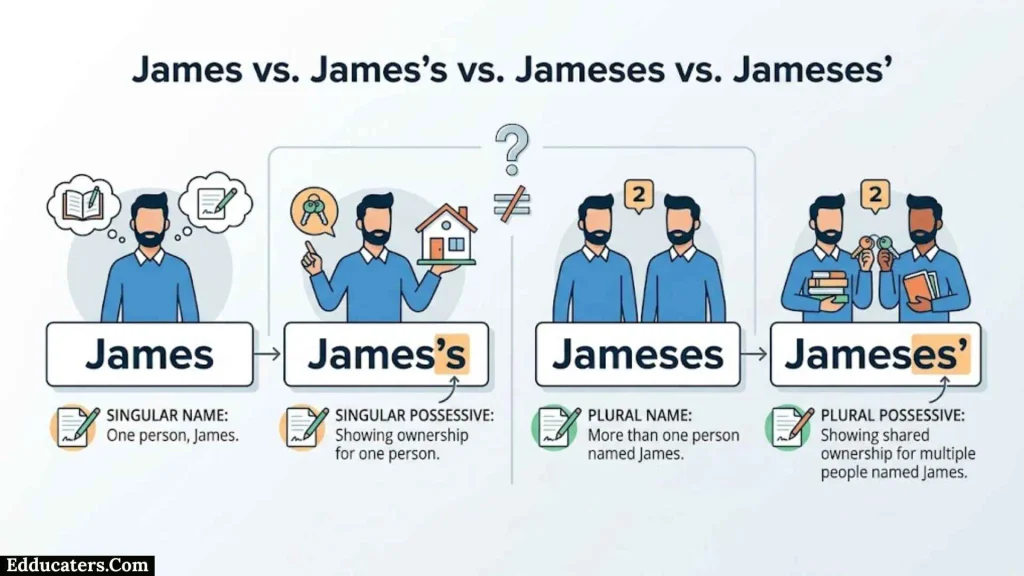
These four forms are easy to confuse, but they perform different jobs.
James
This is the singular name.
James is my neighbor.
Only one person is being identified.
James’s
This is the singular possessive form in styles that use ‘s.
James’s dog is friendly.
One James owns or is associated with the dog.
Jameses
This is the plural form when referring to multiple people named James.
Three Jameses work in our department.
Here, there is more than one person with the name James.
Jameses’
This is the plural possessive form.
The Jameses’ children attend the same school.
The possession or association belongs to multiple people named James.
The Key Difference
Compare:
James’s house
with:
The Jameses’ house
The first normally refers to the house of one James.
The second refers to a house associated with multiple Jameses.
Chicago similarly distinguishes a singular proper name from a plural family or group name when forming possessives.
Common Mistakes With James’s or James’
Understanding the rules becomes easier when you know the errors to avoid.
Mistake 1: Thinking James Is Plural
The final s in James does not make the name plural.
James is normally one person’s name.
If you are talking about several people named James, you need a plural form such as Jameses.
Mistake 2: Writing Jameses’ for One Person
This changes the meaning.
Incorrect when referring to one person:
Jameses’ car is outside.
Correct:
James’s car is outside.
or, under an apostrophe-only convention:
James’ car is outside.
Mistake 3: Treating James’ as the Only Correct Form
Some writers learn that names ending in s should take only an apostrophe.
That is not a universal rule.
Chicago recommends James’s, while Cambridge accepts both James’ and James’s for names such as James.
Mistake 4: Treating James’s as Automatically Wrong
The opposite mistake is just as common.
The extra s is not a grammatical error. It is explicitly recommended by Chicago and used in Oxford’s style guidance.
Mistake 5: Using an Apostrophe to Make James Plural
Do not write:
The James’s arrived.
if you simply mean several people named James.
The apostrophe does not normally make a noun plural.
Use:
The Jameses arrived.
If those Jameses possess something:
The Jameses’ house was sold.
Cambridge also warns against using apostrophes simply to create plurals.
Real-World Examples of the Correct Forms
The best way to understand the difference is to see the forms in different contexts.
Everyday Conversation
I left my keys at James’s house.
This refers to the house of one James.
Workplace Writing
James’s report is ready for review.
The report is associated with James.
Academic Writing
James’s research focuses on language development.
The research belongs to or was conducted by James.
Business Communication
James’s department will handle the request.
The department is associated with James.
Family Context
We are going to James’s parents’ house.
Here there are actually two possessive relationships:
- James’s = associated with James
- parents’ = belonging to James’s parents
Multiple People Named James
The three Jameses attended the meeting.
No possession is involved, so no apostrophe is needed.
Multiple Jameses With Possession
The Jameses’ office is on the third floor.
The office is associated with more than one James.
A Practical Decision Guide for Choosing the Form
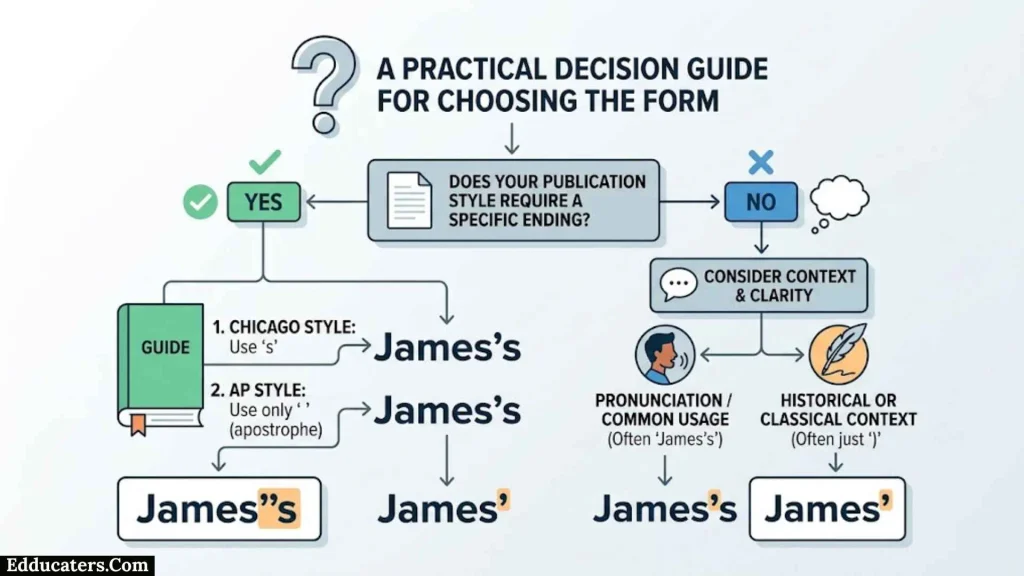
If you need to decide quickly, use this sequence.
Step 1: Is James a Person’s Name?
If yes, determine whether you mean one James or several.
One person:
James
Several people:
Jameses
Step 2: Are You Showing Possession or Association?
If no:
James is here.
If yes, continue.
Step 3: Is the Possessor One James?
If yes, the main choices are:
James’s
or:
James’
Step 4: Does Your Style Guide Give a Rule?
If it follows Chicago or Oxford-style guidance, use:
James’s
If it specifically permits or prefers the apostrophe-only form, use:
James’
Cambridge recognizes both forms for names ending in -s.
Step 5: Are Multiple Jameses Possessing Something?
Use:
Jameses’
For example:
The Jameses’ business has expanded.
Quick Decision Tree
Are you referring to one person named James?
→ Yes → Continue.
Are you showing possession or association?
→ No → Use James.
→ Yes → Continue.
Does your style guide prefer ‘s for singular names ending in s?
→ Yes → Use James’s.
Does your style guide use the apostrophe-only convention?
→ Yes → Use James’.
Are you referring to multiple people named James?
→ Use Jameses.
Do multiple Jameses possess something?
→ Use Jameses’.
For general formal writing without a specified house style, James’s is a sensible default because it is directly supported by Chicago and Oxford.
A Useful Checklist
Before using James’s or James’, check these five points:
- One James? Use a singular form.
- Possession by one James? Choose James’s or the style-approved James’.
- Several Jameses? Use Jameses.
- Possession by several Jameses? Use Jameses’.
- No special style requirement? James’s is a strong formal default.
Also check whether ‘s is actually a contraction.
Compare:
James’s car is outside.
with:
James’s already left.
The first is possessive. The second normally means James has already left.
Frequently Asked Questions
Is James’s or James’ correct?
Both forms are used, but style guides differ. Chicago recommends James’s, while Cambridge Grammar recognizes both James’ and James’s for first and second names ending in -s.
Which is better for formal writing, James’s or James’?
James’s is a strong choice for formal writing when no specific style guide says otherwise. It follows the convention used by Chicago and Oxford.
Is James’ grammatically wrong?
No. James’ is an established possessive form used by some style traditions. Cambridge explicitly recognizes it as an alternative to James’s.
Is James’s always possessive?
No. James’s can also be a contraction of James is or James has.
For example:
James’s car is red.
Here it is possessive.
James’s finished the project.
Here it can mean James has finished the project.
Is Jameses the plural of James?
Yes. When referring to multiple people named James, Jameses can be used.
For example:
Two Jameses joined the team.
What is the plural possessive of James?
The plural possessive is Jameses’.
For example:
The Jameses’ children attend the same school.
Should I write James’s name or James’ name?
If the phrase means the name belonging to one person named James, James’s name is the form preferred by Chicago and used in Oxford-style guidance.
For example:
James’s name appeared on the list.
Why does James’s have two s letters?
The first s is part of James, while the second s belongs to the possessive ending ‘s.
Thus:
James + ‘s = James’s
Do James’ and James’s sound different?
Usually, they are pronounced essentially the same in ordinary speech when used as possessives. Cambridge gives the two forms as alternatives and notes their possessive pronunciation.
Does the rule change for a family named James?
The context changes because a family or group may contain multiple people.
If the family name is James and you are referring to the family as a group, the exact pluralization can depend on the naming context and style. When referring to multiple individual people named James, Jameses is the straightforward plural form.
Can I use James’s in academic writing?
Yes. James’s is appropriate in academic writing when it matches the required style. Chicago explicitly recommends it for personal names ending in s.
What should I use if my editor says to use James’?
Follow the publication or editor’s established style consistently. The purpose of a style guide is to maintain a uniform system throughout a document or publication.
Conclusion
The choice between James’s or James’ can seem confusing because English uses more than one convention for possessive names ending in s.
For a single person named James, both forms may be encountered:
- James’s — preferred by Chicago and used in Oxford’s style guidance
- James’ — accepted in other usage traditions, including Cambridge’s description of alternatives
If you are writing without a specific style requirement, James’s is a strong formal choice.
The bigger distinction is between the singular and plural forms:
- James = one person
- James’s = possession by one James
- James’ = alternative possessive form for one James
- Jameses = multiple people named James
- Jameses’ = possession by multiple Jameses
Once you separate singular, singular possessive, plural, and plural possessive, the spelling becomes much easier to choose.

Hello, I’m Claire Holloway. I have always been passionate about the English language and enjoy turning complex grammar rules into simple, easy-to-follow lessons. I believe that every learner can become a confident English writer with the right guidance.
I create educational content focused on grammar, vocabulary, sentence structure, and writing improvement. Every article I publish is designed to help readers learn with confidence and accuracy.
Books
Grammar Without Confusion
Modern English Usage Guide
 Julian Mercer