
Have you ever wondered whether to write “you’re welcome or your welcome” after someone thanks you? You’re not alone. These two expressions sound alike, which makes them easy to confuse in texts, emails, and everyday conversations.
The correct phrase when responding to “thank you” is “you’re welcome.” The word you’re is a contraction of you are, so the expression means “you are welcome.” By contrast, your indicates possession or a connection to someone. That’s why “your welcome” doesn’t work as the standard response to thanks.
However, there’s an important exception. The words your welcome can be grammatically correct when welcome functions as a noun, as in “Your welcome was warm and sincere.”
Understanding this small difference can help you avoid a common spelling mistake and improve your everyday writing. Let’s explore the grammar, meanings, examples, and simple rules that make the distinction easy to remember.
You’re Welcome or Your Welcome: The Main Difference
The difference between you’re welcome or your welcome comes down to the meaning of you’re and your. Although these words have similar pronunciation, they serve different grammatical purposes.
- You’re welcome: The correct polite response when someone thanks you for something.
- Your welcome: A grammatically possible phrase when welcome acts as a noun, but incorrect as the usual reply to thank you.
Consider these examples:
- “Thank you for helping me with my homework.” “You’re welcome!”
- “Your welcome at the front desk made me feel comfortable.”
The first example uses a standard expression of politeness. The second uses welcome as a noun that describes someone’s greeting or reception.
Here’s a quick comparison to make the distinction clearer.
| Expression | Grammatical Role | Meaning | Correct Example |
| You’re | Contraction | You are | You’re very helpful. |
| Your | Possessive determiner | Belonging or relating to you | Your advice helped me. |
| You’re welcome | Polite expression | A response to gratitude | You’re welcome! |
| Your welcome | Possessive phrase | A welcome or reception associated with you | Your welcome was heartfelt. |
The key is to choose the word that matches your intended meaning. If someone thanks you, write “you’re welcome.” If you’re describing a welcome someone gave or received, your welcome may fit the sentence.
What Does You’re Welcome Mean?
“You’re welcome” is a standard expression people use to respond when someone expresses gratitude. It acknowledges the other person’s thanks and communicates that helping them was acceptable or appreciated.
For example, imagine that your coworker asks you to review an important presentation. You spend twenty minutes checking the slides and correcting a few mistakes. When your coworker says, “Thank you for your help,” you can reply, “You’re welcome!”
The expression works in many everyday situations. You can use it after offering assistance, sharing information, giving someone a gift, or doing a favor.
Examples of You’re Welcome in Sentences
Here are several examples showing how the phrase works in different contexts.
- Everyday conversation: “Thanks for holding the door.” “You’re welcome!”
- School: “Thank you for explaining the math problem.” “You’re welcome. I’m glad it makes sense now.”
- Workplace communication: “Thank you for sending the updated report.” “You’re welcome. Let me know if you need anything else.”
- Helping a friend: “Thanks for giving me a ride home.” “You’re welcome!”
- Digital communication: “Thanks for sharing those notes with me.” “You’re welcome!”
- Customer service: “Thank you for helping me resolve this issue.” “You’re welcome. Have a great day!”
In each example, you’re means you are. The phrase expresses a friendly response to gratitude rather than ownership.
Why Do People Say You’re Welcome?
The expression serves a social purpose beyond its literal grammar. When someone thanks you, a response such as “you’re welcome” acknowledges their appreciation and helps complete the exchange politely.
For instance:
“Thank you for your time.”
“You’re welcome. It was a pleasure speaking with you.”
This short response recognizes the other person’s gratitude without making the interaction awkward or overly formal.
You can also adjust the tone to suit the situation. A cheerful “You’re very welcome!” sounds warm and enthusiastic, while a simple “You’re welcome” works in almost any everyday setting.
Is You’re Welcome Formal or Informal?
The expression works in both formal communication and casual conversation. You can use it in a professional email, a conversation with a teacher, a message to a friend, or a customer service exchange.
The context determines the tone. A brief “You’re welcome” is neutral and polite. Adding a phrase such as “I’m happy to help” makes the response warmer and more personal.
There is no need to avoid the expression in professional writing. Just make sure you spell it correctly.
What Does Your Welcome Mean?
The phrase “your welcome meaning” depends on how the words function in a sentence. Unlike you’re welcome, which is a conventional response to gratitude, your welcome usually contains a possessive determiner followed by a noun.
The word your indicates that something belongs or relates to the person you’re addressing. Meanwhile, welcome can refer to a greeting, reception, or expression of hospitality.
English meaning – Cambridge Dictionary+1
For example:
- “Your welcome message made everyone smile.”
- “Your welcome speech was thoughtful and inspiring.”
- “Your warm welcome helped me feel at home.”
- “Your welcome to the new team was friendly and sincere.”
In these sentences, welcome functions as a noun. The word your tells readers which message, speech, or reception you’re describing.
Is Your Welcome Wrong After Thank You?
Yes. If someone thanks you and you want to acknowledge their gratitude, writing “your welcome” is a common spelling mistake.
Consider this exchange:
Incorrect:
“Thank you for helping me move the furniture.”
“Your welcome!”
Correct:
“Thank you for helping me move the furniture.”
“You’re welcome!”
The incorrect version doesn’t express the intended meaning because your cannot replace you are. The correct expression uses a contraction that fits the sentence.
Remember that the issue isn’t the two words appearing next to each other. It’s whether their grammatical roles match the meaning you want to convey.
Your vs. You’re: Understanding the Grammar Rule
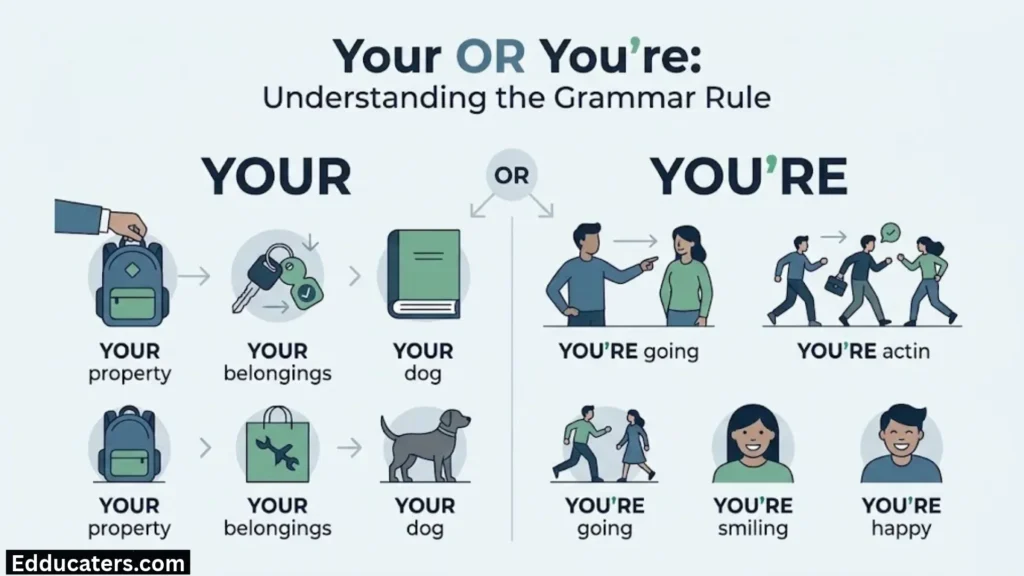
The easiest way to understand your vs. you’re is to examine what each word does in a sentence. One expresses possession or association. The other combines a pronoun and a verb.
When to Use You’re
You’re is a contraction of you are. The apostrophe marks the omitted letters in the shortened form.
You can use you’re whenever the full phrase you are makes sense in the sentence.
Examples include:
- “You’re welcome.”
- “You’re a wonderful friend.”
- “You’re doing an excellent job.”
- “You’re invited to the celebration.”
- “You’re always welcome at our house.”
- “You’re welcome to borrow my book.”
- “You’re going to enjoy this movie.”
Notice that every example works when you replace you’re with you are.
For instance:
- You’re welcome. → You are welcome.
- You’re a wonderful friend. → You are a wonderful friend.
- You’re doing an excellent job. → You are doing an excellent job.
The replacement preserves the intended grammatical structure in every case.
A useful rule: If you mean you are, use you’re.
When to Use Your
Your is a possessive determiner. It comes before a noun or noun phrase to show that something belongs or relates to the person you’re addressing.
English meaning – Cambridge Dictionary
For example:
- “Your phone is ringing.”
- “Your answer is correct.”
- “Your kindness means a lot to me.”
- “Your welcome message was beautifully written.”
- “I appreciate your help with the project.”
- “Your invitation arrived this morning.”
- “Please bring your notebook to class.”
In these sentences, your identifies the phone, answer, kindness, message, help, invitation, or notebook associated with the person being addressed.
You wouldn’t replace your with you are because doing so would change the sentence’s structure.
For example:
- Correct: “Your advice was helpful.”
- Incorrect: “You are advice was helpful.”
The second sentence makes no grammatical sense. That’s your clue that your is the correct choice.
Your vs. You’re Examples in Sentences
Comparing similar sentences helps you recognize the difference more quickly.
| With You’re | With Your |
| You’re a great teacher. | Your teacher is very helpful. |
| You’re welcome to stay. | Your welcome message was kind. |
| You’re ready for the test. | Your test starts at nine. |
| You’re making good progress. | Your progress is impressive. |
| You’re a thoughtful person. | Your thoughtful message cheered me up. |
| You’re going to love the gift. | Your gift is on the table. |
| You’re always welcome here. | Your welcome at the event was warm. |
The expressions may appear similar, but their grammatical roles differ. You’re describes a state, identity, action, or situation using you are. Your identifies something associated with the person you’re addressing.
Why Do Your and You’re Sound Alike?
One reason people confuse these words is their similar pronunciation. In many varieties of American English, your and you’re sound identical or nearly identical in everyday speech.
When you hear someone say the phrase aloud, the pronunciation often doesn’t reveal which spelling they intend. You must rely on the meaning and grammatical structure.
For example, these sentences may sound alike in ordinary conversation:
- “You’re welcome.”
- “Your welcome was lovely.”
The surrounding words help distinguish them in writing. The first is a response to thanks. The second describes a welcome or reception.
This is why relying on sound alone can lead to mistakes. Grammar provides the answer when pronunciation doesn’t.
How to Remember the Difference Between You’re and Your
You don’t need to memorize a long list of grammar rules to choose the correct word. A simple replacement test will solve most cases.
Use the You Are Replacement Test
Whenever you’re unsure whether to write your or you’re, replace the word with you are.
If the sentence still makes sense, you’re is probably correct. If the sentence becomes awkward or grammatically incorrect, you likely need your.
Try these examples:
Example 1
Sentence: “You’re welcome.”
Replacement: “You are welcome.”
Result: The sentence remains correct. Use you’re.
Example 2
Sentence: “Your presentation was excellent.”
Replacement: “You are presentation was excellent.”
Result: The sentence becomes incorrect. Use your.
Example 3
Sentence: “You’re going to enjoy the party.”
Replacement: “You are going to enjoy the party.”
Result: The sentence remains correct. Use you’re.
Example 4
Sentence: “Your opinion matters.”
Replacement: “You are opinion matters.”
Result: The sentence becomes incorrect. Use your.
The test works because it checks the actual grammatical meaning rather than relying on spelling or sound.
A Quick Memory Trick
Use this simple rule whenever you write:
You’re = You Are. Your = Belonging or Relating to You.
Think of the apostrophe in you’re as a reminder that the word combines two separate words. The apostrophe takes the place of omitted letters.
For your, think about something associated with the person you’re addressing. Your shoes, your family, your opinion, and your welcome message all follow the same pattern.
Here is an even shorter reminder:
- You’re describes what you are or what you’re doing.
- Your identifies something connected to you.
Once you learn this distinction, you’ll find it easier to correct the same mistake in emails, essays, captions, and text messages.
Test Your Understanding
Choose the correct word in each sentence.
- Thank you for answering my question. (Your / You’re) welcome!
- (Your / You’re) phone is on the kitchen counter.
- (Your / You’re) going to do great at the interview.
- (Your / You’re) welcome message was thoughtful.
- (Your / You’re) always welcome to visit us.
Answers: 1. You’re · 2. Your · 3. You’re · 4. Your · 5. You’re
Pay attention to the fourth example. Your welcome message is correct because welcome describes the type of message. That differs from using your welcome as a response to gratitude.
Is Your Welcome Ever Grammatically Correct?
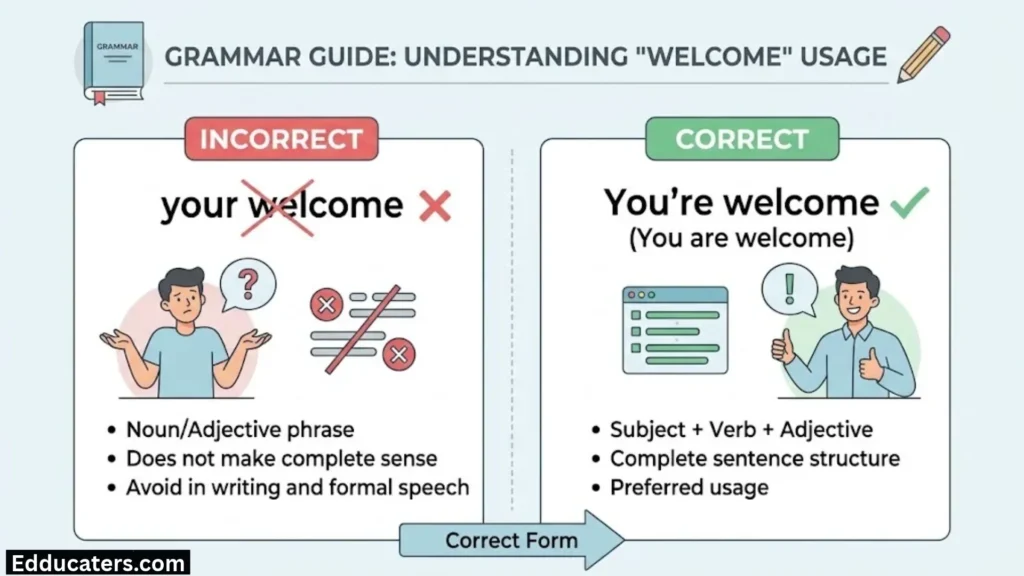
Yes. “Your welcome” can be grammatically correct when the sentence uses welcome as a noun. The problem arises when writers use the phrase in place of you’re welcome after someone says thanks.
Understanding the different meanings of welcome makes this exception easier to recognize.
Welcome as a Noun
A noun names a person, place, thing, or idea. As a noun, welcome can refer to the greeting or reception someone receives when arriving somewhere.
Examples include:
- “Your welcome was warm and genuine.”
- “We appreciated your welcome at the hotel.”
- “Your welcome speech introduced the event beautifully.”
- “The guests remembered your welcome for years.”
- “Your welcome message helped new members feel included.”
In each sentence, welcome names a greeting, reception, or related expression of hospitality. The possessive determiner your identifies the person associated with it.
This usage is perfectly grammatical because the words serve different purposes from those in the standard expression of gratitude.
Welcome as an Adjective
The word welcome can also function as an adjective. In this role, it describes someone or something that is gladly received, appreciated, or permitted.
For example:
- “You’re a welcome guest at our home.”
- “You’re welcome to join us for dinner.”
- “You’re always welcome here.”
- “You’re welcome to use my computer.”
These sentences use you’re because the intended meaning involves you are.
Compare the following examples:
| Sentence | Meaning |
| You’re welcome. | A polite response to thanks. |
| You’re welcome to stay. | You are invited or permitted to stay. |
| Your welcome was warm. | The greeting or reception associated with you was warm. |
| Your welcome message was helpful. | The message you provided or sent was helpful. |
The word welcome can play different grammatical roles depending on the sentence. Don’t assume that every appearance of welcome requires the same spelling before it.
Welcome as a Verb
Welcome also functions as a verb, meaning to greet someone warmly or receive someone in a friendly way.
Examples:
- “You’re welcoming the new students today.”
- “Your team welcomes visitors at the entrance.”
- “You’re welcome to greet the guests.”
- “Your colleagues welcomed the new manager.”
The distinction remains the same. In the first and third sentences, you’re means you are. In the second sentence, your indicates whose team is being discussed. In the final sentence, welcomed is the verb describing what the colleagues did.
These examples demonstrate why context matters when choosing between commonly confused words.
Common Mistakes With You’re Welcome or Your Welcome
Even confident writers sometimes confuse these expressions. The mistake usually happens because the words sound alike or because someone types quickly without checking the sentence.
Here are the most common errors and how to correct them.
Using Your Welcome After Someone Says Thank You
This is the main mistake people make when choosing between you’re welcome or your welcome.
Incorrect: “Thanks for helping me with my assignment.” “Your welcome!”
Correct: “Thanks for helping me with my assignment.” “You’re welcome!”
The correct response means you are welcome. The incorrect version uses a possessive determiner where a contraction is needed.
Forgetting the Apostrophe in You’re
The apostrophe is an essential part of the contraction you’re. Without it, you get youre, which isn’t the standard spelling.
- Incorrect: “Youre welcome!”
- Correct: “You’re welcome!”
In casual digital communication, people sometimes omit punctuation to type faster. However, standard spelling remains important in school assignments, workplace messages, and other polished writing.
Assuming Your and You’re Are Interchangeable
Although these words often sound alike, they aren’t interchangeable. Replacing one with the other can change the sentence’s meaning or make it grammatically incorrect.
- Incorrect: “Your going to love this.”
- Correct: “You’re going to love this.”
The correct sentence means you are going to love this. The incorrect version uses your without a noun to complete its usual possessive function.
Misusing the Replacement Test
The replacement test works when you check the intended meaning carefully. However, you shouldn’t apply it mechanically without considering the sentence.
For example:
- “You’re welcome to visit.” → “You are welcome to visit.” Correct.
- “Your welcome to visit.” → “You are welcome to visit.” The replacement changes your to you’re, correcting the sentence.
In the second example, the original wording is incorrect if the writer means to invite someone to visit. The intended meaning determines the appropriate correction.
Confusing Your Welcome With Your Welcome Message
Both expressions can be correct in different contexts.
- “Your welcome message was lovely.” Correct.
- “Your welcome!” Incorrect as a standard response to thanks.
In the first sentence, message is the noun and welcome describes the type of message. In the second, the writer intends to use the conventional expression you’re welcome.
The best way to avoid these mistakes is to check both grammar and meaning before you send your message.
Is You’re Welcome Appropriate in Formal and Informal Writing?

Yes. “You’re welcome” is appropriate in both formal and informal communication. You can use it in professional emails, school correspondence, friendly conversations, and text messages.
The expression doesn’t become incorrect when the setting changes. Only the tone and level of formality may vary.
You’re Welcome in Professional Emails
In the workplace, you’re welcome offers a courteous and natural response when someone thanks you for completing a task or providing assistance.
For example:
Subject: Re: Updated Project Report
“Thank you for reviewing the report and correcting those errors.”
“You’re welcome! I’m glad I could help. Please let me know if you need anything else.”
This exchange sounds professional without being stiff. You can also choose a slightly warmer response when the situation calls for it.
Other suitable options include:
- “You’re very welcome. I’m happy to help.”
- “You’re welcome. I’m glad the information was useful.”
- “My pleasure. Let me know if I can assist further.”
- “Of course. I’m glad we could get it sorted out.”
When writing to a client, supervisor, colleague, or customer, focus on clarity and courtesy. You don’t need to replace you’re welcome with a more elaborate expression simply to sound professional.
You’re Welcome in Text Messages and Casual Conversation
In casual conversation, a short response often works best.
For example:
Friend: “Thanks for sending me the photos!”
You: “You’re welcome!”
You might also write “No problem!” or “Anytime!” depending on the situation.
Digital communication often encourages abbreviations and informal punctuation. Still, if you want to use the standard expression, the correct spelling remains you’re welcome.
The same rule applies to social media comments, messaging apps, online discussions, and everyday conversations.
Is You’re Welcome the Same in American and British English?
Yes. “You’re welcome” is a standard expression in both American and British English. The spelling distinction between your and you’re remains the same in both varieties.
You don’t need a different spelling for a US audience or a British audience.
For example:
- American English: “Thanks for your help.” “You’re welcome!”
- British English: “Thanks for your help.” “You’re welcome!”
Both versions follow the same grammar rule. Regional differences may affect pronunciation or preferences for alternative expressions, but they don’t change the standard spelling of this phrase.
Alternatives to You’re Welcome
Although you’re welcome works in most situations, other expressions can make your response sound more personal, relaxed, or professional.
The best alternative depends on what you want to communicate.
| Alternative | Typical Tone | Example |
| My pleasure | Warm and courteous | “My pleasure. I’m glad I could help.” |
| No problem | Casual and reassuring | “No problem! Happy to help.” |
| No worries | Relaxed and friendly | “No worries. Anytime!” |
| Anytime | Friendly and generous | “Anytime! Just let me know.” |
| Glad to help | Sincere and positive | “Glad to help with the project.” |
| Of course | Natural and reassuring | “Of course! I’m happy to help.” |
| Don’t mention it | Modest and polite | “Don’t mention it. It was nothing.” |
These expressions share a similar purpose, but they don’t all carry exactly the same meaning.
“My pleasure” emphasizes that you were happy to help. It’s a good choice for professional interactions or thoughtful favors.
“No problem” suggests that the favor wasn’t a burden. It works well in everyday conversation.
“No worries” sounds relaxed and friendly. You might use it with friends, family members, or familiar coworkers.
“Anytime” suggests that you’re willing to help again in the future.
“Glad to help” communicates genuine willingness and works well in both casual and professional settings.
“Of course” reassures the other person that helping was natural or expected.
“Don’t mention it” politely minimizes the favor, although it may sound slightly old-fashioned in some contexts.
Regardless of which alternative you choose, remember that these expressions don’t change the difference between your and you’re.
Frequently Asked Questions
Is “You’re Welcome” Correct?
Yes. “You’re welcome” is the standard expression used to respond to someone who thanks you. It means you are welcome and acknowledges the other person’s gratitude.
Is “Your Welcome” Wrong?
It’s wrong when used as the standard response to “thank you.” However, your welcome can be grammatically correct when welcome functions as a noun, as in “Your welcome was warm and friendly.”
Why Is “You’re Welcome” Correct?
The phrase is correct because you’re is a contraction of you are. The expression uses the grammatical structure needed to say that someone is welcome or under no obligation for the favor received.
What Is the Difference Between Your and You’re?
Your is a possessive determiner that shows ownership or association. You’re is a contraction of you are. Use your before a noun, and use you’re when you mean you are.
Can “Your Welcome” Ever Be Correct?
Yes. For example, “Your welcome speech was excellent” is grammatically correct because welcome describes the type of speech. The phrase isn’t correct as a standalone reply to thanks.
Can I Write “You Are Welcome” Instead?
Yes. “You are welcome” is the full form of you’re welcome. Both are correct when responding to gratitude or telling someone they’re welcome in a particular place or situation. The full form may add emphasis.
Is “You’re Welcome” Formal?
Yes. The expression works in formal emails, workplace conversations, and professional correspondence. You can also use alternatives such as my pleasure when they better match the tone.
Is “You’re Welcome” the Same in American and British English?
Yes. Both varieties use you’re welcome as a standard response to thanks. The grammar and spelling rule are the same.
Why Do People Confuse Your and You’re?
The words often sound alike in spoken English, so pronunciation doesn’t always help you choose the correct spelling. Their different grammatical functions explain why you must rely on meaning and sentence structure.
What Are Some Alternatives to “You’re Welcome”?
Common alternatives include my pleasure, no problem, no worries, anytime, glad to help, of course, and don’t mention it. Choose the expression that suits your relationship with the other person and the situation.
Conclusion: You’re Welcome or Your Welcome?
When choosing between you’re welcome or your welcome, remember that “you’re welcome” is the correct expression for responding to thanks. The word you’re means you are, while your indicates possession or association.
Although your welcome can be grammatically correct in sentences such as “Your welcome message was thoughtful,” it isn’t the standard reply to “thank you.”
Here’s the simplest rule to remember:
- Use you’re when you mean you are.
- Use your when you mean something belongs or relates to someone.
- Replace you’re with you are to check whether the sentence remains grammatical.
Once you understand this distinction, you’ll find it much easier to avoid the mistake in emails, school assignments, text messages, and everyday writing.

I’m Julian Mercer, an English language writer dedicated to helping people master grammar through practical examples and clear explanations. I enjoy teaching grammar in a way that is both engaging and easy to remember.
My work focuses on grammar rules, punctuation, word usage, and writing techniques that readers can apply in everyday life. I believe learning English should be simple, enjoyable, and useful.
Books
English Grammar in Practice
Writing with Precision
 Claire Holloway
 Nathan Whitmore