Have you ever typed tieing and wondered whether the extra e belongs in the word? You’re not alone. English spelling rules can be confusing, especially when a familiar word changes its form before adding a suffix.
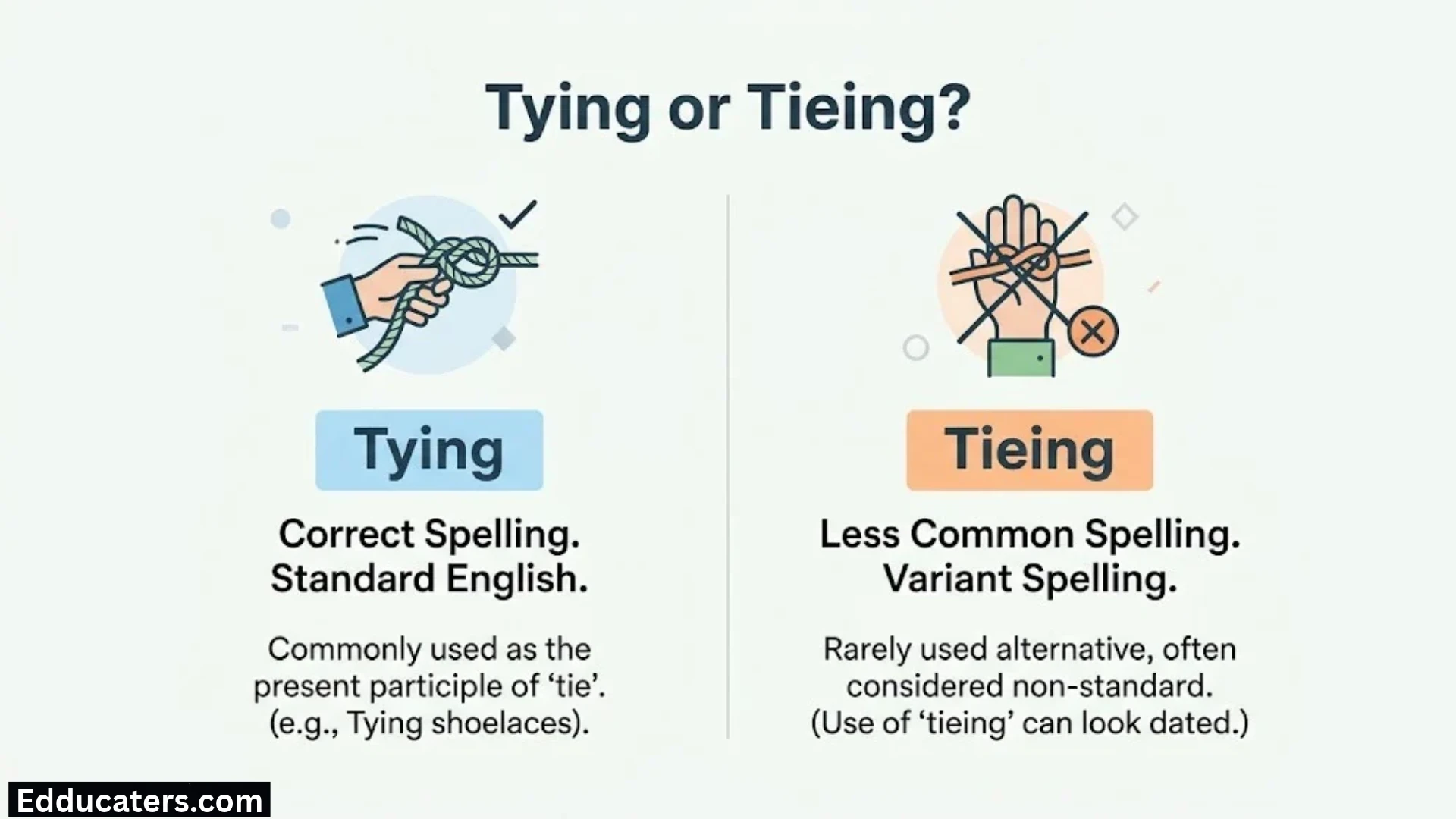
The correct spelling is tying. The spelling tieing is nonstandard in ordinary English writing. When you add the -ing suffix to the verb tie, you change the final ie to y before adding the suffix.
For example:
- Correct: She is tying her shoes.
- Incorrect in standard English: She is tieing her shoes.
- Correct: He is tying a ribbon around the gift box.
- Correct: They are tying the rope to a secure post.
The rule applies in both American and British English. You can use tying in everyday conversations, school assignments, professional emails, academic papers, and formal reports.
In this guide, you’ll learn why tying is correct, what the word means, how it differs from tied and tie, and how to remember its spelling. You’ll also see practical examples and learn how the same spelling pattern works in words such as lying and dying.
Tying or Tieing: Which Is Correct?
Tying is the correct standard spelling. It is the present participle of the verb tie and can also function as a gerund, which is a verb form that acts as a noun.
Although tieing might look reasonable at first, it doesn’t follow the standard spelling pattern for verbs ending in ie. English changes the final ie to y before adding -ing.
Here’s a quick comparison:
| Word | Correctness | Explanation |
| Tying | Correct | The standard -ing form of tie |
| Tieing | Nonstandard | Not the accepted spelling in standard English |
| Tie | Correct | The base form of the verb |
| Tied | Correct | The past-tense and past-participle form |
| Ties | Correct | The third-person singular present-tense form or a plural noun |
The difference isn’t about pronunciation or meaning. Both tying or tieing are usually intended to represent the same action. The issue is spelling: standard written English uses tying.
Is Tieing a Word?
You may encounter tieing in old texts, informal writing, spelling discussions, or material containing typographical errors. However, seeing a spelling in print doesn’t automatically make it standard.
For ordinary modern English, use tying. If you’re writing an essay, preparing a report, editing an article, or completing a school assignment, tying is the form you should choose.
A simple way to remember the difference is to look at the base verb:
- Tie → tying
- Lie → lying
- Die → dying
Notice that each verb ends in ie. When the writer adds -ing, those two letters become y.
What Is the Correct Spelling of Tying in Formal Writing?
The correct spelling remains tying in formal writing. The word doesn’t become more or less correct depending on the audience or situation.
Use it naturally in sentences such as:
- The technician is tying the cables together.
- The student practiced tying several different knots.
- The report explains the importance of tying each sample to its identification tag.
- Volunteers are tying ribbons around the event decorations.
You don’t need a more formal replacement just because the writing is professional. Tying is a standard English word that works across different registers.
Why Is Tying Spelled With a Y?
The spelling becomes easier to understand when you look at how English forms verbs. The key is the combination of letters at the end of the base verb.
The base verb is tie. The -ing suffix turns it into tying, a form used to describe an ongoing action or an activity.
The spelling transformation follows this pattern:
Tie → Tying
The final ie changes to y before you add -ing. You don’t keep the original ie and attach the suffix directly.
The IE-to-Y Spelling Rule
When a verb ends in ie, change ie to y before adding -ing. This spelling pattern appears in several common English verbs.
| Base verb | Spelling change | Correct -ing form |
| Tie | ie → y | Tying |
| Lie | ie → y | Lying |
| Die | ie → y | Dying |
| Vie | ie → y | Vying |
| Untie | ie → y | Untying |
For example, consider the sentence, “She is tying the ribbon.”
Start with tie. Replace its final ie with y, then add -ing. The result is tying.
The same pattern explains why we write lying instead of lieing and dying instead of dieing when referring to the verb die.
This is a useful English spelling rule to learn as a group. Remembering three related words is often easier than memorizing each spelling separately.
How Tying Differs From the Silent-E Rule
You may have learned that verbs ending in a silent e usually drop that letter before taking -ing. That rule works for many common verbs, but tie follows a more specific pattern.
Compare these examples:
| Base verb | Correct -ing form | Spelling pattern |
| Make | Making | Drop final e |
| Hope | Hoping | Drop final e |
| Write | Writing | Drop final e |
| Dance | Dancing | Drop final e |
| Tie | Tying | Change ie to y |
| Lie | Lying | Change ie to y |
| Run | Running | Double the final consonant |
If you simply removed the final e from tie, you’d get ti. Adding -ing to that form would produce tiing, which is also incorrect.
The correct transformation replaces the entire final ie combination with y before adding the suffix.
Remember: Verbs ending in ie generally change that ending to y before -ing. Verbs ending in a single silent e usually drop the e instead.
Why Do People Write Tieing?
The mistake makes sense when you consider how people learn spelling.
First, writers recognize tie as the base word. They may naturally try to preserve its spelling when adding another ending.
Second, the pronunciation can encourage the mistake. When you say tying, the word sounds like the combination of tie and an -ing ending. However, pronunciation doesn’t always tell you which letters to write.
Third, many English spelling rules look similar but work differently. Someone who knows make → making might apply that pattern to every verb ending in e.
The solution is to learn the complete transformation rather than relying on a single general rule.
Tying Meaning and Definition
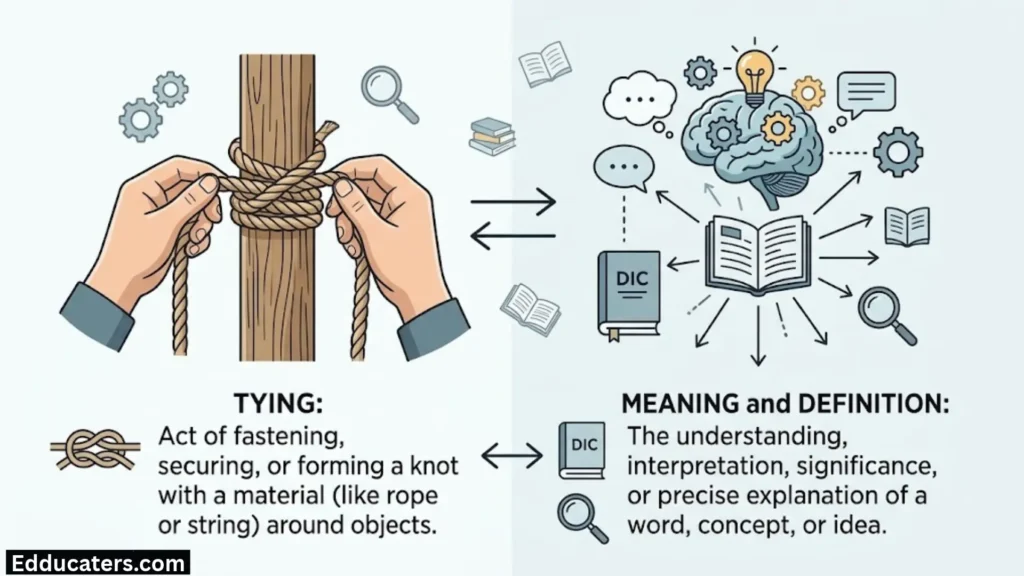
Tying is the -ing form of the verb tie. It generally means fastening, securing, connecting, or joining something with a knot, string, rope, ribbon, or another suitable material.
The exact meaning depends on the sentence. Sometimes the word describes a physical action. In other cases, it refers to connecting ideas, matching a score, or linking one thing to another.
What Does Tying Mean?
Here are the main meanings of tying in everyday English.
- Fastening: Using a cord, lace, or similar material to secure something.
- Joining: Connecting two things so they stay together.
- Securing: Keeping an object in place with a knot or fastening.
- Connecting ideas: Linking two concepts, facts, or events.
- Equaling a score: Bringing a competitor’s score level with another competitor’s score.
For example, “She is tying her shoes” describes a physical action. Meanwhile, “The goal is tying the game” means the goal makes the score equal.
The spelling stays the same even when the meaning changes.
Tying as a Present Participle
A present participle is a verb form ending in -ing. It often appears with a form of be to describe an action in progress.
Consider these sentences:
- She is tying her shoelaces.
- They are tying the boxes together.
- He was tying the rope when the phone rang.
- The workers were tying the equipment down.
In each example, tying forms part of a verb phrase. The helping verb indicates the tense, while tying describes the action.
Although its name contains the word present, a present participle can appear in sentences about the past or other time frames.
Tying as a Gerund
A gerund is an -ing verb form that functions as a noun. It names an action or activity rather than simply describing what someone is doing.
For example:
- Tying a complicated knot takes practice.
- I enjoy tying decorative ribbons.
- Tying your shoes securely can help prevent loose laces from catching underfoot.
In the first sentence, tying names an activity. In the second, it acts as the object of the verb enjoy.
This distinction helps explain why the same word can appear in different grammatical roles without changing its spelling.
Common Uses of Tying
The word appears in many everyday situations.
| Context | Example | Meaning |
| Shoes | She is tying her shoes. | Securing shoelaces |
| Decorations | He is tying a ribbon around the box. | Fastening a ribbon |
| Knots | They are tying a knot in the rope. | Forming a knot |
| Hair | She is tying her hair back. | Gathering and securing hair |
| Animals | The farmer is tying the horse to a post. | Securing an animal |
| Equipment | The crew is tying down the equipment. | Preventing equipment from shifting |
| Sports | The player is tying the score. | Making the scores equal |
| Relationships | The agreement is tying the two groups together. | Creating a connection |
These examples show why understanding the word’s meaning matters as much as remembering its spelling. Whether you describe a shoelace, a rope, or a sports score, the standard form remains tying.
Tieing Meaning: Is It Different From Tying?
No separate standard meaning distinguishes tieing from tying in ordinary modern English.
When a writer uses tieing to describe fastening, connecting, or equalizing a score, the intended word is generally tying. The nonstandard spelling doesn’t create a new grammatical form or a different meaning.
For clarity, use tying in standard written English.
Tie, Tying, Tied, or Ties: What’s the Difference?
The words tie, tying, tied, or ties belong to the same word family. However, each form serves a different grammatical purpose.
Understanding these verb forms will help you choose the right word when writing sentences about actions, completed events, or repeated activities.
| Word | Grammatical role | Example |
| Tie | Base verb | Please tie the package securely. |
| Tying | Present participle or gerund | She is tying her shoes. |
| Tied | Past tense or past participle | He tied the rope to a post. |
| Ties | Third-person singular verb or plural noun | She ties her hair back every morning. |
When to Use Tying
Use tying when you want to describe an ongoing action or name the activity itself.
Examples:
- The child is tying his shoelaces.
- They were tying ribbons around the gifts.
- Tying a secure knot requires practice.
- She enjoys tying decorative bows.
The word can also describe a connection between ideas or events. For example, “The researcher is tying the results to earlier findings” describes the act of connecting information.
When to Use Tied
Use tied for the past tense or past participle of tie.
Examples:
- She tied her shoes before leaving.
- He has tied the rope securely.
- The horse was tied to a post.
- The teams are tied at two goals each.
Notice the difference between tying and tied. The first commonly describes an action in progress, while the second can describe a completed action or a resulting state.
Compare these sentences:
- She is tying the ribbon. The action is in progress.
- She tied the ribbon. The action happened in the past.
When to Use Tie or Ties
Use tie as the base form of the verb. It commonly follows words such as to, will, can, and should.
- I need to tie this package.
- You should tie your shoes before running.
- They will tie the decorations to the railing.
Use ties with a third-person singular subject in the simple present tense.
- He ties his shoes quickly.
- She ties the ribbon into a bow.
The word ties can also be a noun. For example, “He owns three neckties” and “Family ties can remain strong over time” use the plural noun ties.
Tying in a Sentence: Examples and Usage
Seeing tying in different sentences makes its spelling and grammatical role easier to remember. The following examples cover everyday activities, formal communication, and figurative expressions.
Everyday Examples of Tying
- My brother is tying his shoes before school.
- She is tying a red ribbon around the gift box.
- The camper is tying a knot in the rope.
- He is tying his hair back before exercising.
- The farmer is tying the horse to a suitable post.
- They are tying the packages together for transport.
- The goalkeeper made a save, tying the game at one goal each.
Each sentence uses the same spelling, although the action differs.
Examples of Tying in Formal or Professional Writing
The word tying works just as well in professional documents as it does in everyday conversation.
- The technician is tying the cables together to keep the workspace organized.
- The crew is tying down the equipment before transportation.
- The report discusses the process of tying each sample to its identification tag.
- The organizers are tying decorative ribbons around the event displays.
- The analyst is tying the findings to the company’s long-term objectives.
You don’t need to replace tying with a complicated alternative to sound professional. Choose a more specific verb only when it expresses the intended meaning more accurately.
Examples of Tying in Academic Writing
In academic writing, tying can describe physical actions or relationships between ideas.
- Tying the two concepts together helps explain their relationship.
- The researcher is tying the new findings to previous studies.
- The experiment involves tying each sample to a labeled tag.
- The conclusion focuses on tying the evidence to the original research question.
These examples also show why context matters. In one sentence, tying describes fastening an object. In another, it describes linking concepts or evidence.
Is Tying Correct in American English or British English?
Yes. Tying is the standard spelling in both American English and British English. You don’t need to change it when writing for readers in different English-speaking countries.
Some English words have regional spelling variations. For example, American English generally uses color, while British English commonly uses colour. However, tying follows the same spelling pattern in both varieties.
| Writing situation | Recommended spelling |
| American English | Tying |
| British English | Tying |
| International business communication | Tying |
| Academic writing | Tying |
| School assignments | Tying |
| Professional emails and reports | Tying |
The same rule applies to lying and dying. Their standard spellings don’t change simply because the writer uses American or British English.
If you’re writing a headline, social media post, essay, or technical report, choose tying. The nonstandard spelling tieing isn’t the appropriate choice for ordinary edited writing.
Common Mistakes When Spelling Tying
Even familiar words can cause spelling problems when their forms change. Here are the most common mistakes to avoid.
Writing Tieing Instead of Tying
The most obvious error is adding -ing without changing the final ie.
Incorrect: She is tieing her shoes.
Correct: She is tying her shoes.
To avoid this mistake, remember that the standard spelling transformation changes ie to y before adding -ing.
Confusing Tying With Tied
These forms are related, but they don’t serve exactly the same purpose.
Incorrect: Yesterday, she was tied her shoes.
Correct: Yesterday, she tied her shoes.
Also correct: She was tying her shoes when the bell rang.
Use tied for a completed past action and was tying for an action that was in progress at a particular time.
Applying the Wrong Spelling Rule
English has several ways to form words with -ing. Applying one pattern to every verb can lead to errors.
| Base verb | Correct form | Rule |
| Tie | Tying | Change ie to y |
| Make | Making | Drop final e |
| Hope | Hoping | Drop final e |
| Dance | Dancing | Drop final e |
| Run | Running | Double the final consonant |
These patterns demonstrate why you should check the ending of the base verb before adding a suffix. English spelling involves related rules rather than one universal formula.
How to Remember the Correct Spelling of Tying
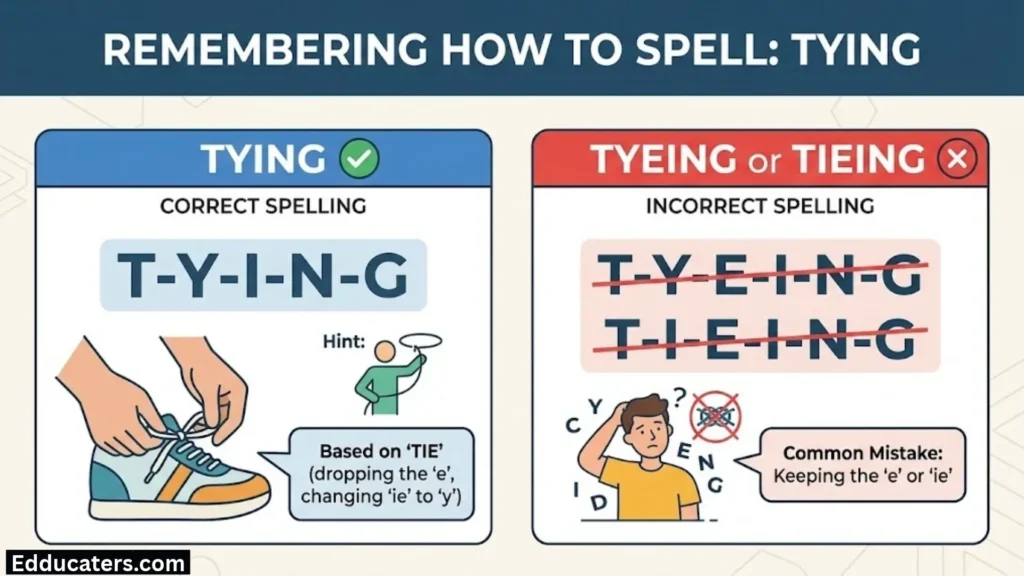
You don’t need to memorize a long explanation every time you write this word. A few simple habits can help you remember it.
- Learn a word group: Remember tie → tying, lie → lying, and die → dying together.
- Practice the transformation: Write the base verb and its -ing form side by side.
- Use the word in sentences: Try writing “I am tying my shoes” or “She is tying a ribbon.”
- Proofread carefully: If you type tieing, replace it with tying in standard writing.
- Check related forms: Remember that the correct sequence is tie, tying, tied, and ties.
A quick memory aid is to think of the phrase “tie changes to ty before -ing.” That reminds you to replace ie with y rather than simply attaching the suffix.
Practice with these examples:
- Tie → tying
- Untie → untying
- Lie → lying
- Die → dying
- Vie → vying
The more often you recognize this pattern, the less likely you are to make the same mistake.
Frequently Asked Questions
What Does Tying Mean?
Tying means fastening, securing, or connecting something, often with a knot, string, ribbon, or rope. It can also describe linking ideas or making a score equal.
Is Tying or Tieing Correct?
Tying is the standard spelling. Tieing is nonstandard in ordinary modern English, so use tying in schoolwork, professional documents, and everyday writing.
Why Is Tying Spelled Without an E?
The spelling changes because the verb tie ends in ie. English changes that ending to y before adding -ing, producing tying.
Is Tying Acceptable in Formal Writing?
Yes. Tying is standard in formal, academic, and professional writing. You can use it whenever it accurately expresses the intended meaning.
Is Tying Correct in British English or American English?
Yes. Both British English and American English use tying. There is no regional spelling difference for this word in standard usage.
What Is the Past Tense of Tie?
The past tense is tied.
Example: “She tied the package with a ribbon before giving it to her friend.”
What Is the Present Participle of Tie?
The present participle is tying.
Example: “He is tying the rope to the post.”
Is Tieing Ever Correct?
For ordinary modern English writing, use tying. Although you may encounter tieing in some sources, it isn’t the standard form recommended for everyday, academic, or professional use.
What Is the Difference Between Tying or Tied?
Tying commonly describes an ongoing action or names an activity, while tied is the past-tense or past-participle form.
Example: “She is tying her shoes” describes an action in progress. “She tied her shoes” describes a past action.
What Happens When You Add -Ing to Tie?
Change the final ie to y and then add -ing.
Tie → Tying
This spelling pattern also appears in lie → lying and die → dying.
Conclusion: Tying or Tieing
When choosing between tying or tieing, the correct standard spelling is tying. The word is the -ing form of tie, and English changes the final ie to y before adding the suffix.
Remember these key points:
- Tying is correct in standard English.
- Tieing is nonstandard and should generally be avoided.
- The spelling follows the ie-to-y pattern.
- Tying works in American English, British English, formal writing, and everyday communication.
- Tied, ties, and tie are also correct forms, but each serves a different grammatical purpose.
Once you learn the pattern, this spelling choice becomes straightforward. Whether you’re tying your shoes, tying a ribbon, securing a rope, or tying two ideas together, always choose “tying” in standard writing.

Hello, I’m Claire Holloway. I have always been passionate about the English language and enjoy turning complex grammar rules into simple, easy-to-follow lessons. I believe that every learner can become a confident English writer with the right guidance.
I create educational content focused on grammar, vocabulary, sentence structure, and writing improvement. Every article I publish is designed to help readers learn with confidence and accuracy.
Books
Grammar Without Confusion
Modern English Usage Guide
 Nathan Whitmore
 Julian Mercer