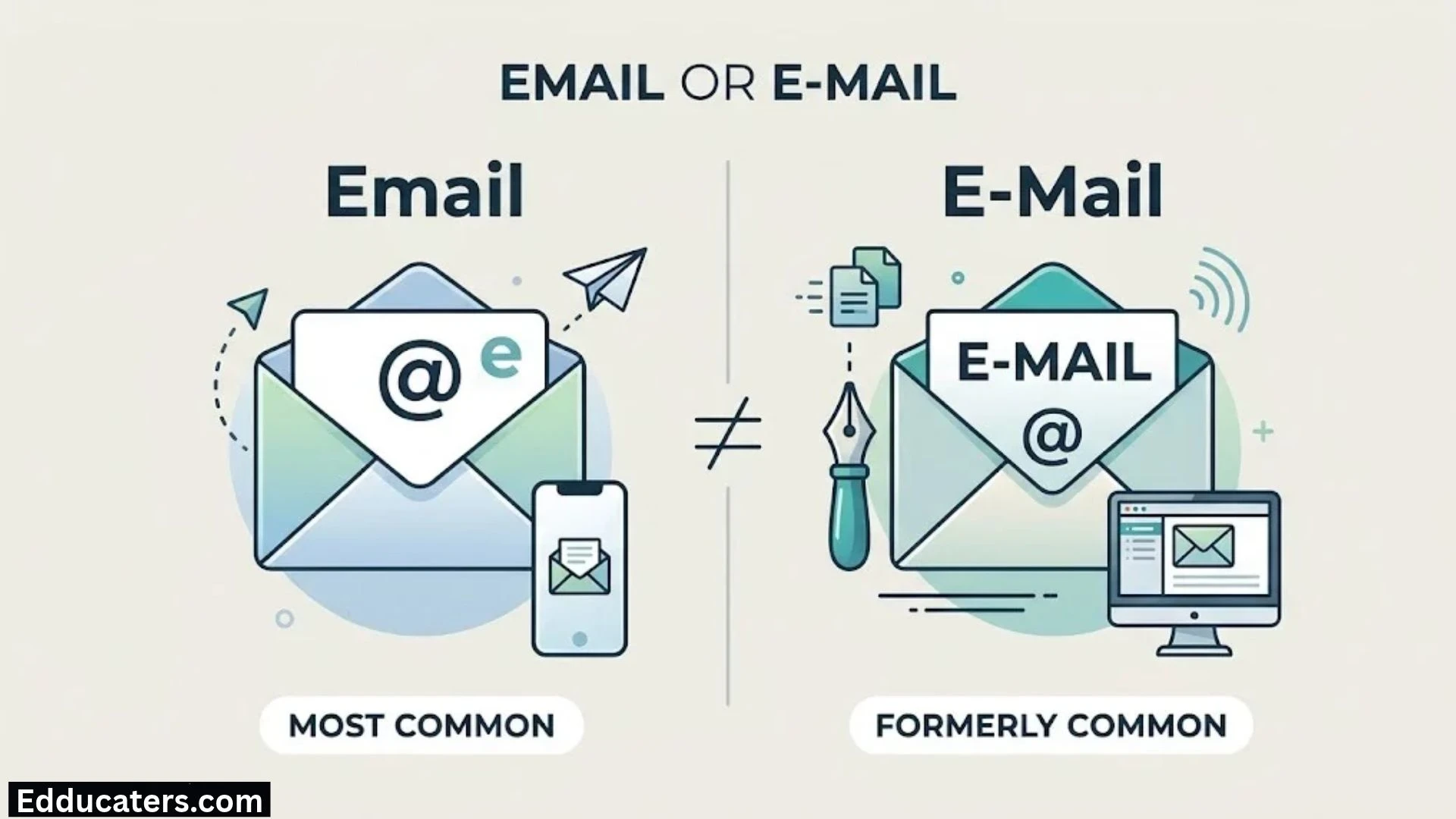
Have you ever paused while writing a message because you weren’t sure whether to type email or e-mail? You’re not alone. Both spellings appear in books, business documents, websites, newspapers, and everyday conversations. That small hyphen can make an otherwise simple word surprisingly confusing.
The good news is that both email or e-mail are correct spellings. They have the same meaning, pronunciation, and grammatical functions. However, modern English strongly favors email, the closed spelling without a hyphen.
You can use either version without changing the meaning of your sentence. The main difference comes down to spelling preference and editorial style. Most contemporary writers choose email because it’s shorter and widely recognized.
For example:
- I sent you an email yesterday.
- Please check your e-mail for the confirmation message.
Both sentences are grammatically correct.
If you’re writing an article, business proposal, academic assignment, or professional message, email is generally the better choice. However, if your employer, school, or publication follows a style guide that requires e-mail, follow that preference.
Let’s explore the difference between these spellings, their history, their grammatical uses, and the rules that can help you choose the right form.
What Does Email or E-Mail Mean?
The word email refers to electronic mail, a form of digital communication that allows people to send and receive messages through computers, smartphones, and other internet-connected devices.
Instead of delivering a physical letter through the postal service, an email system transfers electronic messages between recipients. These messages can contain plain text, photographs, documents, links, and other digital attachments.
The term comes from the expression electronic mail. Writers shortened this phrase to e-mail and eventually adopted the simpler spelling email.
Today, the word has two main meanings:
- The communication system: The technology or service used to send and receive electronic messages.
- An individual message: A particular electronic message sent from one person or organization to another.
For example:
- Our company uses email for internal communication.
- I received an email from my university.
- Please send the completed application by email.
The first sentence refers to the communication system. The other two refer to individual messages or the method of sending them.
What Is Electronic Mail?
Electronic mail, commonly called email, is a system for exchanging digital messages over computer networks. People typically use an email address and an email application or web-based service to communicate.
An ordinary email exchange involves several elements:
- Email sender: The person or organization that sends the message.
- Email recipient: The person or organization that receives it.
- Email address: The address that identifies the destination account.
- Email account: The account used to access and manage messages.
- Email message: The actual written communication.
- Email service: The platform that provides email functionality.
For example, when you send a job application to a company’s hiring department, you use your email account to compose a message. You enter the recipient’s email address and send your application.
The recipient can then open the message and download any attached documents.
Email communication differs from instant messaging because it generally uses a message-based system rather than requiring both participants to exchange messages in a live conversation.
Email as a Noun
The word email functions as a noun when it identifies electronic mail or an individual electronic message.
It can work as both a countable and an uncountable noun.
Countable noun: When you refer to individual messages, you can count them.
Examples:
- I received three emails this morning.
- She sent me an important email.
- Please forward those emails to the manager.
Uncountable noun: When you refer to electronic correspondence as a general form of communication, you usually don’t need a plural ending.
Examples:
- I prefer email to traditional letters.
- We communicate through email.
- Email has changed modern business communication.
This distinction matters because you don’t always need to add an s to make the word plural in a general sense.
For instance, I receive too much email is perfectly natural. However, I received ten emails refers to ten individual messages.
Email as a Verb
Email also works as a verb. It means to send an electronic message to someone.
English frequently turns nouns into verbs when people use them to describe an action. Email follows this familiar pattern.
Consider these examples:
- Please email me the updated document.
- I’ll email the teacher tomorrow.
- She emailed the customer about the appointment.
- We are emailing the invitations this afternoon.
In each sentence, email describes the action of sending electronic correspondence.
The verb works in everyday conversations and professional writing. You can use it without adding another verb such as send.
Both of these sentences are correct:
- I will email you the report.
- I will send you the report by email.
The first is shorter. The second emphasizes the method of delivery.
Why Are Email or E-Mail Both Accepted Spellings?
The existence of two accepted spellings comes from the way English compounds develop.
When a new word enters the language, writers don’t always agree on how to spell it. Some prefer a hyphen to connect its elements. Others eventually remove the hyphen as the expression becomes familiar.
That process explains the development of e-mail and email.
The original expression was electronic mail. Writers shortened it to e-mail, using the letter e to represent electronic. The hyphen connected this shortened element with the existing word mail.
Over time, people increasingly wrote the expression as one word.
Both versions survived. However, the unhyphenated form became the dominant choice in modern English.
How Did the Spelling of Email Evolve?
The history of email spelling reflects the development of electronic communication itself.
The expression electronic mail appeared before the modern internet became part of everyday life. As computer-based messaging developed, people needed a shorter term to describe this new communication method.
The abbreviated spelling e-mail became established during the early development of electronic messaging. Etymological records trace e-mail to 1982 as a shortened form of electronic mail.
The spelling gradually changed as the technology became more familiar.
Here’s a simplified timeline:
| Period | Development |
| Before widespread electronic messaging | Electronic mail describes computer-based message delivery. |
| Late 1970s | The shortened term begins appearing in documented usage. |
| Early 1980s | E-mail becomes an established spelling. |
| 1990s | Electronic messaging becomes increasingly familiar to the public. |
| 2000s | Email gains wider acceptance in everyday and professional writing. |
| 2011 | The Associated Press adopts email instead of e-mail. |
| 2017 | The 17th edition of the Chicago Manual of Style adopts email. |
The Associated Press announced its spelling change in March 2011. The 17th edition of the Chicago Manual of Style also adopted the closed spelling in 2017.
These changes helped establish email as the preferred form in many editorial environments.
Why Did Email Lose Its Hyphen?
The hyphen originally helped readers understand that e-mail represented electronic mail. As the technology became familiar, that explanation became less necessary.
People began recognizing the word as a complete unit rather than two connected elements.
Several factors encouraged the change:
- Frequent use: People encountered the word regularly in messages, websites, and business documents.
- Simpler spelling: Writing email requires one fewer character.
- Digital communication: Computers and online services helped spread the shorter form.
- Editorial preferences: Major publications and style authorities adopted the closed spelling.
- Word formation: Familiar compounds sometimes lose their hyphens as their spelling becomes established.
This development isn’t unusual. English contains many compounds that have changed their spelling over time.
For example:
| Earlier or alternative form | Common modern form |
| Web site | Website |
| Cell phone | Cellphone |
| On-line | Online |
| Data base | Database |
These examples don’t mean every hyphenated word must eventually become one word. Each term develops according to its own usage and editorial conventions.
Email simply became established without its original hyphen.
Email or E-Mail in American English
In contemporary American English, email is the preferred spelling.
You will commonly see it in newspapers, business documents, educational materials, websites, and professional correspondence.
The Associated Press made an important change in 2011 when it announced that writers following AP Style should use email instead of e-mail. This decision reflected changing language conventions and everyday usage.
The unhyphenated spelling is also used in Microsoft’s editorial guidance. Its official style guide explicitly recommends writing email without a hyphen.
Examples of preferred American English usage:
- Please check your email before the meeting.
- I emailed the customer yesterday.
- Send your application to this email address.
- Our department receives hundreds of emails every week.
You may still encounter e-mail in older publications, archived documents, and organizations that retain traditional spelling preferences.
However, there’s generally no reason to choose the hyphenated version when writing new American English content.
Recommendation: Use email in American English unless your publication or organization specifies otherwise.
Email or E-Mail in British English
British English also recognizes both email and e-mail.
Although some writers historically preferred the hyphenated spelling, the closed form has become widely established in contemporary British usage.
You can encounter email in British university documents, business communication, websites, and general publications.
For example:
- Please send your assignment by email.
- I received an email from the university.
- Contact our admissions department by email.
- She emailed the office this morning.
It’s important not to confuse this spelling preference with a major difference between American and British English.
Some English words have distinct regional spellings. For example, American writers use color while British writers generally use colour. Email doesn’t follow that same pattern because both regions commonly use the unhyphenated form.
Recommendation: Use email in British English unless a particular publisher or organization prefers e-mail.
Email vs. E-Mail: What Is the Difference?
The difference between email vs. e-mail is the hyphen.
Both spellings describe the same form of electronic communication. They don’t represent different technologies, meanings, or grammatical categories.
You can replace one spelling with the other in an ordinary sentence without changing its meaning.
Consider this comparison:
| Feature | ||
| Meaning | Electronic mail | Electronic mail |
| Pronunciation | Same | Same |
| Spelling | One closed word | One hyphenated word |
| Hyphen | No | Yes |
| Grammar | Correct | Correct |
| Noun usage | Accepted | Accepted |
| Verb usage | Accepted | Accepted |
| Plural | Emails | E-mails |
| Past tense | Emailed | E-mailed |
| Present participle | Emailing | E-mailing |
| Modern preference | Preferred | Alternative |
The most important distinction is that email represents the modern standard spelling in many widely followed style guides.
Meanwhile, e-mail remains an accepted spelling.
Neither version is automatically more formal or more professional because of its punctuation. Your choice should depend on the writing standard you’re following.
For most readers, email will look more familiar.
Is Email One Word or Two Words?
This question often causes confusion because email originally came from the two-word expression electronic mail.
However, its modern spelling follows a different pattern.
Email is one word. It combines the shortened element e with mail to form a closed compound.
The alternative e-mail is also written as one hyphenated word.
The expression e mail, written with a space and no hyphen, isn’t the standard spelling for electronic mail.
Here’s how the three forms compare:
| Form | Status | Explanation |
| Correct | Modern closed spelling | |
| Correct | Accepted hyphenated spelling | |
| E mail | Nonstandard | Incorrect spacing for the intended term |
A closed compound combines elements without a space or hyphen. An open compound keeps its elements separate, while a hyphenated compound connects them with a hyphen.
Email is a closed compound. E-mail is a hyphenated compound.
Examples:
- Correct: I sent you an email.
- Correct: I sent you an e-mail.
- Incorrect: I sent you an e mail.
Remember that the original phrase electronic mail is still correct when you’re discussing the full meaning or describing the technology.
However, when referring to an ordinary electronic message, use email or e-mail.
Email or E-Mail: Which Spelling Should You Use in Formal Writing?
Formal writing doesn’t require the hyphenated spelling.
In fact, email is generally the better choice for modern professional and academic documents because many established editorial standards prefer it.
The important thing is to follow the spelling conventions of your intended audience.
For example, if you’re preparing a business proposal, writing a university assignment, or submitting a professional report, use email unless the relevant style guide specifies otherwise.
A consistent spelling choice makes your writing easier to read and edit.
Consider these examples:
Modern professional writing:
Please send the revised proposal to my email address.
Traditional spelling preference:
Please send the revised proposal to my e-mail address.
Both sentences are grammatically correct. The first follows the more widely preferred modern spelling.
Email in Business and Professional Communication
Businesses use email for many types of professional correspondence.
Employees exchange reports, schedule meetings, share documents, contact customers, and communicate with suppliers through electronic messages.
The word appears naturally in several common workplace expressions:
- Email communication
- Email correspondence
- Email notification
- Email confirmation
- Email attachment
- Email invitation
- Email address
- Email account
- Email message
Examples:
- The manager sent an email to all employees.
- Please confirm the meeting through email.
- I received an email regarding the job interview.
- The company uses email for customer communication.
These expressions generally use the closed spelling because it matches modern business writing conventions.
Email in Academic and General Writing
Students and researchers also use email when communicating with teachers, professors, universities, and academic departments.
For example:
- I emailed my professor about the assignment.
- Please send the research paper by email.
- The university sent an email confirming my admission.
- Students must check their university email accounts regularly.
When preparing academic documents, check the institution’s editorial requirements.
Some universities follow particular style guides. Others use their own internal writing standards.
The same principle applies to reports, essays, applications, and general correspondence: choose an accepted spelling and use it consistently.
Email or E-Mail According to Style Guides
A style guide establishes writing conventions for a particular publication, organization, or professional environment.
It may specify spelling, punctuation, capitalization, grammar, abbreviations, and word usage.
This matters because English allows several accepted spelling variations. A style guide helps writers choose one form and apply it consistently.
Email provides a good example of how editorial preferences can change.
Associated Press Style
The Associated Press announced in March 2011 that writers should use email instead of e-mail.
The change became effective on March 19, 2011.
The AP decision was part of a broader update to electronic terminology. Other changes included smartphone and cellphone as closed forms.
Writers following AP Style should therefore use email.
Microsoft Style Guide
Microsoft recommends writing email without a hyphen.
Its guidance covers the word’s use as a noun and verb. It also explains when to use email message to distinguish an individual message from the broader email system.
Microsoft provides examples such as:
- You have two new emails.
- Email us your comments.
- Scroll through email to find the message you want.
The guide also says not to capitalize the m in email.
Chicago Manual of Style
The 17th edition of the Chicago Manual of Style adopted email instead of e-mail.
This change appeared among the edition’s significant spelling and editorial updates in 2017.
Do All Style Guides Agree?
Not necessarily.
Different publications and organizations may retain different editorial preferences. A dictionary may also list more than one accepted spelling.
For example, a publisher might prefer e-mail because its house style preserves traditional hyphenation.
That doesn’t make the modern spelling incorrect.
The safest approach is straightforward:
- Check the style guide required by your publication.
- Follow your organization’s spelling preferences.
- Use one form throughout the document.
- Avoid changing spellings without a clear editorial reason.
A style preference isn’t the same thing as a universal grammar rule.
Email Grammar: Noun, Verb, and Word Forms
Understanding email grammar rules makes it easier to use the word naturally.
Email can function as a noun or a verb. Its spelling also changes slightly when you form plurals and different verb tenses.
The same basic grammatical patterns apply to e-mail, although the hyphen remains in the corresponding forms.
What Is the Plural of Email?
The standard plural form is emails.
Add -s to the singular noun when referring to multiple individual messages.
Examples:
- I received five emails yesterday.
- She deleted the old emails.
- We exchanged several emails about the project.
- The manager reads hundreds of emails every day.
The hyphenated alternative is e-mails.
However, you don’t always need a plural ending when referring to electronic mail generally.
Compare:
- I receive too much email.
- I received too many emails.
The first sentence refers to email as a general form of communication. The second refers to individual messages.
Both constructions are correct.
Is It Emailed or E-Mailed?
Both emailed and e-mailed are accepted past-tense forms.
The modern preferred spelling is emailed.
You create the past tense by adding -ed to the base verb.
Examples:
- I emailed the report to my supervisor.
- She emailed me the meeting details.
- They emailed the customer yesterday.
- He e-mailed the documents last week.
The spelling doesn’t change the meaning.
For contemporary writing, choose emailed unless your style guide requires the hyphenated alternative.
Is It Emailing or E-Mailing?
The standard present participle is emailing.
It describes an ongoing action or an activity.
Examples:
- I am emailing the admissions office.
- She is emailing the invitation to everyone.
- They were emailing customers throughout the afternoon.
- He enjoys emailing his colleagues about new projects.
The alternative e-mailing is also accepted.
When adding -ing, you don’t remove the final letter from email. The word becomes emailing.
What Are the Different Verb Forms of Email?
The following table shows the standard forms of the verb.
| Verb form | Modern spelling | Hyphenated spelling |
| Base form | ||
| Third-person singular | Emails | E-mails |
| Past tense | Emailed | E-mailed |
| Past participle | Emailed | E-mailed |
| Present participle | Emailing | E-mailing |
You can use these forms in different sentence structures.
Present tense:
- I email my clients every morning.
- She emails her manager regularly.
Past tense:
- I emailed the documents yesterday.
- They emailed us after the interview.
Present continuous:
- She is emailing the invitations.
- We are emailing the updated schedule.
Present perfect:
- I have emailed the application.
- He has emailed the final report.
The modern forms are generally easier to read and maintain in professional writing.
Should Email Be Capitalized?
In ordinary writing, email is a common noun and should remain lowercase.
You don’t need to capitalize it simply because it refers to an internet-based communication system.
Correct examples:
- I received an email from my manager.
- Please check your email.
- She sent an email yesterday.
Incorrect in ordinary sentence usage:
- I received an Email from my manager.
- Please check your Email.
However, capitalization is appropriate in certain situations.
At the beginning of a sentence:
– Email is an important communication tool.
In headings:
– Email or E-Mail: Which Spelling Is Correct?
In a title or proper name:
Follow the applicable title capitalization rules or the official styling of the name.
One important detail: Don’t capitalize the m in email merely because the word starts with the letter e.
Is It an Email or A Email?
The correct expression is an email, not a email.
The reason comes from the pronunciation of the word rather than its spelling.
The indefinite articles a and an depend on the initial sound of the following word.
Use an before a vowel sound. Use a before a consonant sound.
The word email begins with a long E sound. Therefore, it takes an.
Examples:
- I received an email this morning.
- She sent an email to the company.
- He forwarded an email to his supervisor.
- We are waiting for an email confirmation.
The same rule applies to the hyphenated spelling.
- I received an e-mail yesterday.
- She sent an e-mail to the admissions office.
Although e-mail contains a hyphen, its pronunciation remains unchanged. Therefore, it also takes an.
| Expression | Correct or incorrect? |
| An email | Correct |
| A email | Incorrect |
| An e-mail | Correct |
| A e-mail | Incorrect |
Remember this useful grammar principle:
Choose the article according to the first sound of the following word, not simply its first letter.
That’s why we say an email, an hour, and a university.
Email Address or E-Mail Address: Which Is Correct?
Both email address and e-mail address are correct expressions.
However, email address is the preferred modern form.
An email address identifies an account or destination where someone can receive electronic messages.
For example:
alex@example.com
An ordinary email address contains three main elements:
| Element | Example | Function |
| Local part | alex | Identifies the mailbox or account |
| @ symbol | @ | Separates the local part from the domain |
| Domain | example.com | Identifies the domain receiving the mail |
When someone sends a message to this address, the email system uses the destination information to route it toward the recipient’s mailbox.
An email address isn’t the same thing as an email account or an individual email message.
Here’s the difference:
- Email address: The address used to send and receive messages.
- Email account: The account that provides access to electronic correspondence.
- Email message: The individual communication sent through the system.
For example, you might have one email account with hundreds of stored messages.
Each message can have its own sender, recipient, subject line, date, and attachments.
Use email address in most contemporary writing. The hyphenated alternative is acceptable when required by a particular style guide.
Mail or Email: What Is the Difference?
Although mail and email are related, they don’t always describe the same communication method.
The word mail traditionally refers to letters, postcards, documents, and parcels delivered through a postal service.
Email refers to electronic messages transmitted through computer networks.
The difference becomes clearer when you compare their delivery methods.
| Feature | Physical Mail | |
| Delivery method | Postal service | Electronic network |
| Format | Paper documents or parcels | Digital messages |
| Address | Physical mailing address | Email address |
| Delivery process | Postal transportation | Electronic transmission |
| Attachments | Physical enclosures | Digital files |
| Internet required | No | Usually yes |
| Common examples | Letters and packages | Business messages and digital correspondence |
Consider these examples:
Physical mail:
- The post office delivered a letter to my house.
- I sent a birthday card through the postal service.
- The company mailed the signed contract.
Email:
- I sent the contract through email.
- She received an electronic confirmation.
- The manager emailed the updated schedule.
The two systems serve similar communication purposes. However, their delivery methods and formats differ.
It’s also worth remembering that mail can sometimes refer to electronic mail when the context makes the meaning clear.
For example, someone might say, “Check your mail,” while referring to an email inbox.
The surrounding conversation usually tells you which type of communication they mean.
Common Email Spelling Mistakes to Avoid
Even though the difference between email and e-mail is simple, writers sometimes make unnecessary spelling and grammar mistakes.
Here are the most common problems and how to avoid them.
Writing E Mail Instead of Email or E-Mail
The spelling e mail uses an unnecessary space.
Choose either the closed form or the hyphenated form.
- Correct: email
- Correct: e-mail
- Nonstandard: e mail
Assuming E-Mail Is Incorrect
Some writers believe the hyphenated form is grammatically wrong because modern publications prefer email.
That’s not accurate.
Both forms are accepted. The difference is a matter of spelling convention.
Treating Email and E-Mail as Different Words
The hyphen doesn’t create a different meaning.
Both expressions refer to electronic mail or an individual electronic message.
You don’t need to assign separate definitions to them.
Mixing Both Spellings in One Document
Using email in one paragraph and e-mail in another can make your writing look inconsistent.
Choose one spelling and maintain it throughout the document.
For example, if you begin with email address, continue using that spelling rather than switching to e-mail address later.
Writing A Email Instead of An Email
This mistake involves article usage rather than spelling.
Because email starts with a vowel sound, use an.
- Correct: I received an email.
- Incorrect: I received a email.
Confusing an Email Address With an Email Message
An email address identifies the destination of a message.
An email message contains the actual communication.
For example:
- Send the report to my email address.
- I received your email this morning.
These sentences refer to two different things.
Capitalizing Email Without a Reason
Email is generally a common noun.
Keep it lowercase in ordinary sentences unless it begins a sentence or appears in a title or proper name that requires capitalization.
Frequently Asked Questions About Email or E-Mail
Is Email or E-Mail the Correct Spelling?
Both email or e-mail are correct. However, email is the preferred modern spelling in most contemporary English writing. Use the closed form unless your publication or organization requires the hyphenated alternative.
Is Email One Word or Two?
Email is one word without a hyphen. The alternative e-mail is also written as one hyphenated word. The spaced form e mail isn’t the standard spelling.
Is Email Hyphenated?
Modern English generally writes email without a hyphen. However, e-mail remains an accepted alternative. Both forms have the same meaning and pronunciation.
Is E-Mail Still Correct?
Yes. E-mail remains an accepted spelling of electronic mail. Although many modern publications prefer email, the hyphenated version isn’t grammatically incorrect.
Which Spelling Is Better for American English?
Email is the preferred spelling in American English. The Associated Press adopted it in 2011, and the Chicago Manual of Style followed in its 17th edition.
Is Email Correct in British English?
Yes. Email is widely used and accepted in British English. The hyphenated form e-mail is also recognized, although the closed spelling is common in modern British publications.
Why Did Email Lose Its Hyphen?
The hyphen gradually disappeared as the word became familiar through everyday electronic communication. Writers increasingly treated it as a single compound word. Major editorial style changes also helped establish the closed spelling.
Is It Emailed or E-Mailed?
Both emailed and e-mailed are accepted past-tense forms. The modern preferred spelling is emailed. For example, “I emailed the report yesterday.”
Can Email Be Used as a Verb?
Yes. Email functions as both a noun and a verb. As a verb, it means to send someone an electronic message. For example, “Please email me the document.”
Should I Write Email Address or E-Mail Address?
Both expressions are correct. However, email address is the more common modern spelling. It refers to the unique address used to send and receive electronic messages.
Is Mail the Same as Email?
No. Mail traditionally refers to physical letters and parcels delivered through a postal service. Email refers to electronic messages sent through computer networks. Both involve communication but use different delivery methods.
Is E Mail a Correct Spelling?
No. When referring to electronic mail, the standard spellings are email and e-mail. Writing the expression as e mail with a space isn’t standard usage.
Should Email Be Capitalized?
No. Email is normally a lowercase common noun. Capitalize it at the beginning of a sentence or in a title when the applicable capitalization style requires it.
What Is the Plural of Email?
The standard plural is emails. The alternative e-mails is also accepted. You can use the uncountable form email when discussing electronic correspondence generally.
What Is the Meaning of Electronic Mail?
Electronic mail is a digital communication system that allows people to exchange messages through computer networks. It commonly includes written messages, documents, photographs, and other attachments.
What Are the Verb Forms of Email?
The main verb forms are email, emails, emailed, and emailing. The corresponding hyphenated forms are e-mail, e-mails, e-mailed, and e-mailing.
Conclusion: Email or E-Mail?
So, should you write email or e-mail?
Both spellings are correct. They share the same meaning, pronunciation, and grammatical functions. The difference comes down to the hyphen.
However, email is the preferred spelling in modern English. Major editorial authorities, including the Associated Press, the Chicago Manual of Style, and Microsoft, support the unhyphenated form.
You can still use e-mail when following an organization or publication that prefers traditional hyphenation.
For everyday writing, business communication, academic assignments, and professional documents, choose email.
Remember these simple points:
- Email: Preferred modern spelling.
- E-mail: Accepted hyphenated alternative.
- E mail: Nonstandard spelling.
- An email: Correct article usage.
- Emails: Standard plural form.
- Emailed: Preferred past-tense form.
- Emailing: Preferred present participle.
When in doubt, use email and keep your spelling consistent. It’s simple, familiar, and widely accepted.

Hi, I’m Nathan Whitmore, and I enjoy making English grammar easy for learners of all ages. I believe grammar should be practical, not confusing. I write simple, well-researched guides that help readers improve their writing, speaking, and overall communication skills.
I spend a lot of time studying grammar patterns, sentence construction, punctuation, and modern English usage. My goal is to create lessons that anyone can understand, whether they are students, teachers, or professionals.
Books
Clear English Grammar
The Smart Writer’s Grammar Handbook
 Julian Mercer