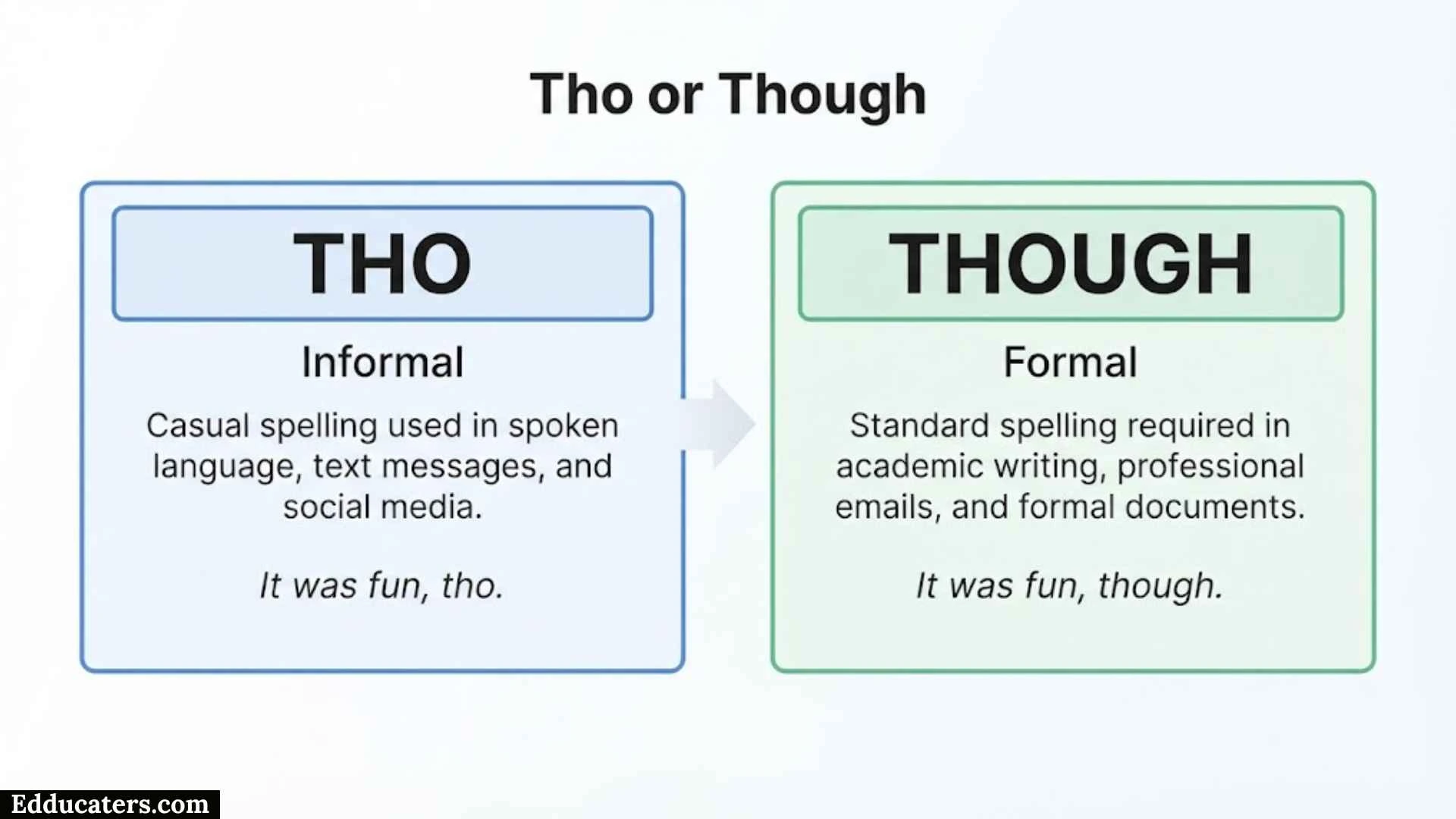
If you are wondering whether to write tho or though, the answer depends on the context. Though is the standard English spelling and is appropriate for formal, academic, professional, and general writing. Tho is an informal shortened spelling commonly used in texting, social media, online chats, and other casual communication.
The two forms usually carry the same basic meaning when tho is being used as a shortened form of though. The important difference is register: though belongs to standard written English, while tho signals an intentionally casual style.
This distinction matters because a spelling that works naturally in a text message may look inappropriate in an essay, business email, application, or published article. This guide explains the meanings, grammar, pronunciation, history, sentence patterns, related expressions, common mistakes, and practical rules that can help you choose the right form.
Quick Answer: Tho or Though?
Though is the standard form you should normally use.
Tho is an informal shortened spelling of though that is mainly associated with casual digital communication.
| Form | Status | Best Used For | Example |
| Though | Standard English | Formal and informal writing | I liked it, though it was expensive. |
| Tho | Informal spelling | Texting and casual online communication | I liked it tho. |
The Simple Rule
If you are writing something that needs to look polished or standard, choose though.
If you are deliberately writing in a casual internet or texting style, tho may be appropriate.
Best default: When you are unsure, use though.
What Does Though Mean?
Though is a standard English word that can function as a conjunction or an adverb. Its main uses involve contrast or introducing information that makes a previous statement less strong or less straightforward.
Oxford defines though as a conjunction meaning “despite the fact that” and also describes its use for adding a fact or opinion that makes a previous statement less strong or important.
For example:
Though the weather was cold, we went for a walk.
Here, though introduces a condition that contrasts with the main action.
It can also appear later in a sentence:
I enjoyed the movie, though it was a little long.
And it can appear at the end:
The movie was a little long. I enjoyed it, though.
In the final example, though has a meaning close to however or nevertheless. Cambridge specifically notes this use, particularly in spoken English.
What Does Tho Mean?
Tho is an informal spelling used to represent though.
It is most commonly encountered in digital communication, where writers may shorten words to create a quicker, more relaxed, or conversational tone.
For example:
That was funny tho.
The standard version is:
That was funny, though.
The meaning is essentially the same. What changes is the writing style.
Is Tho a Separate Word?
In most situations, tho should be understood as an informal shortened spelling of though, rather than as a separate word with a different dictionary meaning.
That distinction is useful when deciding how to edit a sentence. If you are proofreading an academic paper or professional article, changing tho to though is normally appropriate. If you are preserving a person’s casual text message or dialogue, keeping tho may better represent the intended voice.
Tho or Though: What Is the Main Difference?
The biggest difference is not meaning. It is formality and standard usage.
Consider these two sentences:
The restaurant was expensive, though the food was excellent.
The restaurant was expensive tho the food was excellent.
The first sentence follows standard written English. The second deliberately uses an informal spelling.
The distinction becomes clearer when the audience changes.
| Situation | Recommended Form |
| Academic essay | Though |
| School assignment | Though |
| Business report | Though |
| Professional email | Though |
| Published article | Though |
| Formal application | Though |
| Personal letter | Though |
| Text message | Tho or though |
| Social media comment | Tho or though |
| Online chat | Tho or though |
| Informal meme caption | Tho can work |
The safest general-purpose choice is though because it works across a much wider range of situations.
When Should You Use Though?
Use though whenever you want the standard English form. It is not limited to formal writing; it is also completely natural in everyday conversation and casual writing.
Use Though in Academic Writing
Academic writing generally favors standard spelling and conventional grammar.
For example:
Though the initial results were unexpected, the researchers continued the experiment.
Using though keeps the sentence appropriate for an academic context.
A version using tho would introduce an unnecessarily casual tone.
Use Though in Professional Communication
Business emails, reports, proposals, applications, and workplace documents usually benefit from standard language.
For example:
The proposal has several advantages, though there are a few issues that need further discussion.
Here, though sounds natural without being overly formal.
Use Though in Published Articles
When writing an edited article, guide, report, or educational resource, though is normally the appropriate choice.
For example:
The two methods are similar, though they produce different results.
A published piece should generally avoid informal spellings unless the spelling itself is relevant to the subject or is intentionally being used to represent someone’s voice.
Use Though in Everyday English
You do not need to reserve though for formal situations.
It is perfectly normal in casual speech:
I might come later, though.
It’s a little expensive, though.
Though I’m tired, I still want to go.
This is one reason though is the best default: it works in both formal and informal contexts.
When Can You Use Tho?
Tho can be suitable when the writing is intentionally informal.
It commonly appears in:
- Text messages
- Social media comments
- Online conversations
- Chat messages
- Informal posts
- Memes
- Casual digital communication
- Dialogue intended to sound conversational
For example:
That was actually pretty good tho.
I don’t really want to go tho.
It looks strange tho.
You’re right tho.
These examples have a relaxed digital tone.
Why Does Tho Feel More Casual?
Shortened spellings are common in informal digital communication because writers often prioritize speed, conversational tone, and personal style over formal conventions.
The spelling tho visually signals that the writer is being casual. It can therefore contribute to the voice of a message even when the underlying meaning is unchanged.
This is different from making a spelling mistake accidentally. Someone might deliberately write tho because they want an informal tone.
How Is Though Used in a Sentence?
There are several important sentence patterns involving though.
Though at the Beginning
When though introduces a subordinate clause at the beginning of a sentence, a comma normally separates that clause from the main clause.
Though the road was busy, we arrived on time.
Though she was nervous, she gave an excellent presentation.
Though the book is long, it is easy to read.
Oxford and Cambridge both describe though as a subordinating conjunction that can introduce a contrasting subordinate clause.
Though After the Main Clause
Though can also introduce a contrasting clause after the main clause.
We went for a walk, though it was raining.
She accepted the position, though she had some concerns.
I enjoyed the course, though some lessons were difficult.
The exact punctuation can depend on sentence structure and style, but the key point is that though connects contrasting ideas.
Though at the End
One particularly useful feature of though is that it can appear at the end of a sentence.
The hotel was expensive. It was comfortable, though.
I don’t agree with the decision. I understand why they made it, though.
I wasn’t planning to stay. I stayed for another hour, though.
This use is common in conversation and informal writing. Cambridge specifically identifies though as an adverb that can mean “despite this” when used in this way.
Tho or Though in Text Messages
Texting is one of the clearest situations where tho may be acceptable.
Imagine a conversation:
Alex: Did you like the new restaurant?
Sam: Yeah, the food was great tho.
Here, tho fits the relaxed style of the conversation.
The same message written in standard form would be:
Yeah, the food was great, though.
Both are understandable. The first simply has a more casual digital feel.
Should You Always Use Tho in Texts?
No.
There is no requirement to use tho simply because you are texting. Though is also completely natural in a text message.
For example:
Yeah, I liked it though.
There is nothing unusual about this sentence.
The choice is stylistic rather than a grammatical requirement.
Tho or Though in Social Media Posts
Social media allows a wide range of writing styles, so either form may appear.
A casual post might say:
I wasn’t expecting much from this movie tho.
A more polished post might say:
I wasn’t expecting much from this movie, though.
If you are representing a business, organization, educational website, or professional brand, though is usually the stronger choice because it maintains a polished tone.
If you are writing a deliberately casual personal post, tho can fit naturally.
Tho or Though in Professional Writing
For professional writing, though is the clear choice.
Consider:
The project is progressing well, tho we still have several tasks to complete.
The shortened spelling makes the sentence look like an informal message.
A polished version is:
The project is progressing well, though we still have several tasks to complete.
This principle applies to:
- Cover letters
- Resumes
- Business emails
- Reports
- Presentations
- Proposals
- Client communication
- Workplace documentation
- Professional websites
Unless you are deliberately reproducing informal speech, standard though is preferable.
Tho or Though in Academic Writing
Academic writing requires particular care because the expected register is generally formal and edited.
Use:
Though the evidence is limited, the findings are still useful.
Rather than:
Tho the evidence is limited, the findings are still useful.
The first sentence follows conventional academic style.
This does not mean that though itself is too informal for academic writing. It is a standard word, and authoritative dictionaries document its use in written English. Oxford notes that though is used more in spoken than written English, but it remains a standard form with established written uses.
Tho or Though in Formal Emails
When writing to a manager, teacher, client, university, employer, or professional contact, use though.
For example:
Thank you for your suggestion. I agree with most of your points, though I have one concern.
This sounds natural and professional.
Using tho could make the message appear overly casual:
I agree with most of your points tho I have one concern.
The issue is not that the reader cannot understand it. The issue is that the spelling does not match the expected level of formality.
How Do You Pronounce Though?
Though is pronounced differently in British and American English, but both pronunciations contain the same basic consonant and vowel pattern.
Cambridge gives the British pronunciation as /ðəʊ/ and the American pronunciation as /ðoʊ/.
The initial th is the voiced sound /ð/, similar to the sound in:
- this
- that
- those
- they
The pronunciation does not sound like the th in think.
Does Tho Have a Different Pronunciation?
When tho represents though, it is normally intended to be pronounced the same way.
The spelling is shortened, but the underlying word is still though.
Though vs Although
Though is closely related to although, and the two can often introduce the same kind of contrast.
Compare:
Though it was raining, we went outside.
Although it was raining, we went outside.
Both are grammatical.
Cambridge explains that although and though can both mean “in spite of something” and function as subordinating conjunctions.
There is a slight difference in style and flexibility. Though is particularly useful in conversational English and can also appear at the end of a sentence in a way that although cannot.
For example:
The restaurant was expensive. I liked it, though.
You would not normally replace the final though with although:
The restaurant was expensive. I liked it, although.
That construction does not work in the same way.
Though vs Even Though
Even though creates a stronger sense of contrast than ordinary though in many contexts.
Compare:
Though it was raining, we went outside.
Even though it was raining, we went outside.
The second version can emphasize the surprising nature of the result more strongly.
Cambridge describes even though as a form used for contrast similar to although, with a stronger contrast.
Examples
Though he was tired, he kept working.
Even though he was exhausted, he kept working.
Both are correct, but the second sentence places more emphasis on the unexpected contrast.
Though vs However
Though and however can sometimes communicate a similar idea, but their grammatical behavior is different.
Compare:
The task was difficult. However, we completed it.
with:
The task was difficult. We completed it, though.
Both express a contrast.
However, however typically functions as a linking adverb, while though can function as a conjunction or an adverb. Cambridge specifically notes that sentence-final though can have a meaning similar to however or nevertheless.
Understanding this difference helps prevent awkward substitutions.
Though vs But
Though and but can both express contrast, but they do not always fit into the same sentence structure.
For example:
I wanted to go, but I was too tired.
You could also write:
Though I wanted to go, I was too tired.
The grammar changes when the connecting word changes.
Cambridge notes that but is a coordinating conjunction, whereas although/though are subordinating conjunctions.
This is why simply replacing one with another without considering the sentence structure can produce an awkward or incorrect sentence.
What Is the History of Though?
Though has a long history in English.
Oxford traces the word to Old English thēah and notes connections with Dutch and German forms. Oxford also explains that forms influenced by Old Norse became important in the development of the modern word.
This history helps explain why the modern spelling does not look exactly like its pronunciation.
English spelling has developed over many centuries, and words inherited from older forms often preserve spellings that are not obvious from modern pronunciation.
The informal tho is much more recent in everyday usage and functions as a shortened spelling rather than a separate historical development of the standard word.
Common Mistakes With Tho or Though
Knowing the difference is easier when you understand the mistakes writers commonly make.
Mistake 1: Using Tho in Formal Documents
The results were positive tho further research is required.
For formal writing, use:
The results were positive, though further research is required.
Mistake 2: Assuming Tho Is Always Wrong
It is also inaccurate to claim that tho is always unacceptable.
In a casual text such as:
That’s funny tho.
the writer may be intentionally using an informal spelling.
The important question is whether the context calls for standard or casual language.
Mistake 3: Treating Though and Although as Identical in Every Position
Although and though overlap significantly, but though has uses that although does not share, especially the sentence-final conversational use.
I liked it, though.
This is natural.
I liked it, although.
This does not normally work as the same construction.
Mistake 4: Thinking Tho Changes the Meaning
When tho is simply an informal spelling of though, the core meaning does not change.
The major difference is the tone and level of formality.
A Practical Decision Guide: Tho or Though?
Use this quick decision process whenever you are unsure.
Step 1: Is the writing formal or professional?
Yes → Use though.
Examples include essays, reports, applications, business emails, and published articles.
Step 2: Is it casual digital communication?
Yes → Either may work.
You can use though for a standard style or tho for a deliberately casual tone.
Step 3: Are You Writing for a Broad or Unknown Audience?
Yes → Choose though.
The standard form is more universally appropriate.
Step 4: Are You Reproducing Someone’s Informal Voice?
Yes → Tho may be appropriate.
For dialogue, quotations, social posts, or messages where the original tone matters, retaining tho can make the writing sound authentic.
Step 5: Are You Still Unsure?
Choose though.
It is the safest all-purpose option.
Examples: Choosing the Right Form
Here are practical situations showing how the choice changes with context.
Text Message
I can come later tho.
Tho is acceptable because the message is casual.
University Assignment
Though the sample was small, the results were useful.
Though is the appropriate standard form.
Business Email
The proposal is promising, though we need to review the budget.
Though keeps the message professional.
Social Media Comment
That’s actually a good point tho.
Tho can work because the comment has a casual conversational style.
Published Article
The process may take longer, though the final result is usually worth the effort.
Though is appropriate for edited content.
Dialogue in a Novel
“I don’t really like it tho,” she said.
Here, tho could be intentionally used to reflect a character’s informal voice.
Key Takeaways About Tho or Though
The most useful points to remember are:
- Though is the standard spelling.
- Tho is an informal shortened spelling.
- Both can represent the same basic word and meaning when tho is being used as a shortening.
- Though works in formal and informal contexts.
- Tho is mainly suitable for deliberately casual communication.
- Though can function as a conjunction.
- Though can also function as an adverb, especially at the end of a sentence.
- Although has a similar contrastive meaning but cannot always replace though.
- Even though can express a stronger contrast.
- However and though can overlap in meaning but have different grammatical roles.
- When you are unsure, though is the safest choice.
Frequently Asked Questions
Is Tho or Though Correct?
Though is the standard spelling. Tho is an informal shortened spelling commonly used in casual digital communication. For formal or professional writing, choose though.
Is Tho a Real Word?
Tho is widely used as an informal spelling of though, particularly online and in texting. It should not normally be treated as the standard spelling in formal English.
Is Tho Grammatically Correct?
As an informal spelling, tho can be appropriate in casual communication. However, standard edited English normally uses though.
Can I Use Tho in an Essay?
It is best to use though in an essay. Academic writing generally requires standard spelling and a more controlled formal register.
Can I Use Tho in a Text Message?
Yes. Tho can be natural in a casual text message, especially when you want a relaxed or conversational tone. Though is also perfectly acceptable in texting.
Is Though More Formal Than Tho?
Yes. Though is the standard English form and is therefore suitable for formal writing. Tho signals a more informal style.
Are Tho and Though Pronounced the Same?
When tho is intended as a shortened form of though, it is normally pronounced the same way. Cambridge gives /ðəʊ/ for British English and /ðoʊ/ for American English.
Can Though Be Used at the End of a Sentence?
Yes. This is a common use of though, especially in conversational English.
For example:
I didn’t expect to enjoy it. I did, though.
Cambridge and Oxford both document this sentence-final use.
Is Though the Same as Although?
They are closely related and can often introduce the same type of contrast. However, they are not interchangeable in every grammatical position. Though also has a sentence-final use that although does not normally have.
Is Though the Same as However?
Not exactly. They can sometimes express a similar contrast, but they have different grammatical functions. Though can be used as a conjunction or adverb, while however functions differently within sentence structure.
Which Is Better for a Website: Tho or Though?
For standard website content, though is normally the better choice because it is the conventional spelling and is suitable for a broad audience. Tho can be retained when discussing informal language or deliberately creating a casual voice.
Should I Correct Tho to Though?
If you are editing formal, academic, professional, or published writing, changing tho to though is generally appropriate. If you are preserving an informal message, quotation, dialogue, or social-media voice, keeping tho may be intentional.
Final Verdict: Tho or Though?
The correct choice depends on the writing situation, but though is the standard form and the best default.
Use though in essays, articles, professional communication, academic writing, reports, applications, and other polished content.
Use tho when an intentionally informal style is appropriate, particularly in texts, chats, social media, and casual online communication.
The simplest rule is:
Standard English → though
Informal digital style → tho
When there is any doubt, choose though. It is widely accepted, grammatically established, and suitable for both formal and everyday English.

I’m Julian Mercer, an English language writer dedicated to helping people master grammar through practical examples and clear explanations. I enjoy teaching grammar in a way that is both engaging and easy to remember.
My work focuses on grammar rules, punctuation, word usage, and writing techniques that readers can apply in everyday life. I believe learning English should be simple, enjoyable, and useful.
Books
English Grammar in Practice
Writing with Precision
 Claire Holloway
 Nathan Whitmore