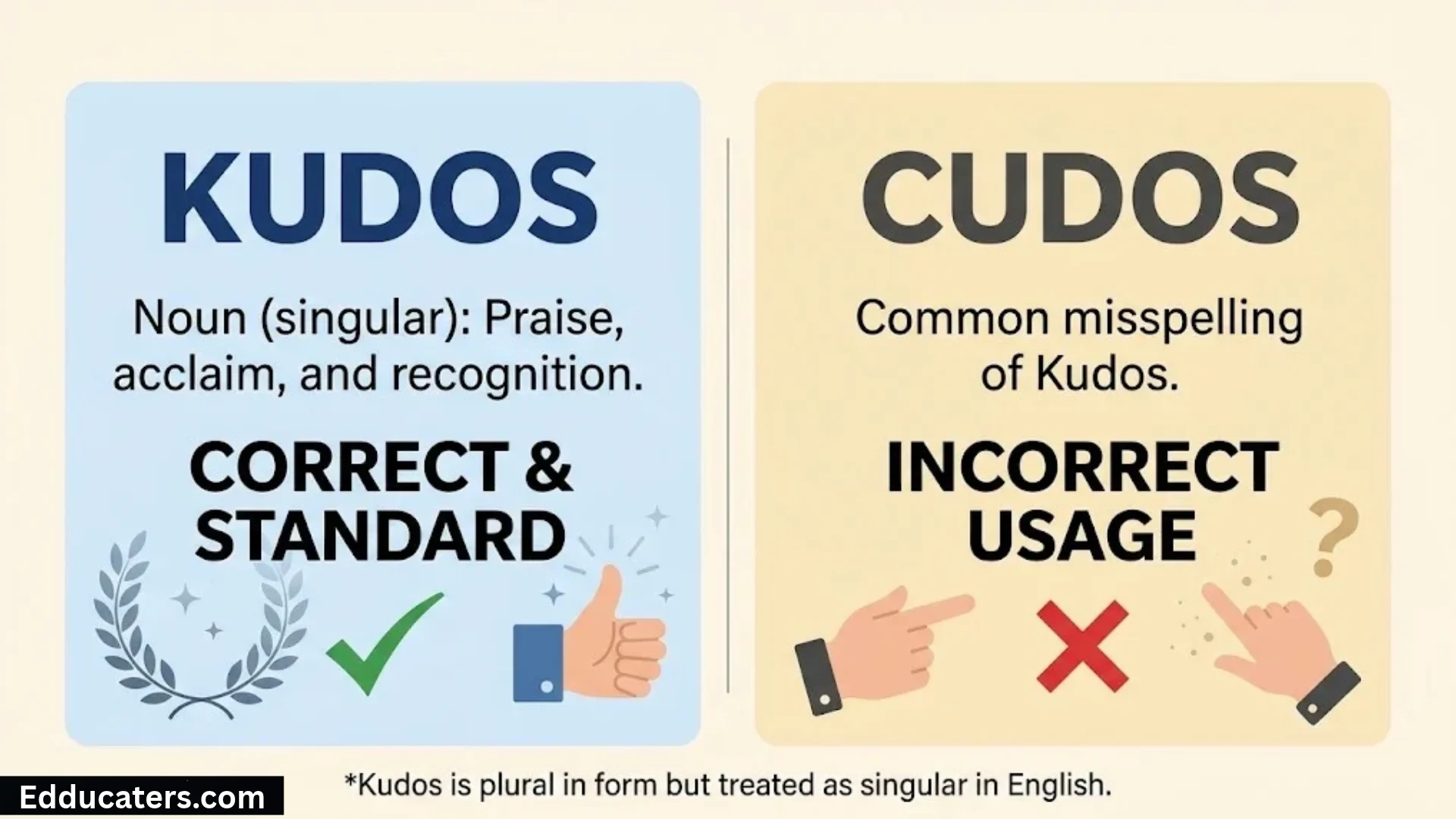
Have you ever written cudos and wondered whether it should actually be kudos? You’re not alone. These two spellings look almost identical and sound very similar. However, only one is the standard English spelling when you want to express praise or recognition.
The correct spelling is kudos, not cudos. It means praise, admiration, honor, or recognition for someone’s achievement, effort, or good work. You can use it to appreciate a colleague, congratulate a friend, recognize a successful team, or acknowledge an impressive accomplishment.
For example:
- Correct: Kudos to the entire team for finishing the project ahead of schedule.
- Incorrect: Cudos to the entire team for finishing the project ahead of schedule.
The confusion often comes from pronunciation. The initial K in kudos sounds like the hard C in words such as cat and credit. That similarity can make the incorrect spelling seem reasonable.
However, kudos has a Greek origin, which explains its unusual spelling. The word also has an interesting grammatical history because its final S doesn’t automatically make it plural.
Let’s explore the correct spelling, meaning, pronunciation, origin, grammar, and everyday usage so you can use the word confidently.
Cudos or Kudos: Which Spelling Is Correct?
Kudos is the correct standard English spelling. Cudos is a common misspelling when someone intends to use the word meaning praise or recognition.
Although both spellings sound similar, they don’t have the same status in standard English. Dictionaries recognize kudos as an established English noun. They don’t recognize cudos as an alternative spelling of that word.
Here’s a quick comparison:
| Spelling | Correctness | Meaning |
| Kudos | Correct | Praise, honor, or recognition for an achievement |
| Cudos | Incorrect | Common misspelling of kudos |
The word kudos appears in American English, British English, Canadian English, Australian English, and other varieties of English. Its spelling doesn’t change based on location.
For example, an American employee might receive kudos for excellent customer service. A British student might earn kudos for an outstanding academic performance. Both use exactly the same spelling.
If you’re writing an email, report, social media post, or formal message, always choose kudos when you mean praise.
Is Cudos a Word?
The answer depends on the context. Cudos isn’t the standard spelling of the English word kudos, but you might encounter the same letter combination in proper names, company names, or branding.
For instance, a business might deliberately use Cudos as its brand name. That doesn’t make it an accepted spelling of the ordinary English word.
This distinction matters because proper nouns don’t always follow standard dictionary spelling conventions. Companies can choose unusual names for their products or services.
Keep these points in mind:
- Kudos: The correct English noun for praise or recognition.
- Cudos: An incorrect spelling when intended to mean praise.
- Cudos as a name: Potentially valid as a proper noun or brand name.
Therefore, if you want to compliment someone, write kudos, not cudos.
Is Kudos Correct in American and British English?
Yes. Kudos is the standard spelling in both American English and British English.
Unlike genuine regional spelling pairs such as color/colour, center/centre, and organize/organise, this word doesn’t have separate American and British forms.
| English variety | Correct spelling | Example |
| American English | Kudos | Kudos to your team! |
| British English | Kudos | Kudos for the excellent work! |
| Canadian English | Kudos | Kudos on your achievement! |
| Australian English | Kudos | Kudos to everyone involved! |
| Indian English | Kudos | Kudos for your contribution! |
You might notice slight differences in pronunciation across regions. However, those differences don’t affect the spelling.
Remember: Kudos is correct regardless of which English variety you use. Writing cudos isn’t a regional preference.
What Does Kudos Mean?
The word kudos means praise, honor, admiration, or recognition earned through an achievement. People use it to acknowledge someone’s success, hard work, talent, or valuable contribution.
When you give someone kudos, you’re telling them that their effort deserves appreciation.
For example, imagine your coworker completes a difficult project before its deadline. You might say:
Kudos to Maria for completing the project ahead of schedule!
This statement recognizes Maria’s effort and successful performance. It also communicates appreciation without requiring a lengthy compliment.
The word can describe recognition in several situations, including:
- Professional achievements and outstanding work.
- Academic success and excellent grades.
- Athletic performances and personal milestones.
- Creative accomplishments and impressive skills.
- Community service and charitable contributions.
- Successful projects and team achievements.
You can also use kudos when someone earns recognition from a wider audience.
For example:
“The documentary received kudos from critics for its powerful storytelling.”
Here, kudos refers to positive recognition and praise from reviewers.
Simple Meaning of Kudos
In simple English, kudos means well done or you deserve praise.
It’s a positive expression that recognizes someone’s effort or accomplishment. You can use it when a person does something impressive or achieves a worthwhile goal.
Consider these examples:
| Situation | Example |
| Workplace success | Kudos for finishing the presentation! |
| Academic achievement | Kudos on earning excellent grades! |
| Athletic performance | Kudos to you for completing the marathon! |
| Team accomplishment | Kudos to everyone who made this possible! |
| Creative work | The artist deserves kudos for the beautiful painting. |
Think of kudos as a verbal pat on the back. It acknowledges someone’s contribution and lets them know their work matters.
What Does Kudos to You Mean?
Kudos to you is an expression of praise directed toward a particular person. It means that you recognize someone’s achievement, effort, or positive action.
The phrase works in friendly conversations, workplace messages, social media comments, and professional communication.
For example:
- Kudos to you for staying focused and reaching your goal.
- Big kudos to you for helping the new employees.
- Kudos to you for handling that challenging situation.
- You completed the entire assignment in one evening? Kudos to you!
The expression carries a positive and encouraging tone. It can also make appreciation sound more natural and conversational.
You don’t need to reserve it for extraordinary achievements. Completing a difficult task, helping someone, or showing consistent effort can all deserve kudos.
How to Pronounce Kudos
The standard pronunciation of kudos varies slightly between American and British English. However, both accents preserve the same spelling and general meaning.
In American English, a common pronunciation is /ˈkuː.doʊz/. Some speakers also use /ˈkjuː.doʊs/. In British English, the common pronunciation is /ˈkjuː.dɒs/.
Here’s a simple pronunciation guide:
| Detail | Explanation |
| Word | Kudos |
| Syllables | Two |
| First sound | K or hard C sound |
| Stress | First syllable |
| American pronunciation | Commonly /ˈkuː.doʊz/ |
| British pronunciation | Commonly /ˈkjuː.dɒs/ |
The first syllable receives the primary stress. The second syllable follows with a softer sound.
Why Does Kudos Start With a K Sound?
The K represents a hard consonant sound, similar to the beginning of kite, kind, and knowledge.
This pronunciation sometimes contributes to the spelling confusion. People hear the sound and associate it with C because English uses both letters to represent similar sounds.
However, the spelling comes from the word’s Greek history. You should preserve the K even when your pronunciation resembles a C sound.
A helpful tip: Remember that kudos begins with K just like kindness and knowledge. The sound might remind you of C, but the spelling doesn’t change.
Where Does the Word Kudos Come From?
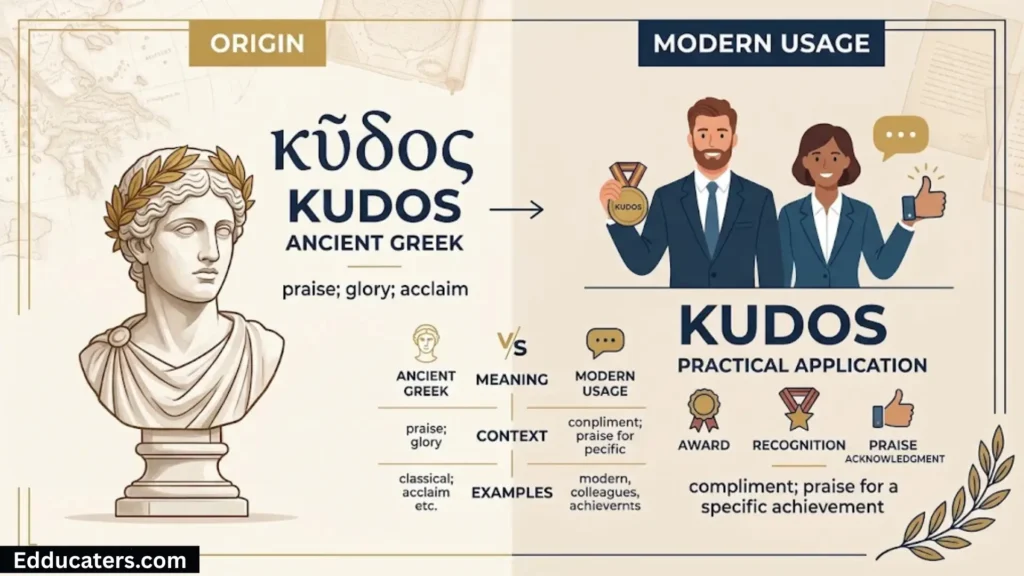
The word kudos comes from Ancient Greek. Its original form is κῦδος (kŷdos), a noun associated with glory, fame, honor, and renown.
The English word retains much of that original sense. However, modern speakers generally use it to recognize someone’s achievement or express admiration for good work.
According to etymological records, kudos appeared in English around the end of the eighteenth century. It probably began as university slang before becoming more widely established.
Etymology, Origin & Meaning+1
Its history explains why the word looks unusual compared with many ordinary English nouns.
Is Kudos a Greek Word?
Yes. Kudos comes directly from the Ancient Greek noun κῦδος.
The original Greek word referred to glory, fame, or renown. It carried a sense of honor associated with someone’s achievements or reputation.
English adopted the word while retaining its distinctive spelling.
Consider these related details:
- Original language: Ancient Greek.
- Original spelling: κῦδος.
- Transliteration: Kŷdos.
- Original meaning: Glory, fame, or renown.
- Modern English meaning: Praise, admiration, credit, or recognition.
The word also has a connection with classical Greek literature. Its original form appears in the language of ancient literary works, including the Homeric tradition.
Etymology, Origin & Meaning+2
Why Does Kudos Start With K?
The initial K reflects the word’s Greek origin.
Ancient Greek used the letter kappa (Κ, κ) to represent the /k/ sound. English preserves that consonant through the letter K in kudos.
This explains why the word doesn’t begin with C, even though the pronunciation might make that spelling seem possible.
English contains plenty of words borrowed from other languages that retain unusual spellings. Their histories often explain patterns that modern spelling rules alone cannot explain.
For example:
- Kudos retains its Greek-derived K.
- Psychology preserves a Greek-derived initial spelling.
- Karaoke retains its Japanese-derived spelling.
- Chemistry reflects a long history of borrowing and spelling development.
The spelling of kudos isn’t a random exception. Its history provides a clear explanation.
Is Kudos Singular or Plural?
This is one of the most interesting questions about the word.
Although kudos ends in S, its original Greek form is singular. English originally borrowed it as a singular noun, commonly used in an uncountable sense.
That means you can correctly write:
- The team deserves kudos.
- She received considerable kudos for her work.
- His performance earned widespread kudos.
- The project brought the company additional kudos.
Notice that these sentences don’t require you to add another S or change the word.
However, modern English usage has developed in more than one direction. Some American speakers treat kudos as a plural noun, while others use kudo as a singular count noun.
The distinction matters when you’re choosing between traditional usage and newer informal patterns.
Dictionary.com+2
Can You Say a Kudo Instead of Kudos?
Yes, kudo exists as a recognized English word, although its history differs from the original Greek form.
It developed through a process called back-formation. This happens when speakers mistakenly interpret part of an existing word as an affix and create a new word by removing it.
In this case, people saw the final S in kudos and assumed it represented a plural ending. They then formed kudo as the supposed singular.
Similar developments occurred with other English words. For example, pea developed from the older word pease, which speakers eventually interpreted as a plural form.
Today, some dictionaries recognize kudo as a singular noun meaning an expression of praise or an accolade. However, traditional usage guides often prefer the original kudos.
Etymology, Origin & Meaning+2
Compare these examples:
| Expression | Explanation |
| She received kudos for her work. | Established use of kudos |
| He earned a kudo for his contribution. | Recognized but less traditional singular form |
| The team received several kudos. | Common plural interpretation |
| The team deserves much kudos. | Traditional uncountable use |
For formal writing, the simplest approach is to use kudos as an uncountable noun.
Instead of writing “She received a kudo,” you can write “She received praise” or “She earned recognition.”
Is Kudo’s or Kudos Correct?
Kudos is correct when you want to express praise or recognition.
Kudo’s is not the standard plural form of kudo or an alternative spelling of kudos.
The apostrophe has specific grammatical functions. It commonly indicates possession or represents missing letters in contractions. It doesn’t normally create plural nouns.
Consider these examples:
- Incorrect: The manager gave the employee lots of kudo’s.
- Correct: The manager gave the employee lots of kudos.
- Correct: The manager gave the employee plenty of praise.
- Correct: The employee’s achievement deserved recognition.
You can use an apostrophe in a genuine possessive construction involving the word.
For example:
“The team’s kudos were well deserved.”
However, you don’t need an apostrophe simply because the word ends in S.
Is Kudoes Correct?
No. Kudoes isn’t the standard spelling of the word or its plural form.
Some English nouns ending in consonants take -es to form their plurals. For example, box becomes boxes, and watch becomes watches.
However, you shouldn’t apply that pattern to kudos.
The word already ends in S. Its established spelling remains unchanged when you use it in ordinary expressions of praise.
| Incorrect form | Correct alternative |
| Kudoes | Kudos |
| Cudos | Kudos |
| Kudo’s (as a plural) | Kudos |
| A kudos | Some kudos / a word of praise |
The easiest way to avoid these mistakes is to remember the original spelling rather than trying to create a new form.
How to Use Kudos in a Sentence
Understanding the definition is useful, but knowing how to use the word naturally matters even more.
You can use kudos to recognize someone else’s effort, celebrate a successful result, or acknowledge an impressive contribution.
It works in everyday conversations and professional messages. The meaning remains positive, although the tone depends on the situation.
Here are several common sentence patterns.
Kudos to Someone
Use kudos to someone when you want to direct praise toward a particular person or group.
This construction works especially well when you want to recognize an achievement publicly.
Examples:
- Kudos to Sarah for delivering an excellent presentation.
- Kudos to the entire team for meeting the deadline.
- Kudos to everyone who volunteered at the community event.
- Kudos to my brother for completing his first marathon.
- Kudos to the teachers who helped organize the competition.
The preposition to identifies the person receiving the recognition.
You can also place an adjective before kudos to make the appreciation sound stronger.
For example:
- Big kudos to the development team!
- Special kudos to everyone who contributed.
- Major kudos to the organizers for their hard work.
Kudos for Something
Use kudos for something when you want to recognize a specific action, achievement, or contribution.
The preposition for introduces the reason someone deserves praise.
Examples:
- Kudos for completing the assignment ahead of schedule.
- She received kudos for her excellent customer service.
- The director earned kudos for managing the project successfully.
- He deserves kudos for helping the new employees.
- The company received kudos for its environmental efforts.
The difference between kudos to and kudos for is simple:
- Kudos to: Identifies the person or group receiving praise.
- Kudos for: Identifies the reason for the praise.
You can combine both constructions in one sentence:
“Kudos to Daniel for organizing such a successful event.”
Here, to Daniel identifies the recipient, while for organizing such a successful event explains the reason.
Common Expressions With Kudos
English speakers use several familiar expressions with this word.
Here are some useful combinations:
| Expression | Meaning |
| Kudos to you | Direct praise for someone’s actions |
| Big kudos | Strong appreciation |
| Special kudos | Particular recognition |
| Give someone kudos | Praise someone’s achievement |
| Earn kudos | Gain recognition through good work |
| Receive kudos | Get praise from others |
| Deserve kudos | Be worthy of recognition |
| Get kudos for something | Receive appreciation for a particular action |
These expressions are easy to incorporate into everyday writing.
For instance, “The research team earned kudos for its detailed findings” sounds natural and clearly identifies the achievement.
Kudos Examples in Everyday and Professional Writing
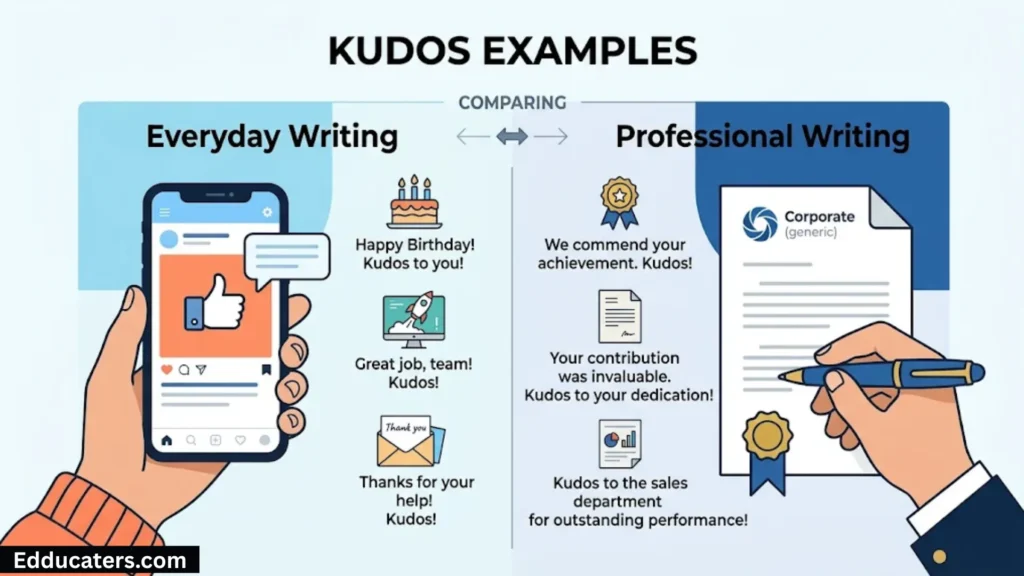
The word kudos fits many communication settings. You can use it when congratulating a friend, appreciating an employee, or recognizing a successful project.
However, context matters. A phrase that sounds friendly in a team chat might feel too casual in a highly formal letter.
Let’s examine some practical situations.
Kudos in Workplace Communication
Workplaces provide plenty of opportunities to recognize people’s contributions.
Employees often work behind the scenes to solve problems, meet deadlines, support colleagues, and improve business results. Acknowledging these efforts helps communicate appreciation.
You can use kudos when recognizing:
- Excellent employee performance.
- Successful project completion.
- Outstanding customer service.
- Creative problem-solving.
- Team collaboration.
- Consistent effort and dedication.
Here are some natural workplace examples:
- Kudos to the sales team for exceeding its quarterly targets.
- She deserves kudos for handling the client presentation so professionally.
- Big kudos to everyone who stayed late to finish the project.
- The manager received kudos for improving communication across departments.
- Kudos to our support team for resolving the issue so quickly.
These sentences recognize specific contributions rather than offering vague compliments.
For stronger workplace communication, connect your praise to an actual accomplishment. This makes appreciation more meaningful.
Kudos in Emails and Business Communication
You can use kudos in business emails when you want to appreciate someone’s work without sounding overly formal.
It works particularly well in friendly workplaces where employees communicate openly.
Example email:
Subject: Great Work on the Project
Hi Team,
Kudos to everyone for completing the project ahead of schedule. Your hard work and cooperation made a real difference.
I especially appreciate the extra effort everyone put into resolving the last-minute challenges.
Thanks again for the excellent work!
Best regards,
Alex
This message sounds positive and professional without becoming stiff.
However, consider your audience before using the expression. A formal letter to a government official or a highly traditional business partner might call for appreciation or commendation instead.
Kudos in Casual Conversations and Social Media
Kudos also works naturally in informal conversations, text messages, and social media comments.
People often use it to celebrate achievements or acknowledge someone else’s effort.
For example:
- Kudos on your new job!
- Big kudos for finishing the race.
- Kudos to everyone who made this event possible.
- You handled that situation brilliantly. Kudos!
- Huge kudos to the volunteers for their dedication.
Social media posts often use shorter expressions because readers prefer quick, direct messages.
For example:
“Just finished my first half-marathon. Big kudos to everyone who supported me along the way!”
This sentence communicates achievement while recognizing the people who helped.
Is Kudos Appropriate for Formal Writing?
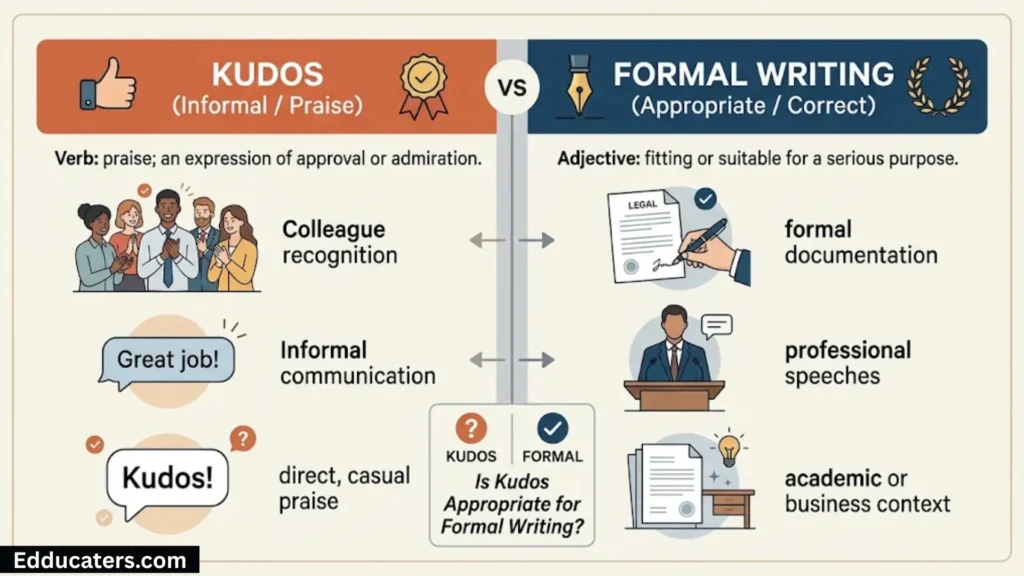
Yes. Kudos is an established English word, not simply internet slang or an informal expression.
You can use it in professional communication, business writing, workplace announcements, and news articles. However, its tone is generally appreciative and conversational.
Whether it suits your writing depends on the audience and situation.
For example:
- Casual: Kudos to you for finishing the project!
- Professional: Kudos to the team for delivering excellent results.
- More formal: The team deserves recognition for its outstanding performance.
All three sentences communicate appreciation, but their tones differ.
In highly formal writing, words such as commendation, recognition, and appreciation may sound more appropriate.
When Should You Use Kudos?
Consider using kudos in these situations:
- Friendly professional emails.
- Team announcements and internal messages.
- Employee recognition posts.
- Informal reports and presentations.
- Social media appreciation posts.
- Conversations about achievements and success.
For example:
“Kudos to the research department for completing the investigation.”
This sentence sounds natural in an internal workplace announcement.
When Should You Choose Another Word?
Although kudos works in many situations, some contexts call for more precise language.
| Situation | Better word or expression |
| Official award announcement | Commendation |
| Formal employee evaluation | Recognition |
| Thanking someone for assistance | Appreciation |
| Celebrating someone’s success | Congratulations |
| Acknowledging a specific contribution | Credit |
The goal isn’t to avoid kudos in formal writing. Instead, choose the expression that best matches your audience and message.
Kudos Synonyms and Alternatives
Several English words share a meaning with kudos. However, they don’t always work as exact replacements.
The best alternative depends on whether you want to express admiration, gratitude, congratulations, or formal recognition.
Here are some useful synonyms for kudos:
| Synonym | Meaning | Example |
| Praise | Expressing approval or admiration | She received praise for her presentation. |
| Recognition | Acknowledging someone’s achievement | His contribution deserves recognition. |
| Appreciation | Showing gratitude or value | We appreciate your hard work. |
| Commendation | Formal praise for good work | She received a commendation for her service. |
| Congratulations | Celebrating someone’s success | Congratulations on your promotion! |
| Credit | Acknowledging someone’s contribution | Give him credit for the idea. |
| Acclaim | Public or enthusiastic praise | The performance received critical acclaim. |
| Applause | Expressing approval or admiration | The audience gave the performers applause. |
| Honor | Recognition for achievement or distinction | The award honors her contribution. |
| Admiration | Respect for someone’s qualities or actions | Her dedication earned everyone’s admiration. |
Kudos or Commendation?
Both words express approval or recognition, but their tones differ.
Kudos usually sounds conversational and appreciative. Commendation often carries a more formal meaning, especially when an organization officially recognizes someone’s work.
Examples:
- Kudos to the employee for solving the problem.
- The employee received a commendation for outstanding service.
The first sentence sounds friendly and informal. The second suggests a more formal recognition.
Use kudos for everyday appreciation and commendation when discussing official praise or recognition.
Kudos or Congratulations?
These expressions overlap, but they don’t communicate exactly the same thing.
Kudos recognizes someone’s merit, effort, or achievement. Congratulations expresses happiness or good wishes when something positive happens.
Compare these examples:
- Kudos to you for working so hard on the project.
- Congratulations on completing the project!
The first recognizes effort. The second celebrates the successful result.
You can also use both expressions together:
“Congratulations on your promotion! Kudos for all the hard work that got you there.”
This sentence celebrates the achievement while acknowledging the effort behind it.
Common Kudos Spelling and Grammar Mistakes
People sometimes make mistakes with kudos because its spelling and grammatical structure aren’t immediately obvious.
Its final S creates confusion. Some writers also replace K with C because the two letters can represent similar sounds.
Here are the mistakes worth remembering.
| Common mistake | Correct form | Explanation |
| Cudos | Kudos | The standard spelling begins with K. |
| Kudoes | Kudos | This isn’t the standard form. |
| Kudo’s (as a plural) | Kudos | Apostrophes don’t normally form plurals. |
| A kudos | A word of praise | Traditional usage treats kudos as uncountable. |
| Cudos to you | Kudos to you | Use K when expressing praise. |
Why Do People Spell Kudos as Cudos?
There are several reasons people accidentally write cudos instead of kudos.
Pronunciation is the biggest reason. In English, the letters C and K can represent the same hard consonant sound.
For example:
- Cat
- Kite
- Credit
- Kind
When people hear kudos, they might associate its opening sound with C rather than K.
Another reason involves unfamiliarity. Unlike everyday words such as kind or credit, kudos has a Greek origin that many English speakers don’t immediately recognize.
Autocorrect and typing habits can also contribute to repeated spelling errors.
To avoid the mistake, remember this simple rule:
Kudos begins with K because it comes from the Greek word κῦδος.
Does Kudos Need an Apostrophe?
No. You don’t need an apostrophe when writing the ordinary word kudos.
An apostrophe generally indicates possession or represents omitted letters in a contraction.
For example:
- The employee’s presentation was excellent.
- The team’s performance deserved recognition.
- Everyone’s contribution mattered.
However, kudos already has its established spelling. Adding an apostrophe doesn’t make it plural.
Compare:
- Incorrect: Cudos for your excellent work!
- Incorrect: Kudo’s for your excellent work!
- Correct: Kudos for your excellent work!
Keep the spelling simple. No extra letters or apostrophes are necessary.
Is Kudos Different in American and British English?
No. American English and British English use the same standard spelling: kudos.
However, the two varieties can differ in pronunciation.
American speakers commonly pronounce the word with a long OO sound and a final voiced Z sound. British speakers commonly use a YOO sound at the beginning and a final S sound.
| Feature | American English | British English |
| Spelling | Kudos | Kudos |
| Common IPA | /ˈkuː.doʊz/ | /ˈkjuː.dɒs/ |
| General meaning | Praise or recognition | Praise or recognition |
| Regional spelling alternative | None | None |
These pronunciation patterns aren’t rigid rules. Individual speakers may use different accepted pronunciations.
The important point is that pronunciation doesn’t change the spelling.
You shouldn’t write cudos simply because you speak American English, British English, or another variety.
The same standard spelling works across English-speaking regions, including Canada, Australia, India, and New Zealand.
Frequently Asked Questions About Cudos or Kudos
Here are direct answers to common questions about the correct spelling, meaning, pronunciation, and grammar of kudos.
Is It Cudos or Kudos?
Kudos is correct. It means praise, honor, or recognition for someone’s achievement. Cudos is a common misspelling when someone intends to express appreciation.
Is Cudos Ever an Accepted Spelling?
No. Cudos isn’t an accepted alternative spelling of the standard English word kudos. However, it may appear as a company name, brand name, or username.
How Do You Spell Kudos?
The correct spelling is K-U-D-O-S. It begins with K, not C, and ends with S. You don’t need an apostrophe or additional letters.
What Does Kudos Mean in English?
Kudos means praise, admiration, honor, or recognition for someone’s achievement or contribution. For example, “Kudos to the team for completing the project successfully” recognizes the team’s hard work.
Why Is Kudos Spelled With a K?
The word comes from Ancient Greek κῦδος (kŷdos). Greek uses the letter kappa to represent the hard K sound. English retains that historical spelling.
Is Kudos Singular or Plural?
Originally, kudos was a singular Greek noun. English traditionally uses it as a singular or uncountable noun. However, some modern speakers treat it as plural or use kudo as a singular count noun.
Can You Say Kudos to You?
Yes. “Kudos to you” is a correct expression of praise. You can use it when someone achieves something impressive, helps another person, or performs exceptionally well.
Is Kudos Appropriate in a Professional Email?
Yes. Kudos works well in friendly professional emails and workplace messages. For highly formal communication, you might prefer recognition, appreciation, or commendation.
What Is Another Word for Kudos?
Common alternatives include praise, recognition, appreciation, commendation, acclaim, admiration, and credit. Choose the word that best matches your intended meaning.
Is Kudo’s the Same as Kudos?
No. Kudo’s isn’t the standard spelling of kudos. An apostrophe doesn’t create a plural. Use kudos when expressing praise or recognition.
Is Kudoes Correct?
No. Kudoes isn’t the standard spelling. The correct established form is kudos. You shouldn’t add -es to create another form.
Is Kudos a British or American Word?
Kudos is used in both American and British English. Its spelling and general meaning remain the same across both varieties.
Conclusion: Cudos or Kudos?
When choosing between cudos or kudos, always use kudos when you mean praise, admiration, or recognition.
The word comes from Ancient Greek kŷdos, which explains why it begins with K rather than C. Although its final S makes it look plural, traditional English usage treats kudos as a singular or uncountable noun.
Remember these simple points:
- Kudos is the correct standard spelling.
- Cudos is a common misspelling.
- Kudos means praise, honor, or recognition.
- The word comes from Ancient Greek.
- American and British English use the same spelling.
- You don’t need an apostrophe to write kudos.
So, the next time someone accomplishes something impressive, you can confidently say:
“Kudos to you for getting it right!”

I’m Julian Mercer, an English language writer dedicated to helping people master grammar through practical examples and clear explanations. I enjoy teaching grammar in a way that is both engaging and easy to remember.
My work focuses on grammar rules, punctuation, word usage, and writing techniques that readers can apply in everyday life. I believe learning English should be simple, enjoyable, and useful.
Books
English Grammar in Practice
Writing with Precision
 Nathan Whitmore