Have you ever paused while writing because you couldn’t decide between loses or looses? You’re not alone. These words look almost identical, sound remarkably similar, and both appear in standard English dictionaries. However, they don’t mean the same thing.
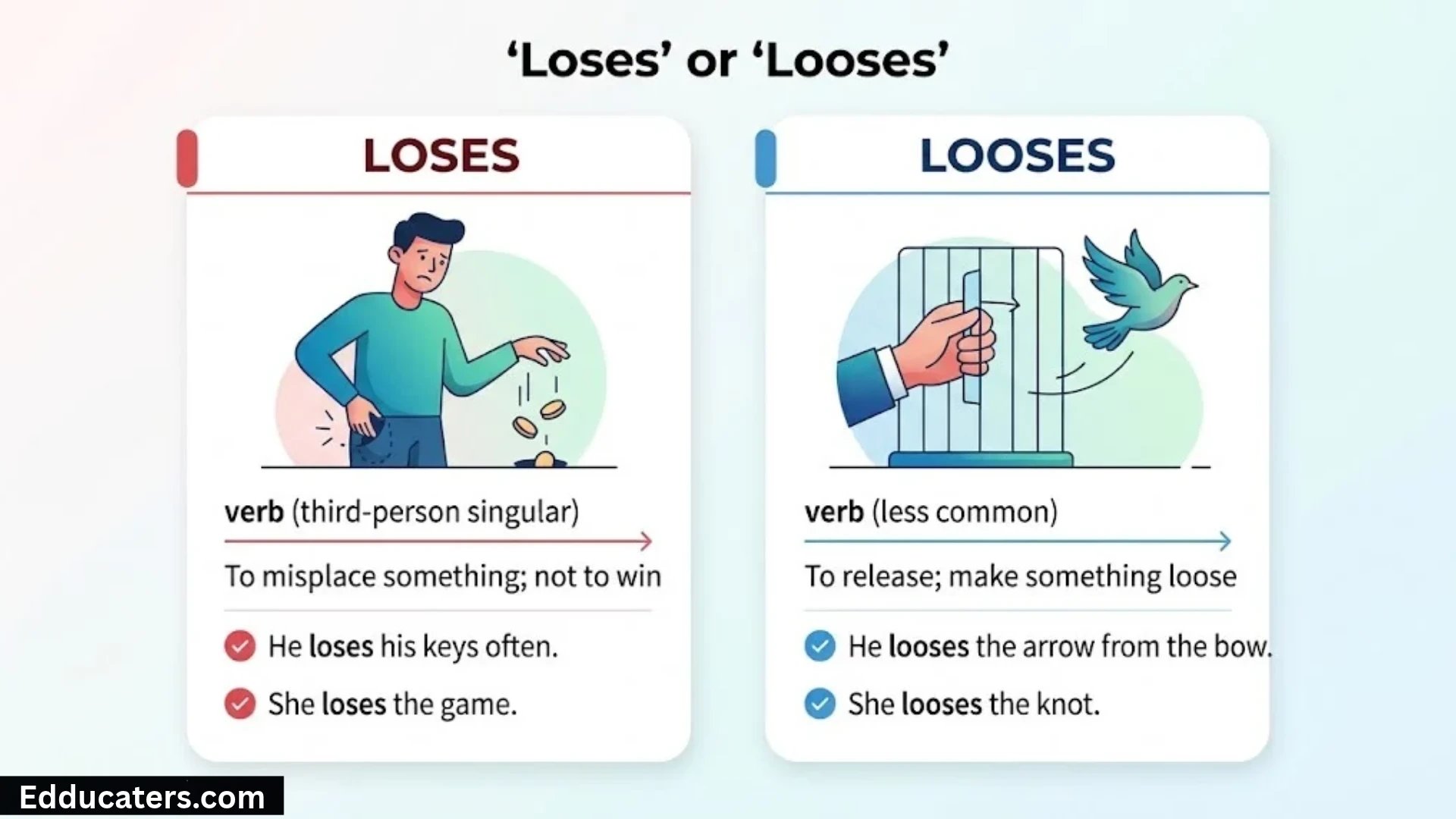
The correct choice depends on what you want to express. Loses comes from the verb lose and describes misplacing something, failing to win, or no longer having something. Looses comes from the verb loose and means releases, sets free, or unties something.
For example:
- Loses: Sarah loses her keys whenever she rushes out of the house.
- Looses: The archer looses an arrow toward the distant target.
Notice the difference? Sarah misplaces something, while the archer releases something.
Although loses appears much more frequently in everyday writing, looses is also grammatically correct in the right context. Understanding their meanings, spelling patterns, and grammatical forms will help you avoid this common English spelling mistake.
Let’s examine both words, their differences, and the situations in which you should use each one.
What Is the Difference Between Loses and Looses?
The main difference between loses and looses comes from their base verbs: lose and loose. Although these verbs share similar spellings, they have different meanings and grammatical functions.
Loses is the third-person singular present-tense form of lose. You use it when someone misplaces something, fails to win, or stops possessing something.
Looses is the third-person singular present-tense form of loose when loose functions as a verb. It describes someone releasing, freeing, or setting something loose.
Here’s a quick comparison:
| Feature | Loses | Looses |
| Base verb | Lose | Loose |
| Part of speech | Verb | Verb |
| Grammatical form | Third-person singular | Third-person singular |
| Main meaning | Misplaces, no longer has, or fails to win | Releases, frees, or unties |
| Spelling | One O in the base verb | Two Os in the base verb |
| Pronunciation | /ˈluːzɪz/ | /ˈluːsɪz/ |
| Everyday usage | Very common | Relatively uncommon |
| Example | She loses her keys. | He looses the arrow. |
Consider these additional examples:
- The company loses money when sales decline.
- The farmer looses the horses into the pasture.
- My brother loses his patience during arguments.
- The archer looses another arrow.
The easiest way to distinguish them is to replace each word with its base verb.
If you mean misplace or fail to keep, choose loses. If you mean release or set free, choose looses.
What Does Loses Mean?
Loses is a form of the verb lose. It describes situations in which someone no longer has something, cannot find something, fails to win, or experiences a decrease.
The word lose has several meanings depending on its context. You might lose your wallet, lose a competition, lose confidence, or lose an opportunity.
In each situation, something disappears, becomes unavailable, or moves out of your possession or control.
The word loses specifically works with third-person singular subjects in the simple present tense.
For example:
- He loses his phone frequently.
- She loses interest in complicated discussions.
- The team loses important matches.
- The business loses customers every month.
When to Use Loses in a Sentence
You should use loses whenever the subject is he, she, it, or a singular noun and the intended meaning relates to losing something.
Here are the most common situations.
1. When Someone Misplaces Something
Use loses when someone cannot find an object they previously possessed.
Examples:
- She loses her house keys almost every week.
- My father loses his reading glasses frequently.
- He loses his wallet whenever he travels.
- The student loses important documents before examinations.
In these examples, the people cannot locate their belongings.
2. When Someone Fails to Win
Use loses when a person, team, or organization doesn’t win a competition, match, or contest.
Examples:
- Our school team loses another football match.
- She loses the tennis competition despite playing well.
- The defending champion loses the final round.
- His team loses against its strongest rival.
Remember that loses describes the outcome of a competition rather than the disappearance of a physical object.
3. When Someone No Longer Possesses Something
The verb also describes situations in which someone stops having something valuable, important, or meaningful.
Examples:
- He loses his job after the company closes.
- She loses an important business opportunity.
- The family loses its home during the disaster.
- The company loses several major clients.
4. When Something Decreases
You can use loses to describe a reduction in weight, money, value, strength, or another measurable quality.
Examples:
- The company loses money during difficult economic periods.
- She loses weight through regular exercise.
- The old building loses value over time.
- The battery loses power throughout the day.
5. When Someone Loses an Emotion or Ability
The word also appears in expressions involving feelings, mental states, and personal qualities.
Examples:
- He loses confidence before important presentations.
- She loses patience when people ignore instructions.
- The child loses interest in the activity.
- My brother loses control whenever he gets angry.
Loses in Example Sentences
The following examples show how loses works in different everyday situations.
| Sentence | Meaning |
| She loses her keys frequently. | She cannot find her keys. |
| He loses every chess match. | He fails to win. |
| The company loses money. | Its finances decrease. |
| My friend loses confidence easily. | His confidence disappears. |
| The student loses focus. | The student becomes distracted. |
| She loses her job. | She no longer has employment. |
| The team loses its captain. | The team no longer has its captain. |
| He loses his way in unfamiliar places. | He becomes unable to find the correct route. |
| The business loses customers. | Customers stop buying from it. |
| She loses interest in the subject. | The subject no longer interests her. |
A useful grammatical point: loses is not interchangeable with lose in every sentence.
Compare:
- I lose my keys.
- You lose your keys.
- They lose their keys.
- She loses her keys.
The verb changes according to the subject. This is an important part of correct English grammar.
What Does Looses Mean?
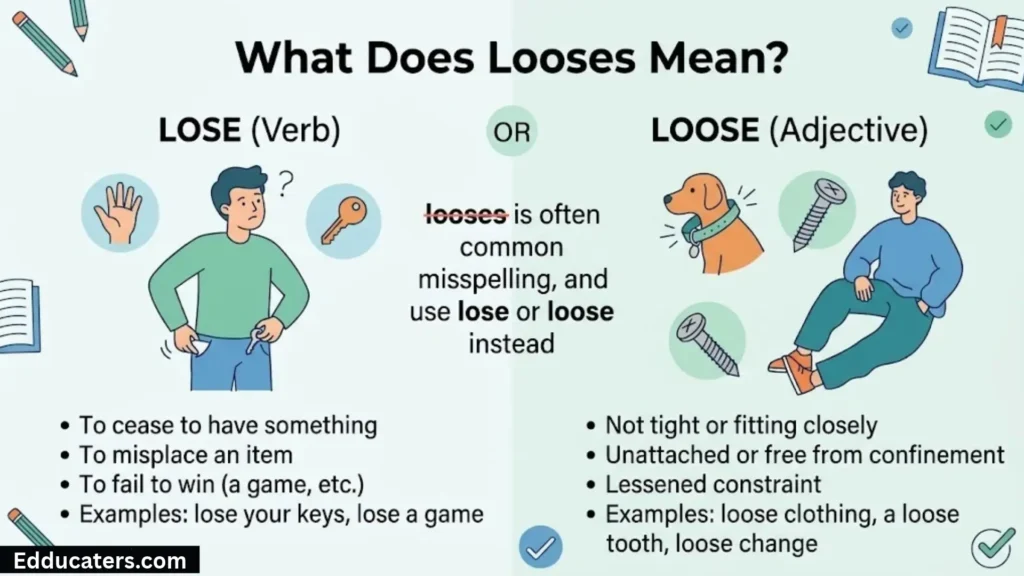
Looses is the third-person singular present-tense form of the verb loose. As a verb, loose means to release, free, untie, or let something go.
Unlike loses, which appears frequently in everyday conversation, looses is relatively uncommon. You might encounter it in descriptions of archery, animals, historical writing, literature, or situations involving the release of something restrained.
For example:
- The archer looses an arrow.
- The farmer looses the horses into the field.
- She looses the bird from its cage.
In each sentence, someone releases something that was previously held, contained, or restrained.
It’s important to distinguish the verb loose from the much more familiar adjective loose.
As an adjective, it describes something that isn’t tight, secure, or firmly attached.
For example:
- He wears a loose shirt.
- The chair has a loose screw.
- She prefers loose clothing.
These examples describe conditions rather than actions. They don’t require the verb form looses.
When to Use Looses in a Sentence
Use looses when a singular third-person subject performs the action of releasing or setting something free.
Here are some situations where the word makes sense.
1. When Someone Releases an Animal
The verb can describe letting an animal go from a place or restraint.
Examples:
- The farmer looses the horses into the pasture.
- She looses the bird from its cage.
- The handler looses the dog in the training area.
2. When Someone Releases an Arrow
This is one of the clearest traditional uses of looses.
In archery, an archer draws a bowstring and then releases it to send an arrow toward a target.
Examples:
- The archer looses an arrow toward the target.
- He carefully looses the final arrow.
- The skilled hunter looses an arrow from his bow.
Here, looses describes the physical act of releasing the arrow.
3. When Someone Frees Something From Restraint
You can also use the verb when someone releases a rope, object, or another restrained item.
Examples:
- He looses the rope from its fastening.
- The sailor looses the secured line.
- She looses the animal from its restraint.
4. When Someone Unleashes Something
In literary or figurative writing, looses can describe releasing something powerful or allowing it to spread.
Examples:
- The storm looses powerful winds across the coastline.
- The villain looses a wave of destruction.
- The speaker looses a sharp criticism against the proposal.
These examples use the word in a more expressive sense. The subject releases something rather than misplacing it.
Looses in Example Sentences
Here are additional examples showing how this less common verb works.
- The archer looses an arrow at the wooden target.
- She looses the bird into the open sky.
- The farmer looses the horses in the meadow.
- He looses the rope from its anchor.
- The hunter looses another arrow before sunset.
- The handler looses the trained dog in the field.
- The storm looses its fury against the village.
- The character looses a powerful attack against his enemy.
Although these sentences are grammatically correct, you shouldn’t force looses into ordinary writing when another expression sounds more natural.
For instance, releases the bird may sound more familiar than looses the bird. Both can communicate the intended action.
Loses vs. Looses: Spelling and Pronunciation Differences
The spelling difference between loses and looses might seem minor, but that extra O changes the meaning of the base word. Their pronunciation also contains an important consonant distinction.
Understanding these differences makes it easier to recognize the correct word, especially when you’re writing quickly.
Spelling Difference Between Loses and Looses
The easiest way to understand their spelling is to look at their original verbs.
- Lose → Loses: The base verb lose contains one O. Add -s to form loses.
- Loose → Looses: The base verb loose contains two Os. Add -s to form looses.
Both words follow a regular spelling pattern when forming the third-person singular present tense.
Here’s how their forms compare:
| Grammatical form | Lose | Loose |
| Base form | Lose | Loose |
| Third-person singular | Loses | Looses |
| Past tense | Lost | Loosed |
| Past participle | Lost | Loosed |
| Present participle | Losing | Loosing |
Notice that the two verbs also have different past-tense forms.
For example:
- She lost her phone yesterday.
- The archer loosed an arrow yesterday.
The past tense of lose is irregular because it changes to lost. However, loose follows the regular pattern by adding -d.
This distinction matters when you’re checking a sentence’s grammar rather than just its spelling.
Pronunciation Difference Between Loses and Looses
Although loses and looses look similar, their base verbs have different final consonant sounds.
| Word | IPA pronunciation | Final consonant |
| Lose | /luːz/ | Voiced /z/ |
| Loose | /luːs/ | Unvoiced /s/ |
| Loses | /ˈluːzɪz/ | Voiced /z/ in the base |
| Looses | /ˈluːsɪz/ | Unvoiced /s/ in the base |
Both base verbs contain the same long U sound, represented by /uː/.
However, lose ends with /z/, while loose ends with /s/. The added -es gives both third-person forms an additional syllable.
Oxford Learner’s Dictionaries+3
How can you hear the difference?
Try saying these pairs aloud:
- Lose and loose.
- Loses and looses.
- Losing and loosing.
When you pronounce lose, your vocal cords vibrate during the final consonant. When you pronounce loose, you produce an unvoiced sound.
You can feel the difference by placing your fingers lightly against your throat while saying each word.
- The /z/ sound produces noticeable vibration.
- The /s/ sound produces airflow without vocal-cord vibration.
This small pronunciation difference helps explain why the words aren’t interchangeable.
Losing or Loosing: Which Spelling Is Correct?
Another common spelling confusion involves losing and loosing.
Both are legitimate English words. However, they come from different base verbs and describe different actions.
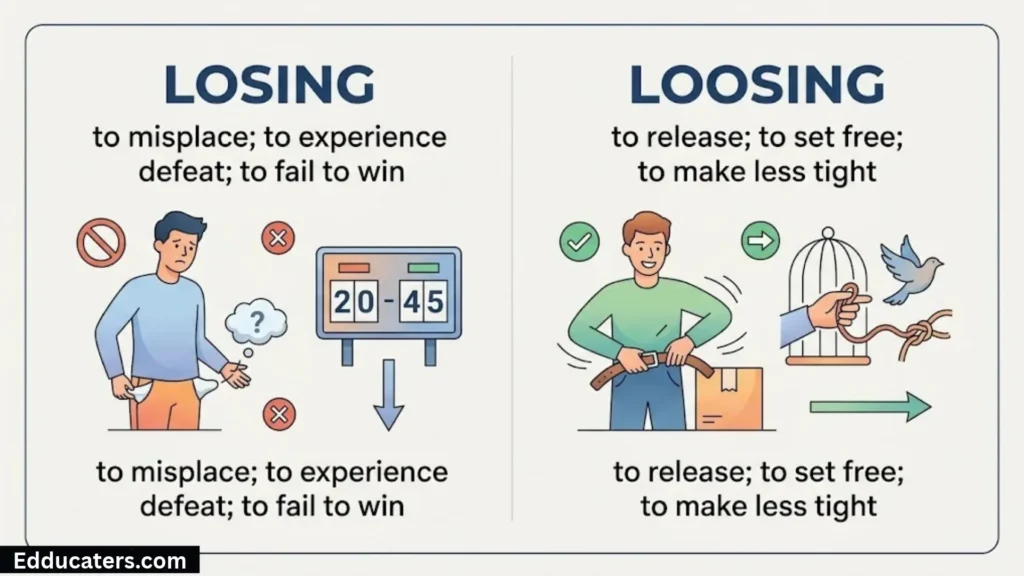
Losing is the present participle of lose. It describes misplacing something, failing to win, or no longer possessing something.
Loosing is the present participle of loose. It describes releasing, freeing, or setting something loose.
Compare these sentences:
- She is losing her keys.
- She is loosing the bird from its cage.
The first sentence describes someone misplacing her keys. The second describes someone releasing a bird.
The difference becomes clearer when you examine their grammatical forms.
| Word | Base verb | Present participle | Meaning |
| Lose | Lose | Losing | Misplacing or no longer having something |
| Loose | Loose | Loosing | Releasing or setting something free |
When to Use Losing
Use losing when the action involves losing possession, failing to win, or experiencing a decrease.
It commonly appears with helping verbs such as am, is, and are to form the present continuous tense.
Examples:
- I am losing my patience.
- She is losing her favorite necklace.
- Our team is losing the championship game.
- The company is losing money.
- He is losing confidence before the interview.
- They are losing valuable customers.
- My phone is losing battery power.
- The child is losing interest in reading.
You can also use losing as a gerund, meaning it functions as a noun.
For example:
- Losing a close friend can be painful.
- Nobody enjoys losing an important competition.
- Losing weight requires consistent lifestyle habits.
In these sentences, losing names an action or experience rather than describing an ongoing action performed by the subject.
When to Use Loosing
Use loosing when someone releases or sets something free.
This form is less common in everyday English. You’ll find it more often in formal, literary, historical, or descriptive writing.
Examples:
- The archer is loosing arrows at the target.
- The farmer is loosing his horses into the pasture.
- She is loosing the bird from its cage.
- The hunter is loosing another arrow.
- He is loosing the rope from its fastening.
- The character is loosing a powerful attack against his enemy.
There’s one useful distinction worth remembering.
When you mean making something less tight, English speakers generally prefer loosening rather than loosing.
For example:
- She is loosening the tight belt.
- He is loosening the screws.
- The mechanic is loosening the bolts.
Loosing means releasing something. Loosening means making something less tight or less firmly fixed.
These meanings overlap in some situations, but the words aren’t always interchangeable.
Losing vs. Loosing Example Sentences
Use the following examples to see how one letter changes the meaning.
| Losing | Loosing |
| She is losing her patience. | She is loosing the bird. |
| He is losing money. | He is loosing an arrow. |
| They are losing the match. | They are loosing the horses. |
| I am losing my keys. | The hunter is loosing another arrow. |
| The company is losing customers. | He is loosing the rope. |
| She is losing confidence. | The archer is loosing his final arrow. |
Quick reminder: If you mean misplacing something, choose losing. If you mean releasing something, choose loosing.
Common Mistakes When Using Loses or Looses
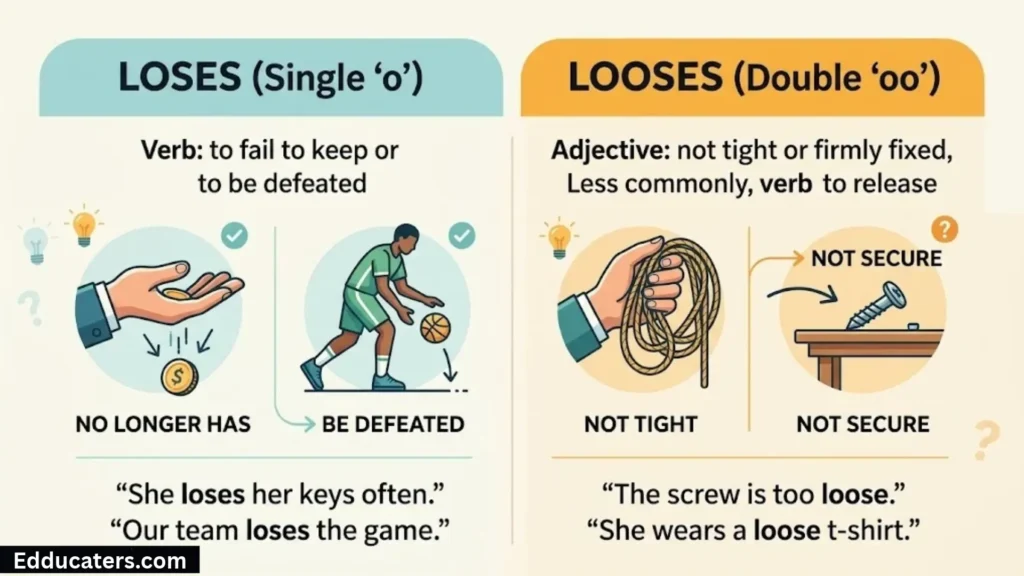
Even experienced writers sometimes confuse these words. Their similar appearance makes it easy to type the wrong spelling without noticing.
However, a small spelling error can change the meaning of an entire sentence.
Here are some common mistakes and their corrections.
Confusing Loses With Looses
The most frequent mistake involves using looses when the intended meaning is loses.
For example:
- Incorrect: She looses her keys every morning.
- Correct: She loses her keys every morning.
The sentence describes someone misplacing her keys. Therefore, loses is the correct choice.
Other examples include:
- Incorrect: He looses every football match.
- Correct: He loses every football match.
- Incorrect: Nobody wants to loose their job.
- Correct: Nobody wants to lose their job.
- Incorrect: I don’t want to loose you.
- Correct: I don’t want to lose you.
The last example is especially common because people sometimes add an unnecessary O when writing lose.
Confusing Losing With Loosing
Another frequent error occurs when writers use loosing instead of losing.
For example:
- Incorrect: I am loosing my phone.
- Correct: I am losing my phone.
- Incorrect: The team is loosing the game.
- Correct: The team is losing the game.
- Incorrect: She is loosing interest in her studies.
- Correct: She is losing interest in her studies.
Remember that losing comes from lose, while loosing comes from loose.
Confusing Loose With Loses
Sometimes, writers understand the general meaning but choose the wrong grammatical form.
For example:
- Incorrect: My shoes are loses.
- Correct: My shoes are loose.
Why?
The sentence describes the condition of the shoes. It doesn’t describe an action.
Therefore, you need the adjective loose, meaning the shoes don’t fit tightly.
Here are more examples:
| Incorrect | Correct | Explanation |
| My shirt is loses. | My shirt is loose. | Describes clothing that isn’t tight. |
| The screw is loses. | The screw is loose. | Describes something that isn’t secure. |
| Her shoes feel loses. | Her shoes feel loose. | Describes an improper fit. |
| The connection is loses. | The connection is loose. | Describes an insecure connection. |
Common Loses or Looses Mistakes at a Glance
| Incorrect sentence | Correct sentence |
| She looses her keys. | She loses her keys. |
| I don’t want to loose you. | I don’t want to lose you. |
| He looses the match. | He loses the match. |
| The team is loosing. | The team is losing. |
| My clothes are loses. | My clothes are loose. |
| The archer loses an arrow. | The archer looses an arrow. |
| She is loosing patience. | She is losing patience. |
The final example deserves attention: loosing patience isn’t the standard expression when you mean becoming impatient. Use losing patience.
How to Remember the Difference Between Loses and Looses
You don’t need to memorize complicated grammar rules to distinguish these words. A couple of simple memory techniques can help you choose the right spelling.
The One O and Two Os Memory Trick
One of the easiest ways to remember the difference is to connect the number of Os with the meaning.
Lose has one O. Use it when something disappears, you misplace something, or you fail to win.
Examples:
- Lose your keys.
- Lose a game.
- Lose money.
- Lose confidence.
Loose has two Os. Think of the extra O as extra room in loose clothing.
Examples:
- Loose trousers.
- Loose shoes.
- Loose clothing.
- A loose belt.
This isn’t a formal spelling rule. It’s simply a spelling memory aid that makes the distinction easier to remember.
You can also remember this sentence:
You can lose your loose shoes.
Here, lose describes misplacing something, while loose describes how the shoes fit.
Check the Meaning Before Choosing
Another reliable method is to replace the word with a simpler alternative.
Ask yourself what you actually mean.
If you mean misplace, fail to win, or no longer have, use a form of lose.
If you mean release, free, or set something loose, use a form of loose.
Consider these examples:
| Your intended meaning | Correct word | Replacement test |
| Misplace something | Loses | Misplaces |
| Fail to win | Loses | Is defeated |
| No longer possess | Loses | No longer has |
| Release something | Looses | Frees |
| Set something free | Looses | Releases |
| Untie something | Looses | Unties |
This method works because it focuses on meaning rather than appearance.
Remember the Difference Between Their Base Verbs
When you’re unsure about loses or looses, remove the final S.
You’ll get either lose or loose.
Then check which base verb makes sense in your sentence.
For example:
- She loses her wallet. → She lose her wallet.
- He looses the bird. → He loose the bird.
The second versions aren’t grammatically correct as complete sentences because the verb forms have changed. However, the exercise helps you identify the underlying verb.
Once you recognize the intended meaning, you can restore the correct third-person form.
Loses or Looses: Quick Comparison Table
If you need a quick reminder while writing, this table summarizes the essential differences.
| Feature | Lose | Loses | Loose | Looses |
| Part of speech | Verb | Verb | Adjective or verb | Verb |
| Meaning | Misplace or fail to keep | Misplaces or fails to keep | Not tight or securely attached; also release | Releases or sets free |
| Spelling | One O | One O | Two Os | Two Os |
| Example | I lose my keys. | She loses her keys. | My shirt is loose. | He looses the arrow. |
| Related form | Losing | Losing | Loosening | Loosing |
The most important distinction is that lose and loose are different base words. Their grammatical forms follow different patterns.
Keep these four examples in mind:
- Lose: I don’t want to lose my wallet.
- Loses: She loses her wallet frequently.
- Loose: My wallet has a loose strap.
- Looses: The character looses the animal from its cage.
Once you understand these differences, choosing the correct word becomes much easier.
Frequently Asked Questions About Loses or Looses
Here are answers to common questions about the spelling, meaning, pronunciation, and grammatical usage of these words.
Is It Loses or Looses?
Both loses and looses are correct English words, but they have different meanings.
Use loses when someone misplaces something, fails to win, or no longer possesses something.
Use looses when someone releases or sets something free.
For example:
- She loses her phone frequently.
- He looses the arrow toward the target.
The intended meaning determines which spelling you need.
Is Looses a Real Word?
Yes, looses is a real English word. It’s the third-person singular present-tense form of the verb loose.
It means releases, frees, or sets something loose.
For example:
- The archer looses an arrow.
- The farmer looses the horses into the field.
However, looses is relatively uncommon compared with loses. You’ll encounter it more often in formal, literary, or descriptive contexts.
Is It Losing or Loosing?
Both losing and loosing are correct spellings, but they come from different verbs.
- Losing: Present participle of lose. It means misplacing something, failing to win, or no longer having something.
- Loosing: Present participle of loose. It means releasing or setting something free.
Examples:
- She is losing her keys.
- The archer is loosing an arrow.
If you’re talking about losing something valuable, losing is almost always the word you need.
What Is the Difference Between Lose, Loses, Loose, and Looses?
These four words have different grammatical functions and meanings.
| Word | Meaning | Example |
| Lose | Misplace or fail to keep something | I don’t want to lose my phone. |
| Loses | Third-person singular form of lose | He loses his phone frequently. |
| Loose | Not tight or securely attached | My shirt is loose. |
| Looses | Third-person singular form of loose | The archer looses an arrow. |
Remember that loose can function as an adjective or a verb. Its verb forms include looses, loosed, and loosing.
Can Loose Be Used as a Verb?
Yes. Although loose usually functions as an adjective, it can also work as a verb.
As a verb, loose means to release, free, or let something go.
For example:
- The archer looses an arrow.
- She looses the bird from its cage.
- He loosed the rope from its fastening.
The verb often appears in formal or literary writing. In everyday conversations, people frequently choose alternatives such as release, free, or let go.
Also, don’t confuse loose with loosen. The verb loosen means to make something less tight.
Why Do People Confuse Loses and Looses?
People confuse loses and looses because their spellings look almost identical.
Both words contain the same letters, except that looses has an additional O. Their pronunciations also share the same long U sound.
However, their meanings are different.
Another reason involves the familiar adjective loose. Because people frequently use this word to describe clothing, shoes, and objects that aren’t tightly secured, they sometimes mistakenly use it when writing about losing something.
For example, someone might write:
- Incorrect: I don’t want to loose my job.
- Correct: I don’t want to lose my job.
Understanding the base verbs helps prevent this mistake.
How Do You Pronounce Loses and Looses?
The words have slightly different pronunciations.
- Loses: /ˈluːzɪz/
- Looses: /ˈluːsɪz/
The main difference comes from the final consonant sound in their base verbs.
Lose ends with a voiced /z/ sound, while loose ends with an unvoiced /s/ sound.
Both words have two syllables when written in their third-person singular forms.
What Is the Correct Spelling: Nobody Wants to Lose You or Nobody Wants to Loose You?
The correct sentence is:
Nobody wants to lose you.
Here, lose means no longer having someone in your life or experiencing their absence.
The word loose doesn’t express this meaning. It refers to something that isn’t tight or, as a verb, to releasing something.
For example:
- Nobody wants to lose a close friend.
- I don’t want to lose someone I love.
- She doesn’t want to lose her family.
In all these sentences, lose is the correct choice.
Is It Don’t Lose or Don’t Loose?
The correct expression is don’t lose when you’re telling someone not to misplace something or give something up.
Examples:
- Don’t lose your keys.
- Don’t lose your confidence.
- Don’t lose this opportunity.
- Don’t lose your way.
However, don’t loose can be grammatically correct when you mean don’t release or set something free.
For example:
- Don’t loose the horses before the gate opens.
- Don’t loose the arrow until you receive the signal.
The meaning determines the correct spelling.
Is Loosing the Same as Loosening?
No. Although the words look related, they describe different actions.
Loosing means releasing or setting something free.
Loosening means making something less tight, secure, or firmly attached.
Compare:
- The farmer is loosing the horses into the field.
- The farmer is loosening the horses’ tight harnesses.
The first sentence describes releasing the animals. The second describes making their harnesses less tight.
What Is the Opposite of Loose?
The most common opposite of loose is tight.
Depending on the context, other opposites include:
- Secure
- Firm
- Fastened
- Attached
- Restrained
- Closely fitted
Examples:
- Loose clothing → Tight clothing
- Loose screw → Secure screw
- Loose connection → Firm connection
- Loose grip → Tight grip
The best opposite depends on what loose describes in your sentence.
Conclusion: Loses or Looses
The difference between loses or looses becomes simple once you understand their base verbs.
Loses comes from lose and describes misplacing something, failing to win, or no longer possessing something. Looses comes from loose and describes releasing, freeing, or setting something loose.
Remember this simple spelling trick: lose has one O, while loose has two Os. Think of the extra O as extra room in loose clothing.
Before choosing either word, check what you want to express. If something disappears or you fail to keep it, use loses. If someone releases something, use looses.
A little attention to meaning can prevent a surprisingly common English spelling mistake and make your writing clearer.

Hi, I’m Nathan Whitmore, and I enjoy making English grammar easy for learners of all ages. I believe grammar should be practical, not confusing. I write simple, well-researched guides that help readers improve their writing, speaking, and overall communication skills.
I spend a lot of time studying grammar patterns, sentence construction, punctuation, and modern English usage. My goal is to create lessons that anyone can understand, whether they are students, teachers, or professionals.
Books
Clear English Grammar
The Smart Writer’s Grammar Handbook
 Julian Mercer