Have you ever stopped while writing because you weren’t sure whether to use dialog or dialogue? You’re not alone. These two spellings look slightly different, yet they share the same meaning. The confusion becomes even greater when you encounter both forms in books, professional documents, American publications, and software applications.
So, which spelling should you choose?
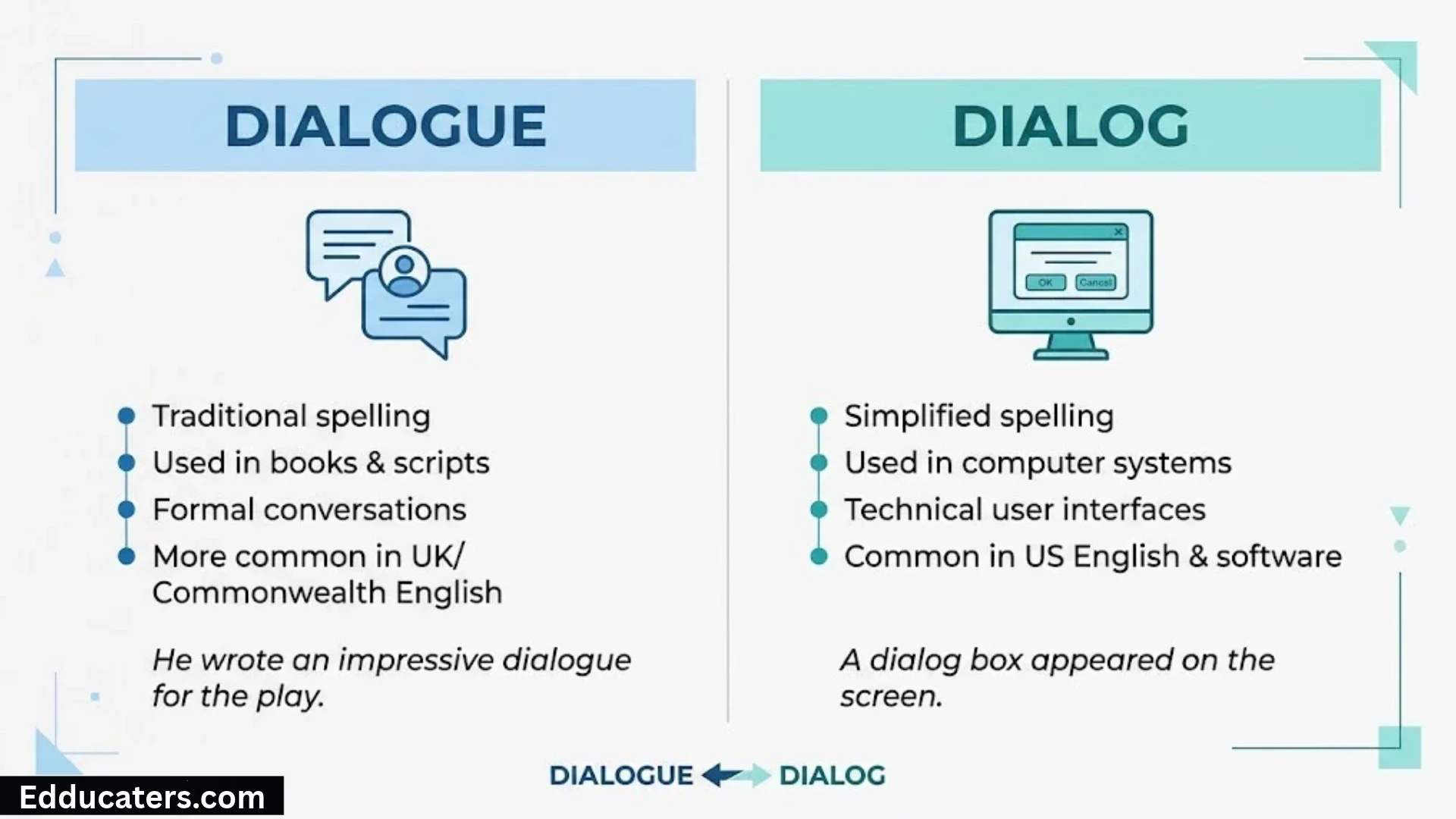
The good news is that both dialogue and dialog are correct English spellings. However, they don’t appear equally often in every region or writing situation. Dialogue is the established spelling in British English and remains widely used in American English. Dialog is an accepted American variant that also appears frequently in computing terminology.
For example, writers generally use dialogue when discussing conversations between characters in novels or movies. Meanwhile, software developers often use dialog box when describing a window that asks users to enter information or select an option.
Understanding these differences will help you choose the right spelling without second-guessing yourself. Let’s explore their meanings, regional preferences, pronunciation, history, and practical applications.
Dialog or Dialogue: What Is the Difference?
The primary difference between dialogue or dialog is their spelling. Both words describe a conversation, discussion, or exchange of ideas between two or more people. Neither spelling changes the fundamental meaning of the word.
The main distinction comes from regional spelling preferences and particular writing conventions.
- Dialogue: The standard spelling in British English and the more widely established form in general international writing.
- Dialog: An accepted alternative spelling in American English, particularly familiar in computing and technical terminology.
Consider these examples:
- The movie features realistic dialogue between its main characters.
- The movie features realistic dialog between its main characters.
Both sentences communicate exactly the same idea. However, the first spelling is more conventional in general literary writing.
Here’s a closer comparison:
| Feature | Dialogue | Dialog |
| Correct spelling | Yes | Yes |
| Basic meaning | Conversation or exchange of ideas | Conversation or exchange of ideas |
| British English | Standard spelling | Less common |
| American English | Widely accepted | Accepted alternative |
| Fiction and literature | Common | Less common |
| Formal writing | Common | Acceptable where appropriate |
| Computing terminology | Used | Common in technical terms |
| International writing | Widely recognized | More regionally associated |
One important detail deserves attention: dialogue isn’t exclusively British, and dialog isn’t exclusively American. American dictionaries recognize both forms. British readers can also encounter dialog in software documentation and American publications.
Therefore, don’t treat these spellings as two completely different words. They represent the same basic vocabulary item with different spelling conventions.
What Does Dialogue Mean?
Dialogue is a noun that describes a conversation or exchange of spoken words between two or more people. It can also refer to written conversations between characters in novels, plays, movies, and television shows.
The word has several related meanings depending on its context.
For example, people use dialogue when discussing everyday communication, professional negotiations, political discussions, and fictional conversations.
Consider these examples:
- The teacher encouraged dialogue between students during the lesson.
- The movie’s dialogue makes every character feel believable.
- Both governments agreed to continue their dialogue about international trade.
- Good workplace dialogue can help employees resolve disagreements.
In each example, the word describes communication or an exchange of ideas.
However, dialogue doesn’t always mean casual conversation. It can also describe serious discussions involving complicated issues, conflicting opinions, or important decisions.
Dialogue as a Conversation
The most familiar meaning of dialogue involves two or more people communicating with one another.
During a conversation, participants exchange information, ask questions, express opinions, and respond to different viewpoints. This interaction creates dialogue.
For example, imagine two friends discussing their weekend plans:
“Are you free on Saturday?” Sarah asked.
“I think so. Why?” Michael replied.
“I was thinking about visiting the museum.”
“That sounds interesting. What time should we go?”
This short exchange represents everyday dialogue. Each person contributes to the conversation and responds to the other.
Dialogue also appears in professional environments.
A manager might encourage dialogue between employees to understand workplace concerns. Similarly, teachers use classroom dialogue to help students explore unfamiliar subjects.
Common expressions include:
- Open dialogue: Honest communication without unnecessary restrictions.
- Constructive dialogue: A discussion intended to produce understanding or positive results.
- Public dialogue: Communication involving members of the public.
- Political dialogue: Discussions between political representatives or groups.
- Intercultural dialogue: Communication between people from different cultural backgrounds.
These expressions demonstrate that dialogue can describe many forms of communication.
Dialogue in Books, Movies, and Plays
In creative writing, dialogue refers to the spoken words exchanged between characters.
Writers use it to develop personalities, reveal emotions, establish relationships, and move stories forward. A well-written conversation can communicate more about a character than several paragraphs of description.
For example:
“Why did you come back?” Emma asked.
“I forgot something,” Daniel replied.
“What?”
He looked toward the empty hallway.
“The truth.”
This brief exchange creates curiosity. Readers immediately wonder what happened and why the character avoided explaining himself.
Dialogue serves several important purposes in storytelling:
- Character development: Reveals personalities, motivations, and relationships.
- Plot development: Introduces information and moves the story forward.
- Emotional expression: Shows happiness, frustration, fear, excitement, or sadness.
- Conflict: Creates tension through disagreements and misunderstandings.
- Realism: Makes fictional situations feel more natural and believable.
You can find dialogue in novels, short stories, screenplays, television scripts, theatrical performances, and comic books.
However, dialogue doesn’t always need quotation marks. Formatting conventions differ between languages, publications, and literary styles.
Dialogue as an Exchange of Ideas
Dialogue also describes a meaningful exchange of opinions between individuals, communities, organizations, or governments.
In this context, the word often suggests communication intended to improve understanding rather than simply exchange information.
For example:
- The two organizations started a dialogue about environmental protection.
- Community leaders encouraged dialogue between different cultural groups.
- The government opened a dialogue with business representatives.
- The conference created opportunities for constructive dialogue.
Notice that these examples don’t describe fictional conversations or casual discussions.
Instead, they involve people or groups communicating about particular issues.
This broader meaning makes dialogue especially useful in journalism, politics, education, diplomacy, and professional communication.
What Does Dialog Mean?

Dialog is an accepted alternative spelling of dialogue. It refers to the same basic concept: a conversation, discussion, or exchange of ideas.
The shorter spelling appears particularly often in American English. It also has an established place in computing terminology.
For example:
- The characters’ dialog makes the story more engaging.
- The software displays a dialog when users open a new file.
- The two departments maintained an ongoing dialog about their responsibilities.
All three sentences use the shorter spelling correctly.
However, the spelling doesn’t have a completely separate definition. You shouldn’t assume that dialog means a computer window while dialogue means a conversation.
Both forms can describe ordinary communication. Their differences primarily involve spelling preferences and established terminology.
Dialog in American English
American English accepts both dialog and dialogue.
Although dialogue remains common in American books, newspapers, academic publications, and everyday writing, dialog is also recognized as a legitimate variant.
The shorter spelling follows a pattern found in several American English words.
Consider these examples:
| Traditional spelling | Common American alternative |
| Dialogue | Dialog |
| Catalogue | Catalog |
| Analogue | Analog |
These examples illustrate a broader spelling pattern. However, they don’t mean that every English word ending in -ogue can automatically lose its final letters.
American writers may encounter dialog in technical manuals, software documentation, business materials, and general publications.
For ordinary writing, either form can work. Your choice should reflect the publication’s spelling preferences and the expectations of your readers.
Dialog in Computing and Technology
One of the most recognizable uses of dialog appears in computing.
A dialog box is a small window that appears within a software application. It communicates information, requests input, or asks users to choose an action.
For example, imagine opening a document in a word-processing application. You select the Save option, but the software needs to know where you want to store the file.
A dialog box might appear with several options:
- File name
- Save location
- File format
- Save button
- Cancel button
You can enter the required information and select an option to continue.
Dialog boxes make software easier to use because they allow applications to communicate directly with users.
Common examples include:
- Confirmation dialog: Asks users to confirm an action.
- Login dialog: Requests account credentials or authentication information.
- File selection dialog: Allows users to locate and select files.
- Warning dialog: Alerts users about a potential problem.
- Error dialog: Explains that something went wrong.
- Save dialog: Helps users choose a filename and storage location.
In technical documentation, dialog is a well-established spelling in expressions such as dialog box.
However, the longer form isn’t automatically wrong. British English documentation may use dialogue box as an alternative.
Dialogue or Dialog in American English and British English
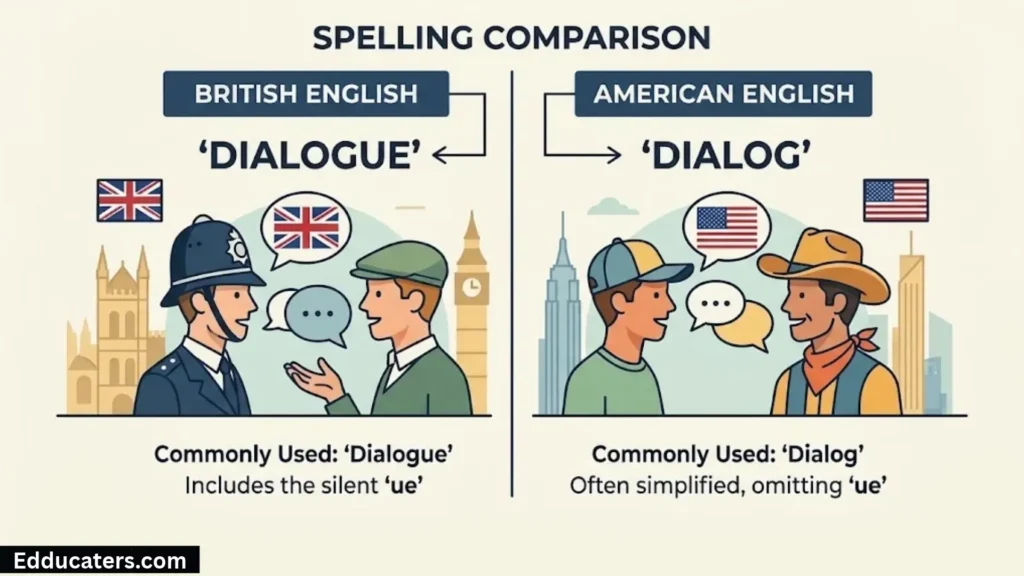
Regional spelling conventions explain much of the confusion surrounding dialogue or dialog.
English has several established varieties. American English and British English share most vocabulary but differ in certain spelling patterns. These differences developed through historical usage, publishing conventions, and regional language preferences.
The important point is that both spellings remain understandable across English-speaking regions.
Dialogue or Dialog in American English
In the United States, both dialogue and dialog are acceptable.
American dictionaries recognize dialog as a variant of dialogue. However, the longer spelling remains widely used in general writing.
For example, American writers commonly use dialogue when discussing:
- Conversations between characters in novels.
- Spoken lines in movies and television shows.
- Discussions between political representatives.
- Communication between colleagues.
- Exchanges of opinions in academic writing.
The shorter form appears in several contexts:
- Software terminology.
- Technical documentation.
- User-interface descriptions.
- Some American publications.
- General writing where the shorter variant is preferred.
Consider these sentences:
- The screenplay contains natural dialogue.
- The application displays a confirmation dialog.
- The two organizations continued their dialogue about workplace policies.
- The software opens a separate dialog when you select the option.
All four examples use accepted American English spelling.
One useful distinction comes from established technical terminology. If a software application consistently uses dialog box, changing that expression to dialogue box may make your documentation less consistent with the product.
Dialogue or Dialog in British English
In British English, dialogue is the established standard spelling.
British writers generally use this form in everyday communication, academic work, fiction, journalism, and professional documents.
For example:
- The author created memorable dialogue between the characters.
- The committee encouraged open dialogue with local residents.
- The film’s dialogue reflects the characters’ different backgrounds.
- The university organized a discussion to promote constructive dialogue.
British readers may also encounter dialog in American publications and technical material.
However, if you’re writing for a British audience, dialogue is usually the safer choice.
This recommendation also applies to many publications that follow British spelling conventions.
Dialogue or Dialog in Australian English and Other English Varieties
Australian English generally follows British spelling conventions in this case. Therefore, dialogue is the conventional choice in Australian writing.
The same preference commonly appears in other English varieties influenced by British spelling traditions.
These include:
- Australian English.
- New Zealand English.
- Indian English.
- South African English.
- Other Commonwealth English publications.
However, regional preferences don’t always control technical terminology.
An Australian software company might use dialog box because its product documentation follows an American technical standard. Similarly, an international website might use dialogue throughout its general content while retaining the exact terminology of a particular software interface.
Here’s a practical overview:
| English variety | General spelling preference | Alternative |
| American English | Dialogue or dialog | Both accepted |
| British English | Dialogue | Dialog is less common |
| Australian English | Dialogue | Dialog may appear in technical contexts |
| New Zealand English | Dialogue | Dialog may appear in American-influenced material |
| Indian English | Dialogue | Dialog may appear in technical contexts |
| Canadian English | Dialogue is common | Dialog is also accepted |
The table describes broad preferences rather than absolute rules. Individual publishers, organizations, and software companies may follow different conventions.
When Should You Use Dialogue or Dialog?
Choosing between dialogue and dialog doesn’t require complicated grammar rules. You simply need to consider your audience, writing context, and preferred spelling convention.
If you’re unsure, dialogue is a dependable choice for general English writing.
The shorter spelling works when your audience expects American usage or when an established technical term requires it.
Let’s examine the most common writing situations.
Use Dialogue in General and Formal Writing
For general-purpose writing, dialogue is a reliable option.
It works naturally in articles, essays, reports, business communication, educational materials, and professional documents.
For example:
- Effective dialogue improves communication between employees.
- The report highlights the importance of public dialogue.
- Students should participate in classroom dialogue.
- The organization supports constructive dialogue between communities.
The spelling is widely recognized and doesn’t restrict your content to British English.
American readers understand it perfectly well. British and Australian readers also recognize it as their standard form.
If you’re writing for an international audience and don’t have a specific style guide, dialogue is a sensible default.
Use Dialogue in Fiction and Creative Writing
When writing novels, short stories, screenplays, or plays, dialogue is the conventional choice.
It refers to the spoken words that characters exchange during a scene.
Good dialogue does more than fill empty space between descriptions. It reveals how characters think, react, and interact.
For example:
“Did you find the letter?” Olivia asked.
“Yes, but I haven’t opened it.”
“Why not?”
“Because I already know who sent it.”
This exchange gives readers information while creating suspense.
When writing fiction, focus on several important elements:
- Natural speech: Make conversations sound believable.
- Character voice: Give each character a recognizable way of speaking.
- Purpose: Make conversations reveal information or advance the story.
- Pacing: Avoid unnecessarily long exchanges.
- Subtext: Allow characters to communicate feelings without explaining everything directly.
Although dialog can also describe fictional conversations, dialogue remains the more familiar spelling in literary contexts.
Use Dialog in Technical Writing and Software Documentation
Technical writing sometimes follows terminology that differs from general literary conventions.
In computing, dialog box is an established term. It describes an interface window that requests information or presents choices.
For example:
“Select the destination folder in the Open File dialog box.”
This sentence uses standard technical terminology.
Software documentation may also include expressions such as:
- Open dialog.
- Save dialog.
- Confirmation dialog.
- Authentication dialog.
- File selection dialog.
When documenting a particular application, use the spelling found in its official interface or documentation.
This approach helps readers recognize the exact feature you’re describing.
For example, if a software platform consistently calls a feature a dialog box, don’t randomly change it to dialogue box throughout your instructions.
Consistency matters more than imposing a different spelling preference.
Choose One Spelling for Consistency
One of the easiest ways to improve your writing is to maintain consistent spelling.
Although both forms are correct, switching between them without a reason can distract readers.
Imagine reading an article that begins with dialogue and later changes to dialog several times. You might wonder whether the author intends two different meanings.
The simplest solution is to establish a spelling preference before writing.
Follow these practical guidelines:
- Use dialogue for conventional British English writing.
- Use dialogue as a reliable general-purpose spelling for international audiences.
- Use dialogue or dialog in American general writing according to your preferred style.
- Use dialog box when following established American computing terminology.
- Follow your organization’s style guide whenever one exists.
Remember that consistency doesn’t mean every document must use the same spelling. Different projects may follow different regional or technical conventions.
Dialogue or Dialog Examples in Sentences
Examples make spelling differences easier to understand. The following sentences demonstrate how both forms work in different situations.
Dialogue Examples in Sentences
Here are examples of dialogue in everyday, professional, literary, and formal contexts.
Everyday conversations
- The children enjoyed listening to their parents’ funny dialogue.
- Good dialogue can prevent small misunderstandings from becoming major problems.
- Their friendly dialogue continued throughout the evening.
- The teacher encouraged dialogue between classmates.
Books and movies
- The novel contains witty dialogue between its main characters.
- The director wanted more realistic dialogue in the screenplay.
- The movie’s dialogue reveals the hero’s hidden motivations.
- The actors practiced their dialogue before the performance.
Professional communication
- Open dialogue helps employees share their concerns.
- The manager encouraged constructive dialogue during the meeting.
- The two departments established regular dialogue about their projects.
- Effective workplace dialogue can improve cooperation.
Political and social discussions
- The leaders agreed to continue their dialogue.
- The organization promotes dialogue between different communities.
- The conference encouraged international dialogue about education.
- Peaceful dialogue can help resolve disagreements.
Dialog Examples in Sentences
The following examples demonstrate dialog in general American English and technical contexts.
General American English
- The author’s dialog gives every character a distinct personality.
- The story contains natural dialog between friends.
- Their dialog revealed an important disagreement.
- The film’s dialog sounds realistic and engaging.
Computing and technology
- Click OK in the confirmation dialog.
- The application opens a file selection dialog.
- A warning dialog appears when you delete the folder.
- The login dialog asks users to enter their account information.
- Close the dialog after saving your changes.
Software documentation
- Select an option from the settings dialog.
- The dialog displays a message when the operation fails.
- Enter the required information in the dialog box.
- The application opens a separate dialog for advanced settings.
Dialogue or Dialog: Side-by-Side Examples
These paired examples show that the two spellings generally communicate identical meanings.
| Dialogue | Dialog |
| The novel contains realistic dialogue. | The novel contains realistic dialog. |
| We encouraged open dialogue. | We encouraged open dialog. |
| Their dialogue lasted an hour. | Their dialog lasted an hour. |
| The characters exchanged witty dialogue. | The characters exchanged witty dialog. |
| The discussion created meaningful dialogue. | The discussion created meaningful dialog. |
The spelling difference doesn’t change the intended meaning.
However, the longer form is more conventional in general international writing. The shorter form is particularly familiar in American usage.
Is It Dialogue Box or Dialog Box?
If you’ve searched for dialogue box or dialog box, you’ve probably noticed that both expressions appear in English-language material.
In computing, dialog box is the established technical expression. It describes a window that appears on a computer screen and asks users to provide information or choose an action.
Oxford Learner’s Dictionaries recognizes dialog box as a computing term. It also identifies dialogue box as a British English alternative.
For example, imagine that you’re trying to delete an important file.
Before completing the action, your computer might display a message:
Are you sure you want to delete this file?
The window might contain two buttons:
- Yes
- Cancel
This is an example of a confirmation dialog box.
The application uses this window to communicate with you before performing an action.
Common Types of Dialog Boxes
Different applications use different dialog boxes depending on their purpose.
Here are some common examples:
| Type | Purpose | Example |
| Confirmation dialog | Requests approval | Confirm file deletion |
| Login dialog | Requests account information | Enter username and password |
| File selection dialog | Allows file selection | Choose a document |
| Warning dialog | Alerts users to a possible problem | Unsaved changes warning |
| Error dialog | Reports an unsuccessful operation | File couldn’t be opened |
| Save dialog | Requests a storage location | Choose a folder and filename |
| Print dialog | Controls printing options | Select a printer and page range |
These windows help users interact with software without navigating complicated menus.
How Dialog Boxes Work
A dialog box usually appears when an application needs information or wants the user to make a decision.
Depending on the software, it may contain several interface elements.
Common components include:
- Title bar: Identifies the dialog’s purpose.
- Message: Explains the situation or requests information.
- Text field: Allows users to enter text.
- Checkbox: Lets users enable or disable an option.
- Dropdown menu: Provides several selectable choices.
- Action buttons: Allow users to confirm, cancel, or continue.
For example, a file-saving dialog might request a filename and destination folder.
After selecting the Save button, the application processes your choices and closes the window.
Some dialog boxes prevent users from interacting with the main application until they respond. Others allow users to continue working elsewhere.
The exact behavior depends on the software design.
This technical meaning explains why dialog has become particularly familiar in computing. It doesn’t mean that the word has a separate dictionary definition from dialogue.
Dialogue or Dialog Pronunciation
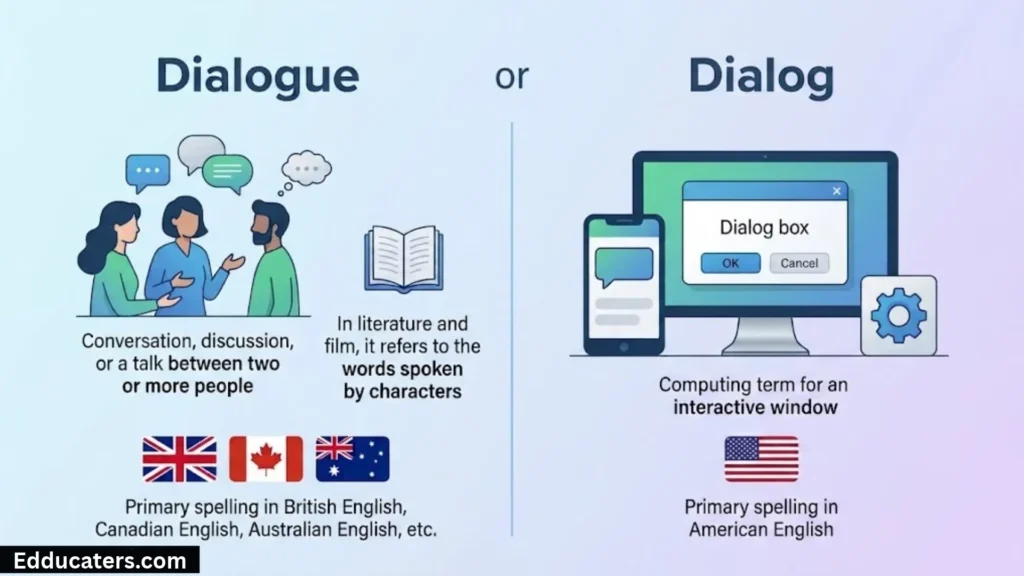
Both dialogue and dialog generally have the same pronunciation. The additional letters in dialogue don’t create another syllable or a different ending sound.
In American English, the word typically sounds like:
- American English IPA: /ˈdaɪ.ə.lɑːɡ/
- British English IPA: /ˈdaɪ.ə.lɒɡ/
The main difference involves the vowel sound in the final stressed syllable, which varies by accent.
Both spellings have three syllables:
- di
- a
- log
The stress falls on the first syllable.
Here’s a quick pronunciation guide:
| Feature | Dialogue | Dialog |
| Syllables | Three | Three |
| Main stress | First syllable | First syllable |
| American pronunciation | /ˈdaɪ.ə.lɑːɡ/ | /ˈdaɪ.ə.lɑːɡ/ |
| British pronunciation | /ˈdaɪ.ə.lɒɡ/ | /ˈdaɪ.ə.lɒɡ/ |
The spelling doesn’t determine a separate pronunciation. Regional accents influence the vowel sounds more than the final spelling difference.
Dialogue or Dialog: Origin and Etymology
The history of dialogue goes back much further than modern American and British spelling conventions.
The word ultimately comes from Ancient Greek, where dialogos referred to conversation or discussion.
English borrowed the word through earlier languages and gradually developed the spelling used today.
Understanding its history also explains why the longer spelling contains the unusual -ogue ending.
The main stages of its development include:
| Language | Historical form | Explanation |
| Ancient Greek | Dialogos | Conversation or discussion |
| Latin | Dialogus | A conversational exchange |
| Old French | Dialoge | A conversation or literary discussion |
| Middle English | Dyaloge / dialogue | An adopted English word |
| Modern English | Dialogue / dialog | Established spelling variants |
The word entered English around the late 12th or early 13th century. Early usage referred particularly to a literary work presented as a conversation between two or more people. Its meaning later expanded to include ordinary conversation.
Etymology, Origin & Meaning+1
Why Does Dialogue End in -Ogue?
The ending -ogue reflects the word’s historical development through Greek, Latin, and French.
English borrowed many words from these languages while retaining spellings influenced by their earlier forms.
That’s why some familiar English words contain endings that might seem unnecessarily long.
Consider these examples:
- Dialogue
- Catalogue
- Analogue
- Monologue
- Prologue
- Epilogue
These words share a recognizable spelling pattern.
However, the ending doesn’t carry exactly the same historical meaning in every word. Each has its own linguistic development.
The final letters in dialogue don’t create an additional spoken syllable. They form part of the word’s established spelling.
Why Does American English Use Dialog?
American English developed several spelling preferences that differ from traditional British conventions.
Some American spelling changes favored shorter or more simplified forms. Examples include color instead of colour, center instead of centre, and catalog instead of catalogue.
The shorter spelling dialog follows a similar pattern.
However, it’s important not to attribute every American spelling difference to one person or a single spelling reform.
American English developed through many influences, including dictionaries, publishers, education systems, and everyday usage.
The shorter form became an accepted alternative while dialogue remained common.
You can therefore encounter both spellings in American books, publications, and professional writing.
Dialogue or Dialog: Related Words With Similar Spelling Differences
The spelling difference between dialogue and dialog isn’t unique.
English contains several word pairs in which American English commonly uses a shorter spelling while British English retains a longer traditional form.
Understanding these examples can help you recognize similar regional spelling patterns.
| British or traditional form | American alternative | Meaning |
| Dialogue | Dialog | Conversation or exchange |
| Catalogue | Catalog | A list of items |
| Analogue | Analog | Something comparable or a non-digital signal |
These examples illustrate the relationship between certain -ogue and -og spellings.
However, don’t assume that every word ending in -ogue has an accepted -og alternative.
For example, monologue, prologue, and epilogue generally retain their established spellings in ordinary modern English.
Catalogue or Catalog
Catalogue and catalog both refer to an organized list of items, products, books, or other information.
For example:
- The library published a new book catalogue.
- The store released its latest product catalog.
Catalogue is the conventional British spelling. Catalog is standard American English.
Analogue or Analog
Analogue and analog can describe something comparable to another thing. The terms also appear in electronics and technology.
For example:
- The engineer studied an analogue signal.
- The device converts an analog signal into digital information.
The longer spelling is conventional in British English, while the shorter form is standard American English.
These related words demonstrate why regional spelling preferences matter. However, each word has its own established usage rules.
Common Mistakes to Avoid When Using Dialogue or Dialog
Although dialogue and dialog are easy to understand, writers sometimes make incorrect assumptions about their usage.
Knowing these mistakes will help you choose the appropriate form.
Assuming Dialog Is Always Misspelled
One common mistake involves treating dialog as an incorrect spelling.
That’s not accurate.
Major English dictionaries recognize it as an alternative spelling of dialogue. American English accepts both forms.
For example:
- The application displays a confirmation dialog.
- The characters exchanged meaningful dialogue.
Both sentences are correct.
Assuming Dialogue Is Exclusively British
Another common misconception is that Americans must always write dialog.
However, American English widely accepts dialogue.
You can find the longer spelling in American novels, screenplays, academic papers, news articles, and professional publications.
Therefore, using dialogue in American writing doesn’t make your spelling British or incorrect.
Treating the Two Spellings as Different Words
The spelling difference doesn’t create two separate meanings.
Both forms can describe conversations, discussions, and exchanges of ideas.
The context determines the intended meaning.
For example, dialog can refer to a conversation between characters or a technical interface window. Similarly, dialogue can refer to ordinary communication or fictional speech.
Mixing Both Spellings Without a Reason
Using both forms in one document can create unnecessary inconsistency.
Imagine writing:
“The novel contains realistic dialogue. The next chapter features excellent dialog between the main characters.”
If you aren’t deliberately following different terminology, choose one spelling and maintain it.
A consistent approach makes your writing easier to read.
Confusing Literary Dialogue With a Dialog Box
Literary dialogue and a software dialog box serve different purposes.
Literary dialogue represents spoken communication between characters.
A dialog box is a graphical interface element that requests information or presents options.
For example:
- The actors practiced their dialogue before filming.
- The application displayed a dialog box after the update.
Understanding the context makes the correct expression easier to identify.
Assuming Every -Ogue Word Has a Shorter American Form
American English uses several shortened spellings, but the pattern doesn’t apply automatically to every word.
For example, catalogue commonly becomes catalog, and analogue commonly becomes analog.
However, you shouldn’t automatically change monologue to monolog or epilogue to epilog in ordinary writing.
Always check whether the alternative spelling is established and accepted.
Frequently Asked Questions About Dialog or Dialogue
Here are straightforward answers to common questions about dialog or dialogue and their correct usage.
Is Dialog or Dialogue the Correct Spelling?
Both dialog and dialogue are correct English spellings. They share the same basic meaning but differ in regional preferences. Dialogue is the established British spelling, while dialog is an accepted American alternative.
Is Dialog an American Spelling?
Yes. Dialog is an accepted American English spelling variant. American writers also commonly use dialogue, particularly in general writing, fiction, and formal communication.
Is Dialogue British or American?
Dialogue is used in both British and American English. It is the standard British spelling and remains widely accepted in the United States. American English also recognizes the shorter form dialog.
Can Dialogue and Dialog Be Used Interchangeably?
Yes. In most general contexts, dialogue and dialog are interchangeable because they share the same meaning. However, regional preferences and established technical terminology may influence your choice.
Is Dialog Grammatically Correct?
Yes. Dialog is a recognized spelling variant rather than a grammatical mistake. You can use it in appropriate American English contexts and technical terminology.
Why Is Dialogue Spelled With an Extra UE?
The spelling reflects the word’s historical development through Greek, Latin, and Old French. English retained the longer -ogue ending when it adopted the word. The shorter American variant eventually became accepted alongside it.
Is Dialogue More Common Than Dialog?
Dialogue is the more widely established spelling in general English writing. It appears across British, American, Australian, and international publications. Dialog is also accepted but has a stronger association with American spelling and computing terminology.
Is It Dialogue Box or Dialog Box?
Dialog box is the conventional computing term, particularly in American technical writing. British English also recognizes dialogue box as an alternative. Follow the terminology used by your software or documentation.
Does Dialogue Have a Different Meaning From Dialog?
No. The two spellings generally share the same meaning. Both can describe conversations, discussions, or exchanges of ideas. The difference involves spelling preferences rather than a separate definition.
Which Spelling Should I Use for International Readers?
Dialogue is a dependable choice for international audiences because it is widely recognized across English varieties. However, you should follow an established style guide or technical terminology when one applies.
Should I Use Dialogue or Dialog in Academic Writing?
Both forms can be acceptable in American academic writing. However, dialogue is a widely recognized general-purpose spelling. British academic writing generally prefers dialogue. Always follow your institution’s or publication’s style requirements.
Conclusion: Dialog or Dialogue?
The difference between dialog or dialogue comes down to spelling preferences rather than meaning.
Both forms describe a conversation, discussion, or exchange of ideas. However, their usage varies across regions and writing contexts.
Here’s what you should remember:
- Dialogue is the standard spelling in British English.
- Dialogue is also widely accepted in American English.
- Dialog is an accepted American spelling variant.
- Dialog box is a conventional term in computing.
- Both spellings generally share the same pronunciation and meaning.
If you’re writing a general article, essay, novel, or professional document, dialogue is a dependable choice. If you’re writing American technical documentation, dialog may be more appropriate, particularly in established expressions such as dialog box.
Ultimately, choose the spelling that suits your audience and remain consistent. That’s the simplest way to avoid confusion.

I’m Julian Mercer, an English language writer dedicated to helping people master grammar through practical examples and clear explanations. I enjoy teaching grammar in a way that is both engaging and easy to remember.
My work focuses on grammar rules, punctuation, word usage, and writing techniques that readers can apply in everyday life. I believe learning English should be simple, enjoyable, and useful.
Books
English Grammar in Practice
Writing with Precision
 Nathan Whitmore