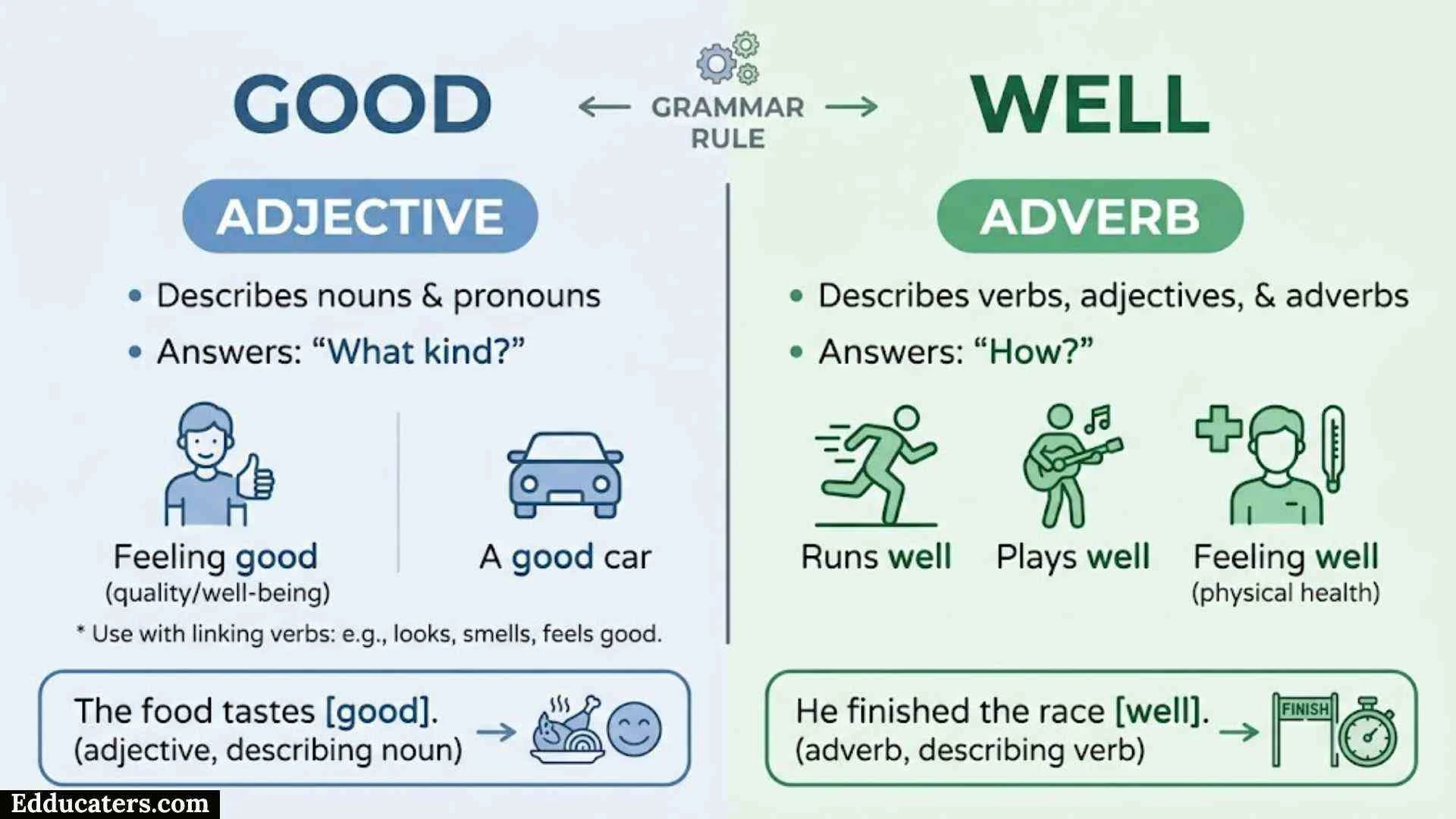
Choosing between good or well can be surprisingly difficult because the two words are closely connected in meaning. Both can express something positive, but they usually have different grammatical jobs. The confusion becomes even greater with verbs such as feel, look, sound, taste, and smell, where good can be correct even though a verb appears immediately before it.
The basic rule is straightforward: good is normally an adjective, while well is normally an adverb. Use good to describe a person, thing, quality, or state; use well to describe how an action is performed. However, well can also be an adjective meaning healthy, so the complete rule needs a little more explanation.
For example:
- She is a good writer.
- She writes well.
- The presentation was good.
- He presented the information well.
- I feel good about the decision.
- I feel well after getting some rest.
Understanding what each word is describing will usually tell you which one to choose.
Good or Well: The Quick Answer
In standard English, good is primarily an adjective and well is primarily an adverb.
Use good when it describes a noun or pronoun:
She is a good teacher.
Here, good describes the noun teacher.
Use well when it describes an action:
She teaches well.
Here, well describes how she teaches.
The distinction becomes especially clear when you put the words into pairs:
| Pattern | Example | What the word describes |
| good + noun | He is a good driver. | The person |
| verb + well | He drives well. | The action |
| linking verb + good | The car looks good. | The car |
| well = healthy | She feels well. | Her health |
So if you are asking whether someone is good at something or whether they do something well, both constructions can be correct, but they are grammatically different.
She is a good singer.
She sings well.
The first describes her as a singer. The second describes her singing.
What Does Good Mean?
Good is an adjective with a wide range of meanings. Depending on the context, it can mean high in quality, satisfactory, useful, effective, enjoyable, suitable, kind, or morally positive.
Consider these examples:
- That is a good idea.
- We had a good meal.
- She is a good doctor.
- This is a good solution.
- He gave me a good reason.
- They are good friends.
The exact meaning changes with the noun.
In “a good meal,” the meal is enjoyable or satisfactory. In “a good solution,” the solution is effective or suitable. In “a good person,” the word may describe someone’s character or moral qualities.
Good Before a Noun
One of the easiest ways to recognize good is to look for a noun that it describes.
Common combinations include:
- a good student
- a good teacher
- a good book
- a good opportunity
- a good question
- a good answer
- a good example
- a good reason
- a good decision
- a good performance
For example:
She asked a good question.
We found a good solution.
He gave a good explanation.
In each case, good modifies a noun.
Good After a Linking Verb
Good can also appear after a linking verb because it can describe the subject.
Examples include:
The food tastes good.
Your idea sounds good.
You look good today.
The plan seems good.
I feel good about our chances.
Here, good is not describing the manner in which the person or thing performs an action. It is describing the subject itself or its state.
This is an important reason why the simple rule “verbs take well” does not work in every sentence.
What Does Well Mean?
Well is most commonly an adverb. It usually explains how successfully, skillfully, or effectively an action is performed.
For example:
- She sings well.
- He writes well.
- They work well together.
- The machine operates well.
- You explained the problem well.
- The students performed well on the test.
A useful question is:
How was the action performed?
If the answer is well, you are probably using the adverb correctly.
How did she sing?
She sang well.
How did he explain the problem?
He explained it well.
How did the students perform?
They performed well.
Well as an Adjective Meaning Healthy
Well is not always an adverb. It can also be an adjective meaning healthy or in good health.
For example:
I am well now.
She is not well today.
Are you well?
He became well after several weeks of rest.
This use is especially important because it explains sentences such as “I feel well.”
Here, well is associated with health rather than simply describing the manner in which someone feels.
Well in Expressions Such as “Well Known”
You will also see well used before adjectives and past participles:
- well known
- well written
- well prepared
- well organized
- well designed
- well educated
- well informed
- well established
For example:
The author is well known for her novels.
The report was well written.
The students were well prepared for the examination.
In these constructions, well contributes the idea of being thoroughly, successfully, or to a high degree.
Good or Well: Why the Grammar Changes
The difference is easiest to understand when you identify the grammatical role of each word.
An adjective describes a noun or pronoun:
She is a good teacher.
An adverb commonly modifies a verb:
She teaches well.
This gives us a useful transformation:
He is a good writer.
He writes well.
She is a good dancer.
She dances well.
They are good performers.
They perform well.
He is a good speaker.
He speaks well.
The meaning is closely related, but the grammatical structure changes.
This is why “She sings good” is not the standard form in careful English when good is intended to modify the verb sings. The standard sentence is:
She sings well.
But:
She is a good singer.
is completely correct because good describes the noun singer.
Good or Well After Linking Verbs
The most confusing part of this topic is what happens after linking verbs.
Common linking verbs include:
- be
- seem
- become
- appear
- feel
- look
- sound
- taste
- smell
These verbs can connect a subject with an adjective that describes it.
For example:
The soup tastes good.
The word good describes the soup.
The music sounds good.
The word good describes the music.
You look good.
The word good describes your appearance.
I feel good.
The word good describes your state or feelings.
The same verbs can sometimes be used as ordinary action verbs, which can change the appropriate word.
“Feel Good” or “Feel Well”?
Both feel good and feel well are correct, but they often emphasize different things.
Feel good commonly expresses a positive emotional or general feeling:
I feel good about the decision.
She feels good about starting her new job.
We felt good after finishing the project.
Here, the speaker is describing a positive state or attitude.
Feel well commonly relates to physical health:
I feel well today.
She didn’t feel well yesterday.
I feel well enough to return to work.
So if someone has been ill and says:
“I feel well now.”
the natural interpretation is that their health has improved.
If someone says:
“I feel good about the decision.”
they are talking about their attitude or emotional response.
There is some overlap in everyday English, so the distinction should not be treated as an absolute rule that feel good can never refer to physical condition. Context matters.
“Look Good” or “Look Well”?
Look good is normally used when discussing appearance:
You look good in that suit.
The new website looks good.
The room looks good after the renovation.
Look well can be used when well means healthy:
She looks well after her recovery.
This distinction is useful because the same verb can connect the subject with different kinds of descriptions.
Compare:
He looks good in the photograph.
This is mainly about appearance.
He looks well after his illness.
This suggests that he appears healthy.
“Sound Good” or “Sound Well”?
When sound is a linking verb, sound good is normally used to evaluate an idea, suggestion, plan, or proposition.
That sounds good.
Your plan sounds good.
A weekend trip sounds good to me.
Here, good describes the idea or proposal.
By contrast:
She sings well.
describes the quality of her singing.
So:
The song sounds good.
and
She sings well.
are both correct, but they describe different things.
“Taste Good” or “Taste Well”?
When discussing flavor, use taste good:
This cake tastes good.
The soup tastes good.
The word good describes the food.
If taste refers to someone’s ability to detect flavors, well can be appropriate:
She can taste well even though she has a blocked nose.
This is a much less common construction, but it demonstrates the underlying grammatical distinction.
“Smell Good” or “Smell Well”?
When discussing a pleasant smell, use smell good:
The bread smells good.
Your perfume smells good.
Here, good describes the smell or the thing being smelled.
When smell refers to someone’s ability to detect odors, well may be used:
Dogs can smell well.
The context determines whether smell is functioning as a linking verb or as an action/ability verb.
Good or Well With “Do”
The difference becomes particularly useful with do.
Compare:
You did a good job.
You did well on the test.
In the first sentence, good modifies the noun job.
In the second, well describes the performance represented by did.
You can also say:
She did a good job of explaining the problem.
But:
She explained the problem well.
Both sentences communicate strong performance, but the grammatical structures are different.
“Do Good” Is a Different Expression
Do good can be correct when good refers to beneficial actions or positive effects.
For example:
The organization does good in the local community.
She wants to do good for others.
This meaning is different from:
She did well in the interview.
The first concerns producing positive effects. The second concerns performing successfully.
Therefore, it is too simplistic to say that do good is always wrong. The intended meaning matters.
Common Mistakes With Good and Well
“She Sings Good”
In standard English, write:
She sings well.
Because well describes how she sings.
However:
She is a good singer.
is correct because good describes singer.
“He Did Good on the Exam”
When talking about performance, the standard form is:
He did well on the exam.
But do good has a legitimate meaning when it refers to doing something beneficial.
“The Food Tastes Well”
If you mean that the food has a pleasant flavor, use:
The food tastes good.
The word good describes the food’s quality or flavor.
“I Feel Well” When You Mean You Are Happy
If you mean that you are emotionally positive about something, feel good is often clearer:
I feel good about our chances.
If you mean that you are healthy, feel well is appropriate:
I feel well after getting some rest.
“He Is a Well Person”
This sentence is grammatical in principle, but it is not the normal way to describe someone’s general character or quality. If you mean healthy, natural alternatives include:
He is well.
He is in good health.
If you mean that he is a high-quality or admirable person, you would normally say:
He is a good person.
The meaning of good and well should always guide the choice.
Good or Well in Different Contexts
Context often provides the answer more reliably than memorizing a single rule.
| Sentence | Correct word | Why? |
| She is a ___ teacher. | good | Describes teacher. |
| She teaches ___. | well | Describes teaches. |
| The food tastes ___. | good | Describes the food. |
| The chef cooks ___. | well | Describes the cooking. |
| I feel ___ about the plan. | good | Describes the speaker’s positive feeling. |
| I feel ___ after my illness. | well | Refers to health. |
| He is a ___ writer. | good | Describes writer. |
| He writes ___. | well | Describes the action. |
| The idea sounds ___. | good | Describes the idea. |
| She explained it ___. | well | Describes the explanation action. |
| You look ___. | good | Usually describes appearance. |
| She looks ___ after treatment. | well | Can describe healthy appearance. |
The table also shows why a single rule such as “after a verb, always use well” is unreliable.
Good or Well in British and American English
The basic distinction between good and well is essentially the same in British and American English.
Both varieties use:
She is a good writer.
and:
She writes well.
Both also recognize well as an adjective meaning healthy:
I hope you are well.
There can be differences in informal speech, regional preferences, and conversational habits, but there is no major British-versus-American spelling distinction comparable to pairs such as colour/color or organise/organize.
For formal writing, the standard adjective/adverb distinction is a safe choice in both varieties.
Pronunciation of Good and Well
The two words are also pronounced differently.
- good — /ɡʊd/
- well — /wel/
The vowel in good is the same general vowel heard in words such as book and foot. The vowel in well is different, as in sell and help.
Neither word should be pronounced as though it were simply a variation of the other.
Correct pronunciation can also help reinforce the fact that these are separate words with different grammatical functions.
Good and Well in Common Expressions
Both words appear in many common expressions, so learners should not assume that one can always replace the other.
Common expressions with good include:
- good luck
- good news
- good idea
- good job
- good point
- good reason
- good time
- good chance
- good at
- good enough
Examples:
Good luck with your interview.
That is a good point.
She is good at mathematics.
Common expressions with well include:
- well done
- well known
- well written
- well prepared
- well organized
- well aware
- well worth
- as well
- as well as
- get well
Examples:
Well done on completing the project.
The article is well written.
I would like to come as well.
The phrase as well means also:
She speaks French as well.
That meaning has nothing to do with the adjective good.
A Practical Test for Choosing Good or Well
When you are unsure, use this three-step test.
Step 1: Identify What You Are Describing
Ask:
Am I describing a person, thing, quality, or state?
If yes, good may be appropriate.
It is a good book.
Step 2: Ask Whether You Are Describing an Action
Ask:
Am I explaining how someone does something?
If yes, well is usually appropriate.
She reads well.
Step 3: Check for a Linking Verb or Health Meaning
If the sentence contains feel, look, sound, taste, or smell, check whether the verb connects the subject to a description.
The soup tastes good.
If well means healthy, it may also be the right choice:
I feel well today.
This final check prevents many common mistakes.
A Simple Memory Trick
Remember this pair:
A good singer sings well.
The person is good at the activity, while the activity is performed well.
You can adapt the same pattern:
A good writer writes well.
A good cook cooks well.
A good dancer dances well.
A good speaker speaks well.
If you remember “good person, good thing; well action”, you will get many everyday sentences right.
Just remember the important exceptions: linking verbs can take adjectives, and well can mean healthy.
Frequently Asked Questions
Is “good or well” a grammar question?
Yes. It is primarily a grammar and usage question. Good is normally an adjective, while well is normally an adverb. However, well can also be an adjective meaning healthy.
Is “She sings good” correct?
In standard English, the usual form is “She sings well.” Well describes how she sings. However, “She is a good singer” is correct because good describes the noun singer.
Is “I feel good” correct?
Yes. “I feel good” is standard English. It commonly expresses a positive emotional or general feeling, especially in contexts such as “I feel good about the decision.”
Is “I feel well” correct?
Yes. “I feel well” is also correct and commonly refers to physical health. For example, someone recovering from an illness might say, “I feel well now.”
Should I say “I did good” or “I did well”?
If you mean that you performed successfully, use “I did well.”
I did well on the exam.
Do good can also be grammatical when it means to produce positive effects or help others.
Should I say “The food tastes good” or “The food tastes well”?
Say “The food tastes good” when describing its flavor.
The soup tastes good.
Here, good describes the soup.
Is “You look good” correct?
Yes. “You look good” is standard and usually refers to appearance.
If you mean that someone appears healthy, “You look well” can also be appropriate.
Is “well” always an adverb?
No. Well can be an adjective meaning healthy:
She is well.
It can also appear in other grammatical roles and expressions, such as as well and well known.
Is “good” an adverb?
In standard formal English, good is primarily an adjective. Informal speech sometimes uses good where standard edited English would use well, as in “He did good.” However, do good is also a legitimate expression when good has the meaning of something beneficial.
Is the difference between good and well the same in British and American English?
Yes. The basic grammatical distinction is used in both British and American English. Neither variety treats good and well as simple interchangeable alternatives.
Conclusion
The choice between good or well becomes much easier once you identify what the word is describing.
Use good primarily as an adjective:
She is a good teacher.
Use well primarily as an adverb:
She teaches well.
But remember two important points. First, linking verbs such as feel, look, sound, taste, and smell can be followed by an adjective:
The food tastes good.
That sounds good.
You look good.
Second, well can be an adjective when it means healthy:
I am well now.
The most useful pattern to remember is simple:
A good writer writes well. A good cook cooks well. A good speaker speaks well.
When you focus on whether you are describing a person or thing, an action, or someone’s health, choosing between good and well becomes far more natural.

Hi, I’m Nathan Whitmore, and I enjoy making English grammar easy for learners of all ages. I believe grammar should be practical, not confusing. I write simple, well-researched guides that help readers improve their writing, speaking, and overall communication skills.
I spend a lot of time studying grammar patterns, sentence construction, punctuation, and modern English usage. My goal is to create lessons that anyone can understand, whether they are students, teachers, or professionals.
Books
Clear English Grammar
The Smart Writer’s Grammar Handbook
 Julian Mercer
 Claire Holloway