Have you ever paused mid-sentence while drafting an email, wondering if you should type “in route” or “en route”? You are not alone. This common dilemma frequently trips up even the most experienced writers. While both phrases attempt to convey the same message that someone or something is on the way only one is considered standard, professional English.
Choosing the wrong one can subtly undermine the authority of your writing, whether in a formal business report or a quick text message to a colleague. In this guide, we will clear up the confusion once and for all, exploring the linguistic origins, grammatical distinctions, and practical applications of these two terms. By the end, you will have the confidence to choose the correct phrase every single time.
Quick Answer
The correct phrase is en route. It is a borrowed French term meaning “on the way.” While “in route” is occasionally used in casual American English, it is widely considered an error in professional, academic, and formal writing. Always use “en route” to ensure your communication remains polished, accurate, and grammatically standard.
Comparison Table: At a Glance
| Feature | Correct Term | Incorrect/Non-Standard Term |
| Phrase | En route | In route |
| Origin | French (en route) | English (erroneous construction) |
| Meaning | On the way; in transit | Often used synonymously but incorrect |
| Part of Speech | Adverbial phrase | Adverbial phrase |
| Formal Usage | Highly recommended | Avoid in professional contexts |
| Pronunciation | “ahn root” (or “on root”) | “in root” |
| Memory Tip | Think of “En” as the French “In” | Avoid the literal English “in” |
Also Check This Post: Rhythm or Rythm: Common Spelling Mistakes You Should Avoid
Understanding “En Route”
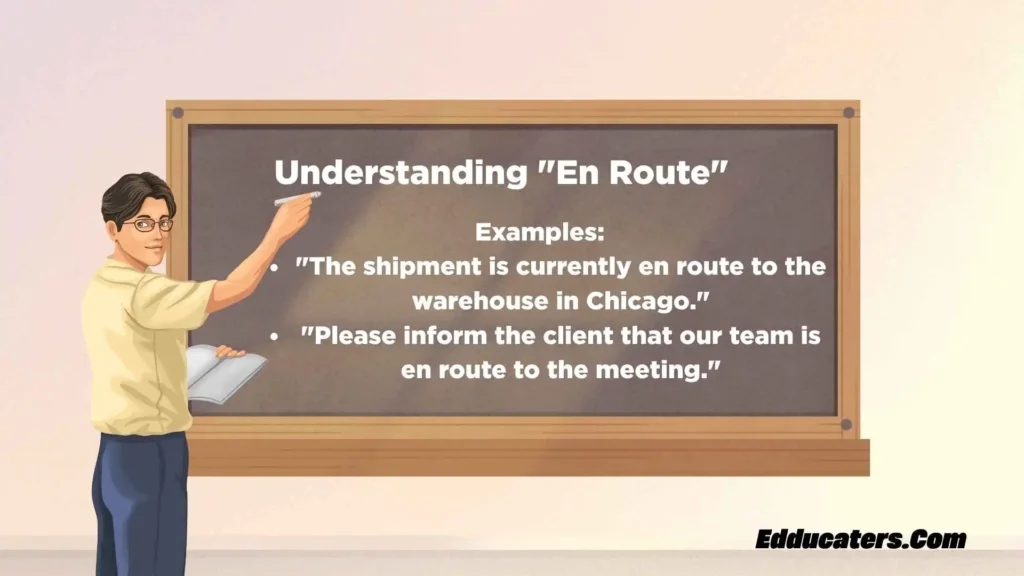
The term en route is a direct loanword from French, where en means “in” and route means “way” or “road.” In English, we treat it as an adverbial phrase meaning “on the way” or “during the course of a journey.”
Because it is a well-established loanword, it carries a tone of precision and formality. It functions by modifying verbs, indicating that an object or person is currently in the process of moving from one location to another.
Examples:
- “The shipment is currently en route to the warehouse in Chicago.”
- “Please inform the client that our team is en route to the meeting.”
Why “In Route” Is Problematic
The phrase “in route” is a classic example of an eggcorn or a folk etymology. Because English speakers often struggle with loanwords, many naturally attempt to “Anglicize” the expression by replacing the French en with the English in.
While you might see this spelling in casual text messages or poorly edited informal content, it is not accepted in standard English dictionaries as a correct alternative. Using it in professional or academic writing can make your prose appear unrefined or imprecise. It is essentially a spelling error that stems from a misunderstanding of the phrase’s linguistic roots.
Key Differences
- Etymological Authority: “En route” has a verified history as a borrowed term. “In route” is an accidental mutation.
- Standardization: “En route” is the only version recognized by major style guides (AP, Chicago, MLA). “In route” is largely considered an error.
- Professional Perception: Using “en route” signals attention to detail, whereas “in route” may lead readers to question your editing standards.
Grammar Rules
In English, the preposition “in” is rarely used with “route” in this specific adverbial sense. We typically say “on the route” if we are talking about a specific path, but “in route” attempts to function as an idiom that does not exist in standard grammar.
Exception: The only time you might see “in” and “route” together legitimately is if you are describing a physical location or a specific path, such as: “We found a detour in the route we were planning to take.” In this case, “in” is a preposition of place, and “route” is the object, which is grammatically valid. However, this is distinct from the adverbial meaning of “on the way.”
Also Check This Post: Paid Attention or Payed Attention: The Ultimate Grammar Comparison
When to Use Each Term
- Academic & Professional Writing: Always use en route. It is the only acceptable form for reports, research papers, and formal correspondence.
- Business Emails: Use en route to maintain a professional demeanor. It shows you value linguistic accuracy.
- Informal Conversation: While you may hear people say “in route” during casual speech, it is still better to use en route. It is just as easy to say and prevents the habit of using incorrect grammar from bleeding into your professional life.
Addressing Common Mistakes
The primary reason for the confusion is the phonetic similarity between “en” and “in.” In many American accents, the vowels are close enough that speakers do not distinguish between them. Because “in” is a very common English preposition, the brain naturally defaults to it.
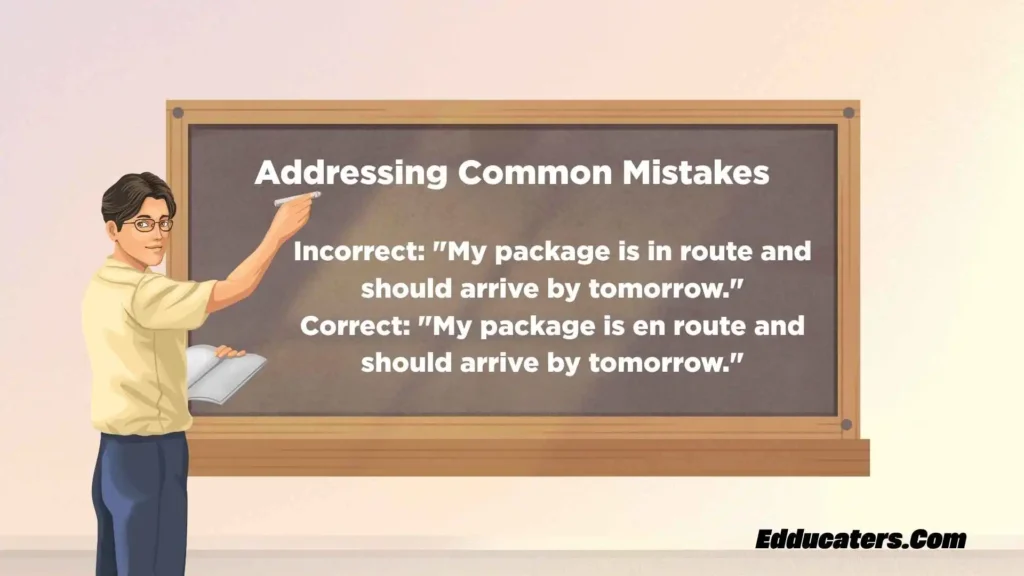
Incorrect: “My package is in route and should arrive by tomorrow.”
Correct: “My package is en route and should arrive by tomorrow.”
Tip: If you are ever unsure, replace the phrase with “on the way.” If “on the way” makes sense in your sentence, use “en route.”
Original Examples
- Our flight is currently en route to London, with an expected arrival time of 8:00 AM.
- The paramedics are en route to the scene of the accident.
- Keep an eye on the tracking app; the courier is en route to your apartment now.
- The CEO is en route to the corporate headquarters for the quarterly earnings call.
- We were en route to the theater when the heavy rain started.
- Even though the train is en route, it has been delayed by technical issues.
- The relief supplies are en route to the disaster zone as we speak.
- I am currently en route to the airport and will call you once I land.
- The new software update is en route to your device and should install automatically.
- The investigative team is en route to gather more evidence from the field.
- Are you still en route to the dinner reservation?
- The mail carrier is en route, so please ensure the gate is unlocked.
- The ship is en route across the Atlantic with a heavy load of cargo.
- A diplomatic delegation is en route to the summit to negotiate the treaty.
- I noticed the delivery status changed to en route this morning.
- The astronauts are en route to the international space station.
- Since the bus is en route, we should be there in about fifteen minutes.
The Memory Trick: The French Connection
To remember the correct spelling, associate the “E” in En route with the word “Expedition.” An expedition is a journey, and you are currently on that journey. Alternatively, simply remember that “En” is the French version of “In.” Since it is a French loanword, it keeps its original French “En.” This keeps you from forcing the English “In” where it does not belong.
Mini Quiz
- Which is the correct spelling?
a) In route
b) En route
c) Onn route
(Answer: b) - What does “en route” mean?
a) Lost in the woods
b) On the way
c) Arrived at the destination
(Answer: b) - Why is “in route” generally considered incorrect?
a) It is a misspelling of a French loanword.
b) It is too formal.
c) It is only used in British English.
(Answer: a) - If you are unsure, what phrase can you substitute to check your meaning?
a) In the middle
b) By the way
c) On the way
(Answer: c) - Which sentence is written correctly?
a) The letter is in route to you.
b) The letter is en route to you.
c) The letter is route en to you.
(Answer: b)
Frequently Asked Questions (FAQs)
Is “en route” only used in British English?
No, “en route” is the standard term in both American and British English. While some American speakers mistakenly use “in route” in casual speech, “en route” is the universally accepted, correct form in both regions for professional, academic, and journalistic writing.
Can I use “in route” in a casual text message?
While you might see it in casual text messages, it is still technically incorrect. Using “en route” is a better habit to form. It ensures that your writing remains high-quality regardless of the platform, and it prevents the potential for confusion or perception of lower literacy.
Is there a difference in meaning between the two?
There is no difference in intended meaning, but there is a major difference in correctness. “En route” carries the meaning of being “on the way.” “In route” attempts to communicate the same thing but fails because it is a grammatical error resulting from a misinterpretation of the French source term.
How do you pronounce “en route”?
The most common pronunciation is “ahn-root” or “on-root.” The “en” is typically pronounced with a soft “ah” or “o” sound, reflecting its French origins. The “route” is pronounced to rhyme with “boot.” Avoid pronouncing it with a hard “in” sound like the word “win.”
What if my spellchecker suggests “in route”?
Many basic spellcheckers are not sophisticated enough to distinguish between a common error and a correct term. If your spellchecker suggests “in route,” it is likely reacting to the commonality of the mistake rather than the grammatical correctness. Always stick with “en route” for professional writing.
Is “en route” hyphenated?
No, “en route” is typically written as two separate words without a hyphen. It functions as an adverbial phrase, and standard grammar rules do not require a hyphen between these two words. Keep them separate to ensure your formatting aligns with major style guides like AP and Chicago.
Key Takeaways
- Correct Terminology: Always use “en route.”
- Linguistic Origin: The term is a French loanword, which explains its unique spelling.
- Grammar Standard: “In route” is a common error and should be avoided in all professional contexts.
- The Substitution Test: If you can replace the phrase with “on the way,” use “en route.”
- Professional Image: Precision in language, including the use of correct loanwords, enhances your credibility as a writer.
Conclusion
Navigating the complexities of English can be challenging, but mastering small details like “en route” significantly elevates the quality of your communication. By understanding that “en route” is a standard French loanword, you can confidently eliminate the incorrect “in route” from your vocabulary.
Remember that high-quality writing is defined by precision and consistency. The next time you need to describe someone or something that is traveling, use “en route” to ensure your message is professional, clear, and perfectly articulated.
Also Check This Post: Grey or Gray: The Ultimate Guide to Spelling the Color Correctly

I’m Julian Mercer, an English language writer dedicated to helping people master grammar through practical examples and clear explanations. I enjoy teaching grammar in a way that is both engaging and easy to remember.
My work focuses on grammar rules, punctuation, word usage, and writing techniques that readers can apply in everyday life. I believe learning English should be simple, enjoyable, and useful.
Books
English Grammar in Practice
Writing with Precision
 Nathan Whitmore
 Claire Holloway