Have you ever stared at a blank screen while drafting a marketing campaign or a flyer for a community event, wondering if you should spell it “flyers” or “fliers”? You are certainly not alone. This subtle spelling variation causes confusion for writers, business owners, and editors alike. While both terms refer to those small printed handbills distributed in public, determining which spelling fits your specific context can feel like a game of linguistic trial and error.
Understanding the nuances between these two spellings helps you maintain professionalism in your writing. In this guide, we will clear up the ambiguity once and for all, exploring the historical origins, regional preferences, and modern usage conventions for both terms so you can write with total confidence.
Quick Answer: The Definitive Guide
Both flyers and fliers are considered correct in US English. Flyers is the most common spelling for printed handbills and promotional materials. Fliers is often used to describe things that fly, such as birds or frequent travelers. In modern usage, “flyers” has become the standard for both definitions in American business and casual writing.
Comparison Table: Quick Reference
| Feature | Flyers | Fliers |
| Common Usage | Printed promotional materials | Things that fly (birds, pilots) |
| Part of Speech | Noun | Noun |
| Grammar Rule | Plural of “flyer” | Plural of “flier” |
| Primary Context | Business and Marketing | Aviation and Biology |
| US English Status | Highly Preferred | Accepted Variant |
| Memory Tip | Think “Advertising” | Think “Flying” |
Also Check This Post: Yea or Yeah: A Beginner’s Guide to These Similar Words
Meaning of Each Word
Flyers
The term “flyers” refers primarily to loose sheets of paper used to advertise a product, event, or service. In the world of marketing, this is the dominant spelling. It is derived from the idea of “flying” through a crowd or being distributed rapidly.
- Examples:
- The marketing team printed thousands of flyers to promote the summer sale.
- She handed out colorful flyers at the entrance of the concert hall.
Fliers
The term “fliers” usually refers to living beings or objects that are in the air. This includes birds, insects, or even individuals who travel by airplane frequently. While dictionaries acknowledge “fliers” as a variant for marketing handouts, it feels slightly more traditional or formal in that specific context.
- Examples:
- The migratory fliers reached the southern wetlands by mid-October.
- The airline offers special perks for its most frequent fliers.
Key Differences Explained

The distinction between these two words is largely one of convention rather than strict grammatical prohibition.
- Contextual Preference: If you are discussing paper advertisements, flyers is the industry standard. Using “fliers” for marketing materials might distract the reader because it looks slightly less common.
- Linguistic Roots: “Fliers” maintains a closer visual connection to the verb “fly.” Therefore, when the context is literal flight, fliers is often the safer, more descriptive choice.
- Interchangeability: In American English, the two are largely interchangeable. A reader will rarely flag “fliers” as a mistake, but “flyers” is now statistically more frequent in digital and print media.
Also Check This Post: Cue or Queue Explained: Simple Rules to Avoid Mistakes
Grammar Rules and Regional Variations
In American English, both spellings are recognized by major style guides, including the Associated Press (AP) Stylebook and The Chicago Manual of Style. Interestingly, both guides lean toward flyers for promotional handbills.
British English occasionally maintains a stronger distinction, but even there, “flyer” has become the overwhelming preference for printed advertisements. The rule is simple: since both words are accepted, consistency is your primary goal. If you choose to use “flyers” in a document, stick with that spelling throughout the entire piece.
When to Use Each Word
Professional and Business Writing
Always use flyers for marketing materials, event handouts, or internal announcements. It appears more modern and aligns with current professional branding standards.
Academic and Formal Writing
If you are writing a technical report about avian biology or aviation statistics, fliers is the more precise choice. It sounds more scholarly when referring to the action of flight.
Emails and Daily Conversation
In casual emails or text messages, flyers is the safest bet. It is the most common form, so your reader will recognize it instantly without needing to pause or second-guess your spelling.
Common Mistakes
The most common mistake is assuming one is “wrong.” Because both are correct, the only true mistake is inconsistency.
- Incorrect: We printed fifty fliers for the event, but the flyers were too expensive. (Mixing spellings in one sentence creates confusion).
- Correct: We printed fifty flyers for the event, and the flyers were very affordable.
Original Examples of Usage
- The local bakery distributed flyers featuring their new seasonal menu.
- High-altitude fliers often encounter turbulence during their long-distance migrations.
- She spent the afternoon designing flyers for the neighborhood cleanup project.
- The airline rewards its most loyal fliers with complimentary seat upgrades.
- Check the community center board for flyers regarding upcoming workshops.
- The swallows are known as some of the most agile fliers in the bird kingdom.
- We need to finalize the layout for the promotional flyers before the printing deadline.
- Frequent fliers often prefer the efficiency of carry-on luggage.
- She accidentally left a stack of flyers on the coffee shop counter.
- The acrobatic fliers performed stunning stunts during the air show.
- Are those flyers for the jazz concert next Friday?
- The research paper tracks the movement patterns of various nocturnal fliers.
- His business grew rapidly after he started distributing flyers downtown.
- Only the most experienced fliers should attempt to land in such high winds.
- Please ensure the contact information on the flyers is accurate.
Memory Trick: The “Y” Test
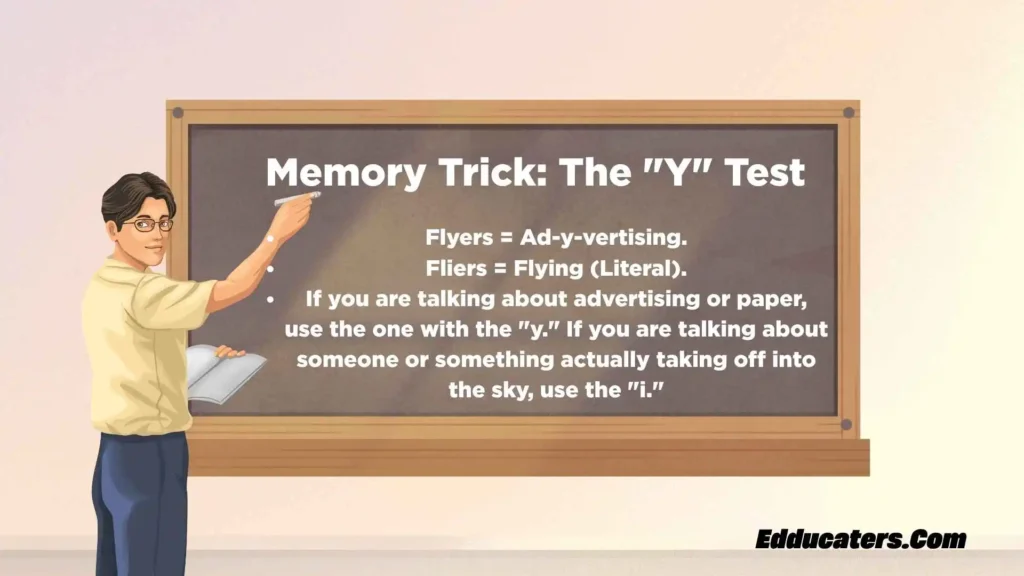
To remember which one to use for marketing, look for the “Y”:
- Flyers = Ad-y-vertising.
- Fliers = Flying (Literal).
If you are talking about advertising or paper, use the one with the “y.” If you are talking about someone or something actually taking off into the sky, use the “i.”
Mini Quiz
- Which spelling is more common for marketing materials?
a) Fliers
b) Flyers - Can “fliers” be used to describe paper advertisements?
a) No, it is incorrect.
b) Yes, it is an accepted variant. - Choose the best word for a bird in flight:
a) Flyer
b) Flier - What is the most important rule when using these words?
a) Always use both.
b) Be consistent. - “Frequent ______” usually refers to:
a) People who travel.
b) People who pass out paper.
Answers: 1-b, 2-b, 3-b, 4-b, 5-a.
FAQs
Is it ever wrong to use “flyers” for paper handouts?
No, “flyers” is the standard and preferred spelling for printed advertisements in US English. Using it in this context is always correct and highly recommended for professional writing.
Does British English prefer “fliers”?
British English follows similar trends to American English. While both spellings appear, “flyer” has become the dominant term for promotional handbills in the UK, mirroring global business English trends.
Should I use “flyers” or “fliers” for an airplane passenger?
You should use “fliers” when referring to people who travel by air. It keeps the focus on the literal act of flying, making it the most appropriate choice for airline terminology.
Are there any other variations like “flier” vs “flyer”?
There are no other standard variations. You only need to choose between these two. Keep your choice consistent throughout your document to ensure the highest level of professional clarity.
Why are there two spellings for the same word?
The two spellings exist because of historical shifts in spelling conventions. One version (fliers) stayed closer to the root verb “fly,” while the other (flyers) became a standardized noun for objects used to advertise.
Can I use both in the same document?
It is highly recommended that you stick to one spelling throughout a single document. Mixing them may confuse the reader and make your writing appear unpolished or poorly edited.
Key Takeaways
- Flyers is the standard spelling for promotional handbills and advertisements.
- Fliers is the preferred spelling for living beings or objects that fly.
- In US English, both are technically acceptable, but flyers is the most frequent choice.
- Consistency is key; choose one and use it throughout your content.
- Use the “Ad-y-vertising” memory trick to keep your marketing copy accurate.
Conclusion
Navigating the choice between flyers and fliers does not have to be a source of stress. By recognizing that flyers is your go-to term for all things related to marketing and paper advertisements, you can simplify your writing process immediately.
While fliers remain a perfectly valid option especially when discussing the literal act of flight, sticking with flyers for your promotional needs will ensure your work looks professional, consistent, and easy to read. Keep this distinction in mind, and you will never need to second-guess your spelling again.
Also Check This Post: In Route or En Route: A Practical Guide to Proper Usage

I’m Julian Mercer, an English language writer dedicated to helping people master grammar through practical examples and clear explanations. I enjoy teaching grammar in a way that is both engaging and easy to remember.
My work focuses on grammar rules, punctuation, word usage, and writing techniques that readers can apply in everyday life. I believe learning English should be simple, enjoyable, and useful.
Books
English Grammar in Practice
Writing with Precision
 Nathan Whitmore
 Claire Holloway