Have you ever stared at a blank screen, cursor blinking, wondering if that elusive word should have an extra “h”? You are certainly not alone. The word describing the measured flow of music, poetry, or even the pulse of daily life is one of the most frequently misspelled terms in the English language. It is a classic linguistic trap that catches even the most seasoned writers off guard.
If you are drafting a professional email, writing a creative essay, or simply checking your notes, getting this spelling right adds a polish of professionalism to your work. In this guide, we will clear up the confusion surrounding “rhythm” and “rythm” once and for all. You will learn the exact spelling, the history behind it, and most importantly a foolproof memory trick so you never have to guess again.
Quick Answer: Which Spelling is Correct?
The only correct spelling is rhythm. The version “rythm” is a common misspelling and is considered incorrect in all forms of English. The word originates from the Greek word rhuthmos, which explains the presence of both the “h” after the “r” and the “h” after the “t.” Always use “rhythm.”
Quick Comparison: Rhythm or Rythm
| Feature | Correct Word | Incorrect Word |
| Spelling | Rhythm | Rythm |
| Definition | A strong, regular, repeated pattern of movement or sound. | N/A (Non-existent word) |
| Part of Speech | Noun | N/A |
| Grammar Rule | Follows Greek etymology (rhuthmos). | Violates standard English orthography. |
| Pronunciation | /ˈrɪð.əm/ | N/A |
| Memory Tip | Rhythm Helps Your Two Hips Move. | N/A |
Understanding the Meaning of Rhythm
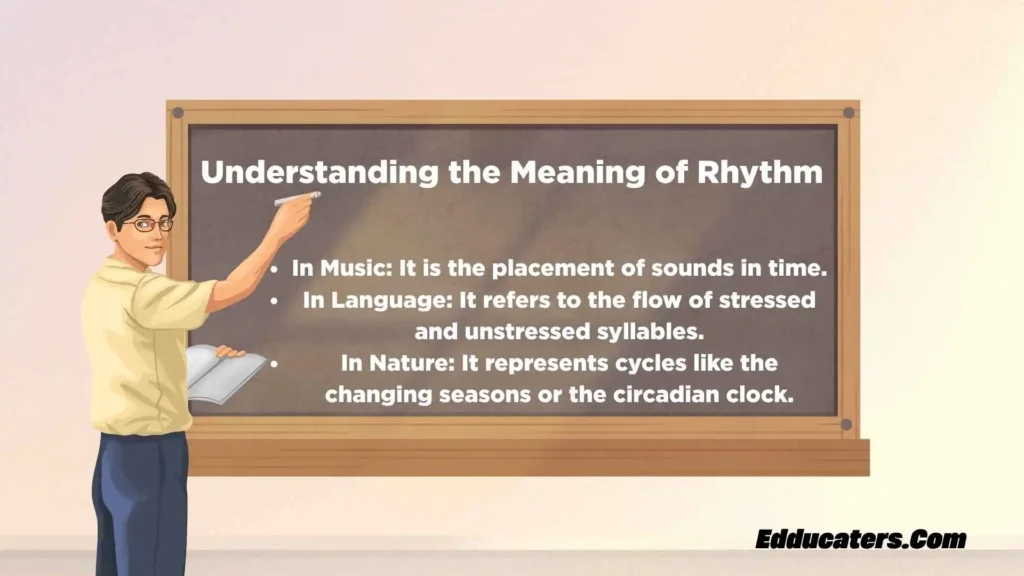
Rhythm is a noun that describes the systematic arrangement of musical sounds, beats, or movements. Beyond music, the term applies to many aspects of life, such as the natural rhythm of the tides, the rhythm of a person’s speech, or the daily rhythm of a busy office.
- In Music: It is the placement of sounds in time.
- In Language: It refers to the flow of stressed and unstressed syllables.
- In Nature: It represents cycles like the changing seasons or the circadian clock.
Examples:
- The drummer established a steady rhythm that got the entire crowd dancing.
- She found a comfortable rhythm while running her morning marathon.
- The poem lacked a consistent rhythm, making it difficult to read aloud.
Also Check This Post: Koozie or Coozie: What’s the Difference and Does It Matter?
Key Differences at a Glance
- Presence of ‘h’: The correct spelling, “rhythm,” contains two ‘h’s. The incorrect version usually omits the first ‘h’ or both.
- Etymological Roots: Because the word enters English via Latin from Greek, the ‘rh’ combination is a structural necessity that carries over from the Greek root rhuthmos.
- Acceptance: Dictionaries worldwide recognize “rhythm” as the sole standard spelling. “Rythm” is flagged as a typo in every grammar checker and word processor.
Grammar Rules and Etymology
The complexity of “rhythm” arises because it does not follow the standard phonetic rules of English. Most English words containing a /rɪ/ sound begin with “ri.” However, “rhythm” serves as a reminder of English’s diverse linguistic history.
The Greek root rhuthmos—meaning “measured flow”—demands the inclusion of the “h.” When this word was adopted into English, linguists maintained the original Greek spelling pattern. Therefore, the “rh” at the beginning is a direct link to its ancient origins. There are no exceptions to this rule; “rythm” is never an acceptable alternative in any dialect, whether US, British, Australian, or Canadian English.
When to Use Rhythm
Because “rhythm” is a standard English noun, it is appropriate for use in all contexts.
- Academic/Professional Writing: Always use the standard spelling to maintain credibility. In a research paper on musicology or biology, “rythm” would be seen as a significant error.
- Business/Emails: Proper spelling reflects attention to detail. Using “rhythm” in emails regarding project timelines or team workflows ensures your message is taken seriously.
- Creative Writing/Social Media: Even in casual settings, using the correct spelling helps your content remain searchable and readable.
Why People Confuse Them
The primary reason for the misspelling is phonetic simplicity. English speakers tend to group the /rɪ/ sound with the letter “r” and an “i,” ignoring the silent or structural “h.” Since we pronounce the word as if it were spelled “rith-um,” our brains naturally favor the simplest phonetic path. “Rythm” looks like a logical shortcut, but it ignores the historical orthography of the word.
Also Check This Post: Suppose to or Supposed to: Common Mistakes to Avoid
Original Examples of Usage
- The factory workers found a better rhythm after updating the assembly line equipment.
- The jazz band’s rhythm section provided a solid foundation for the soloists.
- Reading poetry helps students develop an ear for the rhythm of the language.
- The patient’s heart rhythm returned to normal after the treatment.
- He struggled to find his rhythm in the new job after working remotely for years.
- The tides follow a predictable rhythm that fishermen have observed for centuries.
- During the lecture, she tapped her pen to the rhythm of the professor’s speech.
- The salsa class focused on teaching beginners how to stay on rhythm.
- The cyclical rhythm of the seasons dictates when the crops should be planted.
- Even in silence, there is a certain rhythm to the life of a quiet library.
- The software update disrupted the team’s rhythm, causing a temporary drop in output.
- Her writing style is known for its beautiful rhythm and cadence.
- Learning to dance requires a deep sense of internal rhythm.
- The constant rhythm of the train tracks lulled the passengers to sleep.
- To become a great chef, you must master the rhythm of a busy kitchen.
The Foolproof Memory Trick

To remember that rhythm has two ‘h’s, use the following acronym:
Rhythm Helps Your Two Hips Move.
- R – Rhythm
- H – Helps
- Y – Your
- T – Two
- H – Hips
- M – Move
The two “H”s in the acronym stand for the two “H”s in the word. Every time you need to write it, just remember that your hips need a hythm to move!
Mini Quiz
- Which is the correct spelling of the word?
a) Rythm
b) Rhythm
c) Rhytm
d) Rithym
Answer: b) - What is the root origin of the word?
a) French
b) Latin
c) Greek
d) German
Answer: c) - How many ‘h’s are in the correct spelling?
a) One
b) Two
c) Three
d) Zero
Answer: b) - Which of the following is correct?
a) He has a great sense of rythm.
b) He has a great sense of rhythm.
c) He has a great sense of rhytm.
d) He has a great sense of rythum.
Answer: b) - The word “rhythm” is a:
a) Verb
b) Adjective
c) Adverb
d) Noun
Answer: d)
Frequently Asked Questions
Is “rythm” ever an acceptable spelling?
No, “rythm” is strictly considered a misspelling in all forms of English. Whether you are writing for an American or British audience, the word must always be spelled “rhythm.” Using the incorrect version in professional or academic documents can diminish the perceived quality of your work.
Why is “rhythm” so difficult to spell?
“Rhythm” is difficult because it does not follow the standard phonetic spelling rules most English words use. The silent ‘h’ after the ‘r’ and the ‘h’ after the ‘t’ are remnants of the word’s Greek origin, rhuthmos, which makes the spelling counter-intuitive for modern English speakers.
Does US English and British English spell it differently?
No. Both American and British English use the exact same spelling: “rhythm.” There are no regional variations for this specific word, which simplifies matters for writers communicating internationally. You can rely on this spelling regardless of your target audience’s location.
How can I stop making this mistake?
The most effective way to stop making this mistake is to use the mnemonic device: “Rhythm Helps Your Two Hips Move.” By associating the two ‘h’s with the word “hips” and “helps,” you create a mental anchor that makes the correct spelling easier to recall during writing.
Is “rhythm” a formal or informal word?
“Rhythm” is a standard neutral noun. It is perfectly acceptable in all registers of communication, including highly formal academic papers, professional business reports, casual emails, and daily conversation. It carries no specific tone of formality other than the formality of being a standard English word.
How do I use “rhythm” in a sentence?
You can use “rhythm” to describe anything with a recurring pattern. For example: “The band played with a great rhythm,” or “She found a rhythm in her morning routine.” It functions grammatically as a standard noun, appearing after articles like “the” or “a,” or following possessive pronouns.
Key Takeaways
- The only correct spelling is rhythm.
- The misspelling “rythm” is incorrect in all contexts.
- The word derives from the Greek rhuthmos, which necessitates the two ‘h’s.
- Use the mnemonic “Rhythm Helps Your Two Hips Move” to remember the spelling.
- “Rhythm” is a versatile noun appropriate for any professional or personal setting.
Conclusion
Mastering the spelling of “rhythm” is a small but significant step in refining your English writing skills. While the silent letters may seem counter-intuitive, they are a fascinating connection to the word’s ancient origins.
By remembering the two-h structure through our mnemonic device, you can write with confidence, knowing your spelling is accurate and professional. Whether you are discussing the beat of a song or the flow of a process, “rhythm” is the only correct way to express that sense of measured movement.
Also Check This Post: Grey or Gray: The Ultimate Guide to Spelling the Color Correctly

Hello, I’m Claire Holloway. I have always been passionate about the English language and enjoy turning complex grammar rules into simple, easy-to-follow lessons. I believe that every learner can become a confident English writer with the right guidance.
I create educational content focused on grammar, vocabulary, sentence structure, and writing improvement. Every article I publish is designed to help readers learn with confidence and accuracy.
Books
Grammar Without Confusion
Modern English Usage Guide
 Nathan Whitmore
 Julian Mercer