Language often presents us with subtle choices that spark debate among even the most polished writers. Among the most common points of confusion is whether to use the two-word phrase in between or the compound word inbetween. You might see both versions appearing in emails, novels, and professional documents, leaving you to wonder which one is technically correct. Understanding the distinction is essential for maintaining clarity and professionalism in your writing.
This guide clarifies the nuances of this phrase, providing you with everything you need to know to make the right choice every time. You will learn the grammatical rules governing these terms, discover when to use them in formal versus informal contexts, and find practical strategies to ensure your writing remains error-free.
Inbetween or In Between: (Quick Answer)
Both “in between” and “in-between” are acceptable, but they serve different functions. Use in between as a preposition or adverbial phrase to denote a position separating two things. Use the hyphenated in-between as an adjective to describe something located in an intermediate position. Avoid “inbetween” as a single, unhyphenated word.
Comparison Table
| Feature | In Between | In-Between | Inbetween |
| Status | Correct | Correct | Incorrect |
| Part of Speech | Preposition / Adverb | Adjective | Non-standard |
| Function | Describes location/time | Describes a noun | None |
| Grammar Rule | Two separate words | Hyphenated compound | Spelling error |
| Example | Sit in between them. | An in-between phase. | (Avoid) |
| Memory Tip | “In” + “Between” (Two items) | Hyphen links to noun | Does not exist |
Understanding the Components
In Between
In most cases, you should treat these as two distinct words. As a preposition, it shows the relationship between two entities in space or time. As an adverb, it describes the act of being positioned somewhere within a sequence.
- Example: “The delivery truck arrived in between the morning and afternoon shifts.”
- Usage: It functions as a phrase indicating the space or interval separating two objects or events.
In-Between
When you use these words to modify a noun, English grammar rules dictate that you should hyphenate them. This creates a compound adjective. If you describe a state, a color, or a size that sits in the middle, use the hyphen to signal that these words are working together as a single unit.
- Example: “The project entered an in-between stage where no one knew who held authority.”
- Usage: The hyphen turns the two words into a single modifier that gives specific information about the following noun.
The Myth of “Inbetween”
You may encounter the closed compound “inbetween” in casual digital communication, such as text messages or social media posts. However, in standard English, this is considered a spelling error. It is not recognized in major dictionaries as a standard word. Always prefer the two-word phrase or the hyphenated adjective.
Key Differences
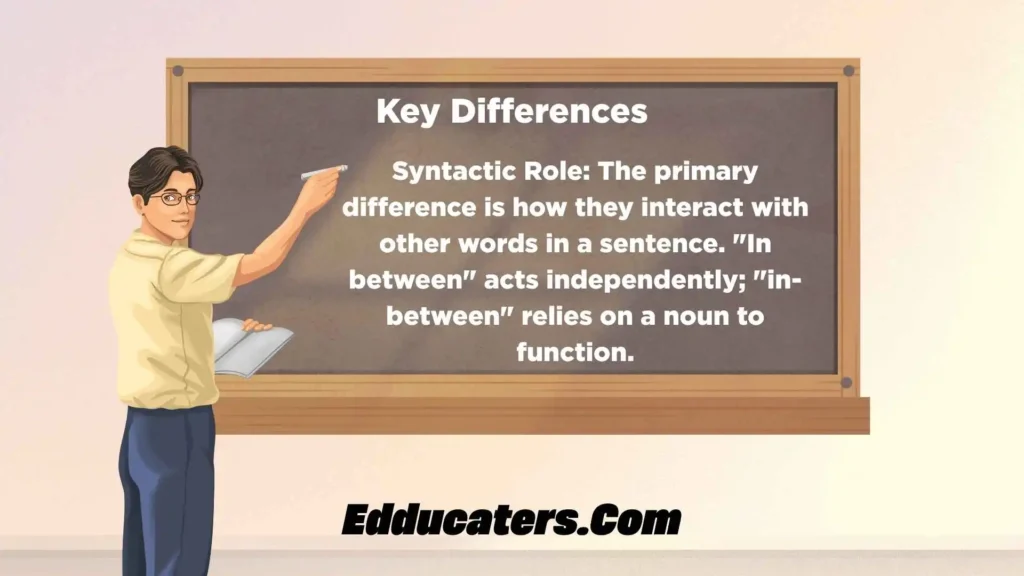
- Syntactic Role: The primary difference is how they interact with other words in a sentence. “In between” acts independently; “in-between” relies on a noun to function.
- Hyphenation: The hyphen is the grammatical glue that holds the words together when they serve as a descriptive adjective. Without a noun to modify, the hyphen is unnecessary and grammatically incorrect.
- Flexibility: “In between” is the more versatile choice. If you are ever unsure whether you need an adjective or a preposition, defaulting to the two-word version is often the safer stylistic choice, provided you aren’t describing a noun.
Essential Grammar Rules
The fundamental rule relies on the “Modifier Test.” Ask yourself: Is this word describing a specific thing?
- The Prepositional Rule: If you are saying something is located inside the space separating two points, keep the words separate. No hyphen is needed.
- The Adjectival Rule: If the phrase is positioned directly before a noun to describe that noun’s quality, add the hyphen.
- British vs. American English: Both dialects follow this standard. While British English occasionally favors hyphenation more frequently in compound structures, both UK and US style guides agree that “inbetween” without a hyphen is poor form.
When to Use Each
Formal and Academic Writing
In research papers, legal documents, or formal reports, always use in between for prepositions and in-between for adjectives. Precision is paramount here; using the unhyphenated “inbetween” can make your writing appear careless.
Professional Business Writing
Emails and business memos benefit from the clarity of standard grammar. Use the two-word form for location: “Our meeting is in between the morning calls.” Use the hyphenated form for states of transition: “We are currently in an in-between period regarding the company merger.”
Casual Conversation
While you might use “in-between” in casual chat, standard conventions still apply if you want your writing to be clear. Avoid the closed-up “inbetween” entirely to ensure your message remains readable and professional.
Common Mistakes
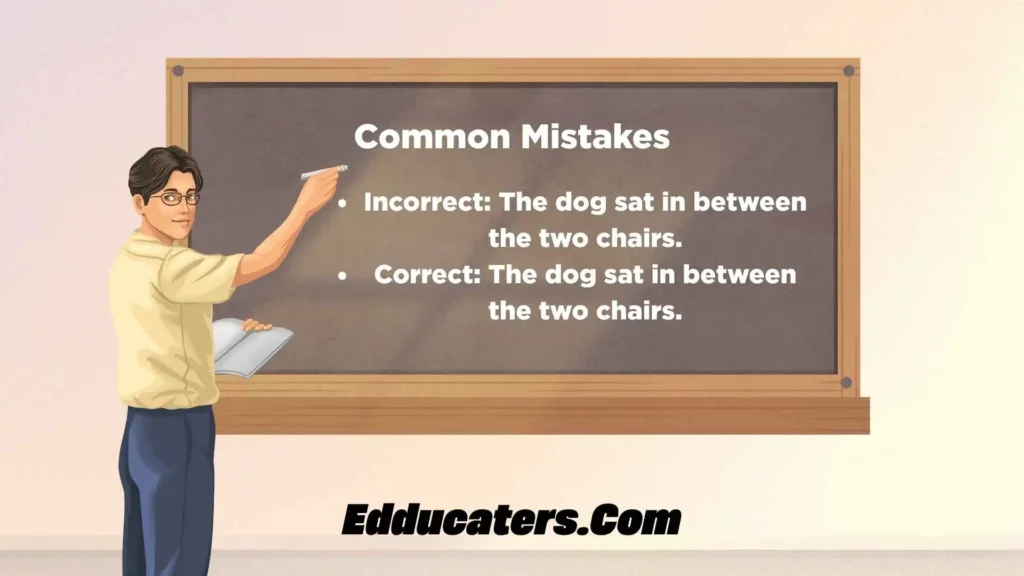
The most common mistake is writing “inbetween” as one word. This often happens because writers equate it to similar words like “inside” or “into.” However, unlike those words, “in between” retains its status as a phrase of relationship.
- Incorrect: The dog sat in between the two chairs.
- Correct: The dog sat in between the two chairs.
- Incorrect: It was an inbetween day for the stock market.
- Correct: It was an in-between day for the stock market.
20 Original Examples
- Please place the vase in between those two books on the shelf.
- The city is located in between the mountains and the sea.
- We are in an in-between stage of our long-term rebranding strategy.
- The toddler squeezed herself in between her parents on the sofa.
- There is a long, awkward silence in between the tracks on this album.
- The report notes an in-between temperature that requires specific storage.
- He found a small gap in between the fence posts to slide through.
- My birthday falls in between the holidays, which makes planning difficult.
- This is an in-between shade of blue that doesn’t quite match the wall.
- The teacher walked in between the rows of desks to monitor the test.
- We are experiencing an in-between season that is neither winter nor spring.
- I need to fit a quick workout in between my morning meetings.
- The runner was stuck in between the lead pack and the rest of the field.
- She wore an in-between size that was slightly loose but comfortable.
- Communication broke down in between the departure of the manager and the arrival of his successor.
- The policy creates an in-between situation for employees hired last month.
- I usually read in between flights during my business trips.
- There is very little room in between the garage and the main house.
- This song has an in-between tempo that is neither fast nor slow.
- They spent the time in between classes reviewing their notes.
Memory Trick
Think of the “Two-Word Rule.” Since “between” inherently suggests two things (you need at least two points to have a space between them), keep the phrase as two words. If you need to make it a single unit to describe a noun, use a hyphen to “clip” the two words together into an adjective. If you try to jam them together without a hyphen, you break the grammar!
Mini Quiz
- Which is the correct way to write the phrase when used as a preposition?
a) Inbetween
b) In between
c) In-between
Answer: b - When should you use a hyphen?
a) When it is a preposition
b) When it is an adjective modifying a noun
c) Never
Answer: b - Is “inbetween” a standard word in English?
a) Yes
b) No
Answer: b - Choose the correct sentence:
a) The cat slept in-between the cushions.
b) The cat slept in between the cushions.
Answer: b - Choose the correct sentence:
a) It was an in-between decision.
b) It was an inbetween decision.
Answer: a
Frequently Asked Questions
Is “inbetween” ever considered correct?
No, “inbetween” is considered a misspelling in all forms of standard English. Dictionaries do not recognize it as a word. You should always separate the components into “in between” or use a hyphen if creating an adjective.
Does American and British English differ in this usage?
Both American and British English follow the same rules. In both dialects, “in between” functions as the prepositional form, and “in-between” functions as the compound adjective. Neither dialect accepts the unhyphenated, closed-up version.
When should I use a hyphen?
Use a hyphen only when the phrase functions as an adjective directly preceding a noun. For example: “an in-between size.” This signals to the reader that the two words are acting as a single modifier describing the following noun.
What if I am using it as an adverb?
When used as an adverb (e.g., “I stood in between”), you should not use a hyphen. The hyphen is reserved exclusively for the adjectival role. If it is not modifying a noun, keep the words separate.
Is it wrong to use “in between” as an adjective?
Yes, grammatically, you should hyphenate “in-between” when it is used as an adjective. If you write “an in between size” without the hyphen, it can cause confusion and is technically incorrect, as the reader expects a noun to follow immediately.
Can I just use “between” instead?
Often, yes. In many contexts, you can simplify your sentence by removing “in.” For example, “The book is between the cushions” is just as clear as “The book is in between the cushions.” Using “between” alone often makes your writing more concise and elegant.
Key Takeaways
- Use two words (“in between”) when functioning as a preposition or adverb.
- Use a hyphen (“in-between”) only when the phrase functions as an adjective before a noun.
- Never use “inbetween” as a single word; it is grammatically incorrect.
- Test for the adjective: If you can replace the phrase with another adjective (like “intermediate”), you likely need the hyphenated form.
- Simplify: When in doubt, often the single word “between” is a stronger, more concise alternative.
Conclusion
Mastering the use of in between and in-between is a simple yet effective way to sharpen your writing. By remembering to treat them as two separate words for location and as a hyphenated unit for description, you ensure your prose remains polished and professional.
Avoiding the incorrect “inbetween” will instantly elevate the quality of your work, demonstrating a strong grasp of English mechanics.

Hi, I’m Nathan Whitmore, and I enjoy making English grammar easy for learners of all ages. I believe grammar should be practical, not confusing. I write simple, well-researched guides that help readers improve their writing, speaking, and overall communication skills.
I spend a lot of time studying grammar patterns, sentence construction, punctuation, and modern English usage. My goal is to create lessons that anyone can understand, whether they are students, teachers, or professionals.
Books
Clear English Grammar
The Smart Writer’s Grammar Handbook
 Claire Holloway
 Julian Mercer