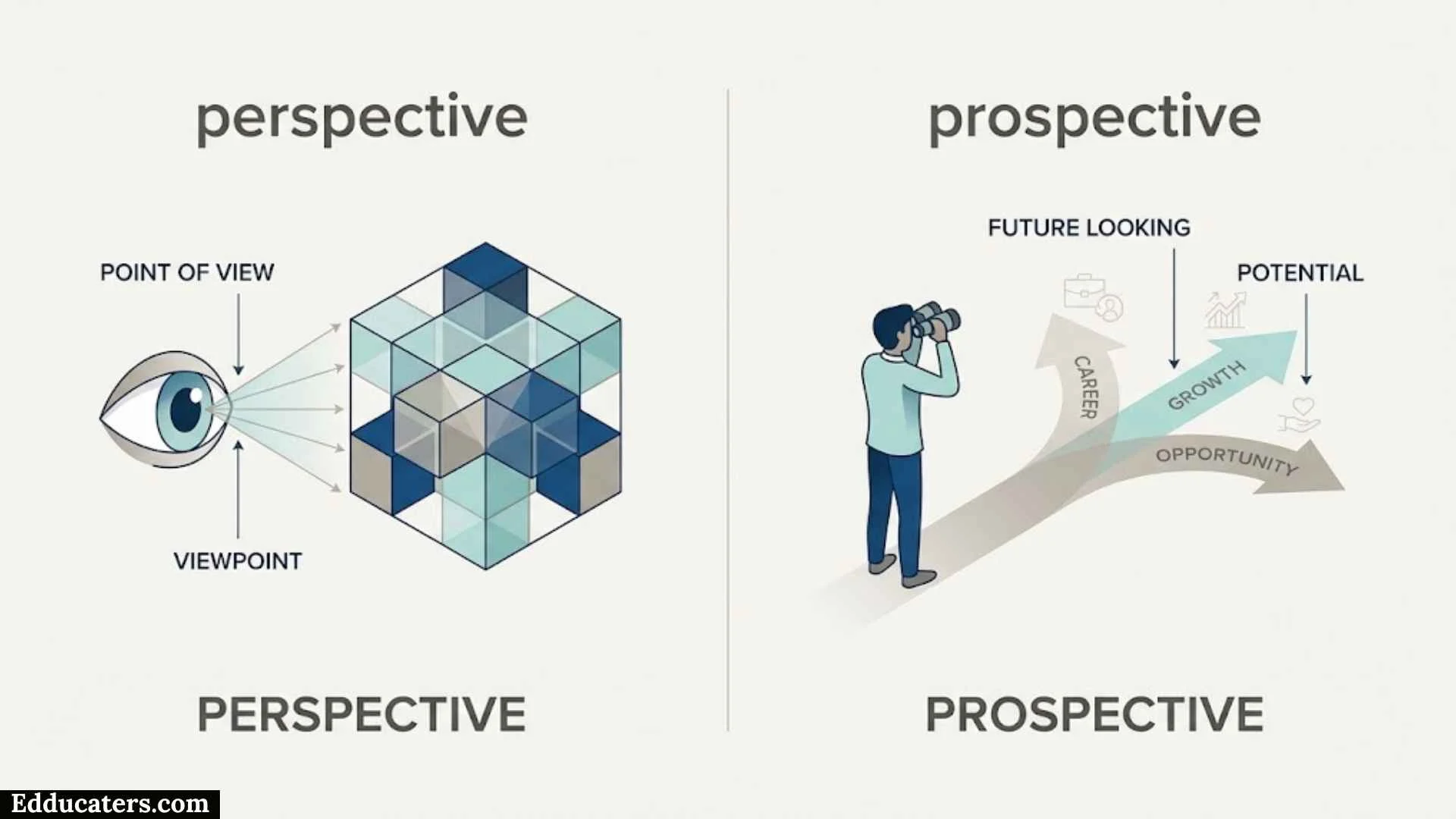
Perspective and prospective are commonly confused because they look similar, sound somewhat alike, and both relate to ways of thinking about people, situations, or the future. However, they are different words with different meanings and grammatical uses.
The simplest distinction is this: perspective is usually a noun meaning a particular way of seeing, understanding, or interpreting something. Prospective is usually an adjective meaning likely, expected, or being considered for something in the future.
For example:
- From my perspective, the decision was reasonable.
- The company interviewed several prospective employees.
So, if you are talking about a point of view, use perspective. If you are describing someone or something that is likely to become or happen in the future, use prospective.
These words are not different spellings of the same word, and neither one is a misspelling of the other. Understanding their meanings makes it much easier to choose the right word.
What Does Perspective Mean?
Perspective is primarily a noun. It refers to a particular way of looking at, thinking about, or understanding something.
A person’s perspective can be shaped by their experiences, knowledge, beliefs, circumstances, or position. Two people can look at exactly the same situation but have completely different perspectives.
Consider this example:
From a teacher’s perspective, the new policy may create additional work.
Here, perspective means the teacher’s point of view or way of understanding the situation.
The word can also refer to the ability to judge something in relation to its importance or overall context:
The experience helped her put her problems into perspective.
In this expression, perspective means a balanced understanding of how important something really is.
Perspective As a Point of View
One of the most common meanings of perspective is point of view.
For example:
- I understand your perspective.
- The article presents a different perspective on education.
- We need to consider the issue from the customer’s perspective.
- His perspective changed after he moved abroad.
In each sentence, the word describes a way of seeing or understanding something.
Perspective In Art And Photography
Perspective also has a specialized meaning in art, drawing, photography, and visual representation. It describes the way objects appear to have different sizes, positions, or distances depending on how they are viewed.
For example:
The artist used perspective to make the road appear to stretch into the distance.
This meaning is related to the general idea of how something is viewed, but it is specifically concerned with visual representation.
Perspective In Everyday Expressions
You will often see perspective in expressions such as:
- from my perspective
- from your perspective
- from another perspective
- a different perspective
- a new perspective
- put something into perspective
- keep something in perspective
- gain perspective
- broaden your perspective
For example:
From my perspective, the benefits outweigh the disadvantages.
Travel can give people a broader perspective on other cultures.
These expressions are usually concerned with someone’s viewpoint, understanding, or overall judgment.
What Does Prospective Mean?
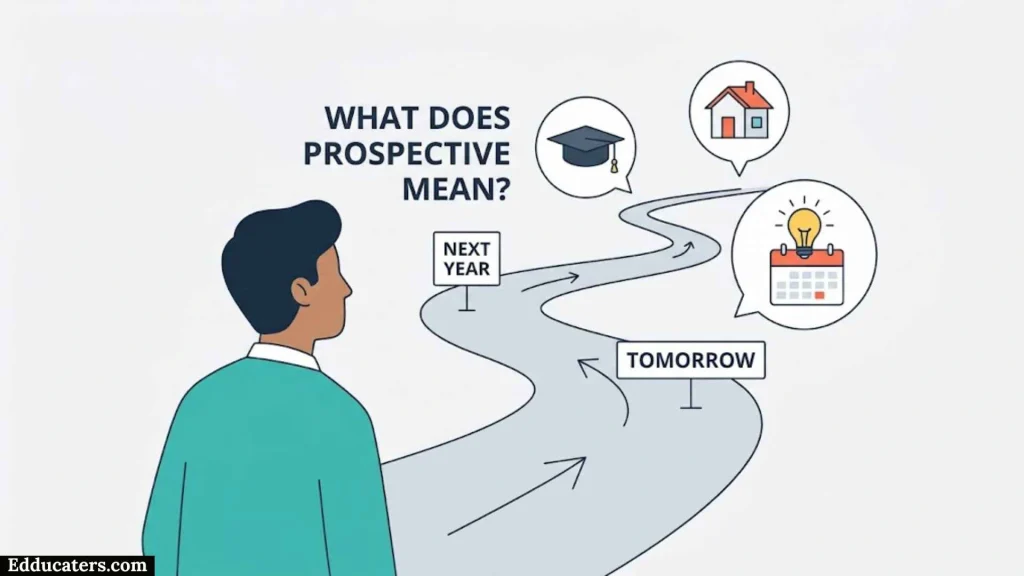
Prospective is primarily an adjective. It describes someone or something that is likely to become, happen, or be involved in something in the future.
For example:
The university held an information session for prospective students.
The students have not necessarily enrolled yet. They are people who may become students in the future.
Similarly:
The company contacted several prospective clients.
These are people or organizations that may become clients.
The word therefore has a strong connection with possibility, expectation, or future involvement.
Prospective Means Potential Or Expected
Depending on the context, prospective can often be understood as potential, possible, likely, or expected.
Examples include:
- prospective buyer
- prospective customer
- prospective employee
- prospective employer
- prospective student
- prospective tenant
- prospective parent
- prospective candidate
For instance:
The prospective buyer visited the house twice.
The person is considering buying the house but has not necessarily bought it.
The school organized an event for prospective students.
The people attending may become students, but they are not necessarily students of the school yet.
Prospective Refers To The Future
The future-oriented meaning is one of the easiest ways to recognize prospective.
Compare:
She is a prospective employee.
This means she may become an employee.
With:
She has a different perspective on employment.
This means she has a particular way of thinking about employment.
The words may appear in similar contexts, but they perform completely different jobs.
Perspective Or Prospective: The Main Difference
The central difference can be summarized simply:
| Feature | Perspective | Prospective |
| Part of speech | Usually a noun | Usually an adjective |
| Main meaning | A way of seeing or understanding something | Likely or expected in the future |
| Common synonym | Viewpoint, outlook | Potential, possible, expected |
| Typical use | A person’s perspective | A prospective customer |
| Future meaning | Not necessarily future-focused | Strongly associated with the future |
| Example | I understand your perspective. | We met a prospective client. |
A useful way to remember the distinction is:
Perspective = how you see something.
Prospective = what may happen or who may become something.
How To Use Perspective In A Sentence
Because perspective is a noun, it commonly follows possessive words such as my, your, his, her, our, or their.
Examples:
- I respect your perspective.
- Her perspective on the issue is interesting.
- Their perspective changed after the experience.
- Our perspective is different from theirs.
It can also follow prepositions:
- from a different perspective
- from my perspective
- in perspective
- into perspective
Examples:
Try looking at the problem from a different perspective.
The conversation put the situation into perspective.
Another common construction is perspective on:
He has an unusual perspective on modern education.
You may also see perspective about, although perspective on is often the more natural choice when discussing a subject or issue.
How To Use Prospective In A Sentence
Because prospective is an adjective, it normally modifies a noun.
Examples:
- The agent spoke to a prospective buyer.
- Several prospective students attended the open day.
- The company is looking for prospective investors.
- We contacted prospective customers by email.
- The landlord met with a prospective tenant.
The adjective usually comes directly before the noun it describes.
For example:
prospective employee
not:
prospective by itself when you need to identify the person or thing being considered.
You can also use it in more formal contexts:
The report examines the concerns of prospective applicants.
Here, prospective applicants are people who may apply.
Perspective And Prospective In Similar Situations
The words become especially confusing when they occur in sentences about people, business, education, or decision-making.
Consider these examples.
Business
The sales manager considered the customer’s perspective.
This means the manager considered the customer’s point of view.
The sales manager contacted a prospective customer.
This means the manager contacted someone who might become a customer.
Education
The teacher tried to understand the student’s perspective.
This refers to the student’s way of seeing or understanding something.
The university invited prospective students to an open day.
These are people who may become students.
Employment
The interviewer’s perspective on the candidate changed during the interview.
The interviewer changed their opinion or viewpoint.
The company interviewed a prospective employee.
The person may become an employee.
These examples show why substituting one word for the other can completely change the meaning of a sentence.
Common Phrases With Perspective
Learning common combinations can make the word easier to recognize.
From My Perspective
From my perspective means from my point of view.
From my perspective, the project was successful.
It is particularly useful when presenting an opinion without suggesting that it is the only possible interpretation.
From Another Perspective
This means looking at something in a different way.
The problem looks different from another perspective.
Put Something Into Perspective
This means to understand something in relation to its wider context or importance.
Talking to her helped put the setback into perspective.
Gain Perspective
This means to develop a broader or clearer understanding of a situation.
Taking a short break helped him gain some perspective.
Broaden Your Perspective
This means to develop a wider way of thinking or understanding.
Reading books from different cultures can broaden your perspective.
Common Phrases With Prospective
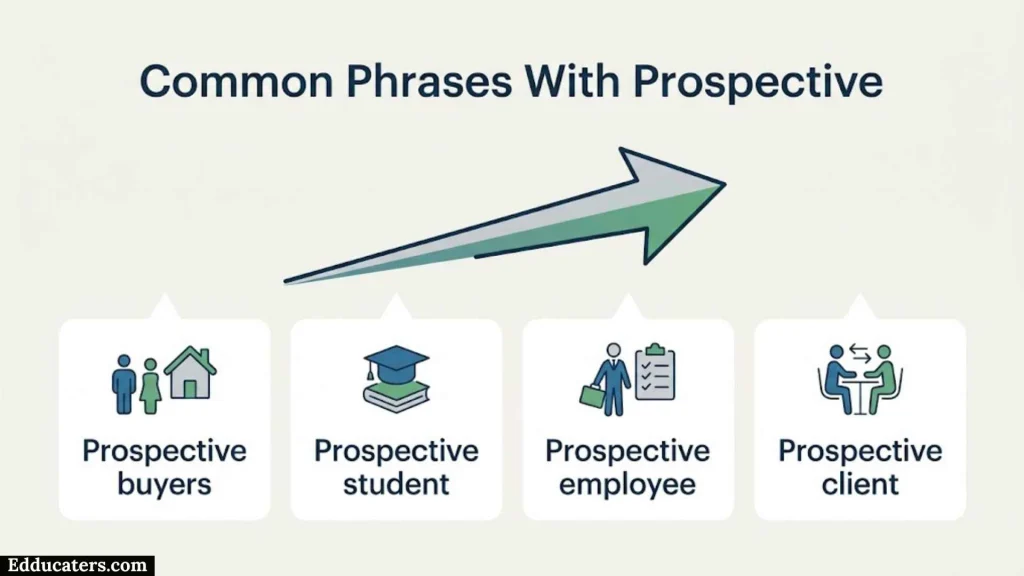
Prospective frequently appears before nouns describing people who may take a particular role or become customers, clients, buyers, or members.
Common combinations include:
- prospective customer
- prospective client
- prospective buyer
- prospective employee
- prospective employer
- prospective student
- prospective tenant
- prospective investor
- prospective candidate
- prospective member
For example:
The website provides information for prospective customers.
Prospective tenants can schedule a viewing.
The university answered questions from prospective students.
These combinations are particularly common in business, education, recruitment, property, and formal communication.
Why Are Perspective And Prospective Confused?
The confusion is understandable because the words have similar spelling patterns.
Both begin with perspec-, and both contain several of the same letters in almost the same order:
- perspective
- prospective
They also have similar pronunciations, although they are not pronounced identically.
The endings provide an important visual clue:
- perspec-tive
- prospec-tive
The meanings, however, are much more useful than trying to memorize the spelling alone.
Perspective is connected with viewing or understanding.
Prospective is connected with what may happen in the future.
This is why a person can have a perspective, while that same person might be a prospective customer.
Perspective Or Prospective: Pronunciation
The words are similar enough in pronunciation to contribute to confusion, but their vowel patterns differ.
Perspective is commonly pronounced approximately:
per-SPEK-tiv
Prospective is commonly pronounced approximately:
pruh-SPEK-tiv
The exact vowel quality can vary somewhat between accents, particularly between British and American English, but the distinction between the two words remains.
The shared -spective sound is one reason the words can be difficult to distinguish when heard quickly.
When speaking, context often makes the intended word clear. When writing, however, choosing the correct spelling is essential because the two words have different meanings.
Are Perspective And Prospective Interchangeable?
No. Perspective and prospective are not interchangeable.
You cannot normally replace one with the other without changing the meaning or making the sentence incorrect.
For example:
I understand your perspective.
This is correct because you are referring to someone’s point of view.
You would not write:
I understand your prospective.
That does not express the intended meaning.
Likewise:
The company contacted a prospective client.
This is correct because the client is a potential future client.
You would not normally write:
The company contacted a perspective client.
That would be incorrect in standard English.
The distinction is therefore about meaning and grammatical function, not British versus American spelling.
Perspective Or Prospective: British And American English
There is no standard British-American spelling difference between these two words.
British English uses:
- perspective
- prospective
American English uses the same spellings:
- perspective
- prospective
The words may have minor pronunciation differences depending on the speaker’s accent, but neither spelling belongs exclusively to British or American English.
So if you are wondering whether perspective is British while prospective is American, or vice versa, the answer is no. They are separate English words used in both varieties.
Common Mistakes To Avoid
The most common error is using prospective when you mean perspective, or using perspective when you mean prospective.
Mistake 1: Using Prospective For A Point Of View
Incorrect:
From my prospective, the plan is reasonable.
Correct:
From my perspective, the plan is reasonable.
The intended meaning is “from my point of view,” so perspective is required.
Mistake 2: Using Perspective For A Potential Customer
Incorrect:
The company sent an offer to every perspective customer.
Correct:
The company sent an offer to every prospective customer.
The customers are potential future customers, so prospective is the correct adjective.
Mistake 3: Treating Prospective As A Noun
Because prospective is usually an adjective, it normally describes a noun:
a prospective buyer
a prospective employee
a prospective student
If you mean a person’s point of view, use the noun perspective.
A Simple Memory Trick
A useful way to remember the difference is to connect perspective with view.
Think:
Perspective = point of view.
If you are talking about how someone sees, understands, or interprets something, choose perspective.
For prospective, think:
Prospective = potential future.
If someone or something may become a particular thing later, prospective is usually the right choice.
For example:
- Perspective: Her perspective on the problem was different.
- Prospective: She was a prospective customer.
Another quick test is to replace the word mentally:
If “point of view” makes sense, use perspective.
If “potential” or “possible future” makes sense, use prospective.
Perspective Or Prospective: Which One Should You Use?
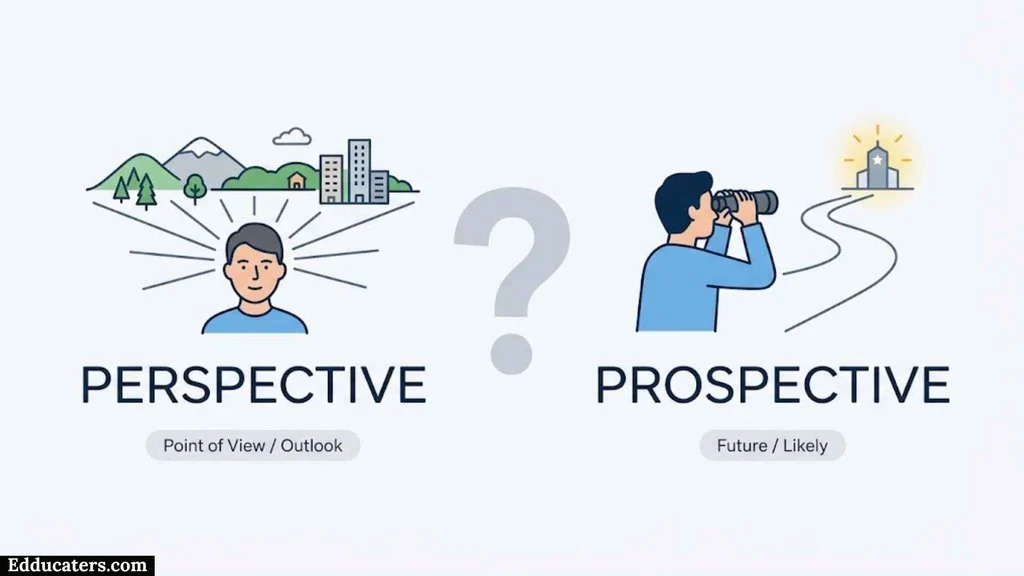
Use perspective when you mean a viewpoint, outlook, interpretation, or way of seeing something.
Use prospective when you mean potential, expected, or likely to become something in the future.
Compare:
The journalist offered a new perspective on the issue.
The journalist interviewed a prospective candidate.
The first sentence concerns a point of view. The second describes someone who may become a candidate.
The distinction becomes even clearer in these pairs:
| If You Mean… | Use | Example |
| A point of view | perspective | I understand your perspective. |
| A way of interpreting something | perspective | Her perspective changed. |
| A broader outlook | perspective | Travel gave him a new perspective. |
| A potential customer | prospective | We contacted a prospective customer. |
| A potential employee | prospective | She is a prospective employee. |
| A potential student | prospective | The event is for prospective students. |
| Something expected in the future | prospective | The prospective changes could affect the company. |
Frequently Asked Questions
Is Perspective Or Prospective Correct?
Both perspective and prospective are correct English words. They simply have different meanings. Perspective usually means a point of view, while prospective describes someone or something that is potential or expected in the future.
Is It “From My Perspective” Or “From My Prospective”?
The correct expression is “from my perspective.”
For example:
From my perspective, the decision was fair.
Here, perspective means “point of view.” Prospective would not be correct.
Is It “Prospective Customer” Or “Perspective Customer”?
The correct expression is “prospective customer.”
A prospective customer is someone who may become a customer. Perspective customer is not the standard expression for this meaning.
What Is The Difference Between Perspective And Prospective?
Perspective is a noun referring to a way of seeing or understanding something. Prospective is an adjective describing someone or something that may become, happen, or exist in the future.
Are Perspective And Prospective Homophones?
No. They are not true homophones because they are not pronounced exactly the same. Their spellings and meanings are also different, although their similar sounds can make them easy to confuse.
Does Prospective Mean Future?
It can refer to something connected with the future, especially something that is expected or likely to happen or someone who may take a particular role. For example, a prospective student is someone who may become a student.
What Is A Prospective Employee?
A prospective employee is someone who may become an employee, usually because they are being considered for a job or are applying for one.
Can Perspective Be An Adjective?
In standard modern English, perspective is primarily used as a noun. For example, “She has a different perspective.” The related adjective perspectival exists, particularly in academic or specialized writing, but it is much less common in everyday English.
Final Takeaway
Perspective and prospective are both correct words, but they belong in different contexts.
Perspective is about how something is seen or understood. It is a noun and is commonly used for a person’s point of view, outlook, or interpretation.
Prospective is about what may happen or who may become something in the future. It is an adjective commonly used with words such as customer, buyer, employee, student, and investor.
The easiest rule to remember is:
Perspective = point of view.
Prospective = potential future.
So write “from my perspective” when you mean “from my point of view,” but write “a prospective customer” when you mean a potential customer. Once you connect each word with its core meaning, this commonly confused pair becomes much easier to use correctly.

I’m Julian Mercer, an English language writer dedicated to helping people master grammar through practical examples and clear explanations. I enjoy teaching grammar in a way that is both engaging and easy to remember.
My work focuses on grammar rules, punctuation, word usage, and writing techniques that readers can apply in everyday life. I believe learning English should be simple, enjoyable, and useful.
Books
English Grammar in Practice
Writing with Precision
 Claire Holloway