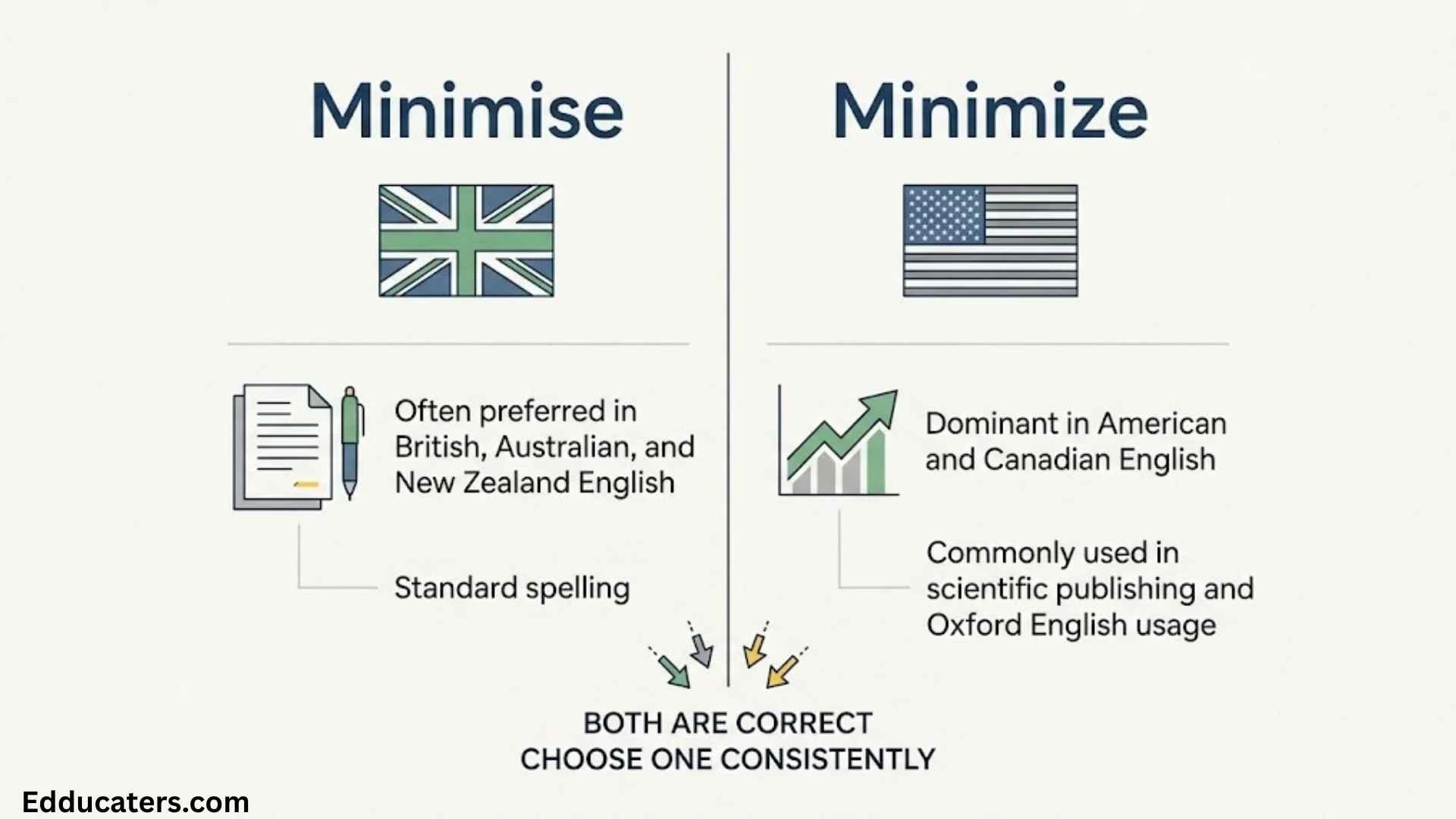
If you’re unsure whether to write minimise or minimize, you’re not alone. Both spellings are correct, but the preferred form depends mainly on the variety of English you’re using. Minimize is the standard spelling in American English, while minimise is widely used in British English and is also common in Australian English.
Both words have the same meaning, pronunciation, and grammatical function. The main difference is simply the spelling of the ending: -ize in minimize and -ise in minimise.
So, which one should you use? Choose the spelling that matches your audience and keep your spelling style consistent throughout your writing.
Minimise or Minimize: Which Is Correct?
Both “minimise” or “minimize” are correct spellings.
| Form | Common usage | Meaning | Example |
| minimize | American English | Reduce something as much as possible | We need to minimize costs. |
| minimise | British English, commonly Australian English | Reduce something as much as possible | We need to minimise costs. |
There is no difference in meaning between the two forms.
For example:
We need to minimize the risk.
and
We need to minimise the risk.
Both sentences mean that the risk should be reduced as much as possible.
The simple rule
- American English: minimize
- British English: minimise
- Australian English: minimise is commonly used
- Canadian English: both spelling patterns can occur, depending on the word and style convention
If you’re writing specifically for an American audience, minimize is the natural choice. If you’re following British English spelling, use minimise.
What Does Minimize Mean?
Minimize is a verb meaning to reduce something to the smallest, lowest, or least amount or degree possible or practical.
It can describe reducing risks, costs, problems, waste, delays, distractions, or other unwanted effects.
For example:
- We need to minimize unnecessary expenses.
- The new system helps minimize errors.
- Good planning can minimize delays.
- Turn off notifications to minimize distractions.
- The company wants to minimize waste.
In British English, the same sentences would normally use minimise instead.
What Does Minimise Mean?
Minimise has exactly the same basic meaning as minimize.
It means to reduce something as much as possible or to make something as small or limited as practical.
For example:
- The company wants to minimise waste.
- We should minimise unnecessary costs.
- These measures can minimise the risk of errors.
- Try to minimise distractions while working.
- The new process should minimise delays.
The spelling minimise is especially familiar in British English.
Minimise or Minimize in British English
In British English, minimise is a standard spelling.
You will commonly see this form in British writing:
The company is taking steps to minimise its environmental impact.
British English often uses -ise spellings in words such as:
- minimise
- organise
- realise
- recognise
- apologise
- emphasise
- specialise
However, British English is not completely uniform about -ise and -ize spellings. Some British style guides and dictionaries accept or prefer -ize in certain words.
For minimise, however, the -ise form is widely established and natural in British English.
Minimise or Minimize in American English
In American English, minimize is the standard spelling.
For example:
The company is trying to minimize production costs.
American English commonly uses -ize in words such as:
- minimize
- organize
- realize
- recognize
- apologize
- emphasize
- specialize
Therefore, if your writing follows standard American English, minimize is the form to use.
The word is not different in meaning from British minimise. Only the spelling convention changes.
Minimise or Minimize in Australian English
Australian English generally follows British-influenced spelling conventions, so minimise is commonly used.
For example:
The new policy is designed to minimise unnecessary expenses.
If you’re writing for an Australian audience, minimise will look natural and familiar.
As with other varieties of English, consistency matters. If the rest of your document follows Australian spelling, using minimise keeps the style consistent.
Minimise or Minimize in Canadian English
Canadian English has its own spelling conventions and can show influence from both British and American English.
Minimize is widely used in Canadian English, although -ise spellings can also appear depending on the word, publication, or style guide being followed.
For Canadian writing, follow the spelling standard required by your school, employer, publisher, or chosen style guide rather than assuming that every Canadian word must follow either British or American spelling.
Minimise or Minimize Meaning
The meaning of minimise or minimize is the same.
Both mean:
To reduce something to the smallest, lowest, or least amount or degree possible or practical.
For example:
We need to minimize the risk of failure.
The British spelling would be:
We need to minimise the risk of failure.
The meaning does not change.
Common contexts for minimize or minimise
You can use the verb when talking about:
- reducing costs
- reducing risks
- limiting damage
- reducing waste
- lowering delays
- reducing errors
- limiting distractions
- reducing environmental impact
- limiting negative effects
For example:
Careful planning can minimize the possibility of mistakes.
or:
Careful planning can minimise the possibility of mistakes.
How Do You Pronounce Minimise or Minimize?
Minimise or minimize are normally pronounced the same way.
A simple pronunciation is:
MIN-uh-mize
IPA:
/ˈmɪnɪmaɪz/
The word has three syllables:
min-i-mize
The main stress falls on the first syllable:
MIN-i-mize
The final sound is /aɪz/, similar to the ending in words such as size and prize.
The spelling difference between minimise or minimize does not normally create a difference in pronunciation.
Minimise or Minimize in a Sentence
Both forms can be used in the same types of sentences.
Examples With “Minimize”
- We need to minimize unnecessary expenses.
- The software helps minimize loading time.
- She tried to minimize the risk of injury.
- Turn off notifications to minimize distractions.
- The company changed its process to minimize waste.
- Good planning can minimize delays.
- We should minimize the amount of plastic we use.
- The new system is designed to minimize errors.
- He adjusted the settings to minimize noise.
- These precautions can minimize potential problems.
Examples With “Minimise”
- We need to minimise unnecessary expenses.
- The software helps minimise loading time.
- She tried to minimise the risk of injury.
- Turn off notifications to minimise distractions.
- The company changed its process to minimise waste.
- Good planning can minimise delays.
- We should minimise the amount of plastic we use.
- The new system is designed to minimise errors.
- He adjusted the settings to minimise noise.
- These precautions can minimise potential problems.
The grammar and meaning are identical. Only the regional spelling differs.
Minimize or Minimise in Computing
In computing, minimize or minimise can describe reducing an open window so that it is no longer displayed in its normal full or working state, while the application remains available.
For example, an American English writer might say:
Click the button to minimize the window.
A British English writer might write:
Click the button to minimise the window.
The spelling depends on the English variety being used.
This usage is related to the familiar minimize button found in many graphical user interfaces.
Minimize or Minimise on YouTube
The word can also be used when describing the action of making a video player or other interface element smaller.
For example:
Minimize the YouTube player to continue browsing.
In British English:
Minimise the YouTube player to continue browsing.
The underlying meaning remains the same: reduce the visible size or presentation of something.
The exact terminology used by YouTube or another application can vary depending on its current interface and localization, so the spelling in an interface may not always match the wording used by an individual writer.
Minimise or Minimize Synonyms
Because minimise or minimize have the same meaning, they generally have the same possible synonyms.
Depending on the context, alternatives include:
- reduce
- lessen
- decrease
- limit
- lower
- diminish
- restrict
- curtail
- mitigate
However, these words are not interchangeable in every situation.
For example:
We need to minimize the risk.
Reduce the risk is a natural alternative.
But in computing:
Minimize the window.
The word minimize refers to a specific interface action, so simply replacing it with decrease would not express the same technical meaning.
Is “Minimise” a Correct Spelling?
Yes. Minimise is a correct standard spelling.
It is particularly common in British English and is also widely used in Australian English.
For example:
We should minimise unnecessary costs.
This is not a spelling mistake.
If you’re writing in American English, however, minimize is normally preferred.
Is “Minimize” a Correct Spelling?
Yes. Minimize is also a correct standard spelling.
It is the usual form in American English.
For example:
We should minimize unnecessary costs.
This is the same idea expressed using American spelling.
Neither form is inherently more correct. The appropriate choice depends on the spelling convention you’re following.
Why Are Minimise or Minimize Spelled Differently?
The difference comes from regional English spelling conventions.
Many words can be spelled with -ise or -ize, with different varieties of English favoring different forms.
For example:
| British-style spelling | American-style spelling |
| minimise | minimize |
| organise | organize |
| realise | realize |
| recognise | recognize |
| apologise | apologize |
| emphasise | emphasize |
The differences are generally orthographic rather than differences in meaning.
This is why a British writer and an American writer can use different spellings while communicating exactly the same idea.
Common Mistake: Mixing Spelling Styles
A common writing problem is not choosing the “wrong” form but mixing regional spelling conventions without a reason.
For example, a document might contain:
- minimise
- organize
- realise
- recognize
If the document is intended to follow one consistent spelling system, this mixture can look untidy.
A British-style document might consistently use:
- minimise
- organise
- realise
- recognise
An American-style document might use:
- minimize
- organize
- realize
- recognize
The important point is to choose the spelling convention that suits your audience and apply it consistently.
Which One Should You Use?
The easiest way to decide is to consider your target audience.
Use “minimize” if:
- You are writing in American English.
- Your publication follows American spelling.
- Your audience primarily uses American English.
Use “minimise” if:
- You are writing in British English.
- Your publication follows British spelling.
- You are writing in a variety that commonly follows British spelling, such as Australian English.
If your audience is international, either form can be understood easily. Consistency throughout your content is more important than treating one spelling as universally correct.
Minimise or Minimize: Quick Answer
If you only need the answer, remember this:
Minimise or minimize are both correct. “Minimize” is the standard American English spelling, while “minimise” is widely used in British English and commonly in Australian English. Both have the same meaning and pronunciation.
So, minimise or minimize is not a case of one correct spelling and one misspelling. It is primarily a difference in regional spelling.
Frequently Asked Questions
Is minimise or minimize correct?
Both are correct. Minimize is standard in American English, while minimise is widely used in British English.
Is “minimise” British or American?
Minimise is primarily associated with British English. It is also commonly used in Australian English.
Is “minimize” British or American?
Minimize is the standard American English spelling. It is also used in other English varieties, including Canadian English.
Do minimise or minimize mean the same thing?
Yes. Both mean to reduce something to the smallest, lowest, or least amount or degree possible or practical.
Are minimise or minimize pronounced differently?
No. They are normally pronounced the same way: /ˈmɪnɪmaɪz/.
Should I use minimise in British English?
Yes. Minimise is a standard and widely used British English spelling.
Should I use minimize in American English?
Yes. Minimize is the conventional American English spelling.
Which spelling is common in Australian English?
Minimise is commonly used in Australian English, which generally follows British-influenced spelling conventions.
Is “minimise” a misspelling of “minimize”?
No. Minimise is a legitimate standard spelling, particularly in British English.
Can I use minimise or minimize in the same article?
You can, but it is usually better to choose one spelling convention and use it consistently unless you’re specifically discussing the difference between regional forms.
Conclusion
Minimise or minimize are both correct English spellings. The difference is mainly regional rather than grammatical or semantic.
Use minimize when following American English conventions. Use minimise when following British English conventions, and note that minimise is also commonly used in Australian English. Canadian English can use both patterns depending on the word and style guide.
The pronunciation and meaning remain essentially the same, so the best choice is simply the one that matches your audience and the spelling style of the rest of your writing.

I’m Julian Mercer, an English language writer dedicated to helping people master grammar through practical examples and clear explanations. I enjoy teaching grammar in a way that is both engaging and easy to remember.
My work focuses on grammar rules, punctuation, word usage, and writing techniques that readers can apply in everyday life. I believe learning English should be simple, enjoyable, and useful.
Books
English Grammar in Practice
Writing with Precision
 Nathan Whitmore
 Claire Holloway