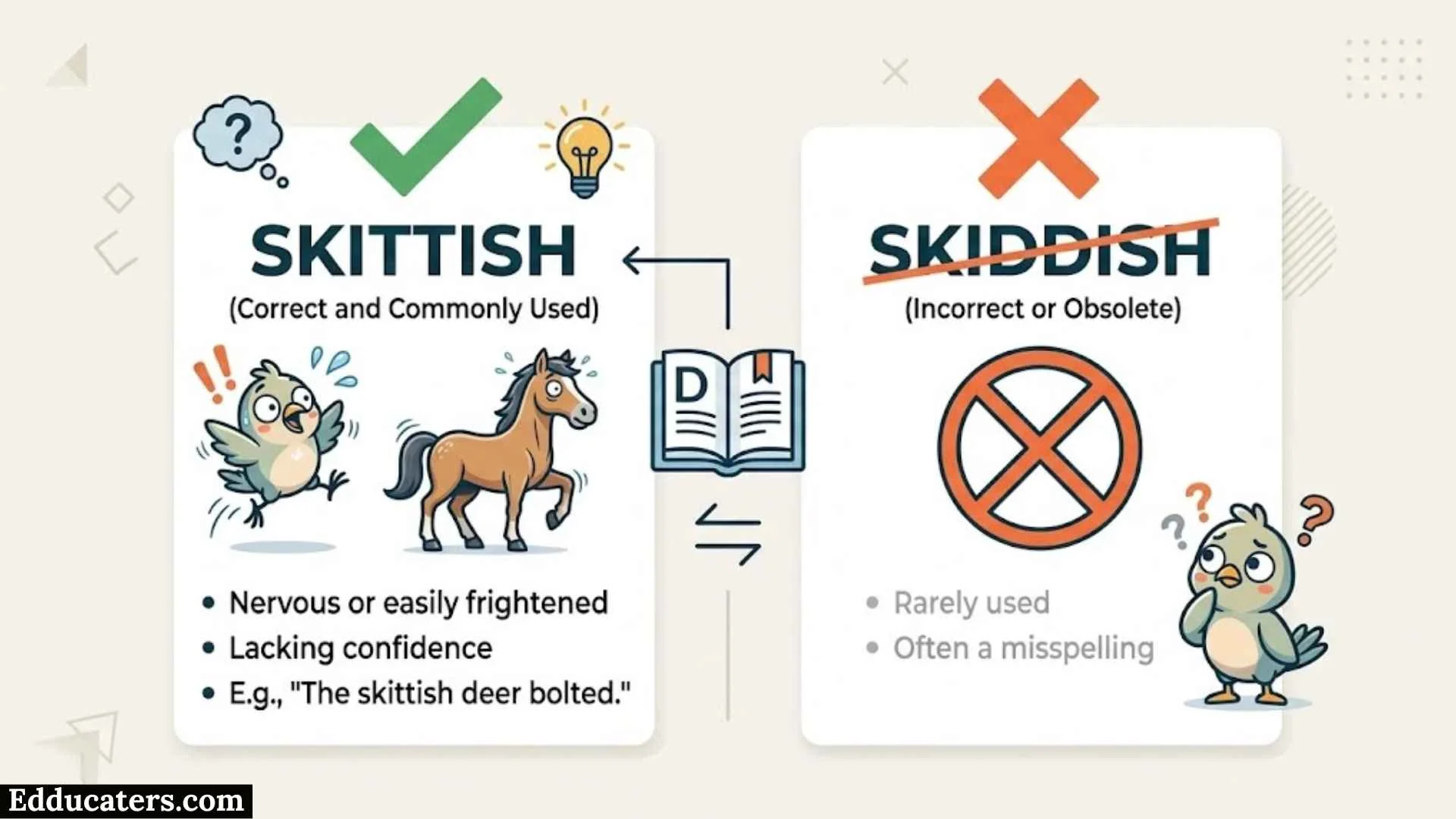
Have you ever written skiddish or skittish and paused because both spellings look as though they could be correct? The confusion is understandable, especially because the word is often heard in quick conversation and the spelling can seem connected to the familiar word “skid.”
The standard English spelling is skittish, with two t’s. It is an adjective used for someone or something that is nervous, easily frightened, easily startled, jumpy, or, in some contexts, unpredictable. Skiddish is generally treated as a misspelling or nonstandard form when it is intended to express that meaning.
So, if you are describing a nervous dog, a frightened horse, an uneasy person, or uncertain investors, skittish is the form you should use. The spelling stays the same in standard British English or American English.
Skiddish or Skittish: Which Is Correct?
Skittish is the correct standard spelling. Skiddish is not the standard spelling when you mean nervous, easily frightened, or easily startled.
| Form | Standard English? | Meaning or use |
| Skittish | Yes | Nervous, easily frightened, jumpy, excitable, or unpredictable |
| Skiddish | No, for this intended meaning | Generally a misspelling of skittish |
The most important thing to remember is the middle of the word:
S-K-I-T-T-I-S-H
There are two t’s, not two d’s.
You might see “skiddish” in informal online writing because people sometimes spell words according to how they hear them. However, seeing a form used online does not make it a standard spelling. For polished writing, schoolwork, professional communication, or edited content, use skittish.
What Does Skittish Mean?
Skittish is an adjective describing someone or something that is easily frightened, nervous, excitable, or quick to react.
The word is especially common when describing animals that become alarmed by sudden sounds, unfamiliar people, movement, or other unexpected situations.
For example:
- The horse became skittish when the thunder started.
- Our new dog is skittish around strangers.
- The cat is still skittish after moving to a new home.
The word can also describe people:
- I felt skittish before the interview.
- She was skittish about making such a big decision.
- He became skittish when the conversation turned serious.
In business or financial writing, skittish can describe people or markets that are nervous and likely to react quickly to changing circumstances.
For example:
- Investors became skittish after the sudden market decline.
- The market remained skittish throughout the week.
Dictionaries also record older or less common senses involving someone who is playful, fickle, changeable, or not particularly serious. The exact meaning therefore depends on context.
Is Skiddish a Word?
If you are asking whether skiddish is a standard spelling of the adjective meaning nervous or easily frightened, the answer is no.
The standard form is skittish.
The spelling skiddish does appear in some informal or user-generated sources, and Wiktionary specifically lists it as a misspelling of skittish. That means you may encounter it, but it should not be treated as the normal standard spelling in edited English.
For example:
Incorrect in standard English:
The skiddish dog hid behind the sofa.
Correct:
The skittish dog hid behind the sofa.
Another example:
Incorrect in standard English:
The horse was skiddish around the traffic.
Correct:
The horse was skittish around the traffic.
If your intended meaning is “nervous” or “easily frightened,” choose skittish.
Why Do People Spell Skittish as Skiddish?
The spelling mistake is understandable because skiddish looks plausible.
One likely source of confusion is the familiar word skid. A vehicle that skids can move suddenly or unpredictably, so it is easy to associate the sound or appearance of “skid” with the idea of something being jumpy or unstable.
However, the adjective skittish does not get its standard spelling from skid. Its history goes back to Middle English, with the word possibly connected to a Scandinavian source associated with quick movement. The modern adjective has been used for centuries, including senses connected with being easily frightened or changeable.
Another reason for the confusion is pronunciation. In American English, the t in skittish can be pronounced with a flap in ordinary speech, making it sound somewhat like a soft d. Cambridge gives the US pronunciation as /ˈskɪt̬.ɪʃ/, while the UK pronunciation is /ˈskɪt.ɪʃ/. This can make the spelling skiddish feel more natural to someone who has mainly heard the word spoken.
But the pronunciation does not change the standard spelling.
The spelling remains:
skittish
How Do You Pronounce Skittish?
The pronunciation of skittish is approximately:
SKIT-ish
IPA:
- UK: /ˈskɪt.ɪʃ/
- US: /ˈskɪt̬.ɪʃ/
There are two syllables:
SKIT-ish
The first syllable receives the main stress.
In British pronunciation, the t is clearly represented in the pronunciation. In American pronunciation, the t may be realized as a flap in natural speech, which can sound somewhat like a quick d.
That difference helps explain why some people write skiddish after hearing the word.
Still, the written form is always skittish in standard English.
Skittish as a Part of Speech
Skittish is an adjective.
It normally describes a person, animal, market, mood, reaction, or another noun.
Before a noun
You can place skittish directly before a noun:
- a skittish dog
- a skittish horse
- a skittish cat
- a skittish investor
- a skittish market
- a skittish reaction
After a linking verb
You can also use it after verbs such as become, seem, feel, or remain:
- The dog became skittish around strangers.
- The horse seemed skittish after the loud noise.
- She felt skittish about the unfamiliar situation.
- Investors remained skittish throughout the afternoon.
The word is not normally used as a verb. If you want to say that something caused an animal or person to become nervous, use a verb such as frightened, startled, or made nervous.
For example:
The sudden noise made the dog skittish.
That is more natural than trying to use skittish as a verb.
Skittish Dog: What Does It Mean?
A skittish dog is a dog that is nervous, easily startled, or uncomfortable in situations that it perceives as unfamiliar or threatening.
A dog might be skittish around:
- strangers
- loud noises
- unfamiliar places
- traffic
- other animals
- sudden movements
- crowded environments
For example:
The skittish dog hid behind its owner when visitors arrived.
Here, skittish suggests that the dog was nervous or easily frightened. It does not necessarily mean the dog is aggressive.
You can also say:
My puppy is skittish around new people.
This tells the reader that the puppy is cautious or easily alarmed in that situation.
Skittish Synonyms
The best synonym depends on the context.
When skittish means nervous or easily frightened, possible synonyms include:
- nervous
- jumpy
- timid
- fearful
- apprehensive
- easily startled
- uneasy
- excitable
- wary
When it describes someone or something unpredictable or changeable, possible alternatives include:
- unpredictable
- uncertain
- fickle
- changeable
- unstable
- inconsistent
These words are not perfect replacements in every sentence. For example, timid often emphasizes a lack of confidence, while skittish often emphasizes a tendency to become startled or react nervously.
Similarly, wary usually suggests caution because of perceived danger, whereas skittish can suggest a more instinctive or easily triggered nervous reaction.
Is Skittish British or American English?
Skittish is used in both British English and American English.
It is not a spelling pair where one form belongs to British English and the other belongs to American English.
You should therefore use:
British English: skittish
American English: skittish
The pronunciation can differ slightly. Cambridge lists /ˈskɪt.ɪʃ/ for UK English and /ˈskɪt̬.ɪʃ/ for US English, but the spelling remains skittish.
So you do not need to change the spelling based on whether your audience is British or American.
Skittish Etymology
The history of skittish is quite old.
Oxford traces the word to late Middle English and connects it, possibly, with the rare verb skit, meaning to move lightly or rapidly. Etymonline also traces the adjective to the early 15th century and suggests a Scandinavian connection associated with rapid movement.
The meaning developed over time. Historical uses included ideas such as being lively or frivolous. By around the 16th century, the word was being used for horses that were shy, easily frightened, or likely to start suddenly.
Later uses expanded beyond horses. Today, skittish can describe people, animals, markets, moods, reactions, or situations depending on the context.
The long history of the word is another reason there is no need to create a spelling based on the modern word skid. Skittish has its own established history and spelling.
Skittish Examples in Sentences
Here are natural examples showing how skittish is used:
- The horse became skittish when the fireworks began.
- Our dog is skittish around unfamiliar visitors.
- The kitten was skittish during its first few days in the house.
- She felt skittish before starting her new job.
- The deer are naturally skittish around people.
- Investors became skittish after the unexpected announcement.
- The bird was too skittish to approach the feeder.
- He seemed skittish whenever the conversation turned personal.
- The market has been unusually skittish this month.
- The rescued horse remained skittish until it became comfortable with its new surroundings.
Notice that the meaning changes slightly according to context. With an animal, it often means easily frightened or startled. With investors or markets, it can mean nervous or uncertain. With a person, it can describe nervousness or, in some contexts, changeable behavior.
Common Mistakes With Skittish
1. Writing Skiddish
Incorrect:
The cat is skiddish around children.
Correct:
The cat is skittish around children.
The standard spelling uses tt.
2. Writing Skitish
A second spelling mistake is leaving out one of the t’s.
Incorrect:
The horse looked skitish.
Correct:
The horse looked skittish.
Remember the full spelling:
S-K-I-T-T-I-S-H
3. Assuming Skiddish Is a Regional Spelling
It is not a standard British spelling or American spelling of skittish.
Both varieties use:
skittish
4. Assuming Skittish Only Describes Animals
Animals are a very common context, especially horses, dogs, cats, birds, and other creatures that can become easily startled. However, the word is also commonly applied to people, investors, markets, reactions, or situations.
5. Using Skittish as a Synonym for Angry
Skittish generally suggests nervousness, uncertainty, jumpiness, or excitability. It does not normally mean angry.
For example:
The dog became skittish after hearing the thunder.
This means the dog became nervous or easily startled. It does not mean the dog became angry.
A Simple Way to Remember the Spelling
The easiest spelling trick is:
Skittish has two T’s.
Break it into:
SKI + TT + ISH
You can also connect it mentally with the sound of skit at the beginning:
skit + tish → skittish
If you are tempted to write skiddish, stop and check the middle of the word.
The correct spelling is:
SKITTISH
Two T’s, not two D’s.
Is Skittish Used in Pokémon?
Yes. Skittish can appear in Pokémon-related terminology, but this does not create a different spelling.
In Pokémon Rumble World, “Skittish” is listed as a Pokémon trait. The trait has a specific in-game effect: it causes a Pokémon to inflict less damage when its HP is not full.
The word is also used in ordinary descriptions of Pokémon behavior. For example, a Pokémon that is shy or easily frightened may naturally be described as skittish in general English.
So if you searched for skittish Pokémon, there are two possible contexts:
- Skittish as an ordinary English adjective describing a Pokémon’s behavior.
- Skittish as a named Pokémon trait in a specific Pokémon game.
The spelling is skittish in both cases.
Is There a “Skittish Language”?
Skittish is not the name of a standard human language.
If you encounter the phrase skittish language, its meaning depends on the context. It may be describing language or communication that seems nervous, uncertain, restless, or changeable, rather than identifying an established language such as English, Spanish, or Japanese.
In ordinary English, skittish is an adjective, not a language name.
For example:
His skittish response made it difficult to understand his position.
Here, skittish describes the nature of the response. It does not identify a particular language.
Which One Should You Use?
If you mean nervous, easily frightened, easily startled, jumpy, excitable, or uncertain, use skittish.
Use:
The dog is skittish around strangers.
Use:
Investors are skittish about the changing market.
Use:
The horse became skittish after hearing the noise.
Do not use skiddish as the standard spelling for this meaning.
There is no British-versus-American spelling decision to make here. The standard spelling is skittish in both varieties.
FAQs
Which is correct, skiddish or skittish?
Skittish is the standard spelling. It is the adjective used for someone or something that is nervous, easily frightened, easily startled, jumpy, or sometimes unpredictable. Skiddish is generally a misspelling or nonstandard form when it is intended to mean skittish.
Is skiddish a word?
Skiddish appears in some informal sources and is listed by Wiktionary as a misspelling of skittish. It is not the standard English spelling of the adjective meaning nervous or easily frightened.
What does skittish mean?
Skittish means nervous, easily frightened, easily startled, jumpy, or excitable. In other contexts, it can describe someone who is changeable or a market that is uncertain and likely to react quickly.
Is skittish an adjective?
Yes. Skittish is an adjective.
You can say:
a skittish horse
or:
The horse became skittish.
How do you pronounce skittish?
Skittish is pronounced approximately SKIT-ish. The UK pronunciation is /ˈskɪt.ɪʃ/, while the US pronunciation is commonly represented as /ˈskɪt̬.ɪʃ/.
Is skittish a British or American word?
It is used in both British English and American English. The spelling is skittish in both varieties, although pronunciation can differ slightly.
What is a skittish dog?
A skittish dog is a dog that is easily startled, nervous, cautious, or frightened in certain situations, such as around unfamiliar people, loud sounds, or new environments.
What are some synonyms for skittish?
Depending on the context, synonyms can include nervous, jumpy, timid, fearful, uneasy, excitable, wary, unpredictable, fickle, or changeable.
Why is skittish spelled with two T’s?
The established spelling is skittish, with two t’s. The word has an old history and is not formed from the word skid. Its pronunciation, particularly in some American speech, can make the middle sound resemble a soft d, which may contribute to the spelling mistake skiddish.
What is the easiest way to remember skittish?
Remember the simple rule: skittish has two T’s. Write it as SKI + TT + ISH. When you mean nervous or easily frightened, choose skittish.
Conclusion
If you have been wondering whether skiddish or skittish is correct, the standard choice is skittish.
Use skittish when describing someone or something that is nervous, easily frightened, easily startled, jumpy, excitable, or, depending on context, unpredictable. The spelling is the same in standard British English or American English.
The main spelling point is easy to remember:
Skittish = two T’s.
Although skiddish can appear in informal writing, it is generally a misspelling when it is intended to mean skittish. If you are writing an article, email, school assignment, professional document, or any other polished English text, skittish is the form to use.

Hi, I’m Nathan Whitmore, and I enjoy making English grammar easy for learners of all ages. I believe grammar should be practical, not confusing. I write simple, well-researched guides that help readers improve their writing, speaking, and overall communication skills.
I spend a lot of time studying grammar patterns, sentence construction, punctuation, and modern English usage. My goal is to create lessons that anyone can understand, whether they are students, teachers, or professionals.
Books
Clear English Grammar
The Smart Writer’s Grammar Handbook
 Claire Holloway
 Julian Mercer