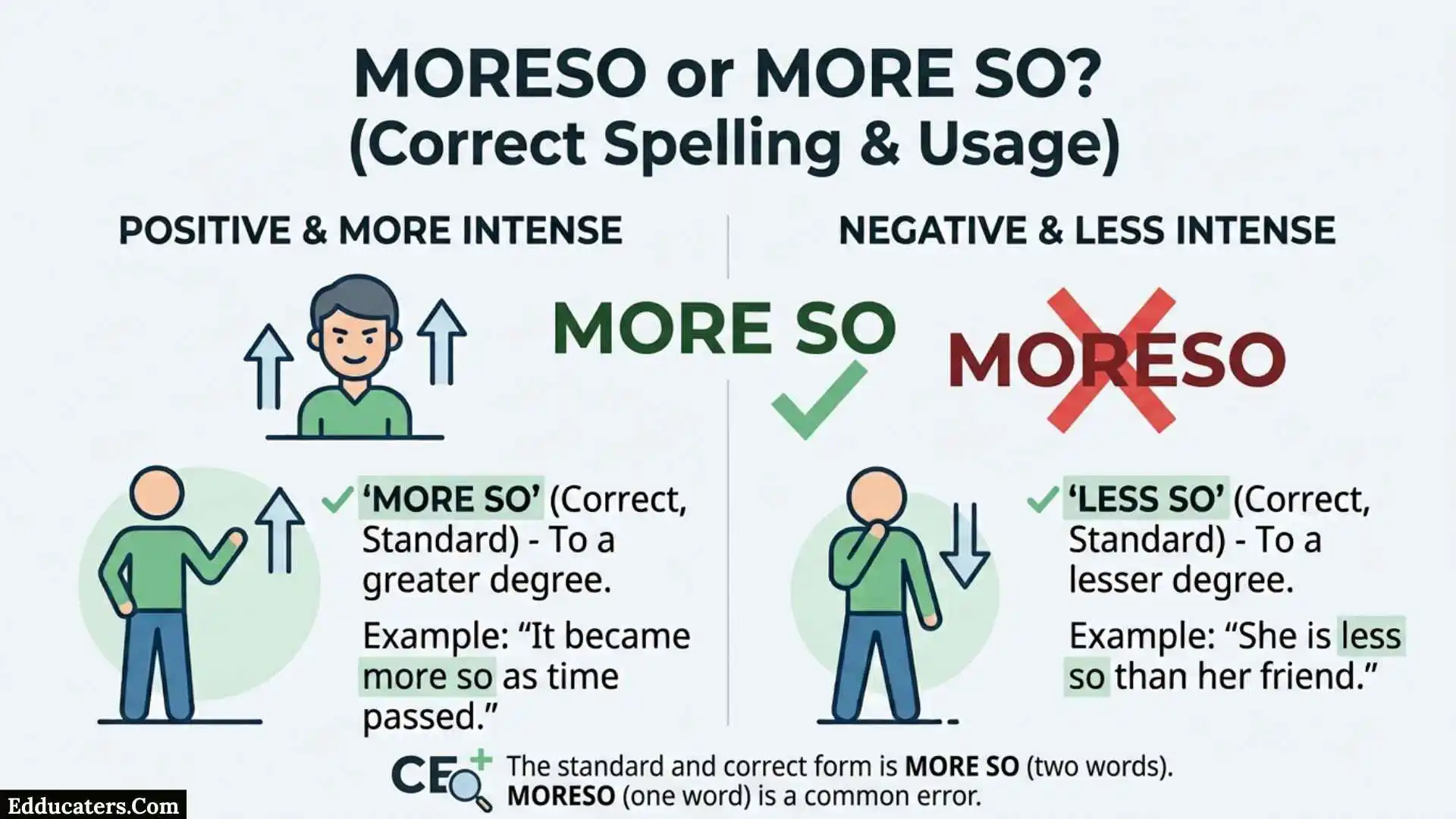
If you are wondering whether the correct spelling is more so or moreso, the safest choice is more so as two separate words.
More so is the conventional form used in standard edited English, particularly in academic, professional, and formal writing. It usually means “to a greater extent” or indicates that something is true to a greater degree than something else.
Moreso, written as one word, also appears in modern English usage and is documented as a variant in some linguistic reference material. However, its acceptability varies by style guide, region, and context. Because more so is widely understood and remains the safer choice in formal writing, it is generally the better option when you are unsure.
For example:
- Correct and safest: I enjoy working from home, more so during the winter.
- Also found in modern usage: I enjoy working from home, moreso during the winter.
- Best choice for formal writing: I enjoy working from home, more so during the winter.
The key point is simple: use “more so” when you want the safest standard form.
More So or Moreso: Quick Answer
| Form | Usage | Meaning | Best choice? |
| more so | Conventional and widely accepted | To a greater extent or degree | Yes |
| moreso | Attested modern variant, with varying acceptance | Usually the same or similar meaning | Use cautiously |
| more | Often simpler and more natural | To a greater degree | Often preferable |
| more than | Used for direct comparison | To a greater extent than something else | Prefer when making an explicit comparison |
If you are writing an essay, report, business document, application, professional email, or other formal material, more so is the safest form.
What Does More So Mean?
More so generally means “to a greater extent,” “to a greater degree,” or “even more.”
The expression is normally used when the writer does not want to repeat an adjective, verb phrase, or idea that has already been mentioned.
For example:
The second proposal is practical, but the first one is more so.
Here, more so means that the first proposal is more practical.
Instead of repeating the adjective, the word so refers back to the earlier description.
Compare:
The second proposal is practical, but the first proposal is more practical.
With:
The second proposal is practical, but the first proposal is more so.
The second sentence avoids repeating practical.
More So Means “To a Greater Extent”
One of the easiest ways to understand more so is to replace it mentally with “to a greater extent.”
For example:
The new system is efficient, and the updated version is even more so.
This means:
The new system is efficient, and the updated version is efficient to an even greater extent.
Another example:
She is interested in science, but her brother is more so.
In this sentence, more so means that her brother is more interested in science.
The expression is therefore useful when the quality or action being discussed is already clear from the surrounding sentence.
More So Can Refer Back to an Earlier Idea
The word so can function as a substitute for something already mentioned.
For example:
The first apartment was expensive, but the second one was more so.
The word so refers back to expensive.
The complete meaning is:
The first apartment was expensive, but the second apartment was even more expensive.
This makes more so particularly useful when repeating the original adjective would sound unnecessary.
How to Use More So in a Sentence
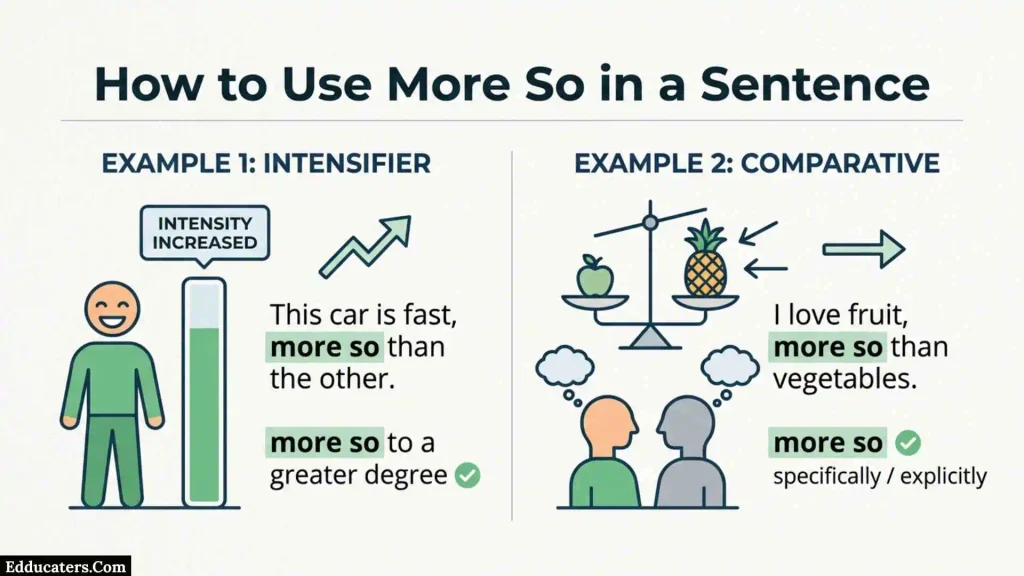
The grammatical role of more so depends on the sentence around it. In many cases, it works as a comparative expression referring back to an earlier description.
Consider:
The northern region is cold, but the mountains are more so.
Here, more so means colder.
Another example:
The first option is complicated, but the second is more so.
Here, more so means more complicated.
The important idea is that so receives its meaning from something already stated or clearly understood.
More So as a Comparative Expression
A common structure is:
[Statement], but [second subject] is more so.
Examples include:
The first route is difficult, but the second is more so.
The book is interesting, but the final chapter is more so.
The first examination was challenging, but the second was more so.
In each example, more so avoids repeating the adjective.
The underlying meanings are:
- difficult → more difficult
- interesting → more interesting
- challenging → more challenging
This makes the expression concise without losing meaning.
More So and Less So
More so has a useful counterpart: less so.
For example:
The first plan is expensive, while the second is less so.
Here, less so means less expensive.
You can therefore use the pair when comparing the degree to which something has a particular quality.
Examples:
The first solution is effective, but the second is more so.
The first solution is effective, but the second is less so.
The city is busy during the week and even more so on weekends.
This comparative use is well established in standard English.
More So or Moreso
The main spelling question is whether the expression should be written as two words or one.
More So: The Safer Standard Form
More so is written as two words and is the safest choice in conventional edited English.
Use it when you want to express a greater degree or extent.
Examples:
The new model is reliable, more so than the previous version.
I enjoy reading historical fiction, more so during the winter.
The problem affects smaller companies, even more so when resources are limited.
For formal writing, more so is the form most writers should choose when they want to avoid controversy over spelling.
Moreso: A Variant Found in Modern Usage
Moreso appears as a single word in contemporary English, particularly in informal and digital writing.
It is important, however, not to oversimplify the issue by saying that moreso is never a word. Linguistic reference material records its use as a variant, and its development reflects changing English usage.
That does not mean that moreso is equally appropriate in every context.
For a formal document, academic assignment, professional report, or carefully edited publication, more so remains the safer choice.
A practical rule is:
When in doubt, write “more so.”
This gives you a conventional form that is widely recognized and unlikely to be questioned by an editor or reader.
When Should You Use More So?
You can use more so when you want to show that a quality, condition, or action applies to a greater degree.
Common situations include comparisons, follow-up statements, and expressions such as even more so.
Use More So for Comparisons
Consider:
The first task was difficult, but the second was more so.
The writer does not need to repeat difficult.
Another example:
The old system was expensive, but the replacement was more so.
This means the replacement was even more expensive.
If the comparison is already obvious from the sentence, more so can make the sentence concise.
Use More So After an Earlier Statement
Sometimes more so appears after a complete statement to emphasize that the preceding idea applies to an even greater degree.
For example:
The policy is important for new employees, and more so for managers.
The meaning is that the policy is important for both groups, but to a greater extent for managers.
Another example:
The change matters to small businesses, more so to businesses operating on tight margins.
Here, the expression increases the degree of relevance.
Use Even More So for Stronger Emphasis
Even more so is a common and natural expression.
It means to an even greater extent.
Examples:
Exercise is important as we get older, and even more so when we spend most of the day sitting.
The decision was difficult during the planning stage and even more so after the circumstances changed.
Good communication matters in every workplace, even more so during a crisis.
The word even strengthens the comparative meaning.
Common Expressions With More So
Some constructions appear frequently in standard English.
More So Than
More so than is used when making a direct comparison.
For example:
I prefer the second design, more so than the first.
However, the sentence can often be made more natural by using more than instead:
I prefer the second design more than the first.
The best choice depends on what you are comparing and what you want to emphasize.
Another example:
The change affected customers more so than employees.
This construction can be understood, but in many contexts a cleaner alternative is:
The change affected customers more than employees.
Do not automatically add so simply because you are making a comparison.
Even More So
Examples:
The rule applies to beginners and even more so to advanced users.
The second stage was demanding, and the final stage was even more so.
This is one of the clearest and most natural uses of the expression.
All the More So
All the more so is an established expression meaning that something applies to an even greater degree, often because of an additional reason.
For example:
The decision was sensible, all the more so because the company had limited resources.
This means the decision was sensible, and the additional circumstance makes it even more clearly sensible.
Another example:
The advice is valuable for new writers, all the more so because it prevents common mistakes.
When “More” Is Better Than “More So”
One of the most useful writing skills is knowing when not to use more so.
Writers sometimes add so when the simpler word would be clearer.
For example:
The second option is more so useful.
This is awkward.
A better version is:
The second option is more useful.
The same principle applies to many adjectives.
Instead of:
This method is more so effective.
Write:
This method is more effective.
Instead of:
The revised process is more so efficient.
Write:
The revised process is more efficient.
The phrase more so generally works when so is standing in for something already understood. It should not simply be added before an adjective.
More So or More Than
These expressions can overlap, but they are not interchangeable in every sentence.
More than is normally the clearer choice when you are making a direct comparison.
For example:
I value accuracy more than speed.
This is direct and natural.
You would not normally write:
I value accuracy more so speed.
However, more so can work when so refers back to an earlier quality or idea.
For example:
The first version is useful, but the second is more so.
Here, so refers to useful.
A simple rule is:
- Use more than for a direct comparison.
- Use more so when so refers back to an earlier description or idea.
- Use more when no additional word is necessary.
More So vs. Especially
More so and especially can sometimes appear in similar contexts, but they do not have exactly the same function.
Especially means particularly or to a notable degree among others.
For example:
I enjoy outdoor activities, especially hiking.
This identifies hiking as a particular favorite.
More so usually indicates a greater degree.
For example:
I enjoy outdoor activities, more so in the summer.
This means the enjoyment is greater during summer.
Therefore, choose the word according to the intended meaning.
Use especially when you mean particularly.
Use more so when you mean to a greater extent.
More So vs. Particularly
The same distinction applies to particularly.
Compare:
The rule is particularly important for beginners.
This means the rule has special importance for beginners.
Now compare:
The rule is important for all users, but more so for beginners.
This means the rule applies to everyone, but its importance is greater for beginners.
The second sentence emphasizes degree, while the first emphasizes special relevance.
Is Moreso Wrong?
The answer requires more nuance than simply saying yes or no.
Moreso is found in modern English usage and has been discussed as a developing or variant form in linguistic research. Some dictionaries, style resources, and editors may still prefer or recommend more so, particularly in formal writing.
Therefore, saying that moreso is always wrong is too absolute.
At the same time, saying that moreso and more so are completely interchangeable in every context is also too broad.
For practical writing purposes, the safest approach is:
Use “more so” as the default form, especially in formal or edited writing.
If you encounter moreso in informal writing, online communication, or contemporary published material, its appearance does not necessarily mean the writer has made an obvious spelling error. English usage changes over time, and forms can develop from frequently used word combinations.
Should You Use Moreso in Academic Writing?
If you are writing an academic paper, thesis, dissertation, research report, university assignment, or formal essay, more so is the safer choice.
For example:
The results are relevant to younger participants, more so than to older participants.
Using more so follows the conventional two-word form and avoids distracting the reader with a spelling choice that may be considered nonstandard by some editors or institutions.
Academic writing generally benefits from conventional forms when a clear alternative is available.
That does not require you to claim that moreso has no legitimate usage. It simply means that more so is the better editorial choice for formal work.
More So in Professional Writing
The same recommendation applies to business and professional communication.
For example:
The revised procedure is useful for large teams, more so when several departments are involved.
This is clear and conventional.
In a professional email, report, proposal, or presentation, there is little advantage to choosing the more controversial one-word spelling when the established two-word form is readily available.
More So in Everyday English
In everyday communication, people may encounter both more so and moreso.
Informal digital communication is generally more tolerant of spelling variation, especially when the intended meaning is obvious.
For example:
I like the second one more so.
Or:
I like the second one moreso.
The meaning is likely to be understood either way.
However, if you are proofreading your writing and want a broadly accepted form, more so remains the safer option.
Common Mistakes With More So
Understanding common errors can make the distinction easier to remember.
Mistake 1: Writing More So Before an Adjective
Incorrect or awkward:
The new version is more so reliable.
Better:
The new version is more reliable.
Here, more already performs the comparative job. There is no useful function for so.
Mistake 2: Treating Moreso as the Only Correct Form
Incorrect assumption:
Moreso is always the correct modern spelling.
That is too strong.
The conventional form remains more so, and it is the safer choice for formal writing.
Mistake 3: Saying Moreso Is Never Used
The opposite claim is also too absolute.
Moreso does occur in real-world English and has been discussed as a variant in linguistic reference material.
The practical question is not simply whether the form exists. The more useful question is which form is safest for your particular type of writing?
Mistake 4: Using More So When More Than Is Clearer
For example:
I prefer quality more so quantity.
This is not the correct construction.
Write:
I prefer quality more than quantity.
When you are directly comparing two things, more than is generally the appropriate structure.
Mistake 5: Repeating the Same Idea Unnecessarily
Sometimes writers use more so even though a simpler sentence would be clearer.
For example:
The second method is more so effective than the first method.
Better:
The second method is more effective than the first.
Clear writing is usually better than adding words merely to make a sentence sound more sophisticated.
More So or Moreso: Side-by-Side Examples
| Intended meaning | Safer sentence | Less conventional variant |
| To a greater extent | The second option is more so. | The second option is moreso. |
| Greater degree | The revised system is more reliable, more so in difficult conditions. | The revised system is more reliable, moreso in difficult conditions. |
| Stronger comparison | The final stage was even more so. | The final stage was even moreso. |
| Formal writing | The policy affects small companies more so than large companies. | The policy affects small companies moreso than large companies. |
| Simple comparison | The second model is more efficient. | The second model is more so efficient. |
The table demonstrates an important point: moreso is mainly a spelling/form issue, while “more so” has a specific grammatical role.
A Simple Decision Guide
If you are unsure which form to use, follow these steps.
Step 1: Do You Mean “To a Greater Extent”?
If yes, more so may be appropriate.
Example:
The second problem is more so.
Meaning:
The second problem has that quality to a greater extent.
Step 2: Are You Directly Comparing Two Things?
If you are comparing two quantities, preferences, or actions, check whether more than or simply more is clearer.
Example:
She values accuracy more than speed.
Do not change this to more so.
Step 3: Is “So” Referring Back to an Earlier Description?
If yes, more so may be exactly what you need.
Example:
The first proposal is ambitious, but the second is more so.
Here, so refers back to ambitious.
Step 4: Are You Writing Formally?
If yes, choose more so rather than moreso when this expression is appropriate.
Step 5: Would “More” Be Simpler?
If more works naturally before an adjective, use it.
Example:
The new method is more effective.
Not:
The new method is more so effective.
Real-Life Examples of More So
Here are examples from several common writing situations.
Academic Example
The findings are relevant to urban populations, more so in areas where public transportation is limited.
The expression indicates that the relevance is greater in a particular situation.
Business Example
The new system benefits larger teams, more so when employees work across multiple locations.
The second part specifies where the benefit is particularly strong.
Professional Email Example
The updated instructions should help new employees, even more so during their first week.
Here, even more so emphasizes the degree of benefit.
Everyday Conversation Example
I like the blue design, but I like the green one more so.
Here, more so means the speaker likes the green design to a greater degree.
Comparison Example
The first exam was difficult, but the second was more so.
The expression avoids repeating difficult.
Formal Report Example
The policy affects smaller organizations, more so than companies with larger administrative teams.
The expression emphasizes the greater impact on one group.
How to Remember More So
A simple memory trick is:
If “so” stands for something already mentioned, keep “more” and “so” separate.
For example:
The first option is expensive, but the second is more so.
Ask yourself:
More what?
The answer is more expensive.
The word so is standing in for expensive.
This explains why more so is naturally written as two words in the conventional form.
Another useful reminder is:
More so = to a greater extent.
If that substitution makes sense, you may be dealing with the expression more so.
Is More So One Word or Two?
The conventional spelling is two words: more so.
For formal, academic, professional, and carefully edited writing, this is the safest form.
Moreso is also found in contemporary usage and has been documented as a variant, but it does not have the same universally accepted status across all writing contexts.
Therefore:
More so = safest conventional choice
Moreso = attested variant with varying acceptance
If you need one form to use consistently, choose more so.
Can More So Start a Sentence?
Yes, but the construction should be clear.
For example:
More so than the cost, the lack of available staff created the biggest problem.
This is understandable, but the sentence can often be improved by restructuring it.
For example:
The lack of available staff created a bigger problem than the cost.
The second version is more direct.
As with many expressions, grammatical possibility does not automatically mean that a particular construction is the clearest stylistic choice.
Is More So Than Correct?
Yes, more so than can be grammatically appropriate when so refers back to a previously stated quality or idea.
For example:
The policy is important for all employees, more so than for temporary contractors.
However, many sentences become clearer with more than.
Compare:
The change affected customers more so than employees.
With:
The change affected customers more than employees.
The second sentence is often simpler.
Use more so than when so has a genuine referring function. Do not add so merely because the sentence contains a comparison.
Does More So Mean Especially?
Not exactly.
More so primarily indicates a greater degree or extent.
Especially means particularly or above others.
Compare:
The rule is important, especially for beginners.
This identifies beginners as a particularly relevant group.
Now:
The rule is important for everyone, more so for beginners.
This emphasizes that its importance is greater for beginners.
The meanings overlap in some contexts, but the grammatical emphasis is different.
What Is the Opposite of More So?
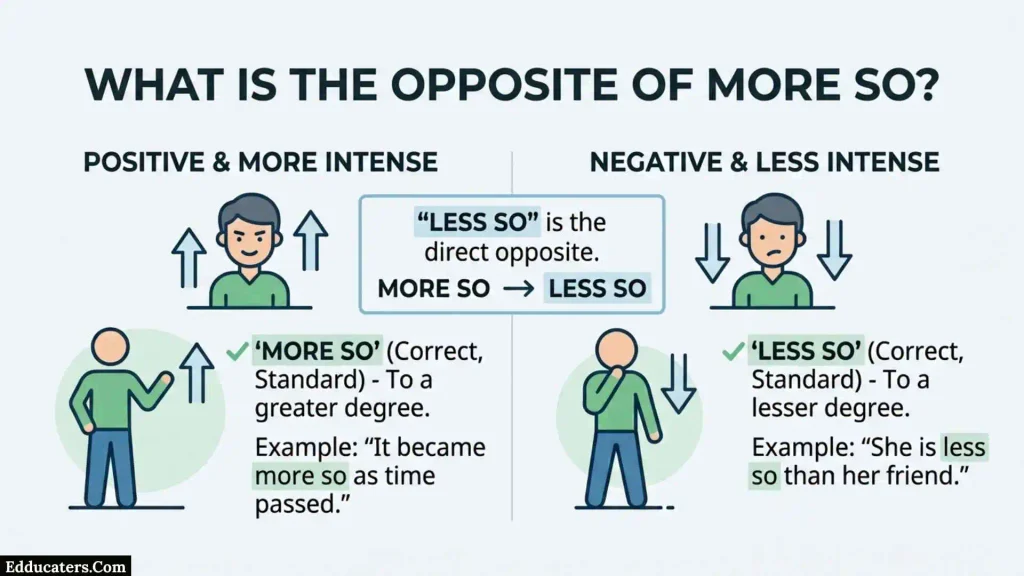
A common counterpart is less so.
For example:
The first method is effective, but the second is less so.
This means the second method is less effective.
You may also encounter:
The first method is effective, and the second is even more so.
This creates a clear contrast between greater and lesser degree.
Is Moreso Accepted?
Acceptance depends on the context and the reference source being followed.
The form moreso occurs in contemporary English, and linguistic research has discussed it as a variant. However, many editors and formal writing conventions still favor more so.
Therefore, the safest practical answer is:
Moreso is found in modern usage, but “more so” is the safer conventional form, particularly in formal writing.
If your goal is clarity, consistency, and broad editorial acceptance, use more so.
Which Form Should You Use?
Use this quick reference:
| Situation | Recommended form |
| Academic essay | more so |
| University assignment | more so |
| Research paper | more so |
| Business report | more so |
| Professional email | more so |
| Formal website content | more so |
| General writing | more so |
| Informal online writing | more so is still the safest |
| Quoting or preserving someone’s original wording | Keep the original wording when appropriate |
| When a simpler comparison works | Consider more or more than |
The broadest practical rule is:
When choosing between “more so” and “moreso,” use “more so” unless you have a specific reason to follow a style or usage convention that permits “moreso.”
Proofreading Checklist
Before publishing a sentence containing more so, ask:
- Does more so mean “to a greater extent”?
- Does so refer back to an earlier adjective, phrase, or idea?
- Would more alone be clearer?
- Am I actually making a direct comparison that requires more than?
- Am I using more so before an adjective where only more is needed?
- Is the writing formal or professional?
- If so, would more so be the safer editorial choice?
- Am I using moreso simply because it looks shorter?
- Could I rewrite the sentence to make the comparison clearer?
- Does the final sentence sound natural when read aloud?
This checklist helps distinguish a genuine use of more so from a sentence where more, more than, especially, or particularly would be better.
Frequently Asked Questions
Is “more so” correct English?
Yes. More so is a well-established expression meaning “to a greater extent” or “to a greater degree.” It is especially useful when so refers back to an earlier description.
Is “moreso” a word?
Moreso is found in contemporary English and has been documented as a variant in linguistic reference material. However, its acceptance varies. More so remains the safer conventional form, particularly in formal writing.
Should I use “more so” or “moreso” in an essay?
Use more so. It is the safer choice for academic and formal writing.
Is “more so than” grammatically correct?
Yes, when so refers back to an earlier quality or idea. However, more than is often simpler when you are making a direct comparison.
Is “more so” the same as “especially”?
No. More so generally expresses a greater degree, while especially means particularly. They can overlap in meaning in some sentences, but they are not exact substitutes.
Can I use “even more so”?
Yes. Even more so is a common and natural expression meaning “to an even greater extent.”
What does “less so” mean?
Less so means “to a lesser extent.” It can be used when comparing how strongly a quality applies.
For example:
The first option is practical, while the second is less so.
Why is “more so” written as two words?
In the conventional expression, more indicates a greater degree and so refers back to a previously mentioned quality or idea. For example, in “The first plan is expensive, but the second is more so,” so stands for expensive.
Is “more so” formal?
Yes. More so is suitable for formal, professional, and academic writing when used appropriately.
Can “more so” be replaced with “more”?
Sometimes. If more can directly modify the adjective or adverb, it is often the clearer choice.
For example:
The second method is more effective.
is better than:
The second method is more so effective.
Is “moreso” always wrong?
No. That claim is too absolute. Moreso occurs in modern usage and has been discussed as a variant. Nevertheless, more so is the safer conventional form for formal writing.
Key Takeaways
The most important points are easy to remember:
- More so is the safest conventional form.
- It is normally written as two words.
- More so generally means “to a greater extent” or “to a greater degree.”
- So can refer back to an adjective, phrase, or idea already mentioned.
- Even more so is a common and natural expression.
- Less so is a useful contrasting expression.
- More than is often better for a straightforward comparison.
- More is better when it directly modifies an adjective or adverb.
- Especially and particularly are not exact synonyms for more so.
- Moreso appears in modern English usage and has been discussed as a variant, so calling it “never a word” is too simplistic.
- For academic, professional, and formal writing, more so is the safest choice.
Conclusion
So, is it more so or moreso?
The best practical answer is more so.
Write it as two words when you want the conventional form that is safest across academic, professional, formal, and general writing.
Moreso is not simply a meaningless typo. It appears in modern English and has been documented as a variant, although its acceptance varies among writers, editors, and style conventions. That makes the issue more nuanced than a simple “right versus wrong” spelling rule.
The most useful distinction is therefore one of standard choice and context:
More so is the safest default.
Moreso is an attested variant whose acceptability depends on context and editorial convention.
And remember that sometimes neither form is necessary. If you mean more effective, write “more effective.” If you mean a direct comparison, more than may be better. If you mean particularly, use “especially” or “particularly.”
Good writing is not just about choosing the correct spelling. It is about choosing the clearest expression for the meaning you intend.

I’m Julian Mercer, an English language writer dedicated to helping people master grammar through practical examples and clear explanations. I enjoy teaching grammar in a way that is both engaging and easy to remember.
My work focuses on grammar rules, punctuation, word usage, and writing techniques that readers can apply in everyday life. I believe learning English should be simple, enjoyable, and useful.
Books
English Grammar in Practice
Writing with Precision
 Claire Holloway